by COWBERRY

9 minute read
Turmeric benefits and side effects: what the evidence says

Turmeric benefits are usually sold in superlatives; this page reads the evidence instead, from the curcumin reviews to NCCIH's cautions, then sets out the turmeric side effects that are documented, the nutrients a spoon of powder actually carries, how much a day has any backing, and how to eat it. The haldi guide covers the spice itself.
What the evidence says about turmeric benefits
The honest opening line comes from NCCIH, part of the US National Institutes of Health: the evidence it has reviewed is not enough to say for sure whether turmeric or curcumin helps with any health purpose. What the same page does record is a set of early, promising leads. For osteoarthritis, several meta-analyses have looked at oral turmeric or curcumin for knee pain and stiffness, and NCCIH reads the initial evidence as positive while asking for higher-quality studies before any conclusion. Initial research suggests oral turmeric or curcumin might improve some measures of nonalcoholic fatty liver disease, though it is unclear which measures consistently, and that it might improve symptoms of oral mucositis, the mouth swelling and irritation seen in cancer care. Turmeric also has a long traditional-medicine record: NCCIH lists its historical uses in Chinese, Indian, Islamic and Thai systems for indigestion, the common cold, skin infections, arthritis, abdominal pain and liver disease.
The curcumin reviews read more warmly, but on the same compound. In a 2017 Foods review, the reading of curcumin is warmer: it reports that curcumin helps in managing oxidative and inflammatory conditions plus metabolic syndrome, arthritis, anxiety and hyperlipidemia, and that it may also help manage exercise-induced inflammation and muscle soreness; the review credits antioxidant and anti-inflammatory effects with most of those reported benefits. A 2019 review in Nutrients lists the properties studied for curcumin, from antioxidant, anti-inflammatory and antidiabetic to hepatoprotective, anti-allergic, anti-dermatophyte and neuroprotective. None of these lines is a promise; they are what the papers report, and the next section sets out the caveat that comes with them.
Curcumin: the compound, and why it is a poor traveller
Most of what is written above about turmeric benefits is really about one compound. NCCIH counts curcumin among turmeric's major components, the compound behind the spice's yellow colour, and the 2017 review names turmeric as the major source of the polyphenol curcumin. The catch follows immediately: the same review states that ingesting curcumin by itself does not lead to the associated health benefits, because its bioavailability is poor; poor absorption, rapid metabolism and rapid elimination are the apparent reasons. The 2019 review locates the problem more precisely: low absorption in the small intestine and extensive reductive and conjugative metabolism in the liver dramatically weaken oral bioavailability, and it describes the adjuvants and new delivery systems researchers have tried in response, some of which can improve solubility, extend the time in plasma and better the pharmacokinetic profile and cellular uptake.
One such workaround is piperine. NCCIH notes that oral curcumin products often contain substances from other plants, piperine from black pepper among them, and calls combining curcumin with piperine one way to improve its bioavailability; the 2017 review reports a 2000 percent jump in bioavailability when piperine was combined with curcumin in a complex. Whether a pinch of black pepper over your food does anything similar is not measured in these sources; that question is taken up on the turmeric and black pepper page, and the supplement side of the story is on turmeric vs curcumin.
The nutrients behind haldi benefits
Forget the capsule for a moment and look at the jar. IFCT 2017 prints turmeric powder at 281 kcal, 7.66 g of protein, 5.03 g of fat, 49.22 g of carbohydrate and 21.38 g of fibre per 100 g, with 46.08 mg of iron, 122 mg of calcium, 260 mg of magnesium, 2374 mg of potassium, 2.64 mg of zinc and 13.86 mcg of folate. That is the whole case for haldi benefits as food, and the honest way to read it is by the spoon, because nobody eats 100 g of turmeric. One level teaspoon weighs 3 g and carries about 8 kcal, 0.2 g of protein, 1.5 g of carbohydrate, 0.6 g of fibre and 1.4 mg of iron.
Against its spice-rack neighbours, turmeric stands out for iron and potassium. Its 46.08 mg of iron per 100 g sits well above black pepper's 11.91 mg and cumin seeds' 20.58 mg, and its 2374 mg of potassium is above black pepper's 1487 mg and cumin's 1886 mg. On fibre, protein and calcium the neighbours win: black pepper has 33.16 g and cumin seeds 30.35 g, against turmeric's 21.38 g of fibre, and both carry more protein and calcium. Even the stand-out figures shrink at a teaspoon's scale, where the iron is 1.4 mg. The ICMR-NIN dietary guidelines keep the spice in proportion: spices like turmeric, cumin, ginger, garlic, cinnamon, pepper and cloves count as rich in antioxidants and fit a balanced diet. The full per-100 g reading is on the turmeric nutrition page.
Turmeric side effects and who should limit it
For the side-effects side of the ledger, NCCIH is the most useful source, and its cautions mostly concern supplements. Oral turmeric can cause stomach complaints: nausea and vomiting, acid reflux, stomach upset, diarrhea or constipation. Conventionally formulated turmeric or curcumin, not modified to enhance bioavailability, stays likely safe within the recommended amounts for a stretch of up to 2 or 3 months; separately, some people who took highly bioavailable formulations developed liver damage, and NCCIH says to stop taking them at once and see a health care provider if any of fatigue, nausea, poor appetite, dark urine or jaundice appears. Turmeric supplements may be unsafe during pregnancy, and little is known about whether taking more than the amounts commonly present in food is safe while breastfeeding. The standing advice closes the list: anyone who takes any type of medicine should talk it over with a health care provider before starting any herbal product, since some herbs and medicines interact harmfully.
For the food itself, the risk to know about is not in the plant but in the supply chain. A 2024 study tested 356 turmeric samples, dried roots and powder, bought in 23 cities spread over India, Pakistan, Sri Lanka and Nepal: 14 percent had detectable lead above 2 micrograms per gram, and the samples at or above 18 micrograms per gram showed a near one-to-one molar ratio of lead to chromium, which the authors take as suggestive of lead chromate. That is why buying matters: the ICMR-NIN guidelines prefer whole spices uniform in colour, size and shape, note that powders are the form more often adulterated, and ask for certified products. One everyday caution completes the list: turmeric stains skin and cloth yellow, so a stained spoon is normal, not a fault.
How much turmeric per day
ICMR-NIN, NCCIH and the curcumin reviews set no daily amount of turmeric. ICMR-NIN gives no per-day figure for any single spice, and NCCIH's safety language is about supplements, not the kitchen. The closest figure sits in the ICMR-NIN elderly balanced-day tables: 10 g of spices a day, for all spices together, on the 65 kg man's and 55 kg woman's days, which is a planning figure for that age group, not a turmeric dose. In the kitchen, the working amounts are small: a dal or sabzi for four gets a quarter to half a teaspoon, and the drink recipes use half a teaspoon for two cups. No study in the references links a bigger spoon to any health result, so more turmeric changes the colour, not the evidence. The fuller answer is on how to eat turmeric.
How to eat turmeric: the five recipes
Turmeric earns its place in food, and five recipes carry the amount it actually takes. Haldi doodh simmers milk with half a teaspoon of turmeric for two cups, the pepper ground in off the heat and jaggery or honey to taste. Turmeric tea simmers half a teaspoon in two and a half cups of water, yielding two cups of tea, finishing with pepper, lemon and honey, and turmeric water stirs half a teaspoon into two cups of warm water the same way. For solid food, haldi laddu works a tablespoon (9 g) of turmeric through sixteen laddus, a little over half a gram each, and turmeric roti kneads a teaspoon (3 g) into 240 g of atta for eight rotis. All five, with times and steps, are grouped on the turmeric recipes page.
Two habits round the spice out. Buy it as the guidelines say: whole fingers or a certified powder, since the powder is the form more likely to be adulterated, and check the pack before the jar; the home tests are on how to check turmeric purity. Cook it, in the tadka or the simmer: eaten raw, turmeric usually tastes raw, and cooked too long it can turn bitter, kitchen notes that the recipes themselves account for. The black-pepper question, the names the spice goes by and the condition pages are all linked from the haldi guide.
FAQs
What is turmeric good for?
No health benefit is firmly established: NCCIH, part of the US National Institutes of Health, says the research does not yet settle whether turmeric or curcumin delivers any health benefit, though early studies look promising for osteoarthritis and a few other conditions. In the kitchen the answer is settled and smaller: colour and taste at roughly 8 kcal for the level teaspoon, from a spice ICMR-NIN counts among the antioxidant-rich ones.
Is haldi milk good for cough?
NCCIH lists the common cold among turmeric's historical uses in traditional medicine, but the same page finds the evidence too short to conclude any benefit. Haldi milk is a warm, pleasant home drink, and nothing in these sources says it will quiet a cough. Make it with the recipe's half teaspoon of turmeric in two cups of milk; for a cough that lingers, see a doctor.
Which turmeric is best for health?
Neither ICMR-NIN nor NCCIH ranks one turmeric variety above another, so the answer is about the pack, not the plant: buy certified products, or whole fingers uniform in colour, size and shape, as ICMR-NIN advises; powders are the form that gets adulterated more often. For cooking, that is the whole choice; a supplement is a different product with NCCIH's cautions attached.
What is turmeric?
Turmeric is the underground stem (rhizome) of Curcuma longa, which belongs to the ginger family; haldi is its Hindi name. NCCIH puts the yellow colour down to curcumin, one of turmeric's major components. IFCT 2017 prints the powder at 281 kcal, 7.66 g of protein and 21.38 g of fibre per 100 g.
How to identify pure turmeric powder?
Start from the market, not the kitchen: the powdered form gets adulterated more often, so buy certified products, or whole fingers rather than powder, as ICMR-NIN advises. Lead above 2 micrograms per gram showed up in 14 percent of the 356 samples of dried roots and powder a 2024 study bought in South Asia. The jar tests are on how to check turmeric purity.
References
- Indian Food Composition Tables (IFCT) 2017, ICMR-National Institute of Nutrition
- Dietary Guidelines for Indians, ICMR-National Institute of Nutrition
- Hewlings SJ, Kalman DS. Curcumin: a review of its effects on human health. Foods, 2017
- Dei Cas M, Ghidoni R. Dietary Curcumin: Correlation between Bioavailability and Health Potential. Nutrients, 2019
- Forsyth JE, Mistree D, Nash E et al. Evidence of turmeric adulteration with lead chromate across South Asia. Sci Total Environ, 2024
- NCCIH: Turmeric (health information page)
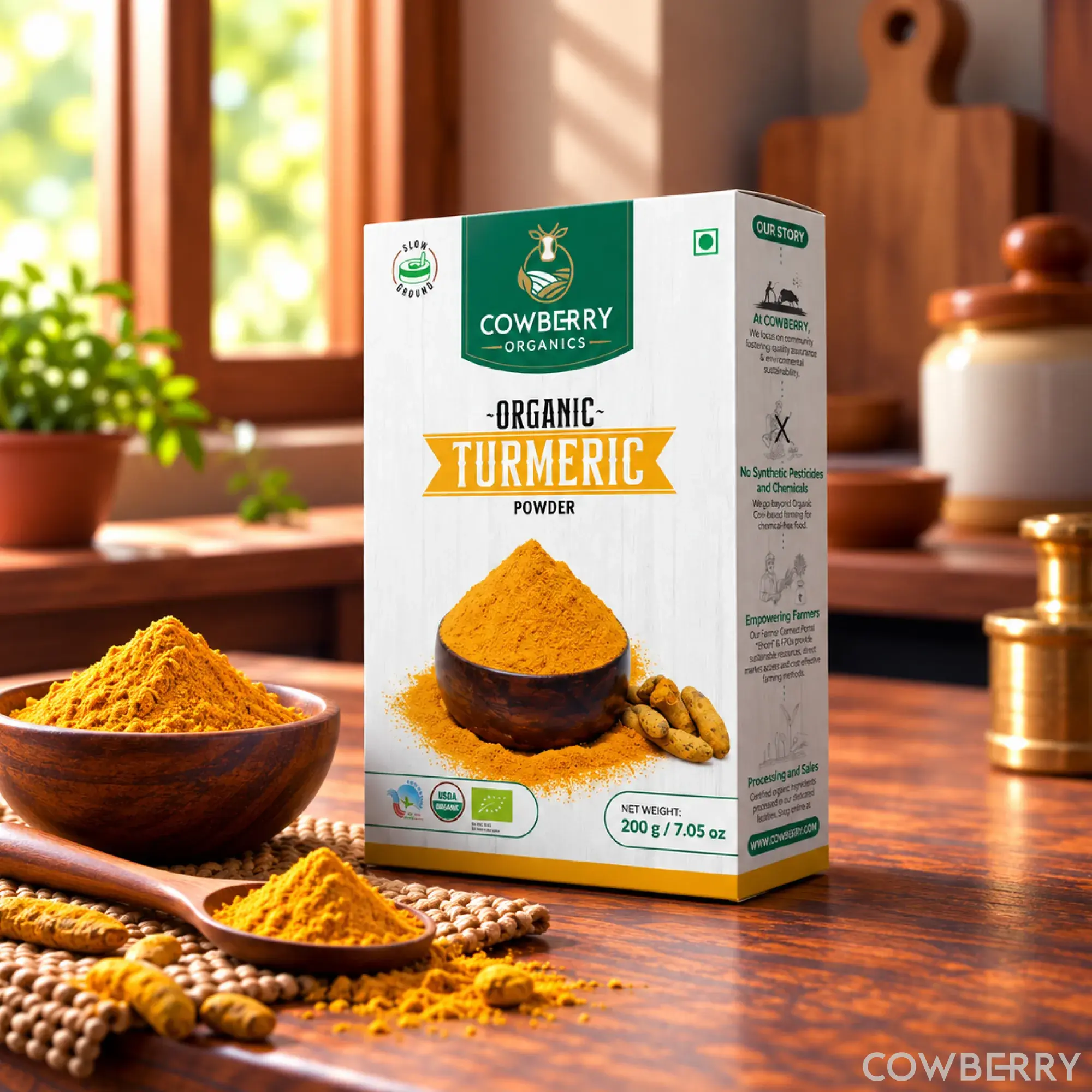
Shop this article
Keep reading
Coriander water benefits: what dhania water actually does
Peanuts in Hindi (moongfali): groundnut names in Indian languages
Coriander vs cilantro: are they the same herb?