by COWBERRY

12 minute read
Do spices need to be organic? Which foods are worth buying organic

Do spices need to be organic? For dried, ground spices such as turmeric and cumin, the organic certificate is a record of how the crop was grown, and a powder cannot be washed or peeled at home. This guide goes food by food — spices, sesame, millets, honey, ghee, tea, coffee, dried beans — and shows where the organic spend counts.
Do spices need to be organic?
The honest answer: most of the value sits in a single fact. Crop sprays can leave residues in the food that reaches the plate, vegetables and fruits especially, and the Dietary Guidelines for Indians warn that such exposure may be harmful. The same guidelines name two home ways to reduce them, washing food thoroughly in running water and peeling, and add that cooking and other processes can also reduce residues.
Neither washing nor peeling is possible with a spice. A dried, ground spice such as turmeric or cumin powder travels from the field to the jar with nothing you can wash or peel away, so a question left about the powder is how the crop behind it was grown. That is the question an organic certificate answers.
In India, organic food is produce grown and handled to the National Organic Standards — holistic farming with chemical-free inputs, focused on soil health and biodiversity — and it is certified under the National Programme for Organic Production (NPOP) or the PGS-India scheme. For the spices used in everyday cooking, the certificate is the one record of how the crop was grown that you can check on the pack.
What organic certification means on an Indian pack
India has one unified mark for organic food: the Jaivik Bharat logo. The mark's tagline, "Jaivik Bharat", sits at the bottom of the logo and means organic food from India; FSSAI's portal calls the logo an identity mark, one that keeps organic products apart from non-organic ones. The logo signals production to the National Organic Standards, and organic food in India is certified under NPOP or PGS. The portal behind the mark was jointly developed by FSSAI, APEDA and PGS-India, and it lets anyone search organic products by the name of the food and by the name of the company.
The Dietary Guidelines for Indians restate the test for a shopper: a pack earns the words 100% organic and the Jaivik Bharat logo only when nothing artificial — no preservatives, flavours or colours — sits in the food, and its ingredients were grown without pesticides and chemical fertilizers. FSSAI itself cautions that mis-labelling happens — a business may mark a product organic while it holds non-organic ingredients or skipped the production standards — and asks buyers to check that food labelled organic is genuinely organic. Our guide to India Organic and Jaivik Bharat certification walks through each mark.
Two more marks appear on imported or exported packs. In the United States, the USDA organic seal is administered by the National Organic Program, a federal programme that accredits third-party certifiers against national organic standards. In the European Union, the green EU organic logo may be used only when at least 95 percent of the ingredients are organic, with the control body's code number printed beside it. One word, meanwhile, carries no weight: "natural" is defined separately in FSSAI claims rules, and it is not a substitute for an organic certificate.
Turmeric and cumin: the spices worth the organic spend
Turmeric and cumin come first on the list because they go into everyday Indian cooking, and because both are usually bought dry: cumin as whole seeds or powder, turmeric almost always as powder. There is no wash or peel step for either. Spices sit on the guidelines' list of foods that are frequently adulterated, with extraneous matter such as sawdust, sand and husk turning up in them; the same guidelines ask that food be bought from reliable sources after careful examination.
The two spices also carry real substance. Per 100 g, turmeric powder gives 281 kcal and 46.08 mg of iron, and cumin seeds give 305 kcal, 20.58 mg of iron and 878 mg of calcium (IFCT 2017). A teaspoon of turmeric powder, about 3 g, works out to about 8 kcal and 1.4 mg of iron. Each dish gets only a small amount.
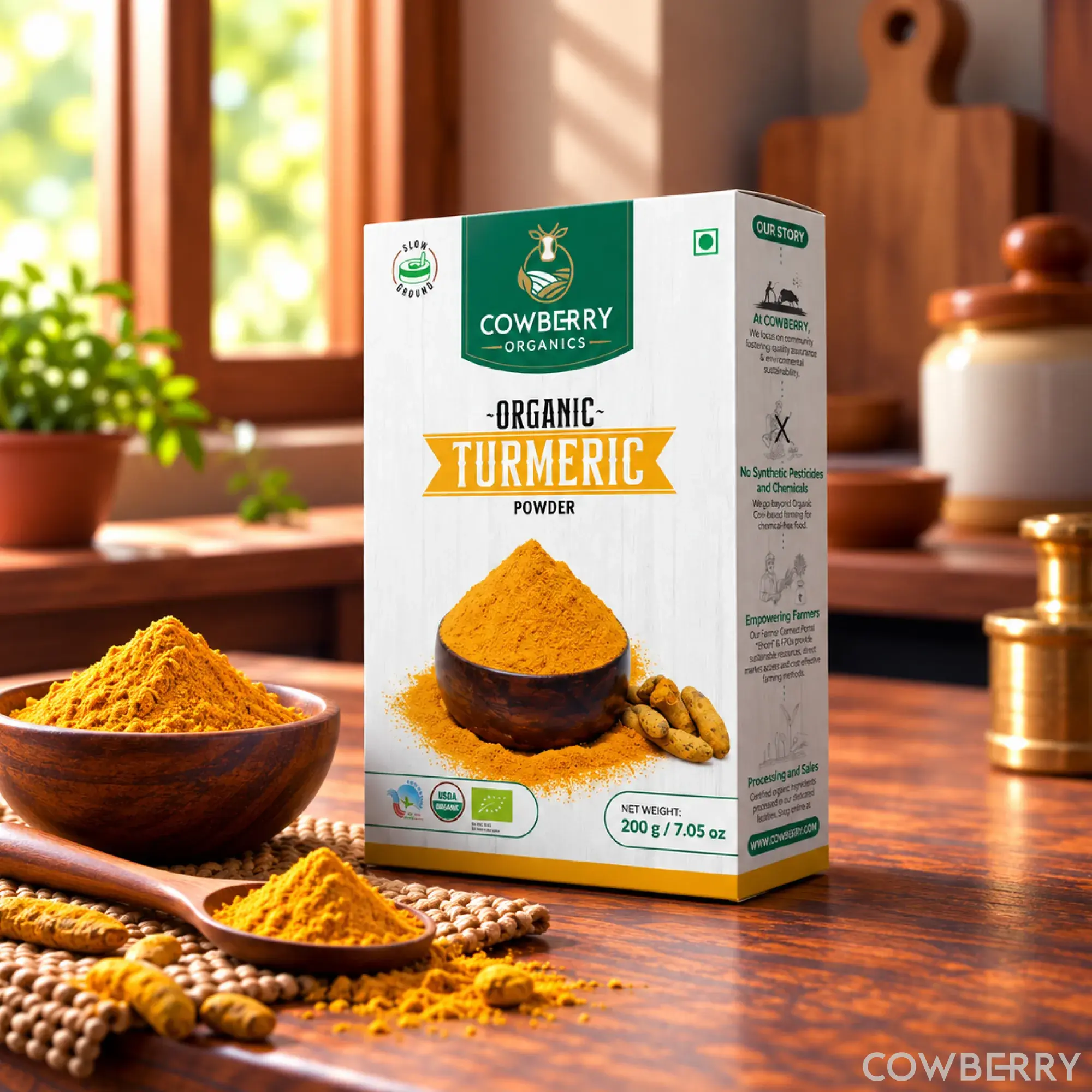
An organic certificate on a turmeric or cumin pack means the crop was grown and processed to the National Organic Standards, with chemical-free inputs. COWBERRY's Organic Turmeric Powder is raw turmeric from Maharashtra (Sangli) and Andhra Pradesh, cold processed to keep its curcumin and flavour.
| Nutrient | Turmeric powder | Cumin seeds |
|---|---|---|
| Energy (kcal) | 281 | 305 |
| Protein (g) | 7.7 | 14 |
| Fat (g) | 5 | 17 |
| Carbohydrates (g) | 49 | 23 |
| Dietary fibre (g) | 21 | 30 |
| Iron (mg) | 46 | 21 |
| Calcium (mg) | 122 | 878 |
| Magnesium (mg) | 260 | 442 |
| Potassium (mg) | 2374 | 1886 |
| Sodium (mg) | 24 | 125 |
| Zinc (mg) | 2.6 | 4.3 |
| Folate (mcg) | 14 | 28 |
Per 100 g raw, edible portion. Composition: IFCT 2017 (ICMR-NIN). — means not reported. These are average values for the food; the label on a pack gives the values for that product.
Sesame seeds organic or not
Sesame lands on the same side of the line as ground spices, and for the same reason: you eat the whole seed. There is no peel to strip and no rinse that reaches the inside of the seed coat, so the washing and peeling that the Dietary Guidelines for Indians suggest as the home defence against pesticide residues do not apply. Certified organic sesame is grown to the National Organic Standards with chemical-free inputs, under NPOP or PGS — the same certificate a spice pack carries.
The seed itself earns the attention. Per 100 g, white sesame seeds give 520 kcal, 21.70 g of protein, 43.05 g of fat and 1283 mg of calcium (IFCT 2017). A tablespoon of the seeds, about 9 g, comes to about 47 kcal and 115 mg of calcium.
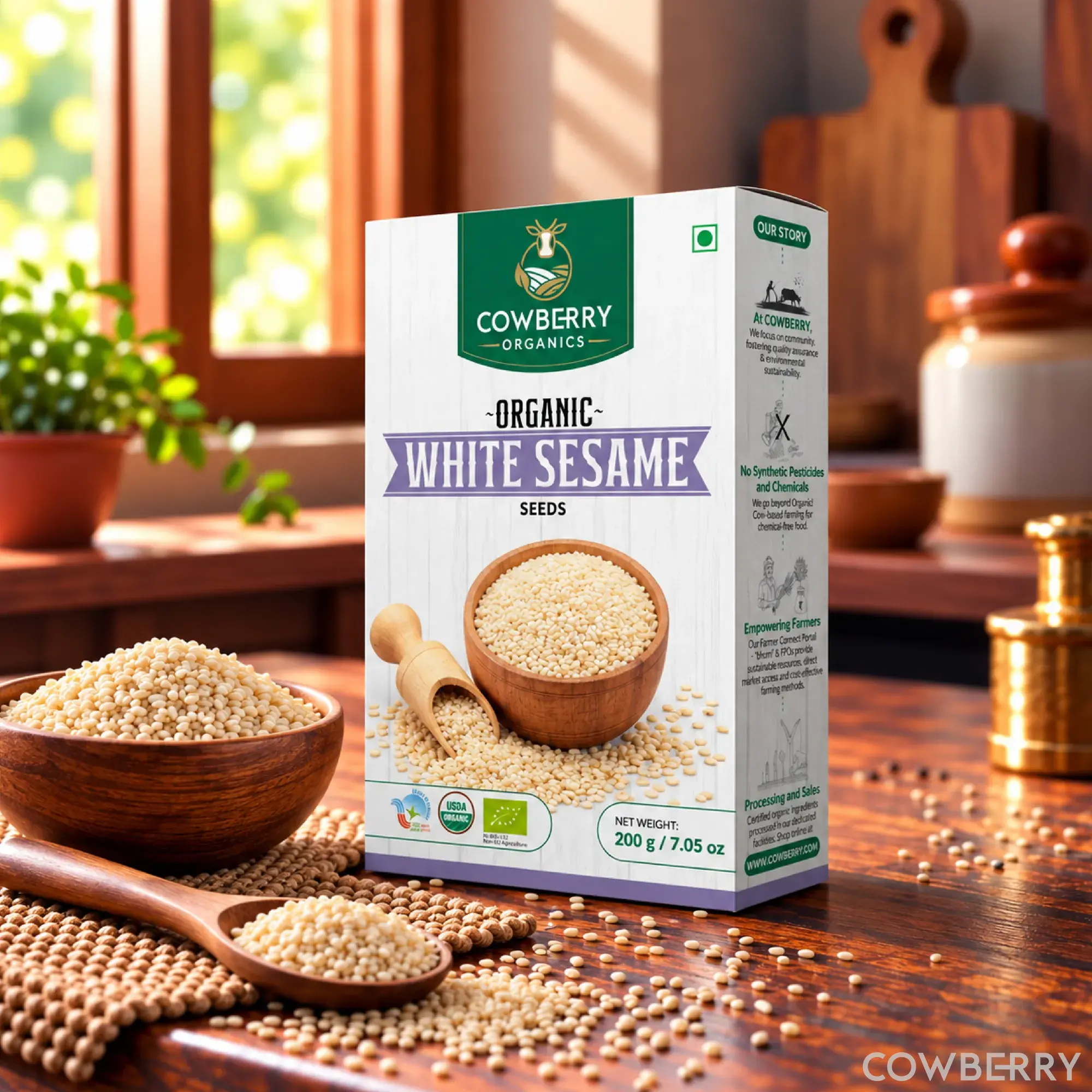
COWBERRY's Organic White Sesame Seeds are grown in Madhya Pradesh and Gujarat without synthetic pesticides, then cleaned and sorted. Buying sesame elsewhere calls for the same label test: a certification mark such as India Organic or Jaivik Bharat, since the word natural on its own means little.
| Nutrient | White sesame seeds |
|---|---|
| Energy (kcal) | 520 |
| Protein (g) | 22 |
| Fat (g) | 43 |
| Carbohydrates (g) | 11 |
| Dietary fibre (g) | 17 |
| Iron (mg) | 15 |
| Calcium (mg) | 1283 |
| Magnesium (mg) | 372 |
| Potassium (mg) | 460 |
| Sodium (mg) | 15 |
| Zinc (mg) | 7.8 |
| Folate (mcg) | 131 |
Per 100 g raw, edible portion. Composition: IFCT 2017 (ICMR-NIN). — means not reported. These are average values for the food; the label on a pack gives the values for that product.
Does millet need to be organic?
Millets have one defence that spices and sesame lack: you wash the grain. The Dietary Guidelines for Indians want foods washed well — but not over and over — before cooking or eating, since the water carries off pesticide residues, parasites and other extraneous material; cooking, they add, can bring residues down further. Whole ragi, bajra or jowar gets that rinse before soaking or cooking, so some of whatever clings to the surface goes down the drain.
The flour is the weaker link. Once millet is milled into ragi flour or bajra flour, there is nothing left to wash — the powder goes straight into the dough — and the same guidelines caution that washing grains again and again loses some minerals and vitamins. Organic millet and organic millet flour, certified under NPOP or PGS, settle the question at the farm, since the crop was grown with chemical-free inputs.
So the practical answer runs like the spice answer, one step milder: whole grain gets a rinse, so certification buys certainty about the farm; flour does not get a rinse, so there the certificate does the whole job.
Honey and ghee: what organic can change, and what it cannot
Honey is where the organic decision needs a reality check. A jar of certified organic honey is honey produced in line with organic production standards; the certificate speaks to how it was produced. It does not change what honey is made of: per 100 g, honey gives 304 kcal and 82.4 g of carbohydrates (USDA FoodData Central), and the University of Sydney GI database puts its glycemic index at 63, the mean of seven entries for plain honey, none of them from India (range 49 to 87). The Dietary Guidelines for Indians count honey among the added sugars, alongside table sugar and jaggery, so the certificate changes how the honey was produced, not its composition.
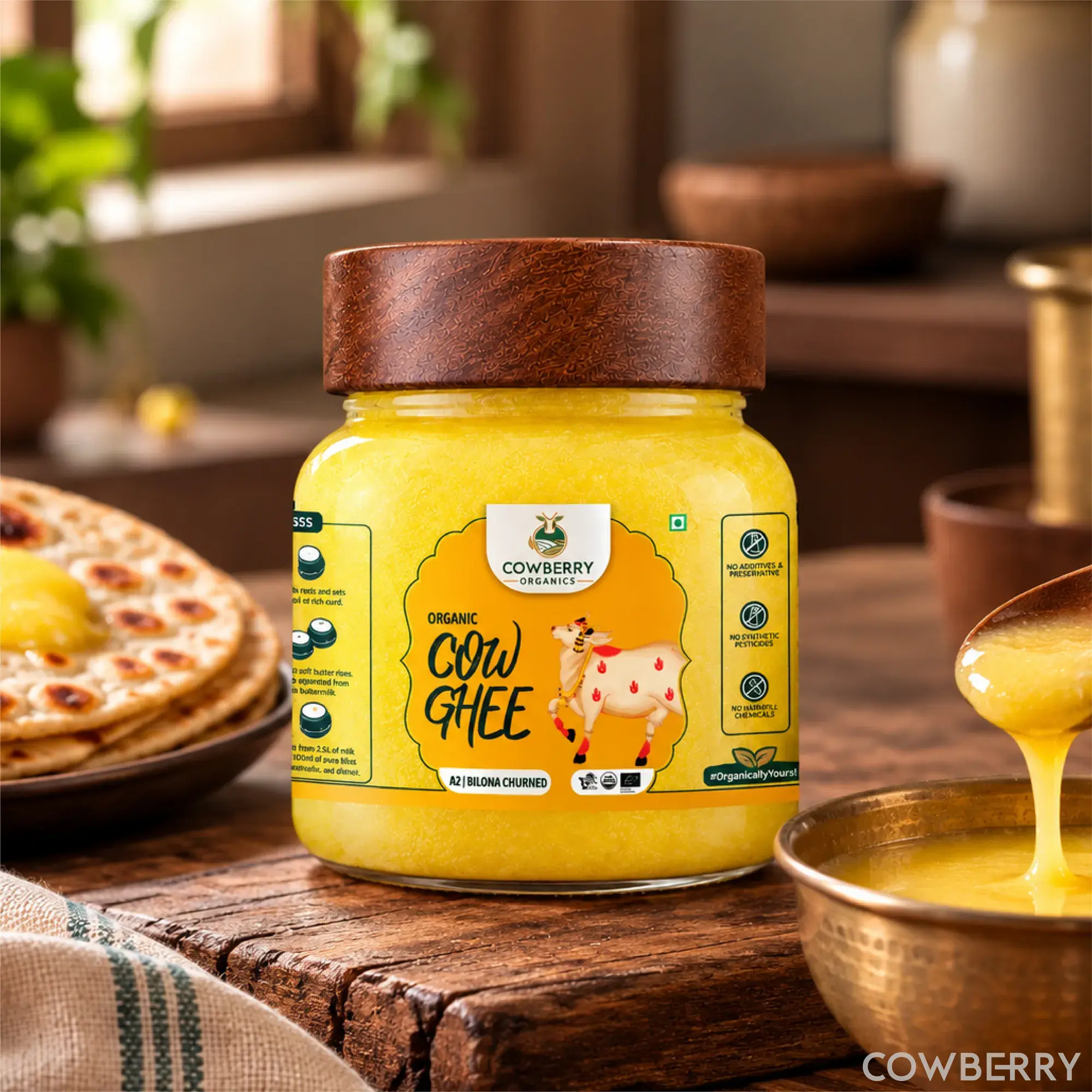
Ghee runs the same logic from the dairy side: a certified jar tells you how the ghee was produced. The certificate cannot change what ghee is made of: fat. On that, the same guidelines are direct — cap ghee and butter at 1 to 2 teaspoons across the day, or go without if you can. Spend on the organic jar for the farming behind it, and keep the daily quantity to the guideline. COWBERRY's Organic A2 Cow Ghee is bilona-churned from milk of the A2 kind, drawn from indigenous Gir cows in Gujarat.
| Nutrient | Honey (USDA FoodData Central) |
|---|---|
| Energy (kcal) | 304 |
| Protein (g) | 0.3 |
| Fat (g) | 0 |
| Carbohydrates (g) | 82 |
| Dietary fibre (g) | 0.2 |
| Iron (mg) | 0.4 |
| Calcium (mg) | 6 |
| Magnesium (mg) | 2 |
| Potassium (mg) | 52 |
| Sodium (mg) | 4 |
| Zinc (mg) | 0.2 |
| Folate (mcg) | 2 |
| Vitamin C (mg) | 0.5 |
| Glycemic index (GI) | 63 |
Per 100 g raw, edible portion. Composition: USDA FoodData Central (SR Legacy), FDC ID 169640, NDB 19296. GI: University of Sydney GI database. — means not reported. These are average values for the food; the label on a pack gives the values for that product.
Tea, coffee and dried beans: where the wash step helps
Tea and coffee are crops like any other, and organic tea or organic coffee means leaves or beans grown and processed to organic standards, certified in India under NPOP or PGS with the mark on the pack. The everyday question behind organic tea vs non organic is residue, and the honest answer is that the certificate describes the farm and its methods, not the cup. A certified pack is the way to know how the leaf or bean was grown.
Dried beans and whole grains sit in the middle. The washing rule in the Dietary Guidelines for Indians applies here: before cooking, a food should get one good wash rather than repeated rinsing, to lift pesticide residues and other extraneous material, and cooking reduces residues further still. A dried rajma or chana is soaked, rinsed and cooked — steps a jar of ground spice never sees — so for dals and beans the certificate competes with the kitchen's own washing and cooking.
Cloves and red chilli, asked about just as often, follow the spice rule: cloves arrive as dry buds and chilli is bought whole, dried or ground, and none of those forms can be washed. For them, as for nutmeg, the certificate on the pack is the check on how the crop was grown.
How to buy organic: the five checks on the pack
A short routine turns the food-by-food logic above into a shelf decision.
- The logo. Look for the Jaivik Bharat mark with its tagline; it distinguishes organic products from non-organic ones and signals production to the National Organic Standards. Imported packs may carry the USDA organic seal or the EU organic logo, which needs at least 95 percent organic ingredients.
- The certificate. Organic food in India is certified under NPOP or PGS, and the Jaivik Bharat portal lets you search products by food and company name — a direct way to check a claim before you buy.
- The word natural. FSSAI's claims rules give it a narrow meaning — one food, nothing added — and phrases like "natural goodness" are barred. It is not a stand-in for organic.
- The food itself. Ground spices, whole seeds and flours cannot be washed or peeled, so the certificate tells you most there. For grains and dals you soak, rinse and cook, washing and cooking already reduce residues, so it adds less.
- The seller. Buy from a reliable source after careful examination, as the Dietary Guidelines for Indians put it.
COWBERRY's own staples follow these checks: Organic Turmeric Powder, Organic White Sesame Seeds and Organic A2 Cow Ghee are India Organic, USDA & EU certified. For the fine print of each mark, see our guide to what organic certification in India means on a pack.
FAQs
Do spices need to be organic?
It is a choice, not a rule, and it matters most for ground spices. Pesticides used while a crop grows can remain as residues in foodstuffs, and the Dietary Guidelines for Indians name washing in running water and peeling as home ways to reduce them — a dried, ground spice gets neither. Certified organic spices, grown with chemical-free inputs under NPOP or PGS, are how you know the crop behind the powder.
Does millet need to be organic?
Less than a ground spice does. Whole millet grains get a rinse before cooking. The Dietary Guidelines for Indians count washing among the ways to lift pesticide residues and other contaminants off food, while cautioning against washing grains again and again. The flour is the weaker link: once millet is milled there is nothing left to wash, so a certified organic millet flour covers what the kitchen cannot.
Does nutmeg need to be organic?
Nutmeg is bought whole or ground, and neither form can be washed or peeled at home, so the same argument as for turmeric and cumin applies: the certificate is the check on how the crop was grown. Organic nutmeg is nutmeg produced to the National Organic Standards and certified under NPOP or PGS, with the mark on the pack; natural on the label is not the same thing.
Are all spices organic?
No. Only a spice that was produced to organic standards and certified for it — in India, under NPOP or PGS — counts as organic, and the pack has to carry a certification mark such as Jaivik Bharat. FSSAI notes that mis-labelling happens, with products marked organic while holding non-organic ingredients, so a pack that merely says natural carries no certified claim.
What is organic atta?
Organic atta is flour milled from grain grown to organic standards, with chemical-free inputs, and certified under NPOP or PGS, so the pack carries the Jaivik Bharat or India Organic mark. The certificate matters at the flour stage because there is no washing step once grain is milled. The Dietary Guidelines for Indians add that AGMARK appears on some agricultural products like atta, as a quality mark separate from organic certification.
What is organic millet?
Organic millet is millet produced to the National Organic Standards — grown with chemical-free inputs and certified under NPOP or PGS — rather than a different variety of grain. Ragi, jowar and bajra can each be grown organically or conventionally, and the certificate, shown by the Jaivik Bharat mark on the pack, is what tells the two apart.
References
- Indian Food Composition Tables (IFCT) 2017, ICMR-National Institute of Nutrition
- Dietary Guidelines for Indians, ICMR-National Institute of Nutrition
- University of Sydney glycemic index database (GI search)
- USDA FoodData Central
- FSSAI Jaivik Bharat: organic food portal (India Organic and Jaivik Bharat logos)
- FSSAI Food Safety and Standards (Advertising and Claims) Regulations 2018, compendium (PDF)
- USDA Agricultural Marketing Service: National Organic Program
- European Commission: the EU organic logo
Shop this article
Keep reading
India Organic logo, Jaivik Bharat, USDA and EU labels explained

The Future of Digital Traceability in Organics