by COWBERRY

5 minute read
Haldi in English: turmeric names in Hindi and Indian languages

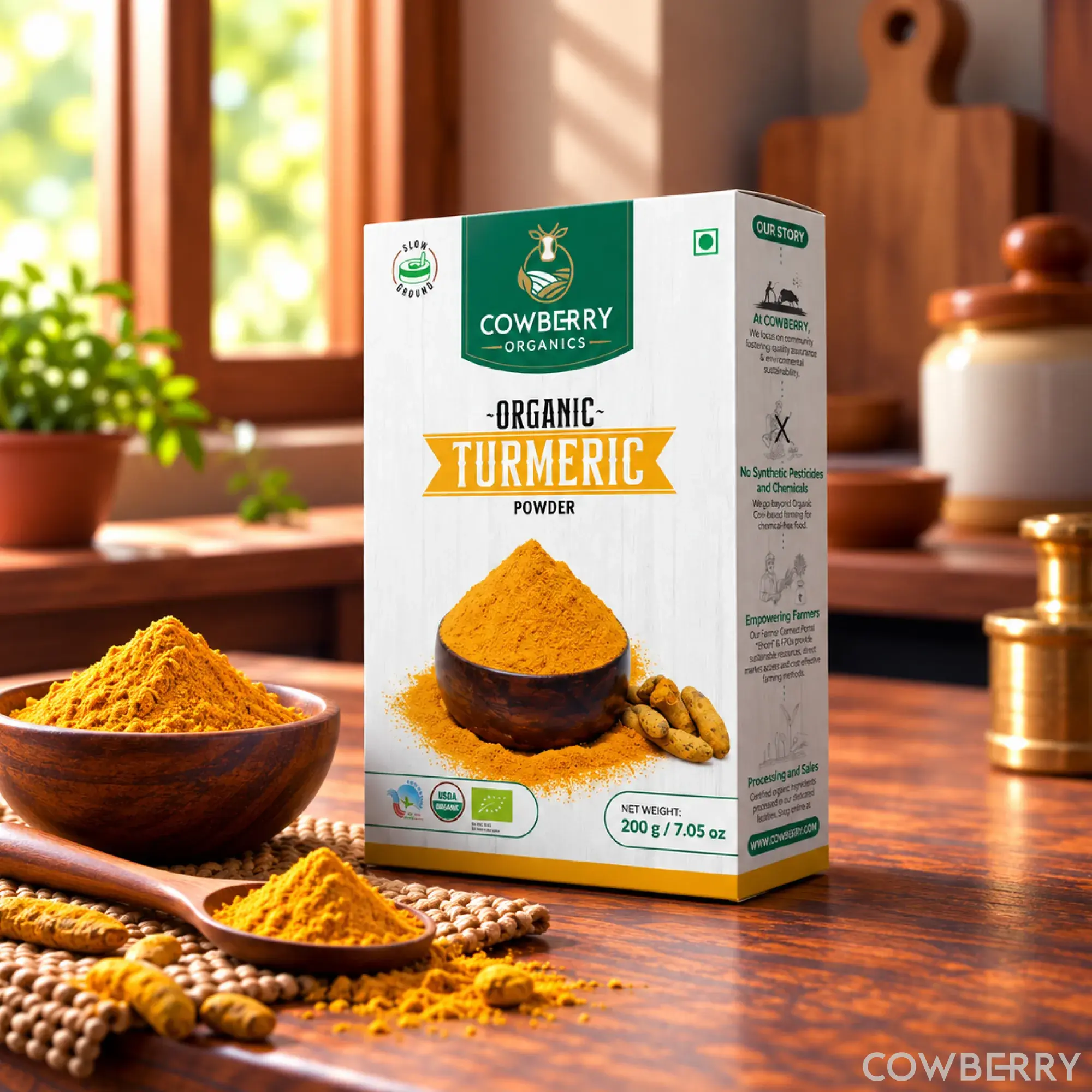
Haldi in English is turmeric, with turmeric powder as the exact food name IFCT 2017 prints, and Hindi is only one of its languages: the same spice is halad in Marathi, haddar in Gujarati, holud in Bengali, manjal in Tamil and anashina in Kannada. Every Indian-language name, with the botanical one, sits in the table below; the haldi guide covers the spice itself.
Haldi in English: the quick answer, language by language
One line per language: haldi in English is turmeric, and turmeric powder is the name IFCT 2017 prints as the English food name. In Hindi, Punjabi and Urdu it is haldi; in Marathi, halad; in Gujarati, haddar; in Bengali, holud; in Odia, haladi; in Assamese, halodhi; in Kannada, anashina; in Telugu, pasupu; in Tamil and Malayalam, manjal; and in Sanskrit, haladi. The botanical name on the same list is Curcuma domestica. The table below carries all of them with the spellings exactly as the list prints them.
| Language | Name (romanised) |
|---|---|
| English | Turmeric powder |
| Hindi | Haldi |
| Marathi | Halad |
| Gujarati | Haddar, Haldar |
| Punjabi | Haldi |
| Bengali | Holud |
| Odia | Haladi |
| Assamese | Halodhi |
| Kannada | Anashina, Arishina |
| Telugu | Pasupu |
| Tamil | Manjal |
| Malayalam | Manjal |
| Urdu | Haldi |
| Sanskrit | Haladi |
| Botanical name | Curcuma domestica |
Source: IFCT 2017 (ICMR-NIN) local-names list. — means no name recorded in the source.
Gujarati ‘Haldar’: spelling variant of the IFCT 2017 name ‘Haddar’. Kannada ‘Arishina’: spelling variant of the IFCT 2017 name ‘Anashina’.
The English name and the botanical name
Haldi meaning in English is turmeric, plain and simple, and the IFCT 2017 list gives the full food name as turmeric powder. On the botanical side, the same list records Curcuma domestica. NCCIH gives the Latin name as Curcuma longa, with Curcuma domestica as a synonym, and describes the plant as a member of the ginger family whose rhizome, the underground stem, has been used for culinary and cosmetic purposes. NCCIH also lists turmeric root and Indian saffron among its English common names; more on that confusion below.
Turmeric names by region
North and East
Haldi is the Hindi and Punjabi name, and it stays haldi in Urdu. To the east, the name changes with the language: holud in Bengali, haladi in Odia and halodhi in Assamese.
West
Marathi says halad and Gujarati says haddar, also spelt haldar. IFCT 2017 prints haddar; haldar is listed under the table as a spelling variant, as is the Kannada spelling below.
South
The southern names break the pattern: anashina in Kannada, also spelt arishina, pasupu in Telugu, and manjal in both Tamil and Malayalam.
Sanskrit
The list gives haladi for Sanskrit, matching the Odia spelling, and completes the 13 Indian languages on the IFCT list.
Often confused with
- Curcumin. Turmeric is the spice; curcumin is one compound inside it, a major component that NCCIH credits with the yellow colour. The difference, with absorption and supplements, is on turmeric vs curcumin.
- Indian saffron. NCCIH lists Indian saffron among turmeric's English common names, so the phrase can mean turmeric itself, not the saffron spice.
- Raw haldi and turmeric powder. The fresh root and the ground dry powder come from the same rhizome, fresh and dried, and IFCT 2017 prints composition values for the powder only. Ways to use both are on how to eat turmeric.
Where turmeric grows
NCCIH places turmeric as a plant in the ginger family grown commercially in Southeast Asia and India. The growing map has a harder number behind it: a 2024 study that sampled turmeric from 23 cities across India, Pakistan, Sri Lanka and Nepal notes that the four countries together produce over 80 percent of the world's turmeric. The powder COWBERRY sells is grown in Maharashtra, around Sangli, and in Andhra Pradesh. The names travel with the recipes too: haldi doodh is turmeric milk, made from the turmeric milk recipe; more dishes are gathered on turmeric recipes, and the spice's full story is on the haldi guide.
FAQs
What is haldi called in English?
Haldi is called turmeric in English, and turmeric powder is the full food name IFCT 2017 prints. The spice is also known in English as turmeric root and Indian saffron, the common names NCCIH lists. On shop shelves, the word on the pack is turmeric, the powder of the dried rhizome.
What is turmeric in Hindi?
Turmeric is haldi in Hindi, and the same word serves Punjabi and Urdu. The fresh root has its own kitchen name, kachi haldi, which means raw haldi, while the ground powder is simply haldi or haldi powder.
What is turmeric?
Turmeric is the yellow spice made from the rhizome of Curcuma longa, a plant in the ginger family grown commercially in Southeast Asia and India, as NCCIH describes it. IFCT 2017 records its composition under the name turmeric powder, at 281 kcal and 49.22 g of carbohydrate per 100 g.
What is the difference between turmeric and curcumin?
Turmeric is the whole spice, and curcumin is a major component inside it that gives the yellow colour, as NCCIH puts it. Cooking uses the spice; NCCIH's safety cautions, such as liver damage reported with highly bioavailable formulations, concern curcumin and turmeric supplements. The full comparison is on turmeric vs curcumin.
What is turmeric powder?
Turmeric powder is the dried turmeric rhizome ground fine, the form measured in food composition tables: IFCT 2017 lists it as turmeric powder with 281 kcal of energy and 7.66 g of protein per 100 g. A level teaspoon of it weighs about 3 g.
References
Shop this article
Keep reading
Coriander water benefits: what dhania water actually does
Peanuts in Hindi (moongfali): groundnut names in Indian languages
Coriander vs cilantro: are they the same herb?