by COWBERRY

10 minute read
Turmeric adulteration test: 3 FSSAI home tests for pure haldi

A turmeric adulteration test at home can flag a suspect batch but cannot prove haldi is pure. FSSAI's household manual has three quick water checks that apply to it: lead chromate in whole turmeric, artificial colour in turmeric powder, and sawdust or powdered bran in any powdered spice. None of them measures lead, which takes a laboratory. Each is set out below with what you see and its limits.
Why turmeric is adulterated
Turmeric is sold by weight and judged by its colour, so the two reasons to tamper with it are bulk and brightness. ICMR-NIN's Dietary Guidelines for Indians list spices among the frequently adulterated foods and note that poor-quality food is at times made to look attractive and fresh by adding harmful colours. They also place adulteration anywhere between farm and plate, and they single out powdered spices as more at risk than whole ones.
Added for colour
Lead chromate is the adulterant that turns a question of quality into one of safety. A 2024 study in the journal Science of the Total Environment notes that spices adulterated with it have been linked with lead poisoning in many countries, from Bangladesh to the United States. The study collected 356 turmeric samples, dried roots as well as powder, from wholesale and retail bazaars in 23 major cities across India, Pakistan, Sri Lanka and Nepal, and analysed them for lead and chromium. In all, 14% of the samples had detectable lead above 2 micrograms per gram. In samples with 18 micrograms of lead per gram or more, lead and chromium were present in a molar ratio near 1:1, which the authors call suggestive of lead chromate. In samples from Patna in Bihar and from Karachi and Peshawar in Pakistan, lead exceeded 1000 micrograms per gram.
Metanil yellow is the example the ICMR-NIN guidelines give of a non-permitted colour used as an adulterant.
Added for weight
Bulk is the plainer trick. The same guidelines say that foods may be adulterated with non-food material or with inferior-quality products, and they give husk, sand and sawdust as examples of extraneous matter in spices. Ground fine and mixed into a yellow powder, such material is hard to pick out by eye; FSSAI's water test for powdered spices, set out below, is one way to bring it to the surface.
Where it enters
Dried turmeric passes through many hands, wholesale and then retail, before it reaches a kitchen. The 2024 study bought its samples at both wholesale and retail bazaars and included whole dried roots as well as powder. A short supply chain that can name its farms counts for more than any check made at the end of it.
How to check turmeric purity at home: FSSAI's three water tests
FSSAI's Detect Adulteration with Rapid Test manual, published through Eat Right India, is written for households and meant to make consumers more aware of food safety. Three of its tests apply to haldi, and each needs only water.
Test for lead chromate in whole turmeric
Put a small quantity of whole turmeric in a transparent glass of water. What you see: pure turmeric leaves no colour in the water. Adulterated turmeric looks bright and colours the water immediately.
Test for artificial colour in turmeric powder
Add a teaspoon of turmeric powder to a glass of water and watch it settle. What you see: natural turmeric powder leaves a light yellow colour as it sinks. Powder with artificial colour leaves a strong yellow in the water.
Test for sawdust and bran in powdered spices
FSSAI writes this one for powdered spices in general, and haldi powder is one of them. Sprinkle the powder over the surface of some water. What you see: a pure spice leaves no sawdust or powdered bran on the water. If either floats on the surface, the spice has been adulterated.
Where the water tests stop
A pass means the batch has cleared a quick screen, not that it is pure. None of the three measures lead: the 2024 study found lead chromate by analysing samples for lead and chromium, which is laboratory work. A careful look before buying adds a little. ICMR-NIN's guidelines say whole spices should be uniform in colour, size and shape, and food should be free from artificial colours, infestation, moulds and foreign matter.
The practical protection
Because no kitchen test measures lead, the source does more than any test after buying. The ICMR-NIN guidelines give two pieces of advice for spices: prefer whole spices to powdered ones, and always buy certified products. They add that food bought from reliable sources is more likely to be of good quality. In practice that means whole dried turmeric fingers ground at home in small batches, or packed powder from a certified source that can say where its turmeric was grown. Whole fingers are not a free pass: the 2024 study sampled dried roots as well as powder, and its summary does not say which of the two carried the lead.
Lab tests and the FSSAI standard for turmeric powder
What a kitchen cannot do, a laboratory can. In the 2024 study every sample was analysed for lead and chromium, and it was the two metals appearing in a molar ratio near 1:1 that the authors read as a sign of lead chromate. Lead can reach food in other ways too: the ICMR-NIN guidelines list it among the heavy metals that contaminate food through environmental pollution or through the soil and water of affected areas.
On the regulatory side, FSSAI's advertising and claims regulations give the word 'pure' a meaning. The word is reserved for a food with one ingredient and nothing added, free from avoidable contamination, whose unavoidable contaminants stay under the limits set in the Food Safety and Standards (Contaminants, Toxins and Residues) Regulations, 2011. 'Pure' must not be worked into a brand name or a coined phrase so as to imply purity in a food that does not meet those conditions.
The figures themselves, such as any minimum for curcumin content or any limit for lead, belong to FSSAI's product standards and contaminants regulations. The references used for this page do not print them, so no number is quoted here. For a buyer the point is simpler: a pack with the FSSAI logo and a licence number comes from a maker the regulator has licensed, and loose powder from an open sack carries neither.
How to identify pure turmeric powder from the label
The label is a check every buyer can run before paying. It is a check of accountability, not of chemistry.
- Ingredients: the ingredient declaration lists everything in the pack, in descending order of quantity. Plain haldi has a single entry: turmeric.
- FSSAI logo and licence number: a sign that the company behind the pack holds a licence from the regulator; its name and address appear on the label too.
- Dates and storage: a manufacture date and a use-by date tell you how old the powder is and how long it is meant to last, and the storage line says how to keep it.
- Certification marks: the ICMR-NIN guidelines note that some packed foods carry certification marks, and give AGMARK on spices as an example.
- Origin: a pack that names the district or state where the turmeric was grown gives you something to hold the seller to.
- Words that are not certification: 'natural', 'pure', 'fresh' and 'real' are claims made by the seller. FSSAI's regulations set conditions for each of these words and require every claim to be truthful, unambiguous and not misleading, but a claim is not a certificate. For how a claim differs from a certificate, see organic vs natural on food labels.
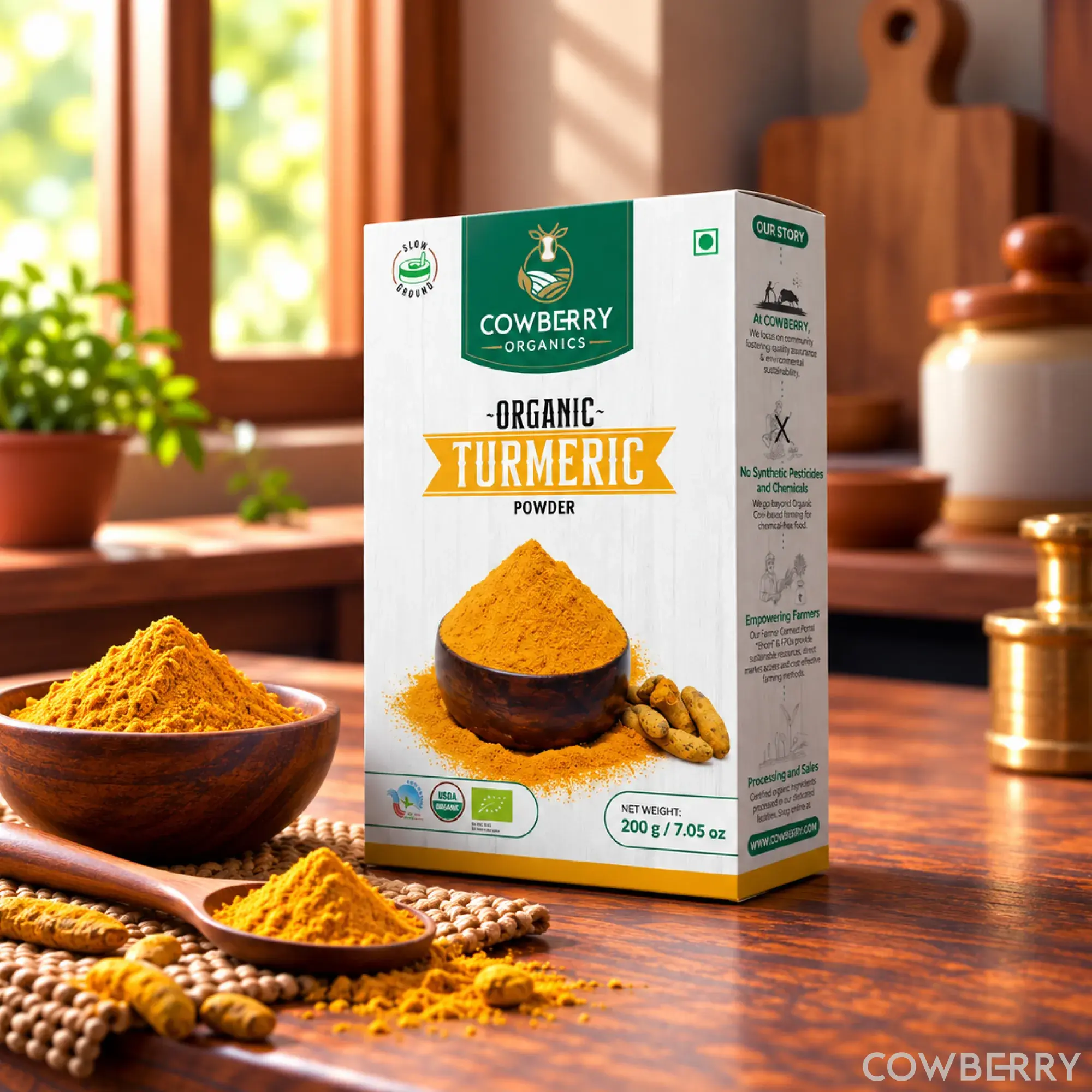
COWBERRY's organic turmeric powder is grown in Sangli (Maharashtra) and Andhra Pradesh, harvested at full maturity and slow-ground, and is India Organic, USDA & EU certified.
Turmeric and curcumin: the spice and the compound
Curcumin is a compound in turmeric, not another name for it. A 2017 review in the journal Foods describes turmeric as the major source of the polyphenol curcumin, and attributes most of the benefits it reviews to curcumin's antioxidant and anti-inflammatory effects.
The same review is frank about the limits. Taken by itself, curcumin has poor bioavailability, which the authors put down mainly to poor absorption, rapid metabolism and rapid elimination. Piperine, the major active component of black pepper, has been shown to increase that bioavailability when the two are combined. The review is about curcumin the compound, so read it as an account of what researchers have studied and not as a promise about the half teaspoon of haldi in a dal.
Cooking with pure haldi and storing it
Good turmeric needs little: a quarter to half a teaspoon colours and seasons a dal for four. Add it to hot oil or ghee for a few seconds in the tadka, or stir it into the dal as it boils; haldi that has not been cooked tastes harsh and raw. It goes into the pot for dal tadka, turns the flattened rice yellow in kanda poha and seasons nearly every sabzi and khichdi in between.
Ground spice loses its aroma faster than whole spice. Keep the powder in an airtight steel or dark glass jar away from the stove, the window and steam, use a dry spoon, and buy a quantity you will finish in a few months. Whole fingers keep their aroma longer; grind a small batch at a time.
The same rule, source first and home check second, applies to other staples: see how to check ghee purity and the pure honey test.
FAQs
How to identify pure turmeric powder?
Start with FSSAI's powder test: add a teaspoon of turmeric powder to a glass of water, and natural powder leaves a light yellow colour as it settles while artificially coloured powder leaves a strong yellow. Sprinkled on water, pure powder also leaves no floating sawdust or bran. Passing both is not proof, so check the pack too: turmeric as the sole ingredient, the FSSAI logo with licence number, and a certification mark.
Can a home test detect lead chromate in turmeric?
Only as a warning sign, not as a measurement. FSSAI's household test puts a small quantity of whole turmeric in a transparent glass of water: pure turmeric leaves no colour, while turmeric adulterated with lead chromate looks bright and colours the water at once. It cannot tell you how much lead is present. The 2024 study that reported lead chromate across South Asia measured lead and chromium in a laboratory.
What is the difference between turmeric and curcumin?
Turmeric is the whole spice; curcumin is one compound inside it, a polyphenol. A 2017 review describes turmeric as the major source of curcumin and notes that curcumin taken by itself has poor bioavailability, which piperine from black pepper has been shown to increase. Cooking with haldi is not the same as taking curcumin.
Is turmeric acid or base?
None of the sources behind this page classes turmeric as an acid or a base. What FSSAI's household manual does record is how turmeric reacts with chuna, the soaked lime used in paan: its test for turmeric in sella rice sprinkles chuna on the grains, and grains coloured with turmeric turn red. So haldi turning red with chuna shows that turmeric is there; it says nothing about whether the powder is pure.
What is turmeric powder?
Turmeric powder is turmeric sold ground instead of whole, listed in IFCT 2017 under the botanical name Curcuma domestica. It is haldi in Hindi, halad in Marathi, manjal in Tamil and Malayalam, pasupu in Telugu and holud in Bengali. Sold plain, it has one ingredient: turmeric.
Is whole turmeric safer than turmeric powder?
By ICMR-NIN's reasoning, usually yes: whole spices are the ones its guidelines tell shoppers to prefer, since powder is where adulteration is more likely. Whole is not automatically clean, though. The 2024 lead chromate study sampled dried roots as well as powder, and FSSAI's household test for lead chromate is written for whole turmeric. Buy fingers that are uniform in colour, size and shape, from a source that can tell you where they were grown.
References
- Forsyth JE, Mistree D, Nash E et al. Evidence of turmeric adulteration with lead chromate across South Asia. Sci Total Environ, 2024
- FSSAI DART: Detect Adulteration with Rapid Test, common quick tests for food adulterants at household (Eat Right India)
- Dietary Guidelines for Indians, ICMR-National Institute of Nutrition
- FSSAI Food Safety and Standards (Advertising and Claims) Regulations 2018, compendium (PDF)
- Hewlings SJ, Kalman DS. Curcumin: a review of its effects on human health. Foods, 2017
- Indian Food Composition Tables (IFCT) 2017, ICMR-National Institute of Nutrition
Shop this article
Keep reading
Coriander water benefits: what dhania water actually does
Peanuts in Hindi (moongfali): groundnut names in Indian languages
Coriander vs cilantro: are they the same herb?