by COWBERRY

7 minute read
Toor dal for diabetes: GI, carbs per katori and how to eat it

Toor dal for diabetes earns its place as a measured pulse course at the table: a katori of cooked dal carries 16.6 g of carbohydrate beside fibre and protein, and boiled pigeon peas test low on the glycemic index. It substitutes part of the rice or roti, never the medication. The numbers, the trials and the portions follow; the toor dal guide covers the plain dal.
Short answer: is toor dal good for diabetes?
Yes, as part of the meal, and the arithmetic decides how. Three habits carry it: a measured portion, the dal standing in for some rice or roti rather than sitting beside them, and a light hand with the tempering. Toor dal good for diabetes is measured toor dal. The trial evidence points the same way. A 2009 systematic review and meta-analysis pooled 41 randomised trials across people with and without diabetes. In its results, pulses by themselves lowered fasting blood glucose and insulin; within low-GI diets the change was in HbA1c or fructosamine; within high-fibre diets it was fasting blood glucose and those same glycosylated proteins. The authors read that as better markers of longer-term glycaemic control, though results varied a lot between trials, so the benefit's size was not uniform. Arhar dal is good for diabetes on exactly this logic, since arhar is simply the Hindi name for it.
None of that makes toor a medicine. It is a carbohydrate food: 55.2 g of carbohydrate per 100 g of raw dal, arriving with 9.1 g of fibre and 21.7 g of protein. Served as a second helping over a full rice plate, it adds carbohydrate the way any other food does.
Toor dal glycemic index and load: the number and its limits
The University of Sydney database holds four tests of pigeon peas. Averaged, they come to 20, but the four individual results spread from 7 to 43. Two of the tests, both from the Philippines, soaked the peas overnight, boiled them, cooled them overnight and reheated them in a microwave; a third, also from the Philippines, boiled them for 45 minutes after soaking; the fourth was run in Jamaica. None was done in India, and all four used whole pigeon peas rather than the split dal sold as toor. So read 20 as a cautious working number: the database draws the low band at 55 and below and the high band at 70 and above, which puts toor in the low band, but the exact score for home-cooked split dal has not been tested.
A glycemic load follows from the same arithmetic, with the same caution. A katori of cooked dal carries 16.6 g of carbohydrate, and 20 times that divided by 100 gives an estimated glycemic load of about 3.3. It stays an estimate because the GI itself comes from whole-pea tests; what holds is that the katori is a small carbohydrate event next to a plate of rice.
Two reminders on reading any GI. First, the number describes a standardised test, not a plate: the standard test feeds ten or more healthy people a portion that carries 50 g of digestible carbohydrate and compares each person's two-hour blood glucose response against their own response to the same amount of glucose. Next, the meal moves the number: rice beside the dal adds its own carbohydrate on top. That sum, more than the GI, is why portion size comes first.
What the numbers say: carbohydrate, fibre and calories
The table below lists what IFCT 2017 counts in 100 g of raw toor dal. On a diabetes plate, watch three of those rows: carbohydrate, fibre and the glycemic index, with the katori arithmetic spelled out under them.
One katori of cooked dal starts from 30 g of dry toor. That comes to about 99 kcal, with 6.5 g of protein, 16.6 g of carbohydrate, 2.7 g of fibre and 0.5 g of fat. The ICMR-NIN guidelines spell out the mechanism: dietary fibre slows how carbohydrates and fats are absorbed and adds to the satiety value, and fibre-rich diets lower glucose and lipids in the blood. A 2014 review of pulses reaches further: pulses pair a high fibre content with a low glycemic index, a combination it counts as particularly useful for people with diabetes, since it helps keep blood glucose and insulin levels healthy.
| Nutrient | Toor dal (split), raw |
|---|---|
| Energy (kcal) | 331 |
| Protein (g) | 22 |
| Fat (g) | 1.6 |
| Carbohydrates (g) | 55 |
| Dietary fibre (g) | 9.1 |
| Iron (mg) | 3.9 |
| Calcium (mg) | 72 |
| Magnesium (mg) | 119 |
| Potassium (mg) | 1395 |
| Sodium (mg) | 18 |
| Zinc (mg) | 2.6 |
| Folate (mcg) | 108 |
| Glycemic index (GI) | 20 |
Per 100 g raw, edible portion. Composition: IFCT 2017 (ICMR-NIN). GI: University of Sydney GI database. — means not reported. These are average values for the food; the label on a pack gives the values for that product.
How much toor dal, and how to eat it
Portions first. On the ICMR-NIN adult plate, pulses and legumes get 85 g a day, and a katori made from 30 g of dry toor sits well inside that allowance. For anyone counting carbohydrates, that katori means about 16.6 g; check the number against the dietitian's target for the meal.
Next, the pairings. The guidelines find that a cereal-pulse pairing at a 3:1 raw-weight ratio can meet the requirement for every essential amino acid, the old dal-chawal wisdom made into a number. Cook it as the guidelines prefer: boiling or pressure cooking lifts the digestibility of pulses and with it their protein availability, and removes the anti-nutritional factors that block nutrients. Serve the katori with vegetables and curd, keep the tempering light, and the meal lands steady. Recipes that fit: toor dal khichdi, sambar and dal tadka made with a small tempering. If weight is on the table too, the toor dal for weight loss page covers the calorie side, and the toor dal guide has the cooking.
Better and worse ways to eat toor with diabetes
Better:
- A katori of plain dal with a small oil tempering, beside vegetables and a measured rice or roti share.
- Toor khichdi in a measured bowl; one pot of dal and rice is the cereal-pulse pairing in the guidelines.
- A small bowl of sambar before the plate, with its carbohydrate counted into the meal rather than stacked on top.
- A bowl of curd on the side, to spread the meal's protein.
Worse:
- The dal served over the full rice or roti portion, a second course instead of a swap.
- Heavy temperings in ghee or oil that push a light dal into a rich plate.
- Sweetened dal and packaged mixes, which stack sugar on top of the dal's own carbohydrate.
- A watery bowl in place of the meal; thin dal holds little of the dal itself.
The same dishes feed everyone; the person with diabetes changes the portion. Thetoor dal recipes roundup has more ideas.
Talk to your doctor or dietitian
Blood sugar rests on a tripod of medication, monitoring and a personal eating plan, and a new staple presses on all three legs. Medicines that lower blood glucose meet less carbohydrate when the dal takes the rice's place, so clear the swap and its portion with your doctor first and bring your meter readings to the visit. A dietitian can slot the dal into your carbohydrate counting. For portions and timing matched to your readings, talk to your doctor or dietitian.
FAQs
What is toor dal?
Toor dal is split pigeon pea, the dehusked and halved seed of Cajanus cajan, and it is the yellow dal of sambar and dal tadka. Arhar, the Hindi name, is the same dal. On the diabetes plate it matters for two numbers: 55.2 g of carbohydrate per 100 g, and a low glycemic index of 20, from tests on whole pigeon peas.
Does toor dal have protein?
Yes: 21.7 g of protein per 100 g of raw dal (IFCT 2017). Cooked from 30 g of dry toor, one katori carries about 6.5 g, and paired with rice or roti it helps meet the amino acid needs in the way the guidelines describe.
Can toor dal cause gas?
It can, as most pulses do. A 2019 review of pulse tolerance puts it down to galacto-oligosaccharides that pass through the small intestine undigested and ferment in the colon, releasing gas, and adds that this explanation has been questioned. The same review notes that most people with flatulence settle down over a few weeks once the intake continues. Cook the dal fully soft and see how your own body responds.
Can toor dal be soaked overnight?
It can be. Soaking appears among the guidelines' household methods that help legumes digest, though no soak time for toor is printed. What decides the result is the cooking: boil or pressure cook until the dal is completely soft.
References
- Indian Food Composition Tables (IFCT) 2017, ICMR-National Institute of Nutrition
- Dietary Guidelines for Indians, ICMR-National Institute of Nutrition
- University of Sydney glycemic index database (GI search)
- University of Sydney: about the glycemic index
- Sievenpiper JL, Kendall CW, Esfahani A, et al. Effect of non-oil-seed pulses on glycaemic control: a systematic review and meta-analysis of randomised controlled experimental trials in people with and without diabetes. Diabetologia, 2009
- Mudryj AN, Yu N, Aukema HM. Nutritional and health benefits of pulses. Appl Physiol Nutr Metab, 2014
- Thompson HJ. Improving human dietary choices through understanding of the tolerance and toxicity of pulse crop constituents. Curr Opin Food Sci, 2019
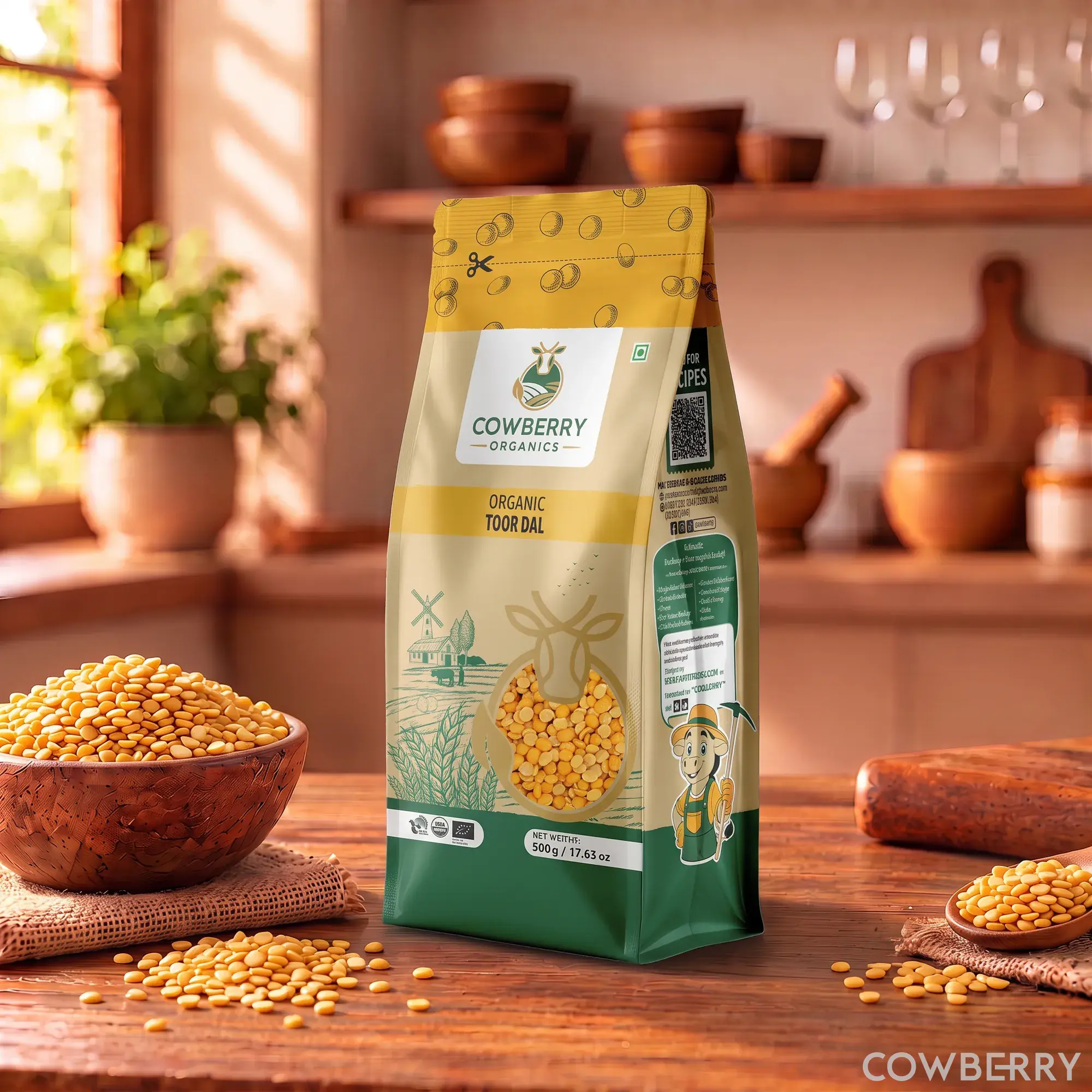
Shop this article
Keep reading
Green gram plant: crop, varieties and how it grows in India
Rajma vs lobia: difference, nutrition and which to choose
Rajma plant: how rajma is grown in India (it is not a tree)