by COWBERRY

10 minute read
Coffee: names, nutrition, benefits and how to make it

Coffee is the roasted seed of the coffee cherry, brewed into everything from a milky filter kaapi to a plain black cup. This page names it in the languages the sources record, counts its per-100 g nutrition, reports what the research says about its benefits and limits, and links every coffee guide on the site, from buying beans to storing the pack.
What is coffee?
Coffee is a seed before it is a drink: the pit of a small red fruit called the coffee cherry. The bushes grow under a canopy of native trees, and the cherries ripen slowly in that shade, which is where their flavour develops; at harvest they are picked by hand at peak ripeness, then washed and sun-dried. The roast comes next, kept mild and in small batches, and it is the step that brings the flavours out.
After roasting the beans take one of two roads: packed whole, sealed immediately after roasting, or ground right away into a fine powder. Hot water then does the rest, whatever the method. The coffee sold on this site is 100% Arabica from Coorg, Karnataka, and the how coffee powder is made page follows the whole chain from plant to packet.
Coffee names in Indian languages
The published sources record one name for this food, the English one, and one regional name for the drink. Most language cells stay empty because no source records a coffee name in those languages, so Hindi, Kannada, Telugu, Malayalam, Marathi, Gujarati, Bengali and Punjabi show none here.
The one regional name the sources record is Tamil, and it belongs to the milky filter cup rather than the bean: Kaapi. The table below shows exactly that, with its source. The same holds for Odia, Assamese, Urdu and Sanskrit: no source records a coffee name in them, so this page shows none. The coffee in hindi page explains every cell, including why the empty ones stay empty.
| Language | Name (romanised) |
|---|---|
| English | Beverages, coffee, instant, regular, powder |
| Hindi | — |
| Marathi | — |
| Gujarati | — |
| Punjabi | — |
| Bengali | — |
| Odia | — |
| Assamese | — |
| Kannada | — |
| Telugu | — |
| Tamil | Kaapi |
| Malayalam | — |
| Urdu | — |
| Sanskrit | — |
| Botanical name | — |
Source: USDA FoodData Central record 171893 (English and scientific name only; no Indian-language names in source). — means no name recorded in the source.
Tamil ‘Kaapi’: Indian filter coffee - Wikipedia.
Coffee nutrition per 100 g
Per 100 g, dry coffee carries 353 kcal, 12.2 g of protein, 0.5 g of fat and 75.4 g of carbohydrate, with 4.41 mg of iron, 141 mg of calcium, 327 mg of magnesium and 3540 mg of potassium. These are the values of the dry instant coffee powder in the USDA FoodData Central record, the only coffee entry the composition tables carry; a brewed cup is mostly water, so the drink itself stays near zero until milk and sugar join it.
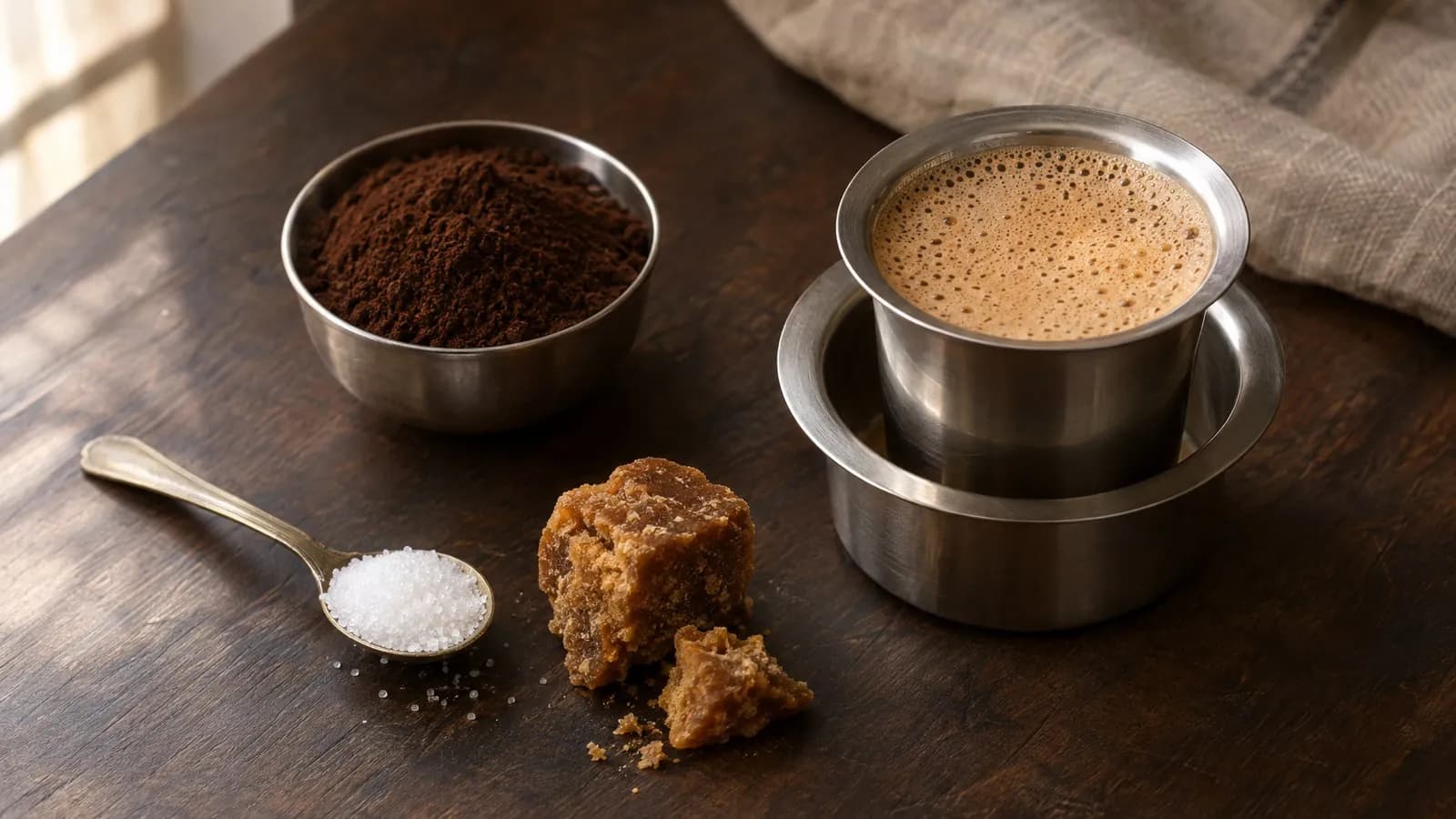
The table also carries white sugar and jaggery, the two common sweeteners for an Indian cup, and both are largely carbohydrate. One hundred grams is also far more coffee than any single brew uses, which is why the per-teaspoon figure matters more in the kitchen. Scaled down, one level teaspoon (5 g) of dry coffee powder comes to about 18 kcal; on the caffeine side, the Indian guidelines count 80-120 mg in a 150 ml brewed cup and 50-65 mg in instant, so three brewed cups at the middle of that range touch the tolerable daily limit of 300 mg. The coffee calories per 100g page works the full arithmetic, spoonful by spoonful.
| Nutrient | Coffee (dry powder) | White sugar | Jaggery (cane) |
|---|---|---|---|
| Energy (kcal) | 353 | 387 | 354 |
| Protein (g) | 12 | 0 | 1.9 |
| Fat (g) | 0.5 | 0 | 0.2 |
| Carbohydrates (g) | 75 | 100 | 85 |
| Dietary fibre (g) | 0 | 0 | — |
| Iron (mg) | 4.4 | 0.1 | 4.6 |
| Calcium (mg) | 141 | 1 | 107 |
| Magnesium (mg) | 327 | 0 | 115 |
| Potassium (mg) | 3540 | 2 | 488 |
| Sodium (mg) | 37 | 1 | 25 |
| Zinc (mg) | 0.3 | 0 | 0.5 |
| Folate (mcg) | 0 | 0 | 14 |
| Vitamin C (mg) | 0 | 0 | — |
| Glycemic index (GI) | — | 70 | — |
Per 100 g raw, edible portion. Composition: USDA FoodData Central (SR Legacy), FDC ID 171893, NDB 14214; USDA FoodData Central (SR Legacy), FDC ID 169655, NDB 19335; IFCT 2017 (ICMR-NIN). GI: University of Sydney GI database. — means not reported. These are average values for the food; the label on a pack gives the values for that product.
Coffee benefits: what the research reports
The strongest evidence for coffee sits in a 2017 BMJ umbrella review: 201 pooled meta-analyses from observational studies, joined by 17 from trials, covering 67 health outcomes. The review's overall reading was that coffee drinking was associated with benefit more often than harm, and the clearest risk reductions came from three to four cups a day, measured against none: relative risk 0.83 for death from any cause, 0.81 for cardiovascular mortality and 0.85 for cardiovascular disease itself.
High versus low consumption carried a relative risk of 0.82 for incident cancer, and the review counted a lower risk of several specific cancers, plus neurological, metabolic and liver conditions, as further beneficial associations. Because the pooled work is mostly observational, these findings show association rather than cause, and the review itself asked for randomised trials to settle the question. The coffee benefits and side effects page lists all ten benefits with their sources, and the same material in everyday Hindi lives on the coffee ke fayde page.
Coffee side effects and caffeine limits
The sources that record the benefits also record the limits. India's dietary guidelines ask for moderation so caffeine stays within the tolerable limit of 300 mg a day; they also record that drinking coffee to excess is known to raise blood pressure and disturb the heartbeat, and that tannin in tea and coffee interferes with how iron is absorbed, which is why they ask for an hour's gap around meals.
A 2017 caffeine safety review went group by group: in healthy adults, daily intakes up to 400 mg carried no clear association with the adverse effects it studied, across cardiovascular, behavioural, reproductive and bone outcomes; for children and adolescents its limited data kept 2.5 mg per kilogram of body weight a day as the level, a study benchmark rather than a serving suggestion. The NHS figure for pregnancy is 200 mg a day, and it ties more caffeine to a higher chance of miscarriage and stillbirth. The coffee in pregnancy page counts a whole day in cups, and the coffee for babies page turns the per-kg level into ages and weights.
Coffee for diabetes, weight loss and everyday cups
For diabetes and weight plans, coffee's part is decided by what travels with it. A plain black cup contributes very little carbohydrate, since a mug begins with only a small amount of powder, and that is what makes it a near-zero swap on a weight plan; the sugar and milk poured in are what move the cup's energy and its blood-sugar arithmetic. The cup can take the place of a sweeter drink, and the saving comes from whatever it replaces.
Neither the BMJ review nor the caffeine review gives a diabetes dose or a weight-loss dose, so this page offers none. The workable guidance is arithmetic and habits: keep the cup plain, count every spoonful that goes in, and stay inside the daily caffeine limits above. The coffee for diabetes page works through the cup's carbohydrate and what your own meter can confirm, and the coffee for weight loss page counts what a cup costs once the additions are in.
How to make coffee at home: filter, instant, press and pot
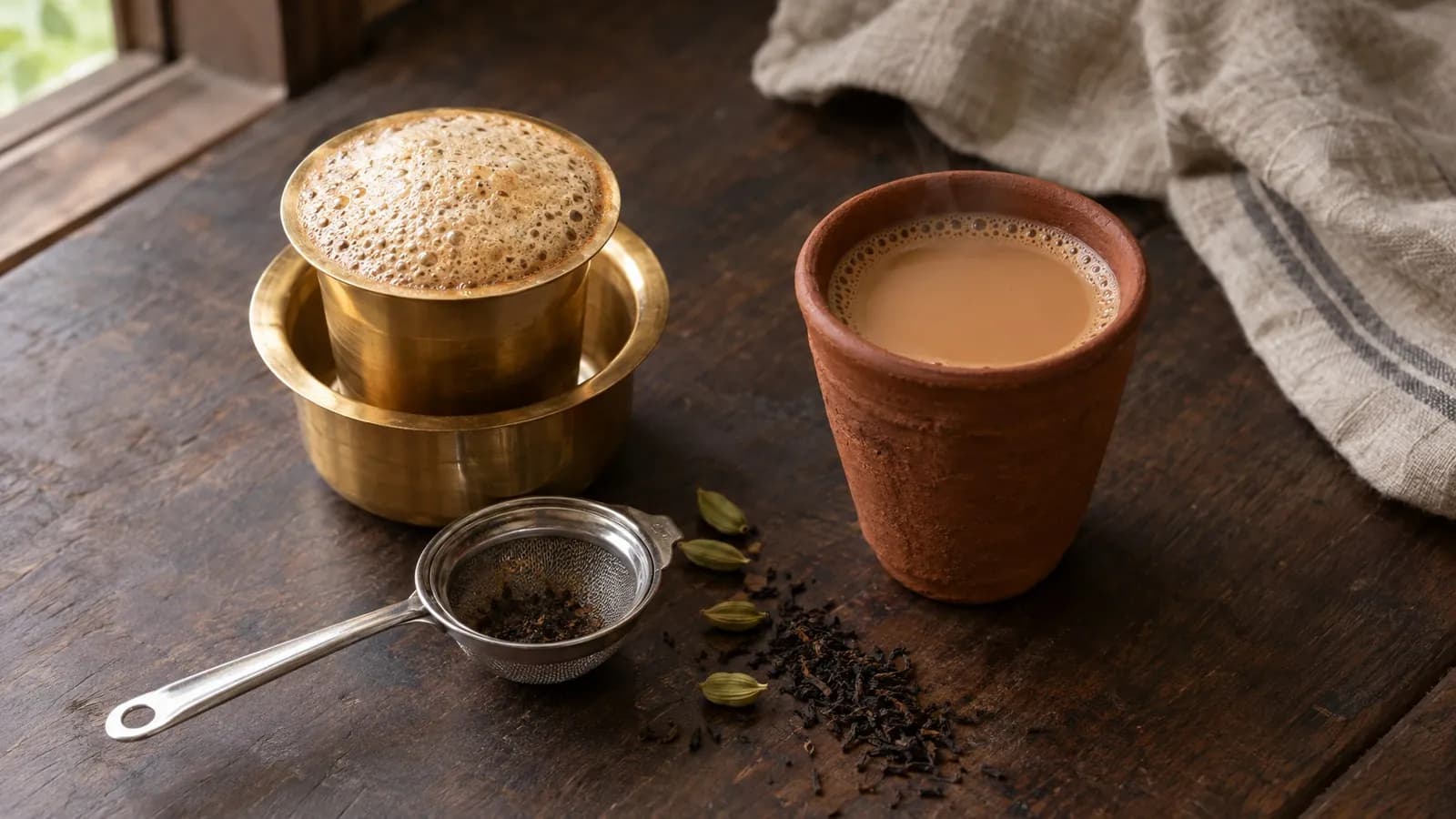
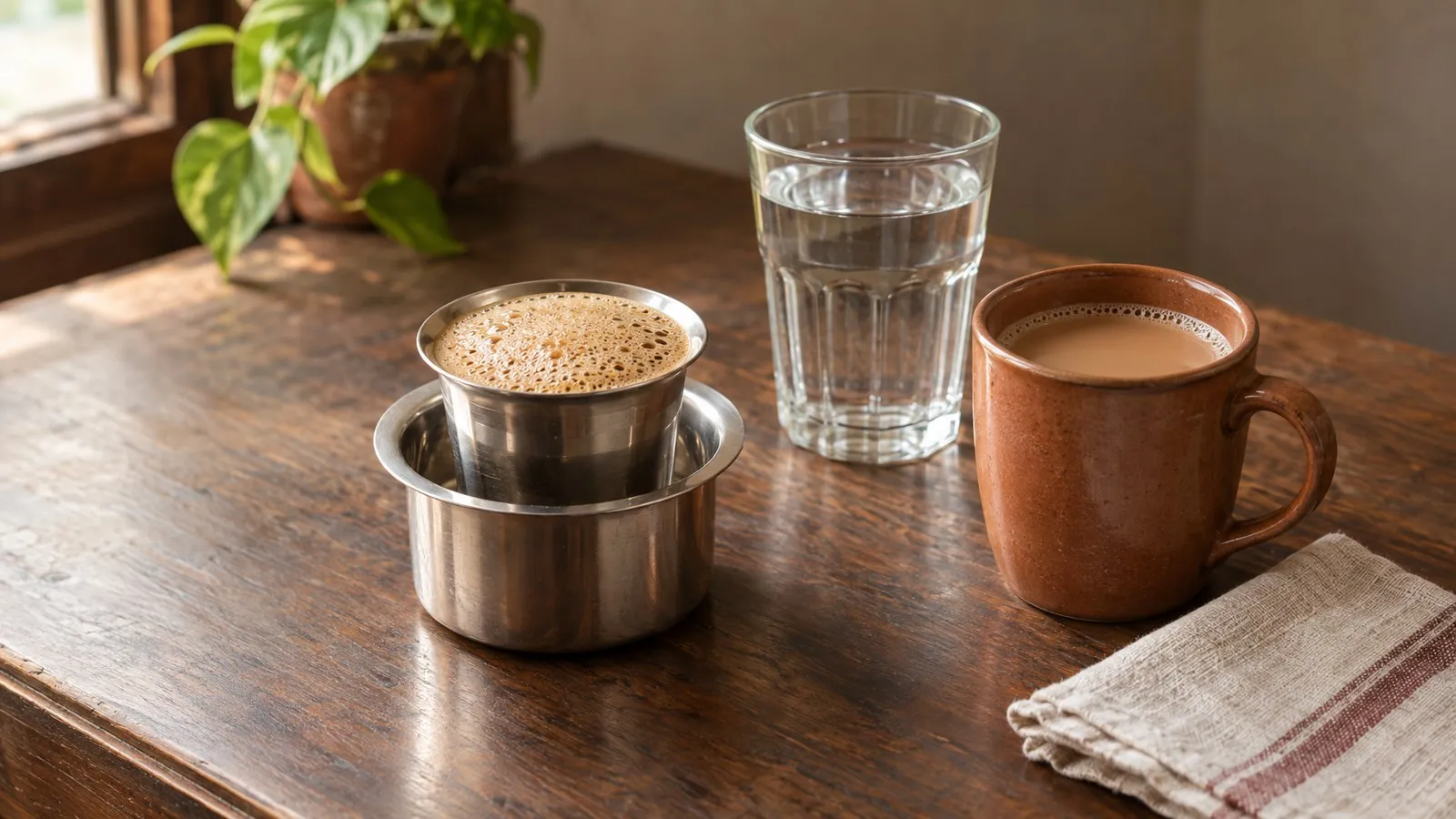
Every brewing method is the same idea with a different tool: hot water meeting ground coffee, and the liquid then separated from the grounds. The South Indian filter drips hot water slowly through a fine grind to make a strong decoction, which is stretched with hot milk and served as the milky kaapi in a tumbler and davara bowl. A French press steeps the coffee and then presses the grounds down, a moka pot drives steam through the coffee under pressure, and instant coffee simply dissolves in hot water, with no brewing step at all.
Which cup to pick depends on time, gear and taste rather than nutrition, since the figures are the same for beans and powder alike. The how filter coffee is made page gives the decoction, the milk ratio and the serving, and the coffee how to make page covers the everyday methods. The filter coffee vs instant coffee page compares the two main Indian choices, what is filter coffee explains the drink itself, and the coffee powder vs beans page sorts the whole-bean question.
How to store coffee
Roasted coffee loses its aroma to air, warmth, light and damp, so storage decides how much of the roast survives to the cup. The rule is a sealed jar or tin kept somewhere cool and dry, out of sunlight and away from the stove, closed again after every use, and amounts small enough to finish while the coffee still smells.
Dry coffee does not belong in the fridge: the air inside it is damp and full of food smells, and both stick to the powder. A smaller jar beats a large one, since less air sits above the powder between brews. COWBERRY's beans are sealed immediately after roasting, and its powder is ground immediately after roasting, so the pack itself does the storing until it is opened. The coffee powder how to store page covers containers, the fridge question and the signs of coffee past its best.
How to buy coffee
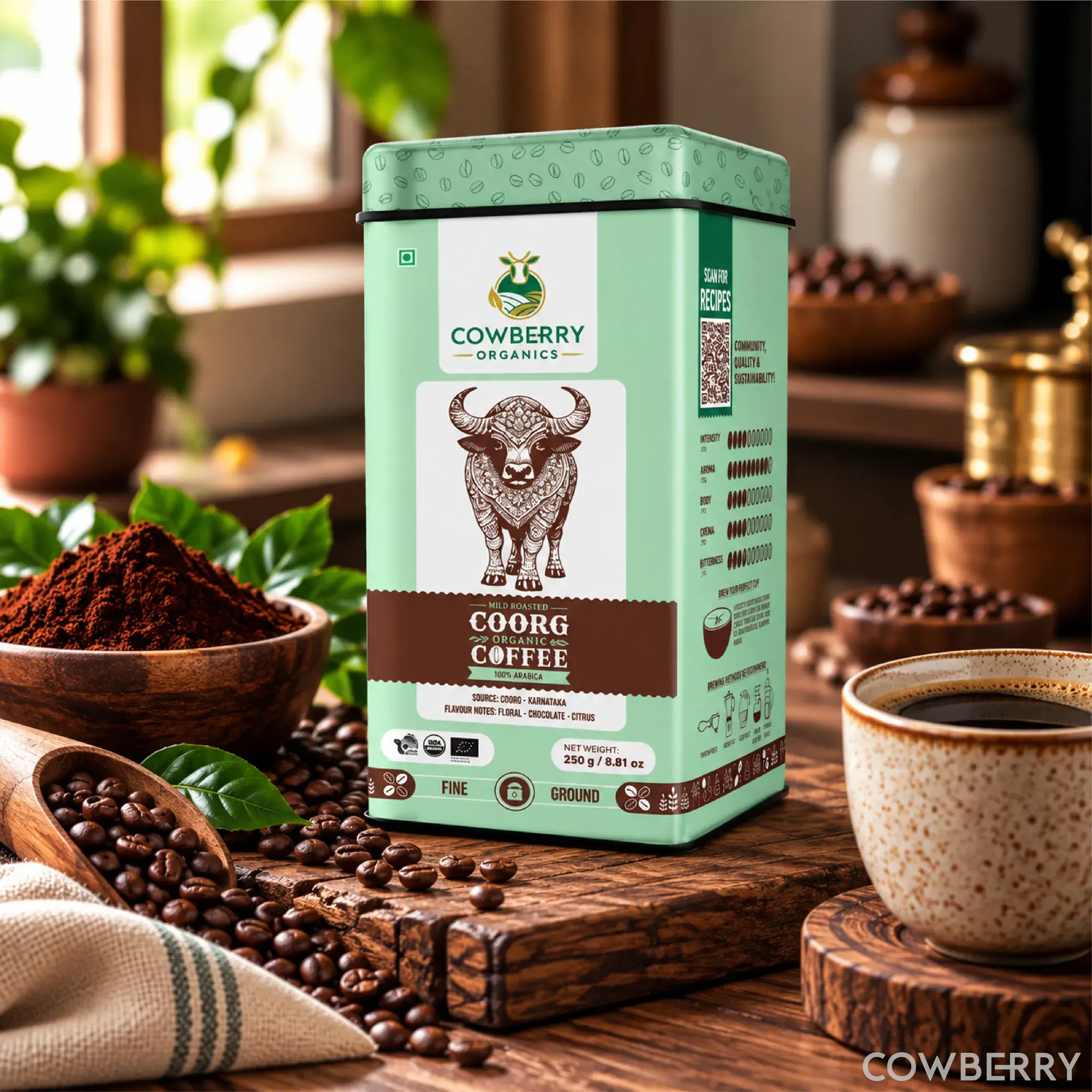
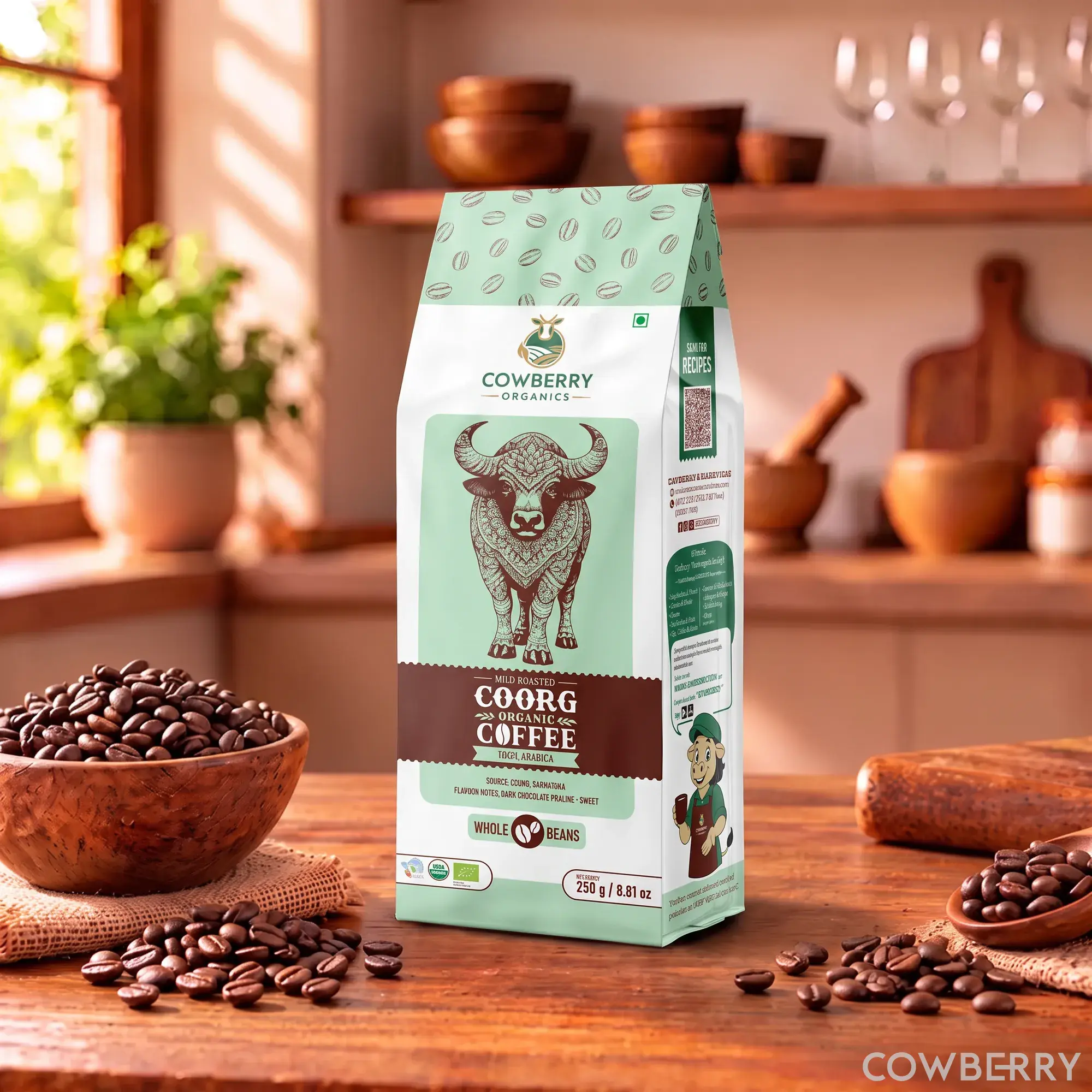
Buy the form that matches how you brew: powder for the filter and quick cups, whole beans if you own a grinder and want the freshest grind. Check the pack for 100% coffee with nothing added. COWBERRY's coffee powder and coffee beans are 100% Arabica from Coorg, Karnataka, mild roasted in small batches, with no chicory, preservatives or additives, and carry the line India Organic, USDA & EU certified; the powder comes ground fine, right for a French press, moka pot, drip machine or pour-over.
Freshness is the quality you taste in the cup, and the pack sealed right after roasting is what protects it. If you are choosing between the two drinks themselves, the coffee vs tea page lays out the comparison, and the product cards below are this site's two coffee picks.
FAQs
What is coffee?
Coffee is the roasted seed of the coffee cherry, and the drink made by brewing the ground seed in hot water. The cherries are handpicked at peak ripeness, washed and sun-dried, then the beans are roasted in small batches, which is where the aroma arrives. Coffee is the pit inside that fruit, saved, roasted and ground. In India the coffee sold on this site is 100% Arabica from Coorg, Karnataka, packed whole or ground.
What is coffee powder?
Coffee powder is roasted coffee, ground fine and ready to brew, the everyday form in many Indian kitchens. COWBERRY's powder is 100% Arabica grown in Coorg, Karnataka, roasted mild in small batches and ground right after the roast, with no chicory or additives. The composition tables carry values only for dry instant powder, and that is the form the figures describe.
Does coffee powder expire?
Coffee powder does go stale: air, warmth, light and damp flatten its aroma, so the storage rule is an airtight container in a cool, dry place away from heat and sunlight. Ground coffee takes up air and smells faster than the whole bean, which is why the airtight jar matters more for powder. A powder with no scent left in the jar has gone past its best.
Is coffee good for health?
On balance the published evidence leans positive. In 2017 the BMJ published an umbrella review: 201 pooled meta-analyses from observational research, plus 17 interventional ones, and its reading was benefit more often than harm, with the clearest risk reductions around three to four cups a day set against none, though the findings are associations, not cause. The pregnancy exception sits on its own page.
Which coffee beans are best?
The big studies pool coffee drinking across countries and settings, so no single bean is crowned best; choose by form and freshness: buy 100% Arabica, whole beans if you have a grinder, sealed immediately after roasting, and grind only what each brew needs. COWBERRY's beans are 100% Arabica from Coorg, Karnataka, mild roasted in small batches, with no additives.
What is filter coffee?
Filter coffee in India is the milky South Indian cup: a strong decoction brewed in a two-tier steel filter from fine-ground roasted coffee, stretched with hot milk and served in a tumbler with a davara bowl. Its caffeine runs at the higher end, since a 150 ml brewed cup holds 80-120 mg and filter coffee can carry more than instant.
References
- USDA FoodData Central
- Poole R, Kennedy OJ, Roderick P et al. Coffee consumption and health: umbrella review of meta-analyses of multiple health outcomes. BMJ, 2017
- Wikoff D, Welsh BT, Henderson R et al. Systematic review of the potential adverse effects of caffeine consumption in healthy adults, pregnant women, adolescents, and children. Food Chem Toxicol, 2017
- NHS: foods to avoid in pregnancy (caffeine section)
- Dietary Guidelines for Indians, ICMR-National Institute of Nutrition
Shop this article
Keep reading
Coffee vs tea: caffeine, benefits and which is better
Coffee calories per 100g: powder, beans and filter coffee
Coffee in pregnancy: how much caffeine is safe