by COWBERRY

6 minute read
Filter coffee: how to make the decoction, milk ratio and serving

Filter coffee how to make at home? The answer is a two-part metal filter, coffee powder, boiling water and patience: the water drips through into a dark decoction, which is then mixed with hot milk and sugar and poured between a tumbler and its bowl. Steps, drip timings, the milk ratio and the serving are below. The coffee guide has the drink's story and nutrition.
Short answer: filter coffee how to make
Filter coffee how to make in short: a two-part metal filter turns coffee powder and boiling water into a strong decoction by slow dripping; that decoction is then mixed with hot milk and sugar and poured between a tumbler and its bowl before drinking. There is no machine, no pressure and no whisk. The decoction is the whole secret, and it takes only patience. Full steps, the drip timing and the milk ratio follow. The coffee guide has the drink itself.
How to make filter coffee with a coffee filter
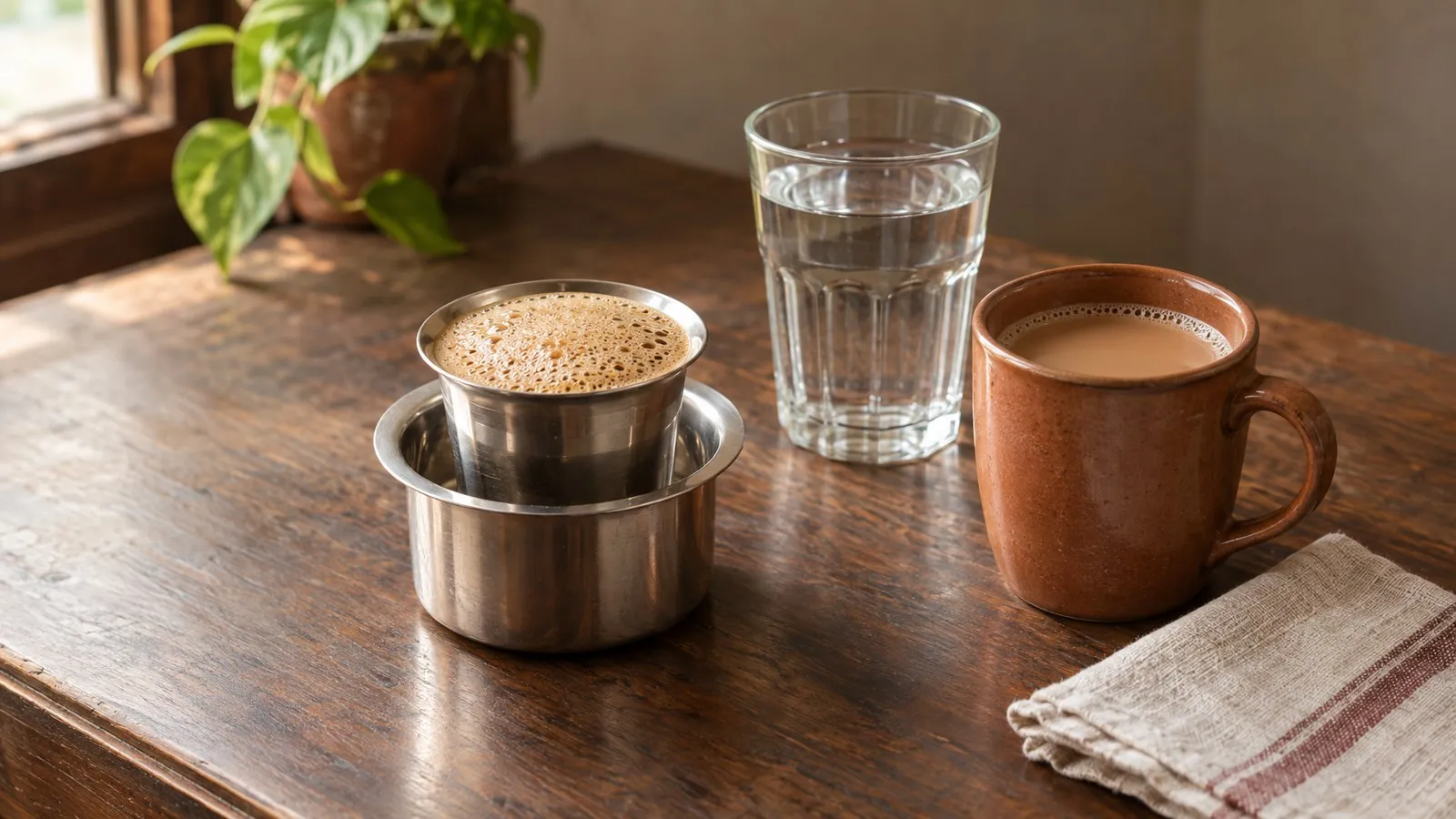
The traditional tool is the South Indian two-part filter: a perforated upper cup that sits on a lower chamber, with a pressing disc and a lid. What follows works with any percolating coffee filter of the same design.
- Assemble the filter dry. Seat the upper cup on the lower chamber and keep the lid off for now.
- Measure the powder. Three heaped tablespoons of coffee powder (about 30 g) go into the upper cup; the powder is fine ground, which suits this filter.
- Press it level. Set the pressing disc on the powder and press down gently; a light, even press is enough, a hard one stalls the drip.
- Pour boiling water over. About 200 ml of boiling water, poured slowly over the disc, is right for that amount of powder; a first splash to wet the powder, then the rest.
- Cover and wait. Put the lid on and leave the filter alone; the decoction drips through into the lower chamber in about 15 minutes.
- Lift off the upper cup. The dark liquid below is the decoction, strong and ready to mix with milk.
Filter coffee recipe: milk ratio and sugar
The filter coffee recipe is two parts: decoction first, then the mix. The usual milk to decoction ratio is one part decoction to two parts hot milk, which gives the classic strength; take it to one to one for a stronger cup or one to three for a lighter one. Heat the milk to a simmer, not a rolling boil, and add the sugar to the decoction, not to the milk, so it dissolves fully. Pour the hot milk into the decoction and stir once. Drink the coffee while it is hot; decoction that sits for hours goes flat, and reheating it makes it bitter.
Serving: the tumbler and the bowl
Filter coffee is served in a small steel tumbler set inside a wide steel bowl, and the bowl is part of the method, not just a saucer. The mixed coffee is passed from the tumbler into the bowl and back a few times; the wide, shallow bowl cools the drink quickly and mixes the milk through it. The last pass lands in the tumbler, and the bowl catches any drips on the way to the table. For the drink's story and its names, see what is filter coffee.
Common mistakes (and fixes)
- Packing the powder hard. A hard press clogs the holes and the drip stalls; press lightly and evenly, and the drip runs on its own.
- Tepid water. The filter needs boiling water; warm water under-extracts and leaves the decoction thin and pale.
- Opening early. Moving or opening the filter mid-drip disturbs the bed of powder and weakens the decoction; let it finish on its own.
- Reheating decoction. Reheating turns the decoction bitter; brew fresh and mix with hot milk instead.
- Weak or strong milk ratio. One part decoction to two parts milk is the balanced middle; adjust only after tasting.
- Old powder. Powder that has sat open goes flat; coffee powder how to store covers the airtight container and the fridge.
Time and quantity table
The numbers are for the two-part steel filter; the drip time is the figure that matters, and the ratio is the one worth remembering.
| Step | Time or quantity |
|---|---|
| Powder | 3 heaped tablespoons (about 30 g) in the upper cup |
| Water | About 200 ml, boiling, poured over the pressing disc |
| Drip | About 15 minutes, without opening or moving the filter |
| Decoction | Strong, dark, collected in the lower chamber |
| Milk | Two parts hot milk per one part decoction |
| Sugar | To taste, stirred into the decoction |
| Serve | Passed between tumbler and bowl, then drunk hot |
Once the filter is rinsed and dried, the same powder also makes plain brewed coffee; coffee how to make has the pot method and the french press.
FAQs
Why filter coffee is served with bowl?
Filter coffee is served with a bowl because the wide steel bowl is both the saucer and the cooler: the hot coffee is passed between the tumbler and the bowl a few times, which cools the drink and mixes the milk through it, and the bowl catches any drips. The coffee is drunk from the tumbler.
Does filter coffee have caffeine?
Yes, the decoction is brewed coffee, so filter coffee has caffeine: the Dietary Guidelines for Indians count 80-120 mg in a 150 ml cup of brewed coffee, and NHS guidance adds that filter coffee can carry more than a mug of instant coffee's 100 mg. In pregnancy the NHS cap is 200 mg of caffeine a day; more is on coffee in pregnancy.
How to drink filter coffee?
Mix the decoction with hot milk and sugar: one part decoction to two parts hot milk is the usual ratio, with sugar to taste, stirred into the decoction first. Pass the mix from the tumbler into the bowl and back a few times to cool and blend it, then drink from the tumbler while it is hot.
Is filter coffee good for health?
For most healthy adults, filter coffee looks to do more good than harm: an umbrella review in the BMJ found three to four cups a day, versus none, associated with a relative risk of 0.83 for death from any cause, 0.81 for death from cardiovascular disease and 0.85 for cardiovascular disease, and high versus low consumption associated with a relative risk of 0.82 for incident cancer. These are associations from observational studies, not proof of cause.
References
Shop this article
Keep reading
Coffee vs tea: caffeine, benefits and which is better
Coffee calories per 100g: powder, beans and filter coffee
Coffee in pregnancy: how much caffeine is safe