by COWBERRY

11 minute read
Urad dal (black gram): names, nutrition, benefits and how to cook it

Urad dal is black gram, the small black bean that Indian kitchens split for dal and grind into idli, dosa and vada batter. Per 100 g of the dry dal, IFCT 2017 records 324 kcal with 23.06 g of protein and 11.93 g of fibre. Sold whole, black split or white split, it has many Indian names and many more dishes; soaking, cooking and storing notes follow.
What is urad dal? Whole black gram, black split and white split
Urad dal is the split seed of black gram, a small bean with a black seed coat and a cream-white interior. IFCT 2017 names the food "Black gram, dal" and gives the botanical name Phaseolus mungo; the names table below uses the current name, Vigna mungo. Black gram is a staple pulse in many parts of India.
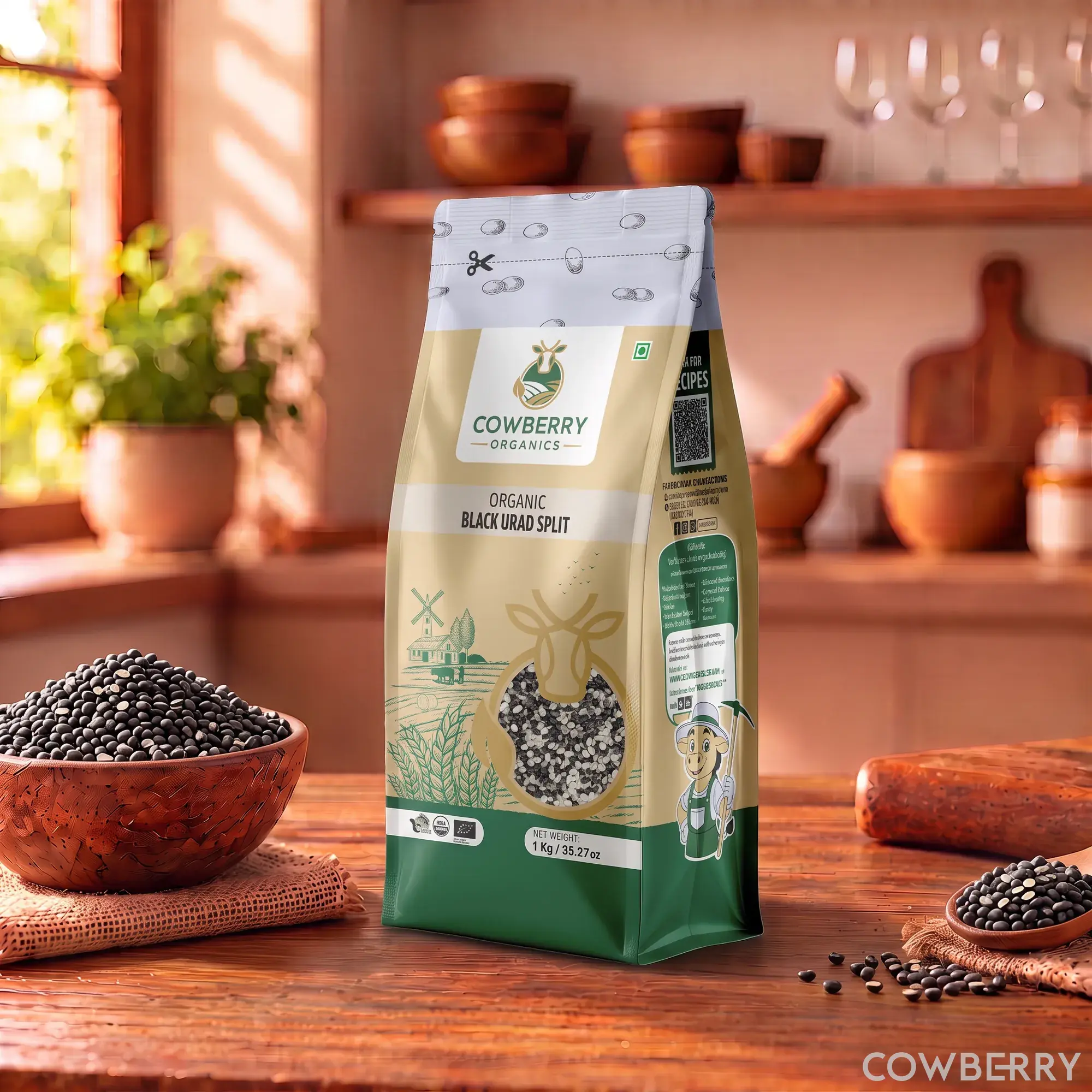
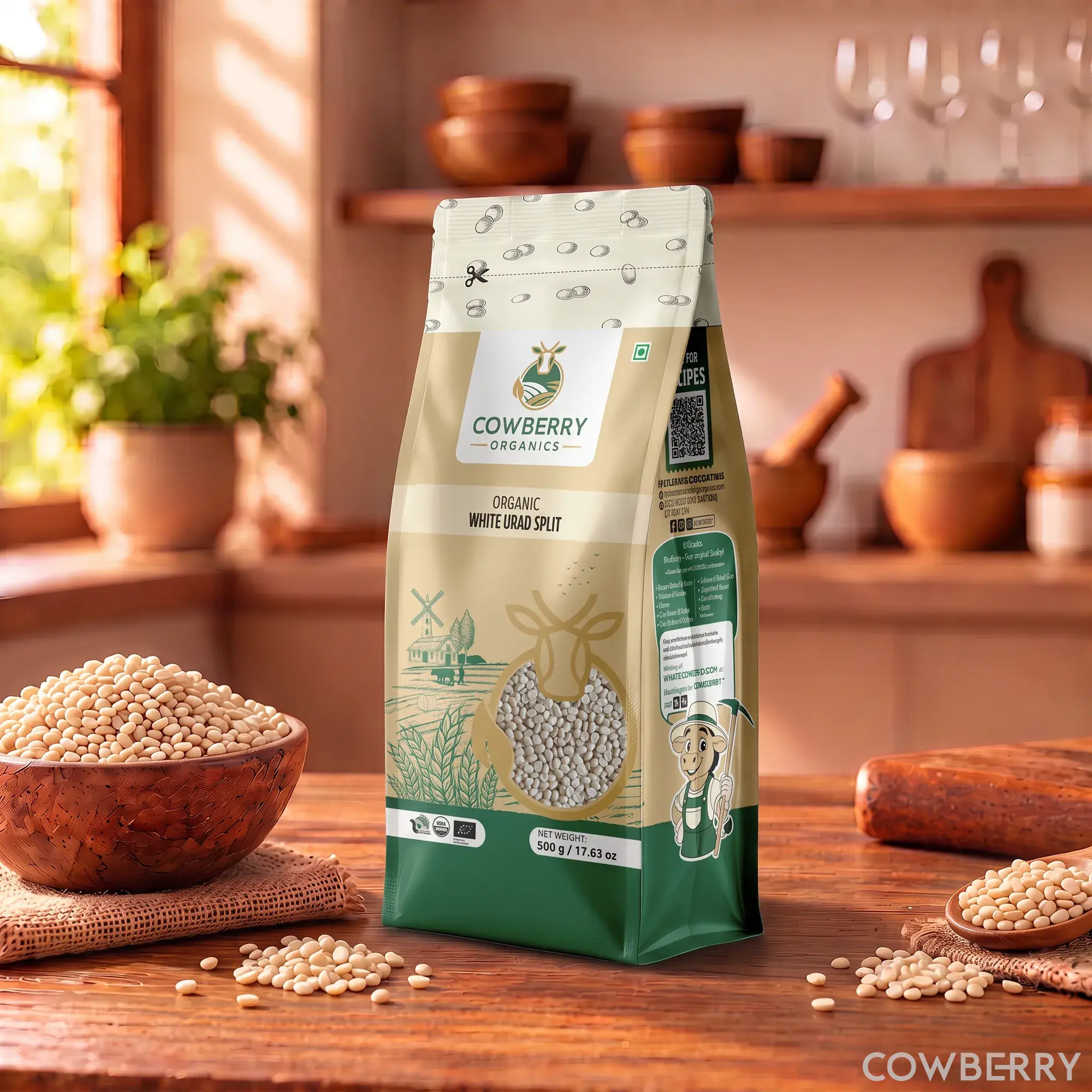
The same bean is sold in several forms. Whole black gram (sabut urad) is the bean with its skin on. Black urad split keeps the skin on the split halves, and COWBERRY's product page gives the black split an earthy flavour and aroma; the split is processed with no water, oil or leather polishing. White urad split is the same bean, skinned by COWBERRY's natural mechanical process to show the creamy white interior. Urad gota is a further form, the whole bean skinned but not split; no separate figures for gota are given, so the dal's figures are the nearest guide. Whole, black split and white split are laid out together in the whole urad dal guide, and the urad gota vs urad dal page compares gota beside the dal.
Urad dal names in Indian languages
Urad dal goes by many names, and the common searches run the other way — "minapappu in English" or "ulutham paruppu in English" — because the English answer is the same: black gram dal. Hindi says urad dal, which the IFCT 2017 list writes as urd dal; Tamil has ulutham paruppu, Telugu minapapappu, Kannada uddhina bele and Malayalam uzhunnu parippu. Punjabi calls it maa ki daal and Bengali biulir dal, while Odia adds birri dali, Urdu mash ki dal and Sanskrit maassa. The table below is the full IFCT 2017 list, with the everyday spellings added as notes; the English name, the botanical name and the look-alikes are walked through on the urad dal names in English, Hindi and other Indian languages page.
| Language | Name (romanised) |
|---|---|
| English | Black gram, dal |
| Hindi | Urd dal, Urad dal |
| Marathi | Uddachi dal, Udid |
| Gujarati | Aadad ni daad, Adad ni dal |
| Punjabi | Maa ki daal |
| Bengali | Biulir dal, Mash kalai |
| Odia | Birri dali |
| Assamese | Matir dail phola, Matimah |
| Kannada | Uddhina bele, Uddina bele, Uddu |
| Telugu | Minapapappu, Minapappu, Minumulu |
| Tamil | Ulutham paruppu, Ulundu |
| Malayalam | Uzhunnu parippu, Uzhunnu |
| Urdu | Mash ki dal |
| Sanskrit | Maassa |
| Botanical name | Vigna mungo |
Source: IFCT 2017 (ICMR-NIN) local-names list. — means no name recorded in the source.
Hindi ‘Urad dal’: spelling variant of the IFCT 2017 name ‘Urd dal’. Marathi ‘Udid’: Wikipedia: Vigna mungo. Gujarati ‘Adad ni dal’: spelling variant of the IFCT 2017 name ‘Aadad ni daad’. Bengali ‘Mash kalai’: Wikipedia: Vigna mungo. Assamese ‘Matimah’: Wikipedia: Vigna mungo. Kannada ‘Uddina bele’: spelling variant of the IFCT 2017 name ‘Uddhina bele’. Kannada ‘Uddu’: Wikipedia: Vigna mungo. Telugu ‘Minapappu’: spelling variant of the IFCT 2017 name ‘Minapapappu’. Telugu ‘Minumulu’: Wikipedia: Vigna mungo. Tamil ‘Ulundu’: Wikipedia: Vigna mungo. Malayalam ‘Uzhunnu’: Wikipedia: Vigna mungo. Botanical name: IFCT 2017 prints ‘Phaseolus mungo’; ‘Vigna mungo’ per Wikipedia: Vigna mungo.
Urad dal nutrition per 100 g
Per 100 g of raw dal, IFCT 2017 records 324 kcal, 23.06 g of protein, 1.69 g of fat, 51.00 g of carbohydrate and 11.93 g of fibre. The mineral column holds 4.67 mg of iron, 55.67 mg of calcium, 173 mg of magnesium, 1157 mg of potassium and 3.00 mg of zinc, with 88.75 mcg of folate; no vitamin C value is reported. These figures describe "Black gram, dal", the split dal, not the whole bean.
Urad's glycemic index is 43: a single India-tested entry in the University of Sydney GI database for plain black gram, and the entry does not say whether the dal tested was split or whole. On the Sydney scale, 55 and below counts as low, so 43 sits in the low band.
In the kitchen, a katori of cooked dal starts from 30 g of dry urad and works out to about 97 kcal, 6.9 g of protein and 3.6 g of fibre. Per-serving sums for batters and dishes, and how urad stands beside other dals, are on the urad dal nutrition per 100 g page.
| Nutrient | Black gram dal (urad), raw |
|---|---|
| Energy (kcal) | 324 |
| Protein (g) | 23 |
| Fat (g) | 1.7 |
| Carbohydrates (g) | 51 |
| Dietary fibre (g) | 12 |
| Iron (mg) | 4.7 |
| Calcium (mg) | 56 |
| Magnesium (mg) | 173 |
| Potassium (mg) | 1157 |
| Sodium (mg) | 19 |
| Zinc (mg) | 3 |
| Folate (mcg) | 89 |
| Glycemic index (GI) | 43 |
Per 100 g raw, edible portion. Composition: IFCT 2017 (ICMR-NIN). GI: University of Sydney GI database. — means not reported. These are average values for the food; the label on a pack gives the values for that product.
Benefits of urad dal
A 2014 review of pulses sums up what the family brings: protein and fibre, with iron, zinc, folate and magnesium, and it notes that half a cup of beans or peas daily can enhance diet quality. ICMR-NIN puts the fibre part in its own words — fibre holds back the absorption of carbohydrates and fats and adds to the satiety value of food — and its guideline adds that cereals combined with pulses at roughly three parts to one part, by raw food weight, can meet the requirement of all the essential amino acids.
Benefit by benefit, each with its number, is on the urad dal benefits page, and the same story in Hindi is on urad dal ke fayde aur nuksan. What the low GI and the katori's grams mean for a diabetes plate is worked out on the urad dal for diabetes page, and the urad dal for weight loss page does the same for the lighter plate. For scale, ICMR-NIN's vegetarian My Plate allots 85 g of pulses for the day, close to three katoris of cooked dal at 30 g of dry dal each. If your meals follow a medical plan, talk to your doctor or dietitian before changing them.
Side effects: gas, heaviness and who should limit urad dal
Many people eat urad dal without trouble, but pulses are not comfortable for everyone. A 2019 review notes that many individuals have an adverse response to pulses, with intestinal discomfort — the heaviness some people feel after a dal meal — and increased flatulence. The usual explanation points to galacto-oligosaccharides in pulses, which pass undigested to the colon and ferment there with the release of gas; whether that is the whole story has recently been questioned, and how much gas any one person gets appears to be influenced in part by heritable factors.
Two life stages get their own pages: urad dal in pregnancy reads the cooking rules and the 80 g of pulses a day that ICMR-NIN's pregnancy food guide suggests, and urad dal for babies starts at six months, cooked soft and mashed. The guidelines set no separate upper limit for urad; how much a person can eat comfortably is individual. A baby's feeding plan is the paediatrician's call, and the urad dal benefits and side effects page holds the full picture, gas included.
How to cook and use urad dal
Every urad dish starts with the same soak: cover the dal with plenty of clean water and leave it overnight, about 12 hours, at room temperature. The ICMR-NIN guidance on pulses carries over from there — wash the dal well, but not repeatedly, then boil or pressure-cook it, the way the guidelines say a pulse's nutritional quality improves most. A 2019 review adds that it found no evidence that properly cooked pulses contain harmful lectins or trypsin inhibitors, and fermentation, along with soaking, is on ICMR-NIN's list of practices that improve digestibility.
After the soak, the grind decides the dish. For the batters, COWBERRY points to the white split — idli, dosa and vada — ground with rice and fermented for idli and dosa, or thick and seasoned for vadas. Black urad split is also listed for idli and dosa batter, skin and all. Dal makhani pairs black urad split with rajma, both soaked overnight, about 12 hours, before the slow simmer, and plain dal and khichdi begin from the same soaked dal, while the porridge and the laddu skip the soak and roast the dry dal first. In a hurry, the quick soak on the how to soak urad dal page uses hot water and a texture test rather than a set time.
How to store urad dal
Dry urad dal sits in an airtight container somewhere cool and dry; both COWBERRY product pages say so, with "away from direct sunlight" on the black split's page. Keep the lid closed between uses and buy in a size the kitchen will cook through. Soaked dal also goes into the fridge, drained and covered, and is used soon; judge it by smell before cooking.
Cooked dal follows the UK Food Standards Agency's rule for leftovers: cool it, refrigerate it, and eat it within two days. Leftover khichdi and dal from the recipes below get the same two days.
Urad dal recipes to start with
The urad dal recipes roundup collects every dish, grouped by meal. These nine have pages of their own, from the overnight batter to the slow-cooked dal:
- Dahi vada: fried urad vadas softened in water and rested in cool, spiced curd.
- Thatte idli: Karnataka's plate-sized idli, steamed thick and served whole.
- Idli with urad dal and rice: the classic 1:3 batter, fermented and steamed into soft idlis.
- Urad dal dosa: the same batter spread thin and cooked crisp on the tawa.
- Urad dal vada (medu vada): thick-ground dal fried into vadas with the hole in the middle.
- Dal makhani: black urad split with rajma, simmered long into the creamy black dal.
- Urad dal laddu: roasted urad flour bound with jaggery and ghee into soft sweets.
- Urad dal khichdi: black urad and rice cooked soft with a ghee tempering, the Makar Sankranti bowl.
- Urad dal porridge (kanji): roasted urad flour simmered into a warm, thick breakfast bowl.
Breakfast gets the idli and dosa pages, lunch and dinner the khichdi and dal makhani, snack time the vadas, and a sweet or a warm bowl the laddu and the porridge.
How to buy urad dal: what to read on the pack
Read the form on the pack first: whole black gram, black urad split, white urad split or gota — the label decides the dish. COWBERRY's black urad split keeps the original skin on, processed with no water, oil or leather polishing; the white split is the same bean, skinned by a natural mechanical process. Both splits are naturally gluten-free.
COWBERRY's urad is grown on organic, cow-based farms in Central India, and both splits are India Organic, USDA & EU certified. Pack sizes and the printed nutrition label sit on the Organic Black Urad Split page and the Organic White Urad Split page. Wherever you shop, pick the form your recipes name and keep the dal airtight and dry once it is home.
FAQs
What is urad dal?
Urad dal is the split seed of black gram, the name IFCT 2017 gives the food: "Black gram, dal". Split with its black skin kept on, it is black urad; with the skin removed to show the creamy white interior, it is white urad. Whole black gram and urad gota are further forms of the same bean.
Is black gram urad dal?
Yes. Black gram is the English name for urad, and urad dal is its split seed, so the two names point at one pulse. The unsplit bean is sold as whole black gram, and the split forms as black urad (skin on) or white urad (skin off). Every regional name is on the urad dal names page.
Which urad dal is used for idli?
White urad split is the one the site's idli recipe uses: it grinds 100 g of it with 300 g of rice into the 1:3 batter, and COWBERRY names the white split for South Indian idlis, dosas and vadas. Black urad split, skin kept on, is listed for idli batter as well, and steams into a speckled idli.
Is urad dal gluten free?
Yes. Urad dal has no gluten of its own: COWBERRY describes both its urad splits as naturally gluten-free, and the idli and dosa batters on this site pair the dal with rice. The laddu and the porridge on this site are urad-based too. For anything served or stirred in beside the dal, read that pack's own label.
Why urad dal is not good for health?
The dal itself is not unhealthy; the question usually means the gas question. A 2019 review notes that pulses can bring intestinal discomfort and increased flatulence, while adding that the usual sugar explanation has recently been questioned. Cook the dal fully, and let a doctor judge pain that persists.
Can urad dal cause stomach pain?
It can, for some people. A 2019 review describes intestinal discomfort and increased flatulence as the response many individuals have to pulses, and notes that how much gas a person gets varies. If the pain keeps coming back, see a doctor.
What is urad dal used for?
For plain dal and the classic batters: urad is the dal behind idli, dosa and vada, and it cooks into dal makhani with rajma, khichdi, laddu and kanji porridge. The nine dishes with their own pages are listed above, and the urad dal recipes roundup groups the rest by meal.
References
- Indian Food Composition Tables (IFCT) 2017, ICMR-National Institute of Nutrition
- Dietary Guidelines for Indians, ICMR-National Institute of Nutrition
- University of Sydney glycemic index database (GI search)
- University of Sydney: about the glycemic index
- Mudryj AN, Yu N, Aukema HM. Nutritional and health benefits of pulses. Appl Physiol Nutr Metab, 2014
- UK Food Standards Agency: How to chill, freeze and defrost food safely
- Thompson HJ. Improving human dietary choices through understanding of the tolerance and toxicity of pulse crop constituents. Curr Opin Food Sci, 2019
Shop this article
Keep reading
Green gram plant: crop, varieties and how it grows in India
Rajma vs lobia: difference, nutrition and which to choose
Rajma plant: how rajma is grown in India (it is not a tree)