by COWBERRY

10 minute read
Minapappu in English: urad dal (black gram) in Hindi, Tamil, Kannada

Minapappu in English is black gram dal: it is the Telugu word for urad dal, the split seed of Vigna mungo. The same dal is ulutham paruppu in Tamil, uddina bele in Kannada, uzhunnu parippu in Malayalam and urad or urd dal in Hindi. Below are the regional names, the four forms (whole, chilka, dhuli and gota) and which one to pick for idli, dosa or dal makhani.
Minapappu in English: the quick answer
Minapappu is urad dal. In English it is black gram dal, or split black gram, and IFCT 2017, the national food composition table, prints it as “Black gram, dal”. Telugu keeps two words for this pulse: minumulu for the whole black gram and minapa pappu for the split dal, since pappu means dal. Minapappu is the everyday spelling; the IFCT list writes it as one word, minapapappu.
The table carries the name in each language the way IFCT 2017 prints it. Spellings that people type more often, such as urad dal, minapappu, uddina bele and adad ni dal, are added as spelling variants, and the names of the gram itself (minumulu, ulundu, uddu, uzhunnu, udid) come from a second source named under the table. If one line is all you need: minapappu (Telugu), ulutham paruppu (Tamil), uddina bele (Kannada), uzhunnu parippu (Malayalam), urad dal (Hindi), maa ki daal (Punjabi), biulir dal (Bengali) and adad ni dal (Gujarati) are the same dal in eight kitchens.
| Language | Name (romanised) |
|---|---|
| English | Black gram, dal |
| Hindi | Urd dal, Urad dal |
| Marathi | Uddachi dal, Udid |
| Gujarati | Aadad ni daad, Adad ni dal |
| Punjabi | Maa ki daal |
| Bengali | Biulir dal, Mash kalai |
| Odia | Birri dali |
| Assamese | Matir dail phola, Matimah |
| Kannada | Uddhina bele, Uddina bele, Uddu |
| Telugu | Minapapappu, Minapappu, Minumulu |
| Tamil | Ulutham paruppu, Ulundu |
| Malayalam | Uzhunnu parippu, Uzhunnu |
| Urdu | Mash ki dal |
| Sanskrit | Maassa |
| Botanical name | Vigna mungo |
Source: IFCT 2017 (ICMR-NIN) local-names list. — means no name recorded in the source.
Hindi ‘Urad dal’: spelling variant of the IFCT 2017 name ‘Urd dal’. Marathi ‘Udid’: Wikipedia: Vigna mungo. Gujarati ‘Adad ni dal’: spelling variant of the IFCT 2017 name ‘Aadad ni daad’. Bengali ‘Mash kalai’: Wikipedia: Vigna mungo. Assamese ‘Matimah’: Wikipedia: Vigna mungo. Kannada ‘Uddina bele’: spelling variant of the IFCT 2017 name ‘Uddhina bele’. Kannada ‘Uddu’: Wikipedia: Vigna mungo. Telugu ‘Minapappu’: spelling variant of the IFCT 2017 name ‘Minapapappu’. Telugu ‘Minumulu’: Wikipedia: Vigna mungo. Tamil ‘Ulundu’: Wikipedia: Vigna mungo. Malayalam ‘Uzhunnu’: Wikipedia: Vigna mungo. Botanical name: IFCT 2017 prints ‘Phaseolus mungo’; ‘Vigna mungo’ per Wikipedia: Vigna mungo.
Urad dal English name and botanical name
The urad dal English name is black gram. IFCT 2017 files four everyday pulses under the word gram, each with a colour or a place in front of it: urad is the black one, moong the green, toor the red, and chana is Bengal gram. The black in the name is the skin. Under it the seed is cream-white, so one pulse is sold as black urad with the skin on and as white urad once the skin is off. The skinned dal is also sold in some places as ivory white lentils, although urad is a bean and not a lentil.
The botanical name printed in IFCT 2017 is Phaseolus mungo, the older name. Black gram has since been moved from the genus Phaseolus to Vigna, together with its relative the green gram, so the name in use today is Vigna mungo; the note under the table above names the source. Mungo and mung are easy to mix up: Vigna mungo is urad and Vigna radiata is moong.
In food terms urad is a pulse. The FAO describes pulses as the legumes that are harvested for their dry seeds, and names beans of the Phaseolus and Vigna groups, chickpeas and peas as the best-known kinds. Black gram sits with the Vigna beans, next to moong and lobia.
Ulutham paruppu in English, uddina bele and the names by region
South India
Ulutham paruppu in English is black gram dal, which is urad dal. Tamil says ulundu for the gram and ulutham paruppu for the dal. Kannada says uddu and uddina bele, which IFCT spells uddhina bele. Malayalam says uzhunnu and uzhunnu parippu, and Telugu says minumulu and minapappu. In all four languages the second word (paruppu, bele, parippu, pappu) only means dal, so the first word is the one to remember.
West India
Marathi calls the gram udid and the dal uddachi dal. Gujarati calls it adad, and the split dal adad ni dal; IFCT romanises this as aadad ni daad.
North India
Hindi says urad dal, which IFCT writes as urd dal. Punjabi says maa ki daal, and the whole bean, sabut maa ki daal, is the one simmered for hours into the black dal of a Punjabi meal. Urdu has mash ki dal.
East India
Bengali has biulir dal and mash kalai, Odia has birri dali, and Assamese has matir dail phola, with matimah for the gram. The Sanskrit name in the IFCT list is maassa.
The name tables for toor, moong, chana and the whole pulses are on our page on types of dal.
Urad gota meaning, and the other forms: sabut, chilka and dhuli
One pulse reaches the shop in four forms, and recipes name the form, not the plant.
- Sabut urad (whole black gram): the whole bean with its black skin. This is the kaali dal of North Indian cooking.
- Urad chilka (split black urad): the bean split in two with the skin left on, black on the outside and white on the cut face.
- Urad dhuli (white urad dal): split and skinned. When a recipe says urad dal and nothing more, it means this one.
- Urad gota: gota means whole. Urad gota is the whole bean with the skin taken off but not split, so it looks like a small white bead.
The urad gota meaning matters mostly for batter: gota and dhuli are the same skinned urad, one whole and one split, and either can be soaked and ground. IFCT 2017 analyses the dal at 324 kcal, 23.06 g protein and 11.93 g fibre per 100 g raw, and lists whole black gram, skin on, as a separate entry with more fibre. How urad stands against toor, moong, chana and masoor is on dal protein per 100g.
Often confused with: black moong and kala chana
Black moong. Whole urad is sometimes described as black moong, because it looks like a moong bean in a black coat: the same small oblong shape, from the same genus. They are two different pulses. Moong is green gram (Vigna radiata in the IFCT list) and urad is black gram. Skinned and split, moong dal is yellow; urad dal is cream-white and goes sticky when it is ground. Moong has its own names page: hesaru bele in English.
Kala chana. Black gram and Bengal gram sound alike in English, and kala chana, the black chana, is sometimes translated as black gram by mistake. Kala chana is the small dark desi chickpea (Cicer arietinum), printed in IFCT 2017 as Bengal gram, whole. It is bigger than urad, brown more than black, and has the pointed beak of a chickpea. In English, black gram on a label means urad.
Kaali dal, maa ki dal, black dal. On a North Indian menu all three mean whole urad. Black dal is not a separate pulse.
Which urad dal for idli, dosa, dal makhani and papad
Idli and dosa: white urad, either dhuli or gota, is soaked, ground with soaked rice and left to ferment overnight. The ground urad is what makes the batter light. The Dietary Guidelines for Indians list fermentation, as in idli, dosa and dhokla, among the common practices of Indian cooking that improve digestibility and the bioavailability of micronutrients.
Medu vada and dahi vada: the same white urad, ground thick with very little water and fried.
Dal makhani and maa ki dal: whole black urad, soaked overnight and simmered slowly, often with a handful of rajma (kidney beans). Chilka urad gives a quicker everyday version.
Papad: urad flour is kneaded into a stiff dough, rolled thin and dried.
Tempering: a teaspoon of white urad dal fried golden in hot oil with mustard seeds gives the crunch in upma, lemon rice and coconut chutney, as in our jowar upma.
Where urad grows and how to buy it
Black gram is a pulse of Indian origin and is still a staple in many parts of the country. India is a major grower, and the crop is also raised in other South Asian countries. Like other pulses it fixes atmospheric nitrogen, which the FAO counts as a gain for soil fertility.
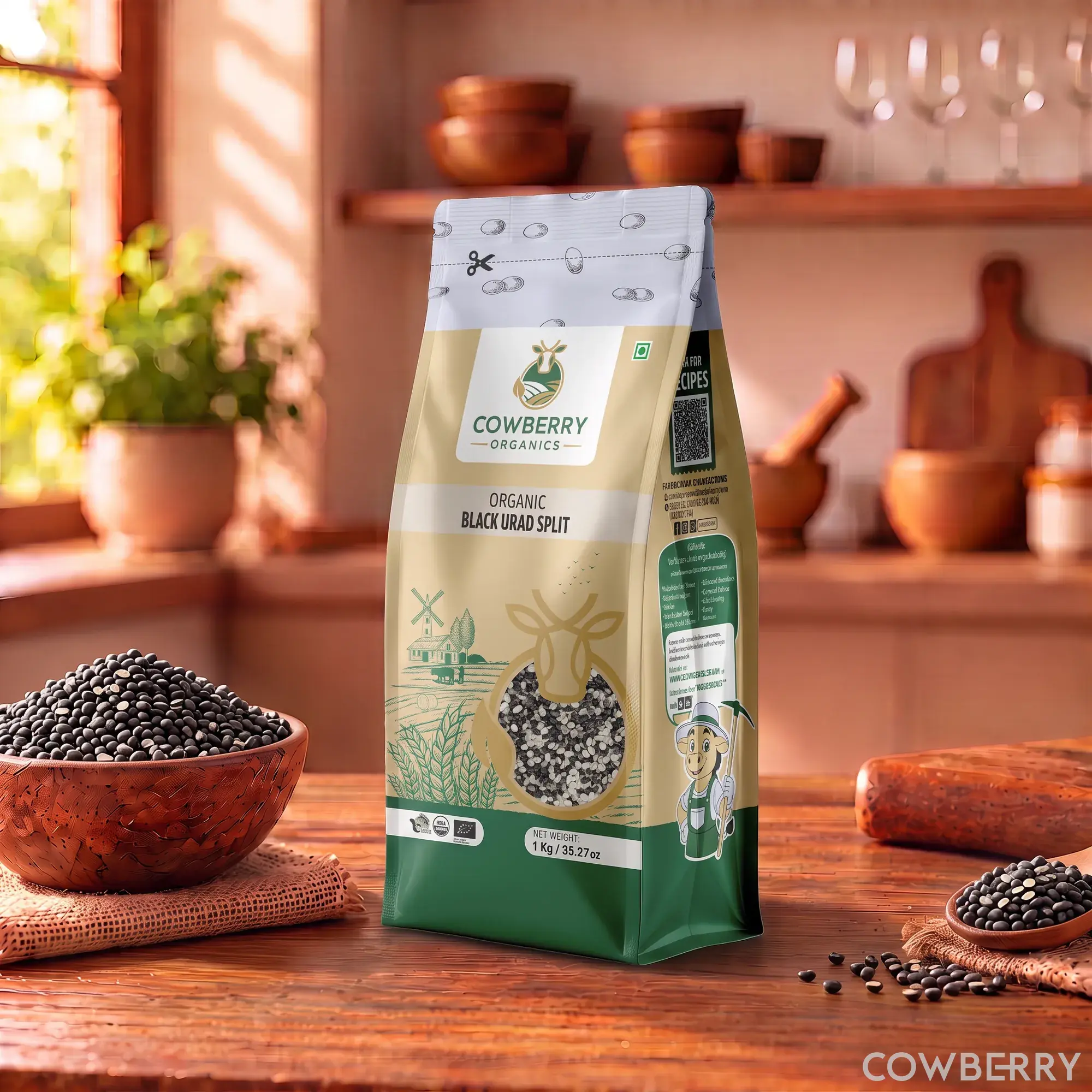
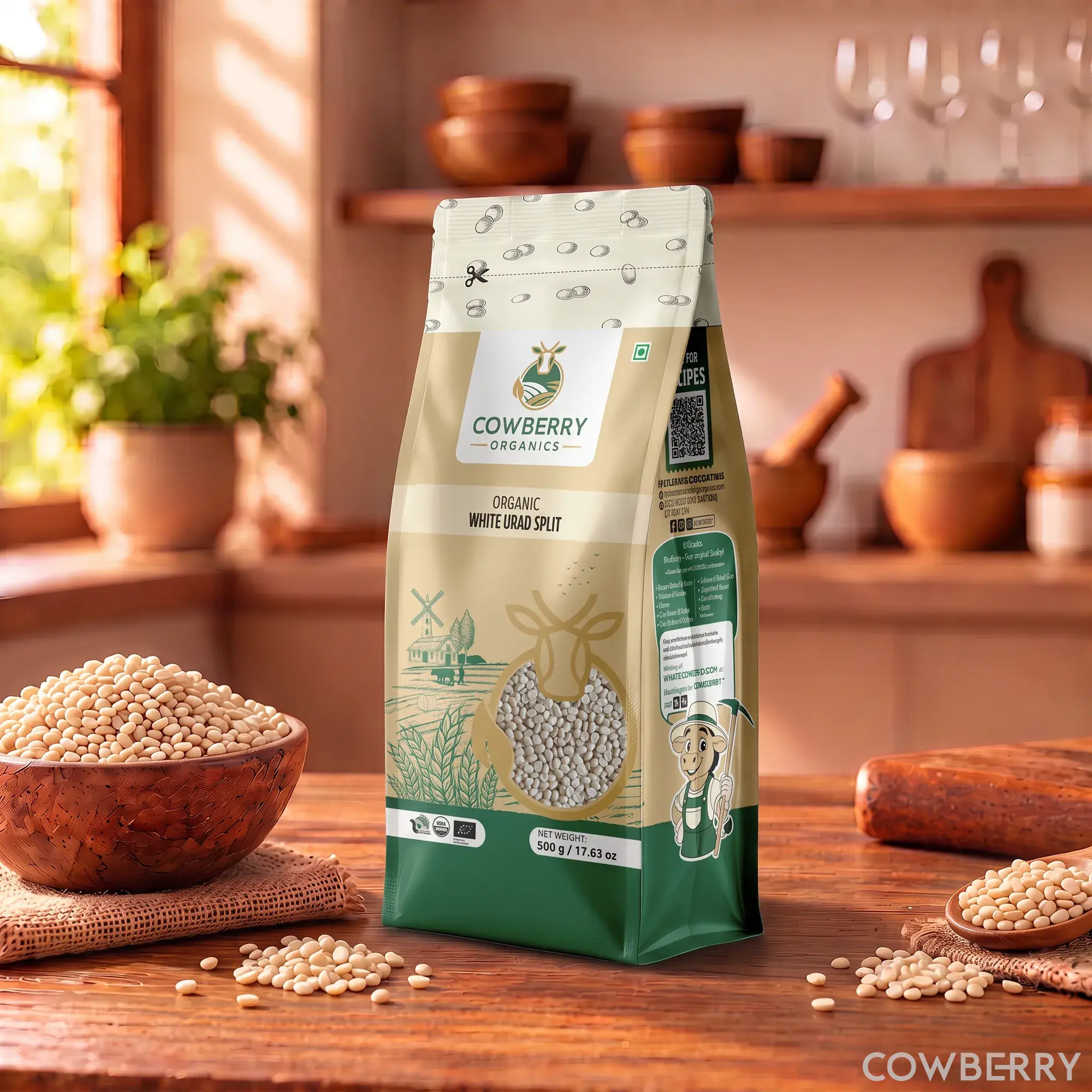
COWBERRY's urad comes from organic farms in Central India that follow cow-based farming, and it is sold in two forms. Organic black urad split is chilka urad, split with the skin left on. Organic white urad split is dhuli urad, skinned by a mechanical process. Neither is polished with water, oil or leather, and both are India Organic, USDA & EU certified.
Wherever you buy urad dal, read the form on the label first (whole, chilka, dhuli or gota) and then look at the dal itself: unpolished white urad has the creamy white colour of the skinned seed. At home it goes into an airtight jar kept cool and dry, which keeps the dal fresh.
FAQs
What is urad dal called in English?
Urad dal is called black gram dal, or split black gram, in English. IFCT 2017 prints it as “Black gram, dal” and the whole bean as “Black gram, whole”. The skinned white dal is also sold in some places as ivory white lentils, but it is a bean of the Vigna group and not a lentil.
Is black gram and urad dal same?
Yes. Black gram is the English name of the urad plant and its seed, and urad dal is that seed split, with the skin on (chilka) or off (dhuli). So every urad dal is black gram, while the whole black bean is called sabut urad or whole black gram instead of dal.
What is black gram in Hindi?
Black gram in Hindi is urad, written urd dal in the IFCT 2017 list. The whole bean is sabut urad, the split dal with its skin is urad chilka, and the skinned white dal is urad dhuli. Kala chana is a different pulse: it is Bengal gram, the dark desi chickpea.
Difference between urad dal and urad gota?
Both are skinned white urad. Urad dal (dhuli) is split into two halves, while urad gota is the whole bean with only the skin removed; gota means whole. They taste the same and either can be soaked and ground for idli, dosa or vada batter. Gota needs a little longer to soak because it is not split.
Which urad dal is used for dosa?
White urad, either dhuli (split) or gota (whole and skinned), is the urad used for dosa and idli batter. It is soaked for a few hours, ground smooth with soaked rice and fermented overnight. Chilka urad also works: rub off the loosened black skins after soaking, or leave them in for a darker, speckled batter.
What is ulutham paruppu in English?
Ulutham paruppu in English is urad dal, that is, black gram dal. Ulundu is the Tamil word for the gram and paruppu means dal. It is the same dal as minapappu in Telugu, uddina bele in Kannada and uzhunnu parippu in Malayalam, and it is the dal ground into idli and dosa batter.
References
Shop this article
Keep reading
Green gram plant: crop, varieties and how it grows in India
Rajma vs lobia: difference, nutrition and which to choose
Rajma plant: how rajma is grown in India (it is not a tree)