by COWBERRY

8 minute read
Urad dal for babies: when to start, how to prepare and what to avoid

Urad dal for babies is a food for after six months, cooked soft and mashed thick, never served as a thin, watery soup. WHO's complementary feeding guidance starts foods at six months of age, and ICMR-NIN's Dietary Guidelines name black gram among the pulses that can be a good source of protein for an infant. The wider story of the pulse is on the urad dal hub.
When can babies start urad dal?
The starting line is six months, not earlier. WHO recommends that infants begin complementary foods at six months of age, alongside breast milk, because that is when breast milk alone stops meeting a baby's need for energy and nutrients. ICMR-NIN's Dietary Guidelines follow the same line: during 6 to 8 months a breastfed child needs complementary feeds at least twice a day, and three or more feeds a day between 9 and 24 months. At about one year of age, the guidelines say, a child moves on to the family diet.
From six months, WHO says, infants can take pureed, mashed and semi-solid foods, so a mashed urad dal fits from the start of complementary feeding, provided it is cooked fully and mashed smooth. ICMR-NIN advises feeding a new food regularly for four to five consecutive days to establish acceptance and to reveal any intolerance or allergy; if the child refuses a food, offer it again after a few days. WHO's guidance also warns against foods served in a form a baby could choke on, naming whole grapes and raw carrots as examples, so serve urad only cooked soft and mashed, never as dry or half-cooked grains.
What urad dal gives a baby: protein, iron and folate
Per 100 g of dry dal, IFCT 2017 records 23.06 g of protein, 4.67 mg of iron, 88.75 mcg of folate, 3.00 mg of zinc and 11.93 g of fibre. A baby eats far less: ICMR-NIN's sample menus for babies of 6 to 8 and 9 to 12 months put 5 g of black gram dal (raw weight) into one feed, cooked with rice flakes, mint leaves and a little oil or ghee. That 5 g of dal carries about 1.2 g of protein, 0.2 mg of iron and 4.4 mcg of folate.
ICMR-NIN names black gram, along with lentils, chickpea and kidney beans, among the pulses that can be a good source of proteins for an infant. A 2019 Indian study measured the protein digestibility of four complementary foods in children under two years: mung bean scored lowest (65.2 percent) and egg highest (87.4 percent), and in the authors' calculation, adding egg or milk to a typical Indian complementary diet raised its protein quality score from 80 to 100. Urad was not among the four foods tested; the authors stressed including animal-source foods to improve growth, and ICMR-NIN makes the matching point for dal itself: pulses provide good quality protein in combination with cereals, which complement each other's amino acids.
| Nutrient | Urad dal (black gram), raw |
|---|---|
| Energy (kcal) | 324 |
| Protein (g) | 23 |
| Fat (g) | 1.7 |
| Carbohydrates (g) | 51 |
| Dietary fibre (g) | 12 |
| Iron (mg) | 4.7 |
| Calcium (mg) | 56 |
| Magnesium (mg) | 173 |
| Potassium (mg) | 1157 |
| Sodium (mg) | 19 |
| Zinc (mg) | 3 |
| Folate (mcg) | 89 |
| Glycemic index (GI) | 43 |
Per 100 g raw, edible portion. Composition: IFCT 2017 (ICMR-NIN). GI: University of Sydney GI database. — means not reported. These are average values for the food; the label on a pack gives the values for that product.
How to prepare urad dal porridge for babies
The aim is a soft, thick porridge with nothing added. Wash the dal well, but not repeatedly, soak it, and pressure-cook it: ICMR-NIN calls boiling or pressure cooking the path that improves the nutritional quality of pulses most, destroying anti-nutritional factors and dropping the phytic acid that hinders mineral absorption to a great extent. Boiling with just enough water, without draining, is the guideline's way to retain folate in legumes. The overnight soak is explained on the how to soak urad dal page. The site's urad dal porridge recipe is a family version, sweetened with jaggery and salted, so for a baby leave out both.
Once the dal is soft, mash it to a semi-solid consistency that spreads on a plate. ICMR-NIN is explicit: do not give watery food such as "dal kaa pani", give mashed dal of a thicker consistency instead, and start with a small quantity, two or three teaspoons. Stir in a little milk or curd to loosen the mash. Add nothing else: ICMR-NIN says complementary foods need no added sugar or salt, and the NHS warns that salt is not good for a baby's kidneys, so keep it out of the cooking water too.
Urad dal for babies benefits, and the gas question
What the bowl carries
What urad dal brings to a baby's meal is mainly protein and fibre, with the iron and folate shown above; fat is only 1.69 g per 100 g. ICMR-NIN notes that iron is less bioavailable from plant foods, and that vitamin C-rich fruits such as guava, pineapple and citrus improve its absorption. The wider picture is on the urad dal hub and on the urad dal benefits and side effects page.
Gas
Pulses, urad among them, can cause gas. A 2019 review gives the usual explanation: the small intestine cannot break down certain sugars in pulses (raffinose, stachyose and verbascose), so they reach the colon and ferment there, releasing gas. The review adds that this explanation has recently been questioned and that how much gas people get varies from person to person. It does not study babies, so any wind that will not settle is a question for the paediatrician.
What to keep out of a baby's bowl
- Salt. Per the NHS advice above, keep it out: no salt in the dal, the cooking water or the family pot the baby eats from, and no stock cubes or gravy.
- Sugar, jaggery and honey. ICMR-NIN says sugar need not be added to complementary foods, and its infant diet charts add that added sugar must be totally avoided below two years of age. The NHS adds that a baby does not need sugar or sweeteners, and that honey is not safe before one year, since it can occasionally carry bacteria that make toxins in a baby's intestines, leading to infant botulism.
- Thin dal water. ICMR-NIN's instruction runs the other way from "dal kaa pani": a child should not be fed a diet of liquid consistency but semi-solid food, which means mashed dal.
- Raw or lightly cooked sprouts. Sprouted urad is a raw sprout, and the US FDA puts children in the group told to avoid sprouts eaten raw or lightly cooked, of every kind, and its page gives no cooking method that makes sprouts safe for that group.
- Tea, coffee and sugary drinks. WHO's complementary feeding guidance says to avoid drinks with low nutrient value, such as tea, coffee and sugary soft drinks.
Talk to your doctor or paediatrician
Feeding advice scales with the child, not with the dal. A family history of food allergy, a baby who is not gaining weight, or a suspected reaction to any new food: those are decisions for the paediatrician. The portions on this page assume a healthy baby on the usual weaning track; a baby with a medical condition needs an individual plan. When in doubt about how much, how soon or how often, talk to your doctor or dietitian, and have the paediatrician weigh in on the baby's feeding plan.
FAQs
Can urad dal be given to babies?
Yes, from around six months, when WHO says complementary foods can begin, provided the dal is cooked until completely soft and mashed to a semi-solid consistency. Start with two or three teaspoons, as ICMR-NIN suggests, feed it on consecutive days, and watch for any reaction. Do not give thin dal water, add no salt or sugar, and check with your paediatrician before starting.
Can urad dal cause gas?
It can, like other pulses. Pulses carry sugars called galacto-oligosaccharides that the small intestine cannot digest, and a 2019 review explains that their fermentation in the colon releases gas, while noting that people differ in how much gas they get. That review did not look at babies, so wind that persists in a baby is for the paediatrician to judge.
Does black gram have protein?
Yes: 23.06 g of protein per 100 g of dry dal, recorded in IFCT 2017. The 5 g of dal in one of ICMR-NIN's sample infant feeds carries about 1.2 g. The same guidelines list black gram among the pulses that can be a good source of proteins for an infant, and say pulses eaten with cereals give better quality protein.
Is black gram and urad dal same?
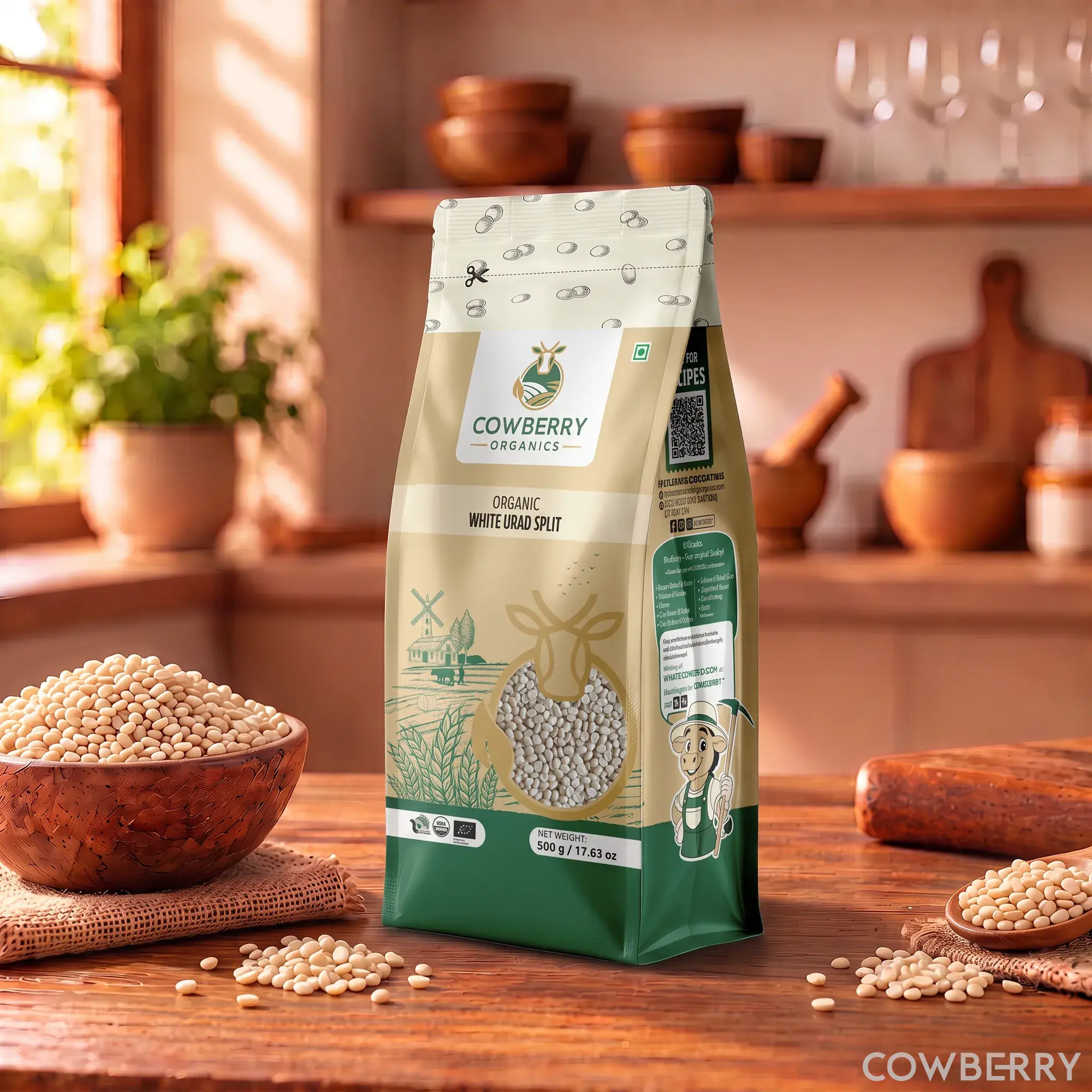
Yes. Black gram is the English name IFCT 2017 prints for urad dal, so black gram and urad dal are the same pulse. It is sold whole, split with the black skin on, or washed white with the skin removed; COWBERRY's white split, for example, is whole black gram with the outer skin removed by a natural mechanical process.
Why urad dal is not good for health?
It is not unhealthy as such: ICMR-NIN names black gram among the pulses that can be a good protein source for infants. The usual worries are gas, which pulses in general can cause, and raw or lightly cooked sprouts, which the US FDA says children should avoid. For a baby, serve it fully cooked and mashed, and ask the paediatrician about any reaction.
References
- Indian Food Composition Tables (IFCT) 2017, ICMR-National Institute of Nutrition
- Dietary Guidelines for Indians, ICMR-National Institute of Nutrition
- WHO: complementary feeding (health topic)
- Shivakumar N, Kashyap S et al. Protein-quality evaluation of complementary foods in Indian children. Am J Clin Nutr, 2019
- NHS: Foods to avoid giving babies and young children
- US FDA: Selecting and Serving Produce Safely
- Thompson HJ. Improving human dietary choices through understanding of the tolerance and toxicity of pulse crop constituents. Curr Opin Food Sci, 2019
Shop this article
Keep reading
Green gram plant: crop, varieties and how it grows in India
Rajma vs lobia: difference, nutrition and which to choose
Rajma plant: how rajma is grown in India (it is not a tree)