by COWBERRY

7 minute read
Whole urad dal, split and washed: black vs white and which to use

Whole urad dal is the form the splits begin from, and this guide lays out the three forms of the pulse — whole black gram, black split and white split — with the differences that decide which to buy. Each dish named below links to its recipe.
The three forms of whole black urad dal
| Form | What it is | Details |
|---|---|---|
| Whole black gram | The whole bean, black seed coat on | The bean the splits are made from; the IFCT 2017 figures on this page are for "Black gram, dal" |
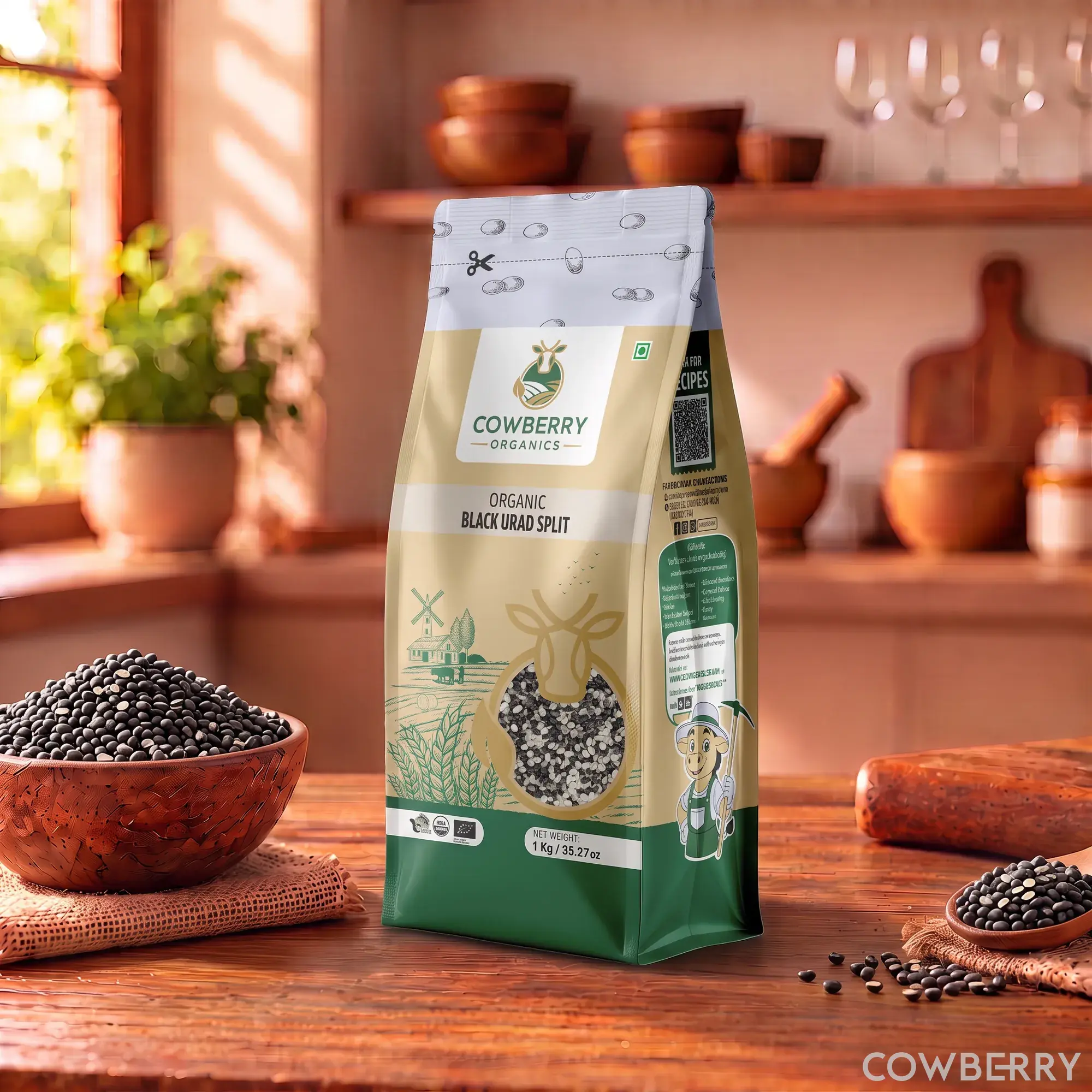
| Black urad split (chilka) | Split urad with the original black skin retained | Processed without water, oil or leather polishing; earthy flavour and aroma; cooks relatively quickly when soaked |
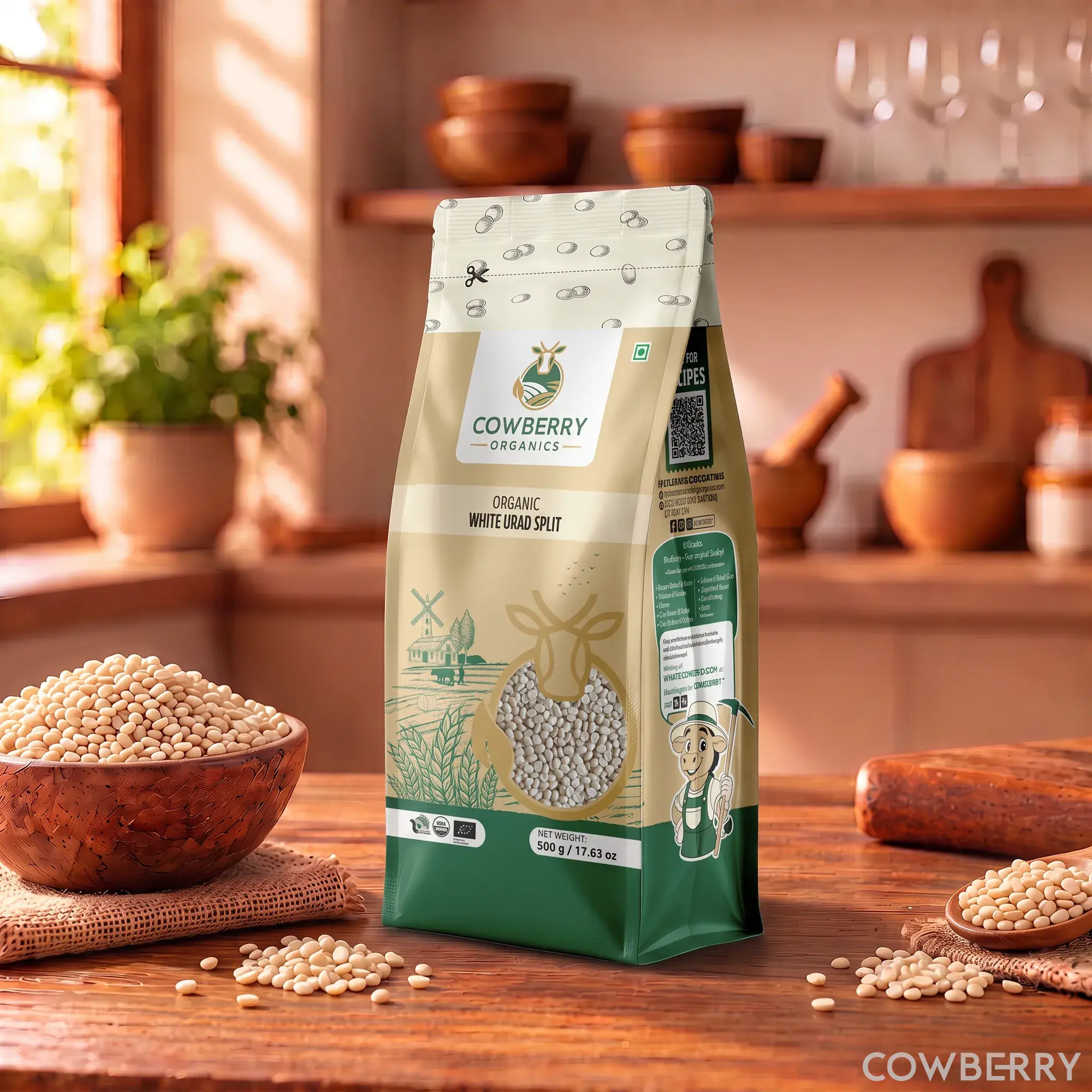
| White urad split (dhuli) | Whole black gram with the outer skin removed, revealing the creamy white interior | Skin removed by a natural mechanical process; light and easy to cook; smooth texture; sold in some parts as ivory white lentils |
Those three are one pulse. IFCT 2017 lists urad dal under the English name "Black gram, dal", and COWBERRY's white split is made from whole black gram, with the outer skin removed, while the black split keeps its original skin. A fourth form, urad gota, has its own comparison on the urad gota vs urad dal page.
In short: whole black gram is the bean, the black split is the bean split with the skin left on, and the white split is the split bean with the skin removed. Each of the next sections takes one question in turn — the black-white difference, the batter question, and the cooking question.
Black vs white urad dal: what actually differs
The difference is the skin. Black urad split keeps its original skin, and COWBERRY's product description gives it an earthy flavour and aroma; the dal stays minimally processed, without water, oil or leather polishing. White urad split has the outer skin removed by a natural mechanical process, revealing the creamy white interior, and the description calls it light and easy to cook, with a smooth texture and balanced flavour.
Those are the differences COWBERRY's product pages give. Both splits are naturally gluten-free, and IFCT 2017 gives one set of figures, for "Black gram, dal", so no per-100 g numbers are compared here. If a dish wants an earthy dal flavour, the black split brings it; if it wants a smooth, easy-to-cook base, the white split suits it.
Which form for idli, dosa and vada
COWBERRY's product pages answer the batter question: black urad split is commonly used for dal, dosa batter and idli batter, and white urad split is a key ingredient in South Indian cuisine for idlis, dosas and vadas, besides its role as a thickener in soups. So both splits are named for idli and dosa batters, and the white split is also named for vadas. The site's idli, dosa and vada recipes below use the white split. ICMR-NIN notes that fermentation is a common practice in Indian cuisine, in idli, dosa and dhokla, and that it improves digestibility, as soaking does for legumes.
Each dish has its own page: idli with urad dal and rice, urad dal dosa, urad dal vada, dahi vada and thatte idli carry the recipes, dal makhani has its own page, and the urad dal recipes roundup collects them all.
Black urad dal, whole vs split: how the form changes cooking
The cooking facts COWBERRY gives are about the splits. Black urad split cooks relatively quickly when soaked, per its product page, and the white split is described as light and easy to cook. No cooking time is given here for whole urad dal. ICMR-NIN's guidance on pulses applies to every form: wash the dal well, but not repeatedly; soak, then boil or pressure-cook, since cooking is how ICMR-NIN says a pulse's nutritional quality improves most, and soaking aids digestibility. The reason it gives: boiling and pressure cooking destroy anti-nutritional factors, and much of the phytic acid that blocks mineral absorption is lost. It also calls boiling in just enough water, so that none has to be drained, the best way to retain the folate in legumes.
The how to soak urad dal page has the split soak times, and the same washing, soaking and boiling guidance applies to the whole bean as well.
Buying and storing urad dal
Both product pages give much the same storage line: keep the dal in an airtight container in a cool, dry place to maintain freshness; the black split's page adds away from direct sunlight. Buy only as much as the kitchen will cook through, since no shelf life is given for the splits. COWBERRY's urad splits are India Organic, USDA & EU certified. The Organic Black Urad Split and Organic White Urad Split product pages carry the full details, including pack sizes and the pack's own nutrition label.
What every form shares: nutrition and GI
IFCT 2017 gives one set of figures for urad, under "Black gram, dal": per 100 g of dry dal, 324 kcal of energy, 23.06 g of protein, 51.00 g of carbohydrate, 11.93 g of fibre, 88.75 mcg of folate and 4.67 mg of iron. The GI is 43, from a single test in India on black gram soaked for 12 hours, kept moist for a day, then steamed for an hour. A 2014 review sums the pulse family up: protein and fibre together, with a low GI.
The urad dal nutrition page expands these figures, and the urad dal benefits and side effects page covers what the numbers do and do not mean. ICMR-NIN notes that dietary fibre increases the satiety value of food, and the urad dal in pregnancy and urad dal for babies pages read the folate and iron in those contexts.
| Nutrient | Urad dal (black gram), raw |
|---|---|
| Energy (kcal) | 324 |
| Protein (g) | 23 |
| Fat (g) | 1.7 |
| Carbohydrates (g) | 51 |
| Dietary fibre (g) | 12 |
| Iron (mg) | 4.7 |
| Calcium (mg) | 56 |
| Magnesium (mg) | 173 |
| Potassium (mg) | 1157 |
| Sodium (mg) | 19 |
| Zinc (mg) | 3 |
| Folate (mcg) | 89 |
| Glycemic index (GI) | 43 |
Per 100 g raw, edible portion. Composition: IFCT 2017 (ICMR-NIN). GI: University of Sydney GI database. — means not reported. These are average values for the food; the label on a pack gives the values for that product.
FAQs
Is urad dal black or white?
Both. Urad dal is commonly sold as whole black gram with its black seed coat, split with the skin on (chilka), or split with the skin removed to reveal the creamy white interior (dhuli); urad gota is a further form. Black and white urad split are the same pulse, one step of processing apart.
What is urad dal dhuli?
Dhuli is white urad split: whole black gram with the outer skin removed to reveal the creamy white interior. COWBERRY removes the skin by a natural mechanical process, without water, oil or leather polishing, and describes the dal as light and easy to cook, with a smooth texture.
What is whole black gram?
Whole black gram is the whole urad bean with its black seed coat on. The splits both begin from it: COWBERRY's white urad split is made from whole black gram, with the outer skin removed.
Which urad dal is best?
Neither form is better; each suits different dishes. Black urad split keeps its skin and earthy flavour and is commonly used for dal, dosa batter and idli batter; white urad split is light, smooth and easy to cook, and is named for idli and dosa batters, vadas and as a thickener in soups.
Which urad dal is used for dahi vada?
White urad split. COWBERRY's product page names it a key ingredient for South Indian idlis, dosas and vadas, and the site's dahi vada recipe uses it for the vada batter.
Which urad dal is used for dosa?
Either split: black urad split is listed for dosa and idli batters, and white urad split is named a key ingredient for idlis, dosas and vadas. The site's urad dal dosa recipe uses the white split.
Difference between urad dal and black urad dal?
Only the skin: black urad dal is urad dal with its black skin still on. When the skin is removed, as COWBERRY does by a natural mechanical process, the same dal is sold as white urad split, or dhuli. Both come from whole black gram.
References
- Indian Food Composition Tables (IFCT) 2017, ICMR-National Institute of Nutrition
- Dietary Guidelines for Indians, ICMR-National Institute of Nutrition
- University of Sydney glycemic index database (GI search)
- Mudryj AN, Yu N, Aukema HM. Nutritional and health benefits of pulses. Appl Physiol Nutr Metab, 2014
Shop this article
Keep reading
Green gram plant: crop, varieties and how it grows in India
Rajma vs lobia: difference, nutrition and which to choose
Rajma plant: how rajma is grown in India (it is not a tree)