by COWBERRY

10 minute read
What is chawal (rice): nutrition, benefits and how to cook it

What is chawal? Chawal is the Hindi word for rice, the grain of Oryza sativa that cooks into India's everyday staple; in English it is simply rice. Raw milled rice gives 357 kcal and 78.24 g of carbohydrate per 100 g (IFCT 2017), the grain behind dal chawal, curd rice, khichdi, idli or pulao. Read on for names, nutrition, cooking, storage and buying.
What is arwa chawal, ukda chawal and pakka chawal?
Chawal is rice: the English name IFCT 2017 prints for it is 'Rice, raw, milled', and the everyday names sort into three buckets. Arwa chawal is the raw grain, milled straight from dried paddy with no steaming step in between. Ukda chawal, also called usna, is parboiled rice: the paddy gets steamed inside its husk before any milling, so the grain stays firm and separate in the pot; the same parboiled grain answers to usna chawal, ukadla tandool, siddha chowl and puzhungal arisi across Hindi, Marathi, Bengali and Tamil. Pakka chawal is the everyday phrase for cooked rice, the ready grain on the plate. The three names mark the same grain at different stages, raw, parboiled and cooked. For every variety in one place, see types of rice in India.
Chawal names in Indian languages
IFCT 2017 prints the local names of raw milled rice: chawal in Hindi, tondool in Marathi, choka in Gujarati, chaul in Punjabi, chowl in Bengali, chaula in Odia, milat khunda chaul in Assamese, akki in Kannada, biyyam in Telugu and arisi in Tamil. Brown rice keeps its own set, from kathai chokha in Gujarati and bhura choul in Punjabi to matia rangar chaul in Assamese, dampudu biyyam in Telugu and kuthari in Malayalam. The table below carries the full set for raw milled rice.
| Language | Name (romanised) |
|---|---|
| English | Rice, raw, milled |
| Hindi | Chawal |
| Marathi | Tondool |
| Gujarati | Choka |
| Punjabi | Chaul |
| Bengali | Chowl |
| Odia | Chaula |
| Assamese | Milat khunda chaul |
| Kannada | Akki |
| Telugu | Biyyam |
| Tamil | Arisi |
| Malayalam | — |
| Urdu | — |
| Sanskrit | — |
| Botanical name | Oryza sativa |
Source: IFCT 2017 (ICMR-NIN) local-names list. — means no name recorded in the source.
Chawal nutrition per 100 g
The numbers below are IFCT 2017 values for the raw grain; there is no basmati-specific entry, so the white rice figures are the pooled 'Rice, raw, milled'. White rice carries 357 kcal per 100 g, with 78.24 g of carbohydrate, 7.94 g of protein, 0.52 g of fat and 2.81 g of fibre, plus 0.65 mg of iron, 7.49 mg of calcium, 19.30 mg of magnesium, 108 mg of potassium, 2.34 mg of sodium, 1.21 mg of zinc and 9.32 mcg of folate. Brown rice, with its bran layer on, gives 354 kcal, 9.16 g of protein, 1.24 g of fat and 4.43 g of fibre, and its magnesium is far ahead at 93.91 mg per 100 g. The same 100 g cooks into about two and a half katoris once the grain takes up water.
Cooked, a katori made from 40 g of raw rice brings about 143 kcal with 31 g of carbohydrate, 3.2 g of protein and 1.1 g of fibre, before any ghee or tadka. On the glycemic index, one India-tested entry puts plain white basmati at 50, in the low band of 55 or below, and brown rice at 58, in the medium band; a 2023 review adds that rice is typically regarded as high or medium-high on the index and that the value varies with variety, processing and what it is eaten with. The per-variety details are on the low GI rice in India page.
| Nutrient | White rice (IFCT raw milled rice) | Brown rice (raw) |
|---|---|---|
| Energy (kcal) | 357 | 354 |
| Protein (g) | 7.9 | 9.2 |
| Fat (g) | 0.5 | 1.2 |
| Carbohydrates (g) | 78 | 75 |
| Dietary fibre (g) | 2.8 | 4.4 |
| Iron (mg) | 0.7 | 1 |
| Calcium (mg) | 7.5 | 11 |
| Magnesium (mg) | 19 | 94 |
| Potassium (mg) | 108 | 199 |
| Sodium (mg) | 2.3 | 3.6 |
| Zinc (mg) | 1.2 | 1.7 |
| Folate (mcg) | 9.3 | 12 |
| Glycemic index (GI) | 50 | 58 |
Per 100 g raw, edible portion. Composition: IFCT 2017 (ICMR-NIN). GI: University of Sydney GI database. — means not reported. These are average values for the food; the label on a pack gives the values for that product.
Benefits of eating chawal
Chawal is mainly an energy food: 357 kcal and 78.24 g of carbohydrate per 100 g, and the guidelines' food pyramid gives cereals and nutricereals together a 250 g share of a 2000 kcal day.
A measured katori is easy to count: 40 g of raw rice is 143 kcal with 3.2 g of protein, before dal, ghee or sabzi. Whether that suits a weight plan depends on the rest of the day; for the portion numbers, see chawal for weight loss.
The variety choices add up. One India-tested entry puts basmati at a GI of 50, in the low band, and the low GI rice in India guide gives each grain's GI with its country and form. Pairing rice with dal in the guidelines' 3:1 cereal-to-pulse ratio improves the protein quality of the meal. In its puffed form, rice is covered on the puffed rice benefits page, and the quinoa vs rice comparison lays out the two grains side by side. Swap the second katori for a second bowl of sabzi and the meal stays varied while the grain stays measured.
Side effects of rice and who should limit it
White rice's weakness is fibre: 2.81 g per 100 g against brown rice's 4.43 g, so a diet built on white rice alone is a low-fibre diet unless vegetables and dal fill the gap. Portion is the other honest risk. Two katoris, from 80 g of raw rice, come to about 286 kcal before dal, ghee or sabzi, and a 2022 review in BMJ Open associated higher white rice intake with a higher risk of type 2 diabetes, while brown rice intake was associated with lower risk, an association rather than a sentence. The review compared the highest and lowest intake groups, and its dose-response showed up only at intakes above about 300 g of white rice a day. Variety, portion and the rest of the meal all move the needle.
Who should limit it: anyone counting carbohydrates or managing blood sugar should keep the katori measured, and the guidelines' cereal share, 250 g on a 2000 kcal day, is the frame it belongs in. For many households the fix is not giving up rice but keeping the katori honest and the dal generous. If you have diabetes or are managing weight, set the amount with your doctor or dietitian.
How to cook chawal
Start with a wash, not a wash marathon: the guidelines say to wash grains well but not repeatedly, since extra washes rinse out minerals and vitamins. Then soak white rice for 20 to 30 minutes if you have the time; brown rice wants longer, and the how to cook brown rice page covers its timing.
Water is where many pots go wrong. For basmati, the pack's ratio is one cup of rice to about one and a half cups of water; for sona masoori it is one cup to two cups (the 1:2 ratio). Cook covered on low for 12 to 15 minutes, then let the pot rest, covered, for five minutes off the heat and fluff with a fork. The grains are done when a pressed grain mashes without a hard centre; the covered rest finishes the steam.
One extra step is worth knowing: cooking rice in excess water and draining it lowers the arsenic in the cooked grain. A US FDA laboratory study found that excess-water cooking cut average inorganic arsenic by 40 percent in long-grain polished rice, 60 percent in parboiled and 50 percent in brown, while iron, folate, niacin and thiamin fell by 50 to 70 percent in enriched polished and parboiled rice, and by much less in brown rice, which is not enriched. A 2019 review agrees that sequential washing and excess water lower arsenic at the cost of nutrient content.
How to store rice
Dry rice is a patient grain: kept airtight in a cool, dry cupboard, it keeps for many months. The guidelines advise keeping dry foods in airtight containers to protect them from moisture. Check the rice before cooking, and do not use grain that looks mouldy, has insects or smells off.
Cooked rice is a different animal. Cool it quickly, cover it and refrigerate within one to two hours, then eat it within two days. Reheat only the portion you will eat, and heat it through fully. Decant the big sack into airtight dabbas the day it comes home and cook the jars in the order you filled them, so nothing sits past its prime. Monsoon storage for every grain in the pantry is covered on our how to store atta page.
Rice recipes: from idli to payasam
Rice cooks into every course of the Indian day, and each recipe below starts from the same grain this guide is about.
Start at breakfast: soft steamed idli from a fermented rice and urad batter, crisp dosa and its stuffed masala dosa cousin, thick fluffy uttapam, lacy appam, coarse no-ferment adai, steamed noodle cakes called idiyappam, coconut-layered puttu, and creamy peppery ven pongal.
Lunch and dinner lean one-pot: sambar rice, tomato rice, curd rice, coconut-flecked coconut rice, cumin-scented jeera rice, tamarind puliyogare, bisi bele bath, spiced one-pot masala khichdi, vegetable vegetable pulao and layered vegetable biryani.
The sweet and snack shelves close the circle: steamed modak, milk-simmered payasam, sakkarai pongal, and for tea time, crisp rice-flour spirals like chakli and murukku, baked savoury handvo and steamed khichu.
How to buy rice: what to look for
At the shop, look at the grain before the price: the guidelines say food should be free from infestation, moulds and foreign matter, and that some pre-packaged foods carry certification marks assuring quality and purity. Look for those marks on the pack, and move the grain into airtight storage once it is home.
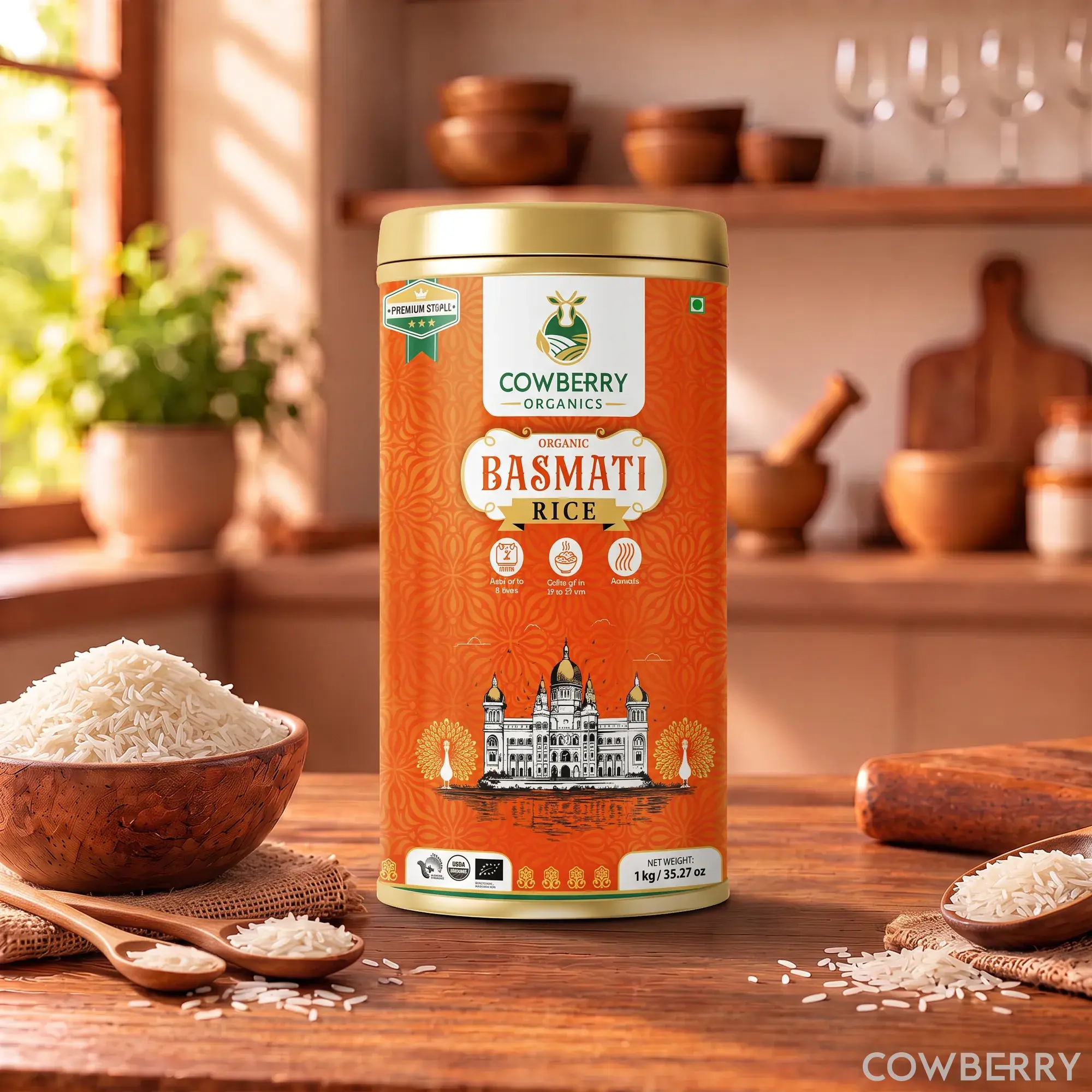
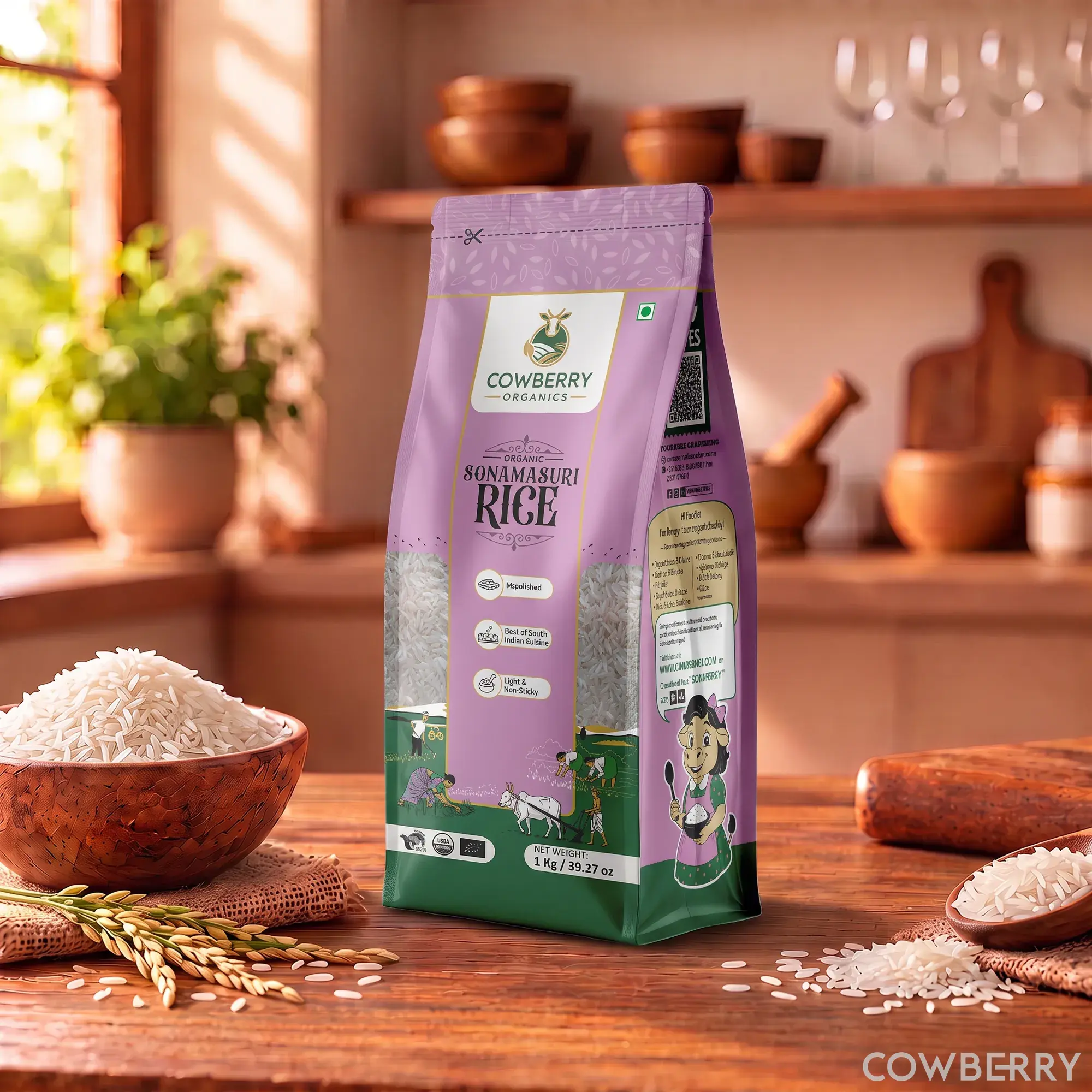
COWBERRY's basmati and sona masoori come from cow-based farming and carry India Organic, USDA & EU certified assurance; both are below.
FAQs
What is chawal?
Chawal is the Hindi word for rice, the grain of Oryza sativa that India eats daily as dal chawal, khichdi, idli, curd rice and biryani. IFCT 2017 prints its English name as 'Rice, raw, milled': 357 kcal and 78.24 g of carbohydrate per 100 g of the raw grain.
What is chawal in english?
Rice. IFCT 2017 prints the English name 'Rice, raw, milled', and everyday English simply calls it rice, whether the grain is raw, soaked or cooked; 'chawal' and 'rice' name the same staple, one in Hindi and one in English.
What is arwa chawal?
Arwa chawal is the raw rice of the pantry: dried paddy milled straight, with no steaming step before the mill. It is the grain the IFCT 2017 entry 'Rice, raw, milled' describes, and the one the nutrition numbers on this page are for.
What is pakka chawal?
Pakka chawal is cooked rice. In everyday Hindi, pakka carries the sense of done or ready, so the phrase means the grain after boiling, the soft rice served with dal, while kaccha chawal is its raw, uncooked opposite.
What is ukda chawal?
Ukda chawal, the usna of Hindi-speaking kitchens, is parboiled rice: the paddy is steamed inside the husk before the mill ever touches it. That steaming sets the grain, so it holds its shape in the pot and cooks firm and separate.
Which rice is best for diabetic person?
No rice is a safe pick for everyone with diabetes. One India-tested entry puts plain white basmati at a GI of 50 (low band) and unpolished brown rice at 58 (medium band); each is a single entry, so read them as indications, and the portion and the rest of the plate matter too. Ask your doctor or dietitian how much rice suits you.
Is chawal good for weight loss?
Weight depends on the energy of the whole day, not on rice alone. A katori from 40 g of raw rice is about 143 kcal with 3.2 g of protein and 1.1 g of fibre, so measuring it makes the count easy. If you are managing weight, set the portion with your doctor or dietitian. See the numbers on our chawal for weight loss page.
References
- Indian Food Composition Tables (IFCT) 2017, ICMR-National Institute of Nutrition
- Dietary Guidelines for Indians, ICMR-National Institute of Nutrition
- University of Sydney glycemic index database (GI search)
- University of Sydney: about the glycemic index
- Yu J, Balaji B et al. White rice, brown rice and the risk of type 2 diabetes: a systematic review and meta-analysis. BMJ Open, 2022
- Ngo TV, Kunyanee K et al. Insights into recent updates on factors and technologies that modulate the glycemic index of rice and its products. Foods, 2023
- UK Food Standards Agency: How to chill, freeze and defrost food safely
- Gray PJ, Conklin SD, Todorov TI, et al. Cooking rice in excess water reduces both arsenic and enriched vitamins in the cooked grain. Food Addit Contam Part A Chem Anal Control Expo Risk Assess, 2016
- Kumarathilaka P, Seneweera S, Ok YS, et al. Arsenic in cooked rice foods: Assessing health risks and mitigation options. Environ Int, 2019
Shop this article
Keep reading
Red rice vs brown rice: the fibre, GI and honest verdict
Red rice vs black rice: nutrition, glycemic index and which to choose
Red rice nutrition per 100g: calories, protein, fibre and GI