by COWBERRY

13 minute read
Types of rice in India: basmati, sona masoori, indrayani and GI

The main types of rice in India are basmati, sona masoori, kolam, ponni and indrayani, red rice and black rice, plus the brown and parboiled forms of the white grains. They differ in grain length, aroma, stickiness and glycemic index: for rice grown in India, the University of Sydney database records basmati at 50 and sona masoori at 72. This guide matches each rice to its dish.
Types of rice in India: the everyday grains
India grows a great many rice varieties, but a handful fill the kitchen shelf. They sort into three groups: long and aromatic, medium and mild, short and aromatic. All of them are Oryza sativa; the differences lie in grain shape, starch and aroma.
Basmati
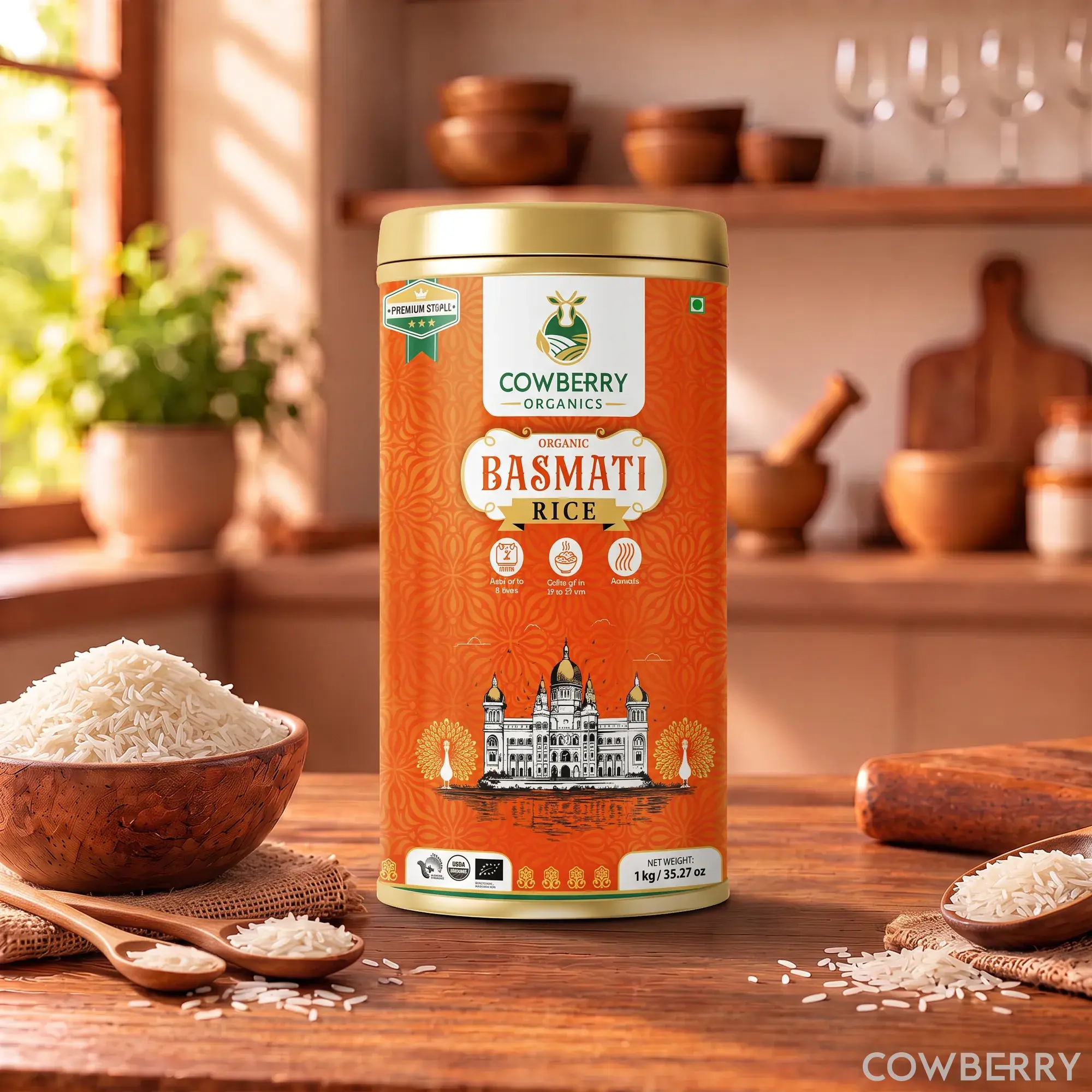
Long, slender and fragrant, basmati is grown on the plains of northern India, in states such as Punjab and Uttarakhand. Aged basmati cooks dry and separate and the grain lengthens as it cooks, which is why it is the rice of biryani and pulao.
Sona masoori
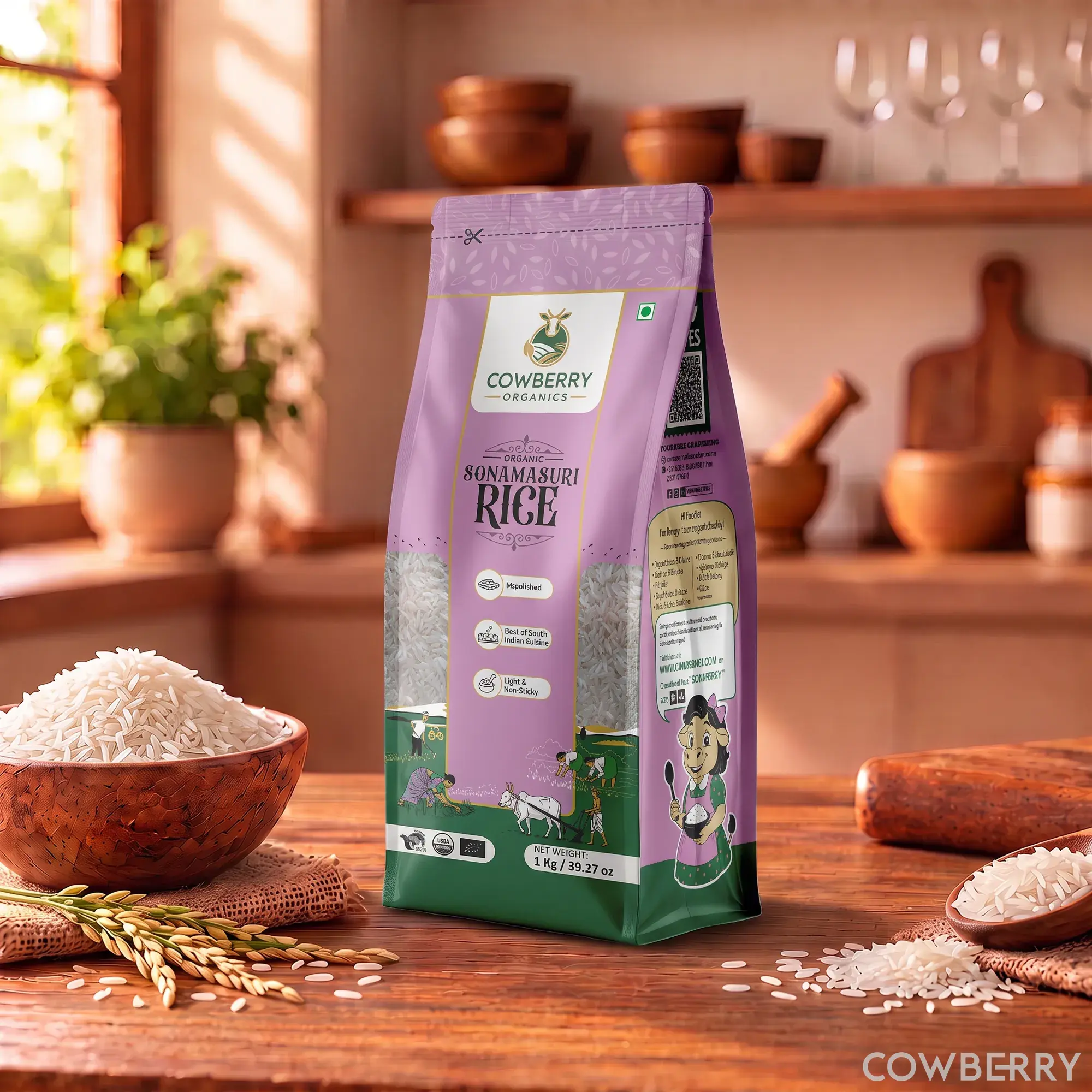
A medium, lightweight grain grown in Andhra Pradesh, Telangana and Karnataka. It cooks soft without turning gluey and is an everyday rice in much of South India: plain rice with sambar or rasam, curd rice, lemon rice and pongal.
Kolam
Kolam is a fine, medium grain grown in Maharashtra and Madhya Pradesh. Surti Kolam is one named variety, and the one whose GI appears below. It cooks soft and mild, which suits dal-chawal, khichdi and masale bhaat.
Ponni
A medium grain sold raw and parboiled. The parboiled form, often labelled boiled rice, is an everyday meals rice in parts of the south and goes into idli and dosa batter.
Indrayani rice and the short aromatic grains
Indrayani rice
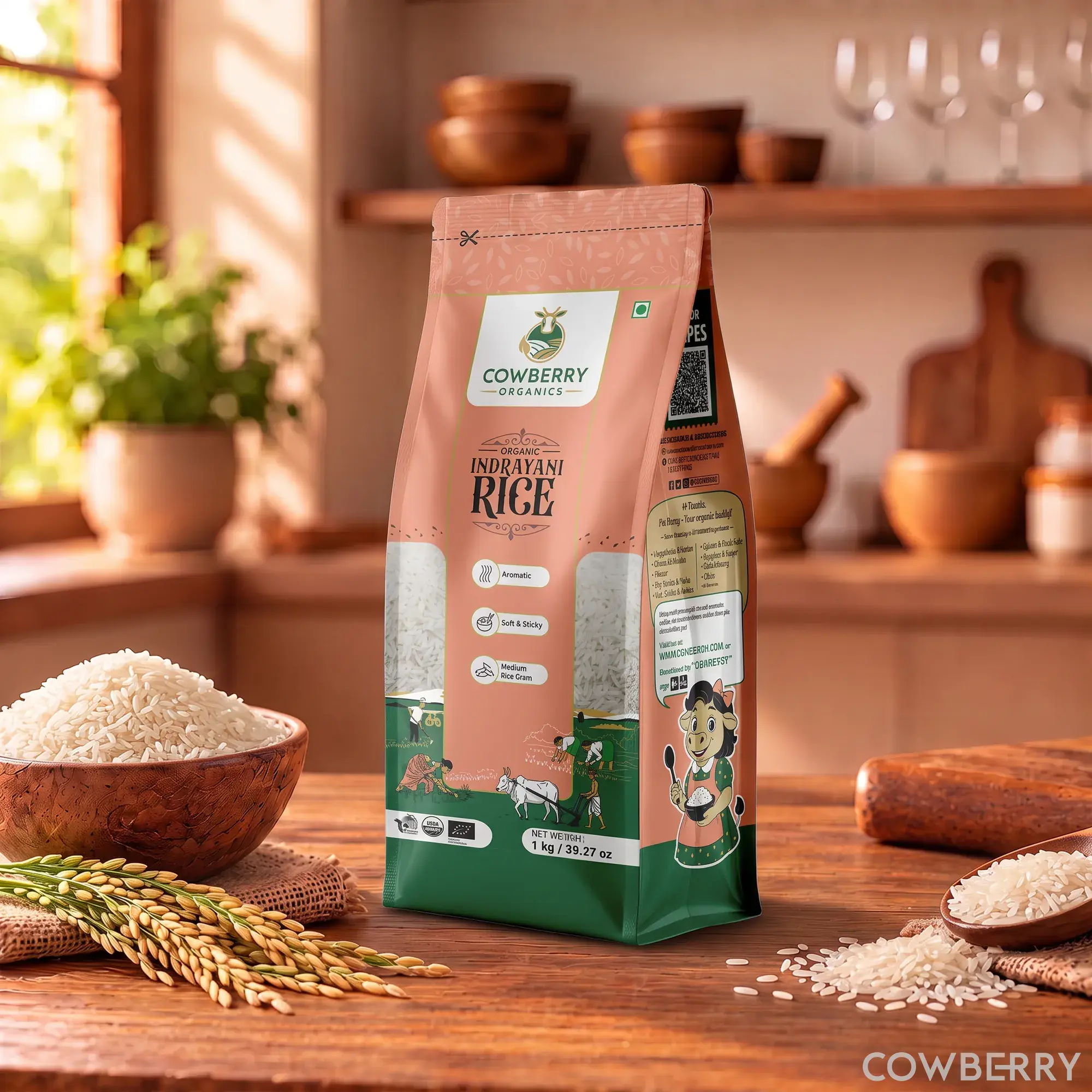
Indrayani rice is a short-to-medium, fragrant grain from the Pune and Maval regions of Maharashtra, where the Indrayani river flows. It cooks soft and slightly sticky, which is what varan-bhat, khichdi and metkut-bhat need, and it is done in about 12 to 15 minutes, like basmati, sona masoori and kolam. It also goes into kheer. It can be used for pulao, but when you want long grains that stay apart, basmati is the better choice.
The other short aromatic grains
Besides indrayani, India grows several other short, fragrant rices, each sold under a local name in its own region. What they share is starch that cooks soft and clings, and an aroma that carries through a simple dish. They are chosen for comfort food and sweets, not for a plate of long, separate grains.
Types of red rice, black rice, brown rice and parboiled rice
Colour and processing cut across variety. Any rice can be sold brown or white, raw or parboiled; red and black rices are varieties whose bran is pigmented.
Types of red rice
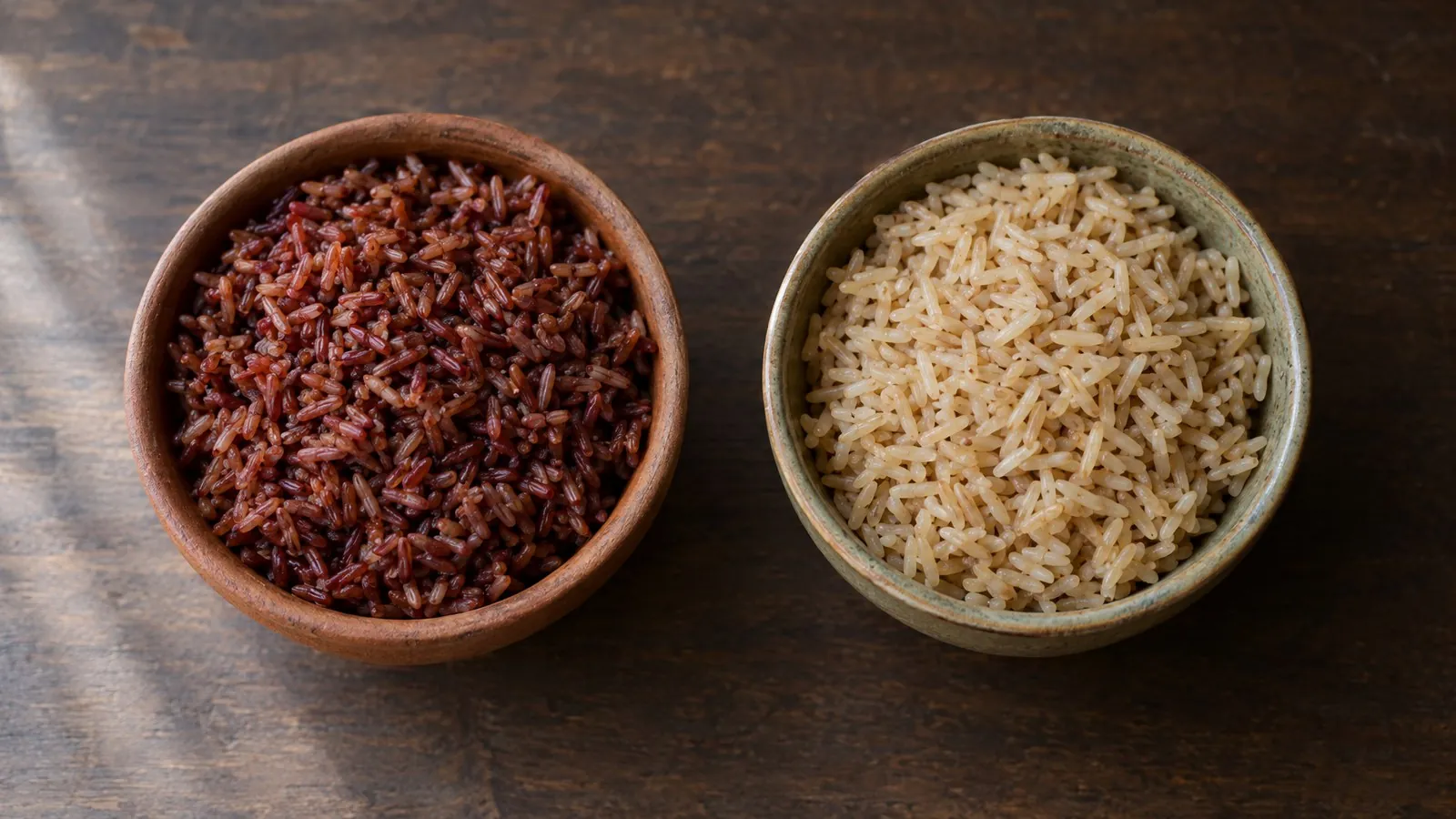
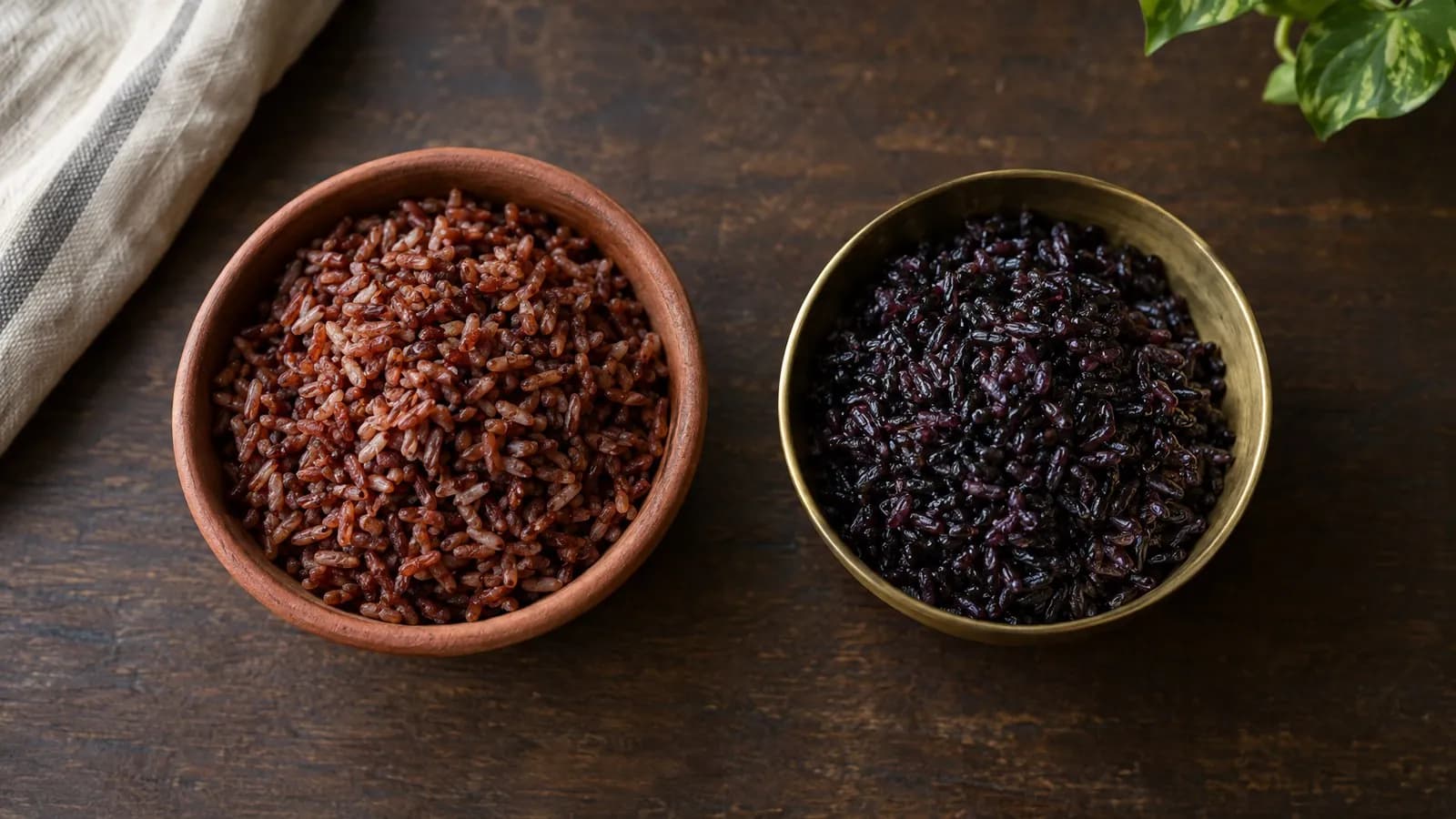
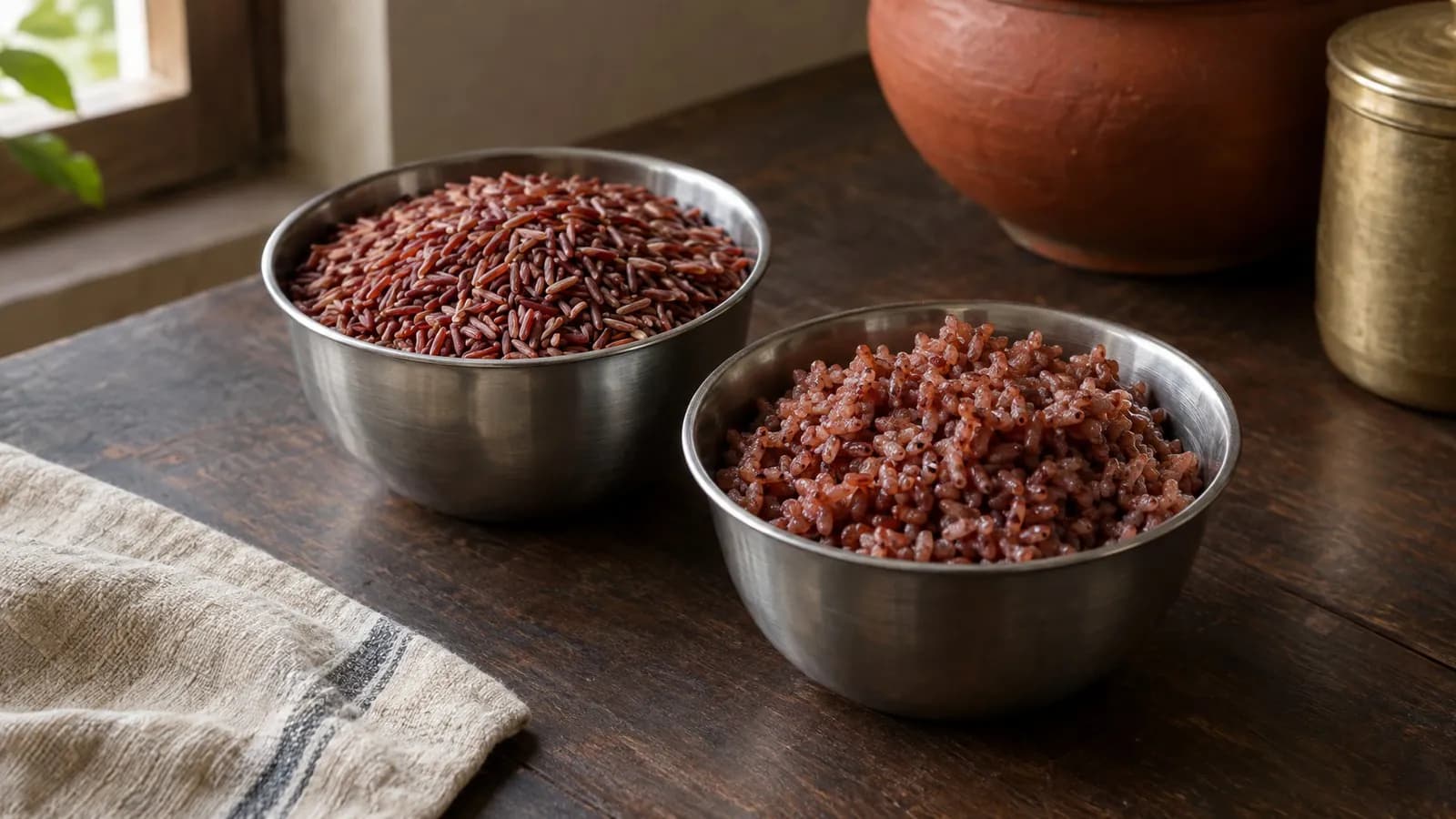
Red rice has a red-brown bran layer and an earthy, nutty taste. It is not one variety: rices with a red bran are grown in several regions of India, each under its local name. They are sold unpolished or semi-polished and take longer to cook than white rice, about 30 to 40 minutes against 12 to 15.
Black rice
Black rice gets its purple-black bran from anthocyanin pigments and turns deep purple when cooked. In India it is grown in Manipur and the wider Northeast. It is chewy and nutty, needs soaking and is often made into kheer.
Brown rice vs white rice
Brown rice is rice with only the husk removed. The bran and germ stay on, which gives more fibre and minerals, a longer cooking time and a shorter shelf life. White rice is what is left after the mill strips the bran and germ and polishes the surface. Brown is a degree of milling, not a variety: brown basmati is one example.
Parboiled rice (usna, ukadla, siddha)
Parboiled rice is paddy that was soaked, steamed and dried in the husk before milling. The grain hardens, breaks less and cooks firm and separate. Its names follow the language: usna chawal in Hindi, ukadla tandool in Marathi, siddha chowl in Bengali and puzhungal arisi in Tamil. Rice milled without this step is raw rice, or arwa chawal.
Rice nutrition per 100 g: white, brown and what changes
Our figures come from IFCT 2017, and the entry used for basmati, sona masoori, kolam and indrayani alike is its pooled one for raw milled rice. So the white rice columns below are identical: 357 kcal, 7.94 g protein, 0.52 g fat, 78.24 g carbohydrate and 2.81 g fibre per 100 g of raw grain. Between white rices, the differences that matter are grain shape, aroma, cooking behaviour and glycemic index, not calories.
Milling is what moves the numbers. Brown rice gives 354 kcal, 9.16 g protein, 1.24 g fat and 4.43 g fibre, along with 93.91 mg magnesium against 19.30 mg in milled rice. Parboiled milled rice sits between the two on fibre at 3.74 g. Black rice, from USDA data, gives 370 kcal, 3.44 g fat and 4.2 g fibre.
In household terms, a katori of cooked white rice is made from about 40 g of raw rice and gives about 143 kcal, 31 g carbohydrate and 3.2 g protein. The same weight of brown rice gives 142 kcal, with 1.8 g fibre in place of 1.1 g. The Dietary Guidelines for Indians note that cereals are low in the amino acid lysine while pulses are rich in it, and that a meal with both supplies all the amino acids; that is the sense in dal-chawal. How rice compares with jowar, bajra and ragi is set out in millets vs rice.
| Nutrient | Basmati (IFCT raw milled rice) | Sona masoori (IFCT raw milled rice) | Brown rice (IFCT) |
|---|---|---|---|
| Energy (kcal) | 357 | 357 | 354 |
| Protein (g) | 7.9 | 7.9 | 9.2 |
| Fat (g) | 0.5 | 0.5 | 1.2 |
| Carbohydrates (g) | 78 | 78 | 75 |
| Dietary fibre (g) | 2.8 | 2.8 | 4.4 |
| Iron (mg) | 0.7 | 0.7 | 1 |
| Calcium (mg) | 7.5 | 7.5 | 11 |
| Magnesium (mg) | 19 | 19 | 94 |
| Potassium (mg) | 108 | 108 | 199 |
| Sodium (mg) | 2.3 | 2.3 | 3.6 |
| Zinc (mg) | 1.2 | 1.2 | 1.7 |
| Folate (mcg) | 9.3 | 9.3 | 12 |
| Glycemic index (GI) | 50 | 72 | 58 |
Per 100 g raw, edible portion. Composition: IFCT 2017 (ICMR-NIN). GI: University of Sydney GI database. — means not reported. These are average values for the food; the label on a pack gives the values for that product.
Low glycemic index rice in India: what the tested values say
The glycemic index (GI) is a ranking of carbohydrate foods by how much they raise blood glucose after eating. The University of Sydney, which keeps the database used here, counts a value of 55 or less as low and 70 or more as high.
For rice grown in India, the database records plain white basmati at 50, unpolished brown rice at 58, sona masoori at 72 and kolam at 77. That puts basmati in the low band and the two everyday white rices in the high band, with brown rice between the two. Each figure comes from a single test, so read it as a guide and not as a fixed property of the grain.
The red rice and black rice values in the table below are averages of tests on rice grown outside India, and the individual results were far apart. There is no red rice entry in the IFCT values we use, so that column carries the parboiled milled rice figures, while its GI comes from tests on unpolished red rice. The database has no entry for indrayani, so we print no value for it.
Why the spread? A 2023 review in the journal Foods notes that rice is generally regarded as a high or medium-high GI food, but that the value varies with the variety, the nutrient composition, the processing and accompanying factors. It describes the digestibility of rice products as process-dependent. In kitchen terms: the grain you choose and how far it was milled both count.
On long-term health, a systematic review published in BMJ Open in 2022 pooled eight cohort studies. People with the highest white rice intake had a higher risk of type 2 diabetes than those with the lowest, and for brown rice the association ran the other way. These are associations, not proof of cause, and the trials that swapped white rice for brown gave inconsistent results on risk factors. With diabetes, the portion counts as well as the grain: talk to your doctor or dietitian and fix it together.
| Nutrient | Kolam (IFCT raw milled rice) | Red rice (IFCT parboiled milled rice) | Black rice (USDA) |
|---|---|---|---|
| Energy (kcal) | 357 | 352 | 370 |
| Protein (g) | 7.9 | 7.8 | 7.6 |
| Fat (g) | 0.5 | 0.6 | 3.4 |
| Carbohydrates (g) | 78 | 77 | 77 |
| Dietary fibre (g) | 2.8 | 3.7 | 4.2 |
| Iron (mg) | 0.7 | 0.7 | 1.1 |
| Calcium (mg) | 7.5 | 8.1 | 14 |
| Magnesium (mg) | 19 | 27 | 113 |
| Potassium (mg) | 108 | 142 | 256 |
| Sodium (mg) | 2.3 | 3.2 | 0 |
| Zinc (mg) | 1.2 | 1.1 | 1.7 |
| Folate (mcg) | 9.3 | 9.8 | — |
| Glycemic index (GI) | 77 | 62 | 91 |
Per 100 g raw, edible portion. Composition: IFCT 2017 (ICMR-NIN); USDA FoodData Central (Foundation), FDC ID 2710825, NDB 100349. GI: University of Sydney GI database. — means not reported. These are average values for the food; the label on a pack gives the values for that product.
Which rice for which dish: biryani, pongal, idli, khichdi and kheer
- Biryani and pulao: aged basmati, for long grains that stay separate.
- Rajma and dal with rice: basmati or any long-grain raw rice, as in our rajma chawal.
- Pongal: raw, not parboiled, sona masoori or ponni, cooked soft with moong dal until it can be mashed.
- Idli and dosa: parboiled rice, often with some raw rice, soaked and ground with urad dal.
- Khichdi: a soft-cooking short or medium grain such as sona masoori, indrayani or kolam. Start with moong dal khichdi.
- Kheer and payasam: a short, starchy, fragrant rice such as indrayani; black rice for a deep purple kheer.
- Curd rice, sambar rice and lemon rice: sona masoori or ponni.
- Varan-bhat and metkut-bhat: indrayani or kolam.
Poha is rice too: paddy that is soaked, roasted and flattened. Its forms and uses are covered in our guide to poha, and the choice between thick poha, thin poha and red poha has its own page. When you want a change from rice, the small millets cook and eat much like it; see the types of millets grown in India.
How to cook rice: rinse, soak and how much water
Rinse. Wash the rice gently once or twice. That is enough to take off dust and some of the surface starch that makes grains clump, and the ICMR-NIN guidelines advise against washing grains like rice again and again, since each extra wash carries away some minerals and vitamins.
Soak. Basmati and other white rices need twenty to thirty minutes; it lets the grain take up water so that it cooks evenly and lengthens without breaking. Brown, red and black rice need a few hours, because the bran slows the water down. Parboiled rice also gains from a longer soak.
Water. For white rice cooked by absorption in a covered pot, start with about two cups of water to one cup of rice, and a little less, about one and a half cups, for soaked basmati or in a pressure cooker. New-crop rice needs less water than aged rice. Red and black rice take about two cups of water to one of rice and a longer simmer, until the grains are tender; brown rice also cooks longer. Khichdi, pongal and kheer are cooked with far more liquid because the grain is meant to break down.
Cook and rest. Bring to a boil, cover, lower the flame and leave the lid alone until the water is absorbed. Rest the pot off the heat for ten minutes, then fluff with a fork. Many homes in the south and east boil rice in plenty of water and drain it instead, which gives separate grains.
How to store and buy rice: what to look for
Storage. White rice keeps for many months in a steel dabba or a glass jar with a tight lid, kept off the floor in a cool, dry place. Brown, red and black rice keep for less time, because the oil in the bran turns rancid; buy small packs and use them within a few months. Humidity is the problem in the monsoon: it brings weevils and a musty smell. The Dietary Guidelines for Indians ask that food grains be dried well and stored in airtight containers, away from moisture, and the FAO's bulletin on grain storage gives separate chapters to drying, insect control and rodent control. For the rainy months, see how to store atta, rice and dals through the monsoon.
Buying. Choose by dish first. Then look at the grain: even length, few broken pieces, no dust, webbing or pin-holes. Aromatic rice should smell sweet, never musty. If organic matters to you, the bag should carry a certification mark such as India Organic; natural on its own certifies nothing.
COWBERRY packs several of the rices in this guide. Organic Basmati Rice is a long-grain, naturally aged basmati from Uttarakhand and Punjab. Organic Sonamasuri Rice is a medium grain from Andhra Pradesh, Telangana and Karnataka. Organic Indrayani Rice comes from the Pune and Maval regions of Maharashtra. The same shelf holds organic kolam rice, red rice, black rice and brown basmati rice.
FAQs
Which rice has the lowest glycemic index?
Of the rices in this guide, plain white basmati grown in India has the lowest value in the University of Sydney database, at 50, followed by unpolished brown rice at 58. Sona masoori (72) and kolam (77) test higher. Each is a single test, and the variety, the processing and other factors shift the response, so portion size still matters.
Is poha made of rice?
Yes. Poha is flattened rice: paddy is soaked, roasted and pressed flat, and the husk is removed. It is rice in a quick-cooking form, so it needs only a quick rinse before it goes into the pan. Thick, thin and red poha, and what each is used for, are explained in our guide to poha.
How much calories in 100 g rice?
Raw milled white rice gives 357 kcal per 100 g and raw brown rice 354 kcal (IFCT 2017). Rice absorbs a lot of water as it cooks, so 100 g of cooked rice carries far fewer calories than 100 g of raw rice. A katori cooked from 40 g of raw white rice gives about 143 kcal.
What is arwa chawal?
Arwa chawal is raw rice: paddy that is dried and milled without being steamed first. The word sets it apart from usna chawal, the Hindi name for parboiled rice. Arwa rice cooks softer than parboiled rice, which stays firm and separate, and it suits kheer and pulao.
What is vrat ke chawal?
Vrat ke chawal is not rice. It is barnyard millet, called sanwa in Hindi and sama in Gujarati, a small white millet that is cooked like rice on fasting days when ordinary grains are avoided. It cooks quickly and makes khichdi, pulao and kheer. Its relatives are described in our guide to the types of millets.
What happens if rice is soaked overnight?
White rice soaked overnight takes up so much water that the grains turn fragile, break while cooking and give a mushy pot; in warm weather the water can also begin to sour. Twenty to thirty minutes is enough for white rice. Brown, red and black rice do well with a long soak; keep the bowl in the fridge and cook with less water.
Which rice to eat in diabetes?
There is no single rice for diabetes; how much you eat and what you eat it with matter, not only the variety. Among Indian-grown rices in the University of Sydney database, basmati (50) and brown rice (58) sit lower than sona masoori and kolam. Keep the portion modest and pair it with dal, vegetables and curd; for the amount that suits your sugar readings, talk to your doctor or dietitian.
References
- USDA FoodData Central
- Indian Food Composition Tables (IFCT) 2017, ICMR-National Institute of Nutrition
- University of Sydney glycemic index database (GI search)
- University of Sydney: about the glycemic index
- Ngo TV, Kunyanee K et al. Insights into recent updates on factors and technologies that modulate the glycemic index of rice and its products. Foods, 2023
- Yu J, Balaji B et al. White rice, brown rice and the risk of type 2 diabetes: a systematic review and meta-analysis. BMJ Open, 2022
- FAO: Grain storage techniques, evolution and trends in developing countries
- Dietary Guidelines for Indians, ICMR-National Institute of Nutrition
Shop this article
Keep reading
Red rice vs brown rice: the fibre, GI and honest verdict
Red rice vs black rice: nutrition, glycemic index and which to choose
Red rice nutrition per 100g: calories, protein, fibre and GI