by COWBERRY

6 minute read
Red rice vs brown rice: the fibre, GI and honest verdict

Red rice vs brown rice in short: two whole grains, red bran against brown bran, and the measured differences are small but real. Brown rice lists more fibre (4.43 g against 3.74 g per 100 g) and protein (9.16 g against 7.81 g); red rice's seven GI tests average 62 against brown rice's one India-tested 58. The red rice hub carries the red grain's wider story.
Verdict in three lines
Brown rice wins the measured nutrition: more fibre, protein and minerals per 100 g, and a GI of 58 from a test done in India.
Red rice is the pigmented one, with anthocyanins in its red bran, and its foreign-tested GI average of 62 still sits in the medium band.
The honest verdict: on paper brown rice is the stronger everyday grain; red rice is the equally sensible choice where you want its colour, and both carry the bran layer intact. The brown rice hub tells the brown grain's side.
Red rice vs brown rice: side by side per 100 g
Both columns in the table draw on IFCT 2017, per 100 g of raw grain, with one caveat: IFCT 2017 carries no red-rice entry, so the red column is filled by its nearest match, parboiled milled rice, which makes this comparison indicative rather than exact.
Energy and carbohydrate nearly tie — 352 kcal against 354, and 77.16 g of carbohydrate against 74.8 g. Brown rice then pulls ahead: 4.43 g of fibre against 3.74 g, 9.16 g of protein against 7.81 g, 93.91 mg of magnesium against 26.72 mg, 199 mg of potassium against 142 mg, 1.68 mg of zinc against 1.08 mg, 1.02 mg of iron against 0.72 mg and 10.93 mg of calcium against 8.11 mg. Fat is 1.24 g against 0.55 g. Per katori — made with about 40 g of raw grain — the two are closer still: about 141 kcal, 31 g of carbohydrate and 1.5 g of fibre for red rice, against 142 kcal, 30 g and 1.8 g for brown. For the red grain's complete per-100 g breakdown, see red rice nutrition per 100g.
| Nutrient | Red rice (parboiled, milled) | Brown rice (raw) |
|---|---|---|
| Energy (kcal) | 352 | 354 |
| Protein (g) | 7.8 | 9.2 |
| Fat (g) | 0.6 | 1.2 |
| Carbohydrates (g) | 77 | 75 |
| Dietary fibre (g) | 3.7 | 4.4 |
| Iron (mg) | 0.7 | 1 |
| Calcium (mg) | 8.1 | 11 |
| Magnesium (mg) | 27 | 94 |
| Potassium (mg) | 142 | 199 |
| Sodium (mg) | 3.2 | 3.6 |
| Zinc (mg) | 1.1 | 1.7 |
| Folate (mcg) | 9.8 | 12 |
| Glycemic index (GI) | 62 | 58 |
Per 100 g raw, edible portion. Composition: IFCT 2017 (ICMR-NIN). GI: University of Sydney GI database. — means not reported. These are average values for the food; the label on a pack gives the values for that product.
Glycemic index: red rice vs brown rice
The two GI numbers come from different shelves. Brown rice carries one India-tested entry: an unpolished Bapatla rice, pressure cooked, at 58. Red rice carries seven entries, all from outside India, spread from 46 to 76 and averaging 62. Both figures land in the medium band, between the University of Sydney's cut-offs of 55 for low and 70 for high. For brown rice, tests from other countries run wider, from 51 to 95, so the single India-tested number is the one quoted here.
None of this settles a single number for your plate. A 2023 review in Foods notes that rice's GI shifts with the variety, its composition, the processing and the company it keeps on the plate. If blood sugar is the deciding factor, the low GI rice in India guide ranks the whole shelf, and the condition pages for is red rice good for diabetes and brown rice for diabetes do the portions.
Taste and cooking
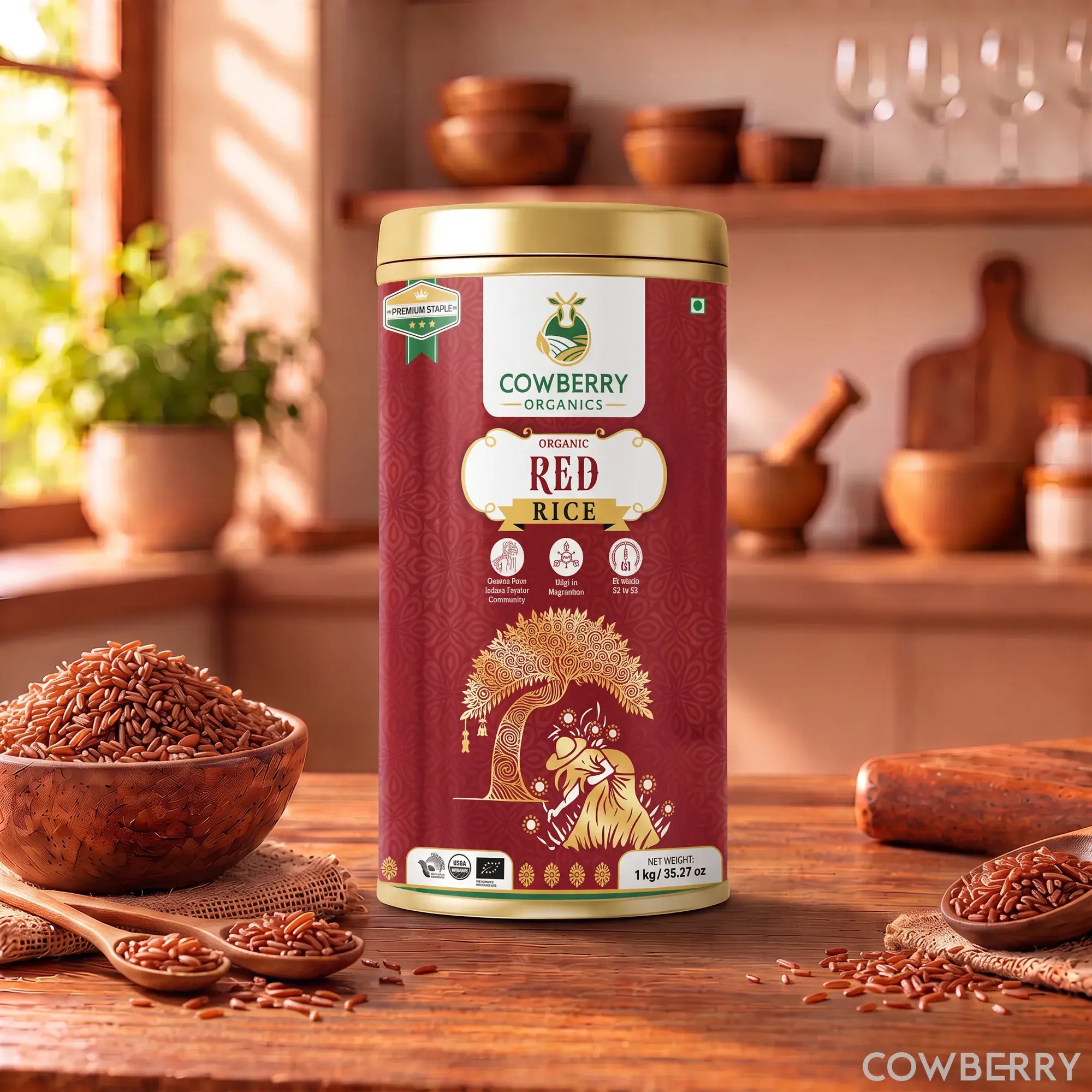
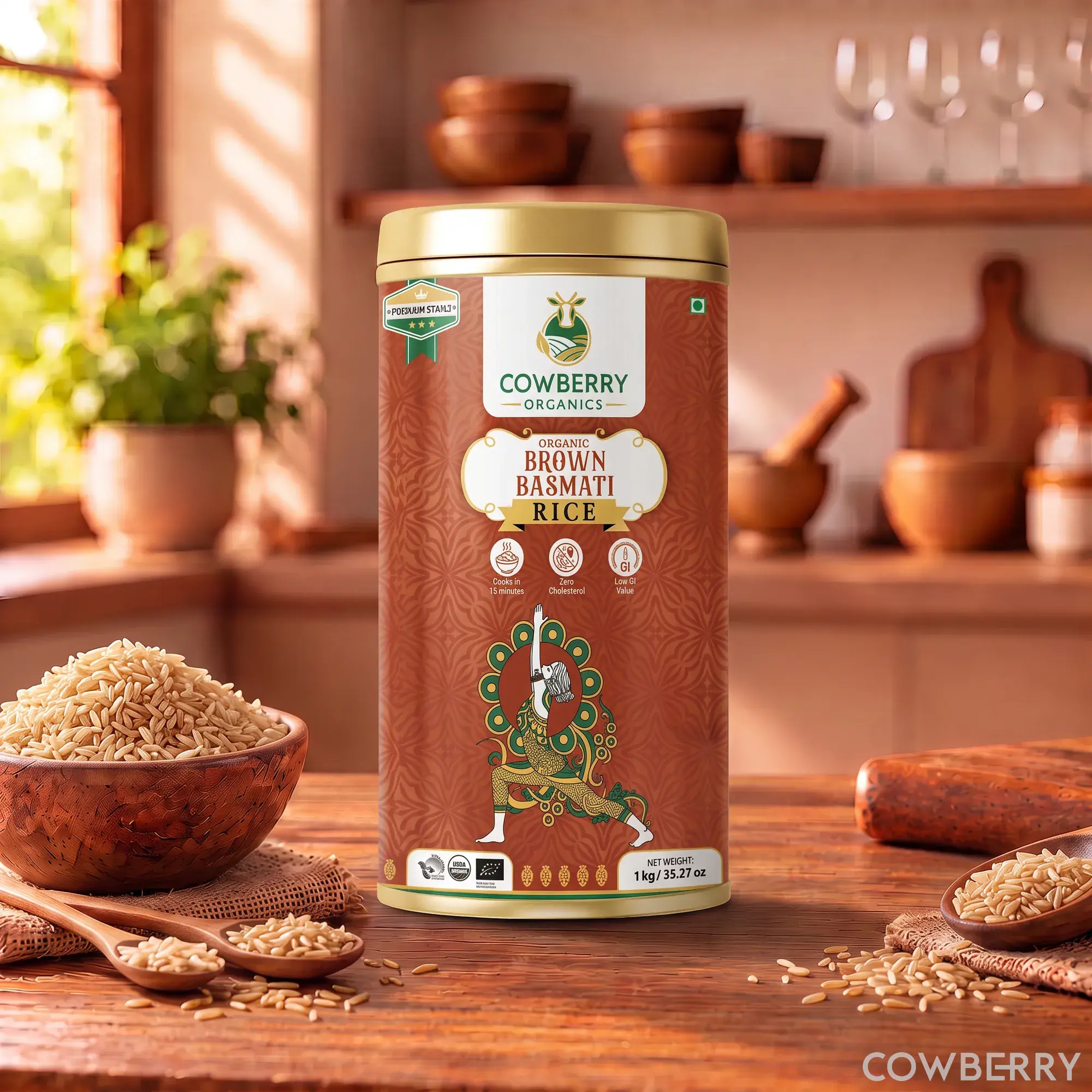
Taste: red rice brings a nutty flavour and firm texture, brown basmati a nutty, chewy one — each per its own product page. Both packs quote 30 to 40 minutes on the stove, and the red rice pack gives a 1:2 rice-to-water ratio. Wash either grain well, without repeating the washing — the guidelines note that repeated washing of rice loses minerals and vitamins. Keep either grain in a sealed container, somewhere cool and dry.
Recipes: the brown rice khichdi and brown rice upma recipes are written for brown basmati, and the how to cook brown rice page walks through the method. Red rice also suits salads and mixed rice, as its pack notes.
Cost and where each fits
No prices here: the two grains come from different fields — red rice is grown for COWBERRY in Kerala and Tamil Nadu, brown basmati in Uttarakhand and Punjab — and what decides the shelf space is use, not the bill.
Brown basmati fits the everyday dal-chawal, khichdi and pulao plate, and every brown rice recipe on the site. Red rice fits the same everyday plate with a deep red colour, and its pack suggests salads; the red rice hub carries that plate in full. Both packs quote 30 to 40 minutes of cooking, so a household can keep both.
Which for whom
- Fibre and protein first: brown rice — 4.43 g of fibre and 9.16 g of protein per 100 g, and the India-tested GI of 58.
- Colour and antioxidants: red rice — its bran carries anthocyanins, and a 2023 review of seventeen randomised trials of pigmented rice (it does not split them by colour) found lower after-meal glucose and insulin after single-meal intake, with small mixed findings over the longer term.
- Diabetes: both sit in the medium GI band, so the portion matters more than the colour; the two condition pages linked above do the arithmetic, and your doctor or dietitian can say which rice suits your readings.
- Weight: the energy nearly ties at 352 against 354 per 100 g, so calories do not separate them; brown rice lists 4.43 g of fibre against 3.74 g.
- Both, rotated: the katori is the same size on either grain. The third pairing, red rice vs black rice, sits on its own page.
FAQs
What is the difference between red rice and brown rice?
The bran and the numbers. Both packs describe the bran layer as intact; red rice's is red with anthocyanins, brown rice's is tan. On IFCT 2017, brown rice lists more fibre (4.43 g against 3.74 g per 100 g), protein (9.16 g against 7.81 g) and magnesium (93.91 mg against 26.72 mg); red rice's GI average of 62 is foreign-tested, brown rice's 58 India-tested.
Is red rice and brown rice same?
No. Both are whole-grain rices and both packs quote the same cooking time, but the grain and the numbers differ: red rice has a red, anthocyanin-carrying bran and brown rice a tan one, and brown rice's IFCT 2017 entry runs higher on fibre, protein and minerals. They are close enough to rotate on the same plate, not the same rice.
Brown rice or red rice which is better?
For measured nutrition, brown rice: more fibre, protein and minerals, and an India-tested GI of 58. For colour and antioxidants, red rice. Neither is better for everyone — red or brown is partly a taste call, and the portion matters too.
Does red rice have more calories than brown rice?
No, the two nearly tie: 352 kcal per 100 g for red rice against 354 for brown, and about 141 against 142 kcal per katori. The calorie gap is one or two kilocalories, so the decision rests on fibre, minerals and taste, not energy.
Is red rice better than brown rice for diabetes?
On these numbers, brown rice's single India-tested GI of 58 sits below red rice's foreign-tested average of 62, but both are medium-band, and neither number promises your reading. The meal around the rice and the portion also count. The condition pages linked above hold the portion detail; talk to your doctor or dietitian about your own plate.
Can I use red rice instead of brown rice in recipes?
For plain boiled rice, yes: both packs quote about 30 to 40 minutes on the stove. The brown rice khichdi and upma recipes on this site are written for brown basmati, so follow them with that grain.
References
- Indian Food Composition Tables (IFCT) 2017, ICMR-National Institute of Nutrition
- Dietary Guidelines for Indians, ICMR-National Institute of Nutrition
- University of Sydney glycemic index database (GI search)
- University of Sydney: about the glycemic index
- Ngo TV, Kunyanee K et al. Insights into recent updates on factors and technologies that modulate the glycemic index of rice and its products. Foods, 2023
- Mendoza-Sarmiento D, Mistades EV, Hill AM. Effect of Pigmented Rice Consumption on Cardiometabolic Risk Factors: A Systematic Review of Randomized Controlled Trials. Curr Nutr Rep, 2023
Shop this article
Keep reading
Red rice vs black rice: nutrition, glycemic index and which to choose
Red rice nutrition per 100g: calories, protein, fibre and GI
Is red rice good for diabetes? GI 46 to 76 and the honest verdict