by COWBERRY

6 minute read
Brown rice water ratio: how to cook brown rice perfectly

The brown rice water ratio is 1:2 — one part rice to two parts water. Brown rice takes longer than white because of its bran layer: about 30 to 40 minutes on a gentle simmer. Wash the grains well, but not repeatedly. The rest of the grain's story is in our brown rice guide.
Short answer: the water ratio and the time
Start with the 1:2 ratio — one cup of brown rice (200 g) to two cups of water — and the same 1:2 holds in the pressure cooker. Covered on a low flame, brown rice needs 30 to 40 minutes, longer than white because of its bran layer; a pressure cooker gets it there sooner. It is done when the grains are tender and the water is absorbed; if the grain is still firm, add a splash more water. There is no soak to schedule: brown rice cooks well unsoaked, and a brief soak is an option, not a step. Eat any cooked leftovers within two days.
Step by step: how to cook brown rice
- Measure. A cup of brown rice weighs 200 g; pair it with two cups of water. Cook what the meal needs and what you will eat within two days; the rice swells as it cooks.
- Wash, but not repeatedly. Rinse the rice in a bowl or strainer under running water and drain. Wash it well, but not again and again: the ICMR-NIN guidelines warn that rice and pulses lose certain minerals and vitamins when washed repeatedly.
- Soak if you like. A short soak while the dal and vegetables are prepped is optional, and an overnight soak is not needed. Skipping this step changes nothing in the ratio.
- Bring to a boil. Tip the drained rice into the pot with its two cups of water, and a pinch of salt if you salt rice, then bring it up to a rolling boil on high heat.
- Simmer with the lid on. Turn the flame to the lowest setting and cook covered for 30 to 40 minutes, until the grains are tender and the water is absorbed. Test one grain by pressing it: it should squash soft all the way, without a firm centre.
- Rest, then fluff. Lift the pot off the flame and give it a few covered minutes for the steam to settle, then loosen the grains gently with a fork. Serve with dal and sabzi, or turn it into khichdi or upma — the brown rice recipes roundup has more ideas.
Common mistakes (and the fix)
- Too little water. The white-rice habit of less water leaves brown rice chewy in the middle; give it the full 1:2.
- Repeated washing. Washing again and again costs the grain some of its minerals and vitamins; wash well, then stop.
- Lifting the lid. Every peek lets steam escape and stretches the 30 to 40 minutes.
- Stirring too often. Each stir breaks grains and turns the pot gummy; one stir at the start is plenty.
- Skipping the rest. Rice taken straight from the heat to the plate is damp and sticky; the covered rest firms it.
- Keeping it too long. Finish leftover brown rice in two days, or freeze it.
Time and quantity table
| Step | Brown rice |
|---|---|
| Measure | 200 g of rice (1 cup) with 2 cups of water, a 1:2 ratio |
| Rinse | Well, but not repeatedly; repeated washing loses certain minerals and vitamins (ICMR-NIN) |
| Soak (optional) | A brief soak while the rest of the meal is prepped; overnight is not needed |
| Cook on the stove | 30 to 40 minutes on the lowest flame, lid on, until tender and soft through |
| Cook in a pressure cooker | The same 1:2 ratio, in less time; the grain is done when soft through |
| Rest | A few minutes off the heat, covered, then fluff with a fork |
| Store, cooked | Fridge for two days at most, per the UK Food Standards Agency; freezer for longer |
At 40 g of raw grain per katori of cooked rice, a 200 g cup of brown rice yields about five katoris — enough for a family dinner or two days of meals.
Pressure cooker, soaking and what to cook next
A pressure cooker takes the same 1:2 measure and cuts the time; COWBERRY gives no whistle count for brown rice, so the done test stays the same — a pressed grain that is soft through. Brown basmati cooks on the same terms: COWBERRY's product page gives 30 to 40 minutes and puts the time down to the bran layer.
On soaking, the answer stays small: no soak is required, an overnight soak is unnecessary, and a short soak while the meal is prepped is the most the grain asks for. What to make with it: brown rice khichdi for the one-pot dinner, brown rice upma for breakfast, and our brown rice guide for the rest of the grain's story.
FAQs
Should brown rice be soaked overnight?
No, it is not needed. Brown rice cooks through from dry in 30 to 40 minutes at the 1:2 water ratio. A short soak while the dal simmers is optional. If you do soak it overnight, drain the water and expect the soaked grain to need a little less water and time.
Can brown rice be cooked in a pressure cooker?
Yes. Use the same 1:2 rice-to-water ratio in the cooker, and the grain cooks faster than the stove's 30 to 40 minutes, because pressure does the softening the time would have done. No whistle count is given; go by the grain — done when a pressed grain is soft through, with no hard centre.
How long to soak brown basmati rice?
No soak time is given for brown basmati, and none is needed: COWBERRY's product page gives 30 to 40 minutes of cooking and puts that down to the bran layer. If you soak, a brief one while the rest of the meal is prepped is plenty. After a long soak, use a little less water than the usual 1:2.
Does brown basmati rice take longer to cook?
Yes. COWBERRY lists brown basmati at 30 to 40 minutes on the stove and white basmati at 12 to 15, and names the bran layer as the reason for the longer cook. Brown is cooked with the fuller 1:2 ratio, where white takes roughly 1:1.5. A pressure cooker cuts both times down.
Does brown rice contain arsenic?
Rice can carry arsenic, and a 2019 review in Environment International found that polishing lowers total arsenic in cooked rice, so brown rice keeps more. A US FDA study found that cooking brown rice in excess water cut its inorganic arsenic by about half, with significantly smaller losses of iron and B vitamins than in enriched polished rice. The ICMR-NIN guidelines still advise using only enough water, since B vitamins may be lost when cooking water is discarded.
Can brown basmati rice go bad?
It can, so store it well: COWBERRY's product page says to keep brown rice in an airtight container in a cool, dry place to maintain its freshness. No shelf life is given there, so cook the pack while it smells and tastes fresh. For cooked brown rice, the UK Food Standards Agency's leftover advice applies: cool it, get it into the fridge inside one to two hours, and finish it within two days.
References
- Dietary Guidelines for Indians, ICMR-National Institute of Nutrition
- UK Food Standards Agency: How to chill, freeze and defrost food safely
- Gray PJ, Conklin SD, Todorov TI, et al. Cooking rice in excess water reduces both arsenic and enriched vitamins in the cooked grain. Food Addit Contam Part A Chem Anal Control Expo Risk Assess, 2016
- Kumarathilaka P, Seneweera S, Ok YS, et al. Arsenic in cooked rice foods: Assessing health risks and mitigation options. Environ Int, 2019
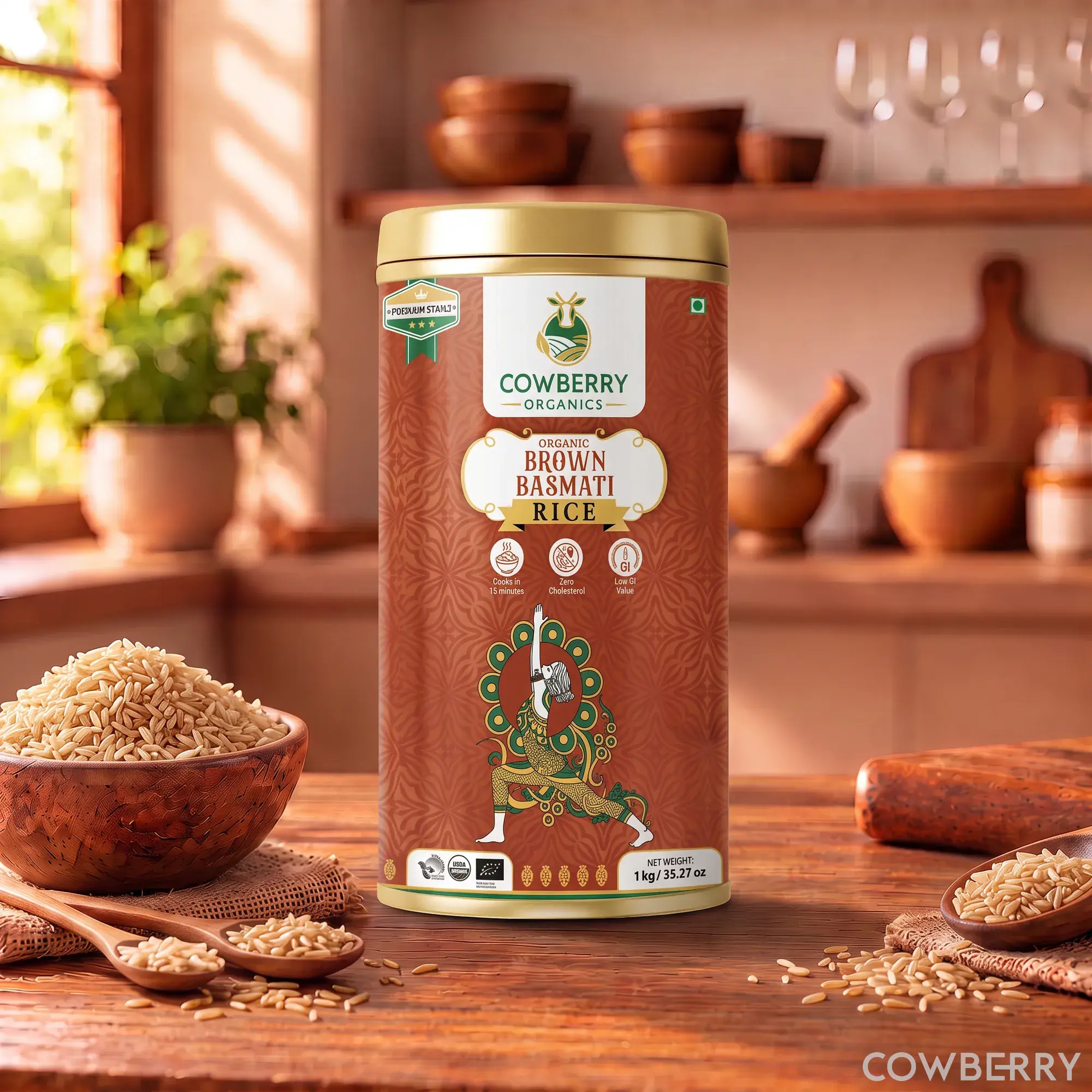
Shop this article
Keep reading
Red rice vs brown rice: the fibre, GI and honest verdict
Red rice vs black rice: nutrition, glycemic index and which to choose
Red rice nutrition per 100g: calories, protein, fibre and GI