by COWBERRY

7 minute read
Red rice vs black rice: nutrition, glycemic index and which to choose

Red rice vs black rice in short: both are pigmented rices, red rice the everyday one and black rice the mineral-dense one. Per 100 g, red rice carries 3.74 g of fibre and averages a GI of 62, while black rice lists 4.2 g of fibre, 113 mg of magnesium and a mean GI of 91. The red rice hub covers the red grain itself.
Verdict in three lines
Red rice is the lighter everyday choice: fewer minerals but a firm grain, and its seven database tests average a GI of 62, in the medium band.
Black rice is the denser one: in the IFCT 2017 and USDA figures it wins the minerals — 113 mg of magnesium against 26.72 mg, 256 mg of potassium against 142 mg, 1.72 mg of zinc against 1.08 mg, all per 100 g — and its three GI tests average 91, the high band.
The honest verdict: neither is the wrong rice. Pick red rice for the everyday plate and the lower mean GI; pick black rice for minerals, colour and occasion dishes, and measure the katori the same either way. The black rice hub tells the darker grain's own story.
Red rice vs black rice: side by side per 100 g
The table below puts both grains side by side per 100 g of raw grain. One caveat first: IFCT 2017 has no entry for red rice, so the red column stands in with its nearest neighbour, parboiled milled rice, while the black column is a USDA FoodData Central record. Read the numbers with that in mind.
Carbohydrate nearly ties at 77.16 g against 77.2 g, and energy runs close at 352 kcal against 370. Protein does too, at 7.81 g against 7.57 g. Where the two separate is fat — 0.55 g against 3.44 g — and the minerals: black rice lists 14 mg of calcium to red rice's 8.11 mg, 1.12 mg of iron to 0.72 mg, and 113 mg of magnesium to 26.72 mg. Fibre is close, 3.74 g against 4.2 g. What the black grain carries that the mineral rows do not show: a 2019 review in Food Chemistry lists anthocyanins, the dark pigments, along with phenolic compounds and fibre among black rice's components. The full per-100 g breakdown of each grain sits on black rice nutrition per 100g and red rice nutrition per 100g.
| Nutrient | Red rice (parboiled, milled) | Black rice (raw) |
|---|---|---|
| Energy (kcal) | 352 | 370 |
| Protein (g) | 7.8 | 7.6 |
| Fat (g) | 0.6 | 3.4 |
| Carbohydrates (g) | 77 | 77 |
| Dietary fibre (g) | 3.7 | 4.2 |
| Iron (mg) | 0.7 | 1.1 |
| Calcium (mg) | 8.1 | 14 |
| Magnesium (mg) | 27 | 113 |
| Potassium (mg) | 142 | 256 |
| Sodium (mg) | 3.2 | 0 |
| Zinc (mg) | 1.1 | 1.7 |
| Folate (mcg) | 9.8 | — |
| Glycemic index (GI) | 62 | 91 |
Per 100 g raw, edible portion. Composition: IFCT 2017 (ICMR-NIN); USDA FoodData Central (Foundation), FDC ID 2710825, NDB 100349. GI: University of Sydney GI database. — means not reported. These are average values for the food; the label on a pack gives the values for that product.
Glycemic index: red rice vs black rice
Both grains' GI entries need the same honest reading: none of them was tested in India. The database holds seven tests of plain cooked red rice — from the UK, Indonesia and Malaysia — spread from 46 to 76, averaging 62, which is the medium band. For black rice there are three tests — two of waxy black rice steamed in China and one of an Indonesian black rice — running from 64 to 109 and averaging 91, which is the high band. The bands are the University of Sydney's: 55 or under is low, 70 or over is high.
Served as a katori, either grain brings about 31 g of carbohydrate, which puts the glycemic load near 19 for red rice and near 28 for black rice. A 2023 review in Foods adds the standard caution: the GI of rice moves with the variety, the processing and what else is on the plate, so take both averages as averages. Low GI rice in India ranks the wider shelf.
Taste and cooking
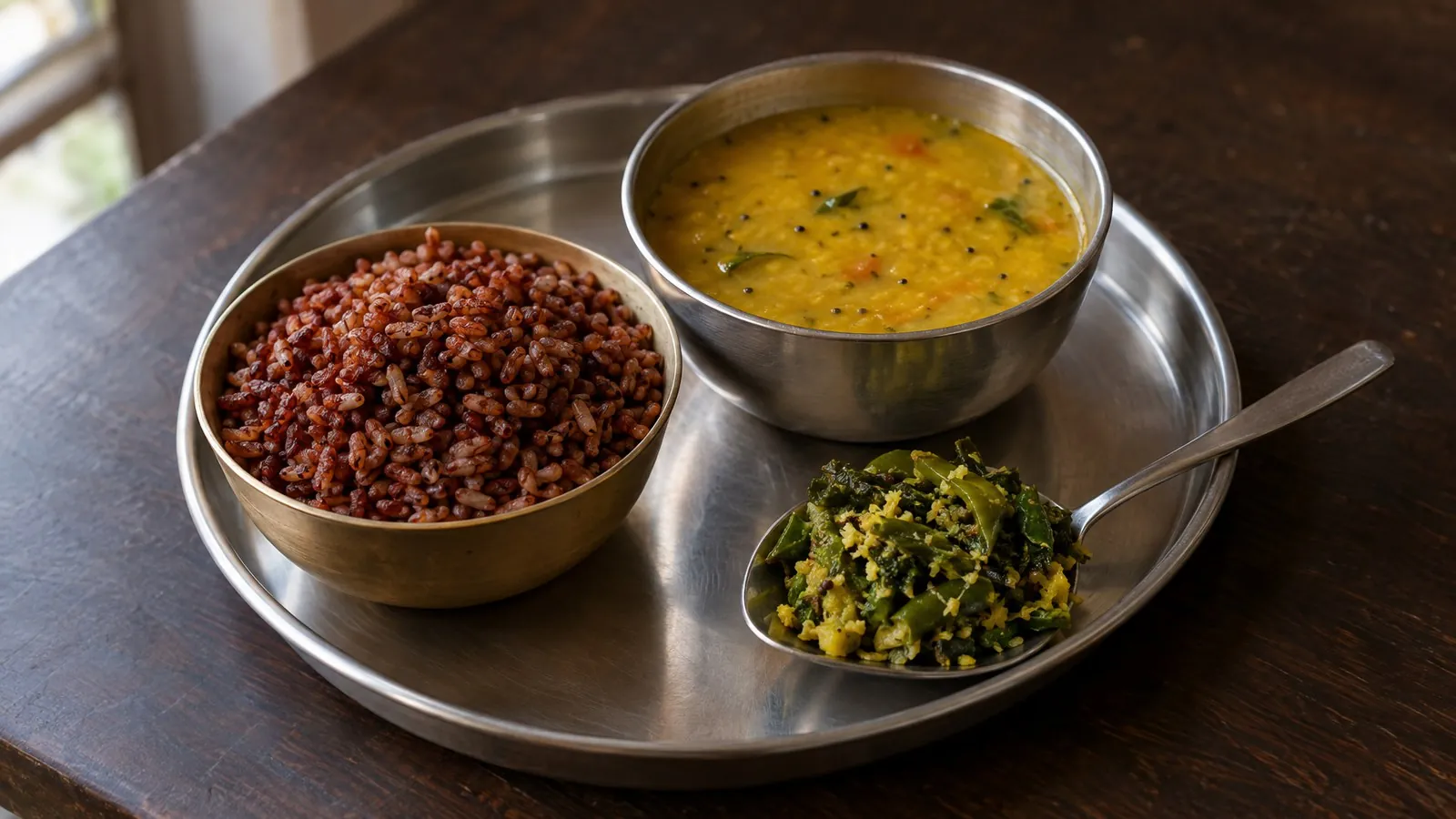
Red rice's pack describes a nutty flavour, a firm texture and a deep red bran layer; black rice has a deep colour and an earthy, mildly nutty flavour. Both keep best in an airtight container in a cool, dry place, and both cook at a 1:2 rice-to-water ratio. Red rice's pack points to 30 to 40 minutes on the stove; black rice's pack says the cooking time varies with the variety. Rinse each grain well before cooking, without repeating the rinse, as the dietary guidelines advise for rice.
In the kitchen the two take different jobs. Red rice's pack notes that cooked red rice works in salads. Black rice's pack suggests rice puddings; the payasam recipe shows the milk-and-jaggery method with sona masoori rice.
Cost and where each fits
No prices are quoted here; what differs between the two grains is where each fits in the kitchen. Red rice is the everyday grain — grown for COWBERRY in Kerala and Tamil Nadu, cooked in 30 to 40 minutes, it slots into the daily dal-chawal and sambar plate. Black rice, grown in Manipur and the Northeast, is the smaller-quantity grain for coloured dishes, desserts and the days you want its minerals. You can use both across the week; measure the katori the same on both.
Which for whom
- Everyday family meals: red rice — its pack describes a firm texture, and the GI tests average 62 against black rice's 91. The red rice hub has the cooking and storage detail.
- More minerals per plate: black rice — magnesium, potassium, iron and zinc all run higher in its USDA record.
- Diabetes: the GI averages are lower for red rice, but neither average replaces a meter reading, and the portion matters either way; talk to your doctor or dietitian about which rice suits your readings. The arithmetic is on is red rice good for diabetes and the darker grain's own page, black rice for diabetes.
- Antioxidants and colour: both are pigmented rices. Seventeen randomised trials on pigmented rice, reviewed in 2023, found one meal lifted plasma antioxidant activity and brought after-meal glucose and insulin down, with small and mixed findings over the longer term — worth knowing, not a reason to overpour.
- Weight: the calorie gap is small — 352 against 370 per 100 g — so the portion matters more than the colour of the bran.
FAQs
What is the difference between red rice and black rice?
The bran colour and the numbers behind it. Red rice has a deep red bran and, in the IFCT 2017 and USDA figures, less fat and fewer minerals; black rice is the darker, denser grain — 4.2 g of fibre against 3.74 g per 100 g, 113 mg of magnesium against 26.72 mg, and a mean GI of 91 against red rice's 62. Both are pigmented rices; the everyday difference is what you want on the plate.
Which red rice is good for health?
The whole, unpolished grain with the red bran intact, cooked plainly — that is the red rice the database's GI tests were run on (the per 100 g figures use IFCT 2017's nearest entry, parboiled milled rice). Look for a pack that lists only the grain, and read any variety the same way: the database's seven GI tests of red rice come from outside India and spread from 46 to 76, so no single variety carries a special health claim.
Is red rice good for diabetes?
Red rice's seven GI tests average 62, the medium band, against black rice's 91, so on these averages red rice is the lower of the two; the portion and what sits around it affect the reading, so talk to your doctor or dietitian about your own plate. The full answer, with portions, is on is red rice good for diabetes.
Is black rice healthier than red rice?
Black rice has more minerals in the figures above: its USDA record lists more magnesium (113 mg against 26.72 mg per 100 g), potassium, iron, calcium and zinc, and a little more fibre. On the GI, red rice's average of 62 beats black rice's 91. Which matters more depends on your plate and your numbers, so neither grain carries the word healthier on its own.
Does black rice have more fibre than red rice?
Yes, a little: 4.2 g of dietary fibre per 100 g against red rice's 3.74 g. Per katori, made from about 40 g of the dry grain, that is about 1.7 g against about 1.5 g. Fibre delays the absorption of carbohydrate and adds to satiety, per the dietary guidelines, so the fibre in either grain counts toward that.
Can red rice and black rice be eaten daily?
Yes, as part of the day's cereals, with the katori measured and the grains rotated across the week. The dietary guidelines ask that at least half of the day's cereals be whole grains, and red rice with its bran intact fits that. A katori here means about 40 g of dry grain; ask your doctor or dietitian how much suits you.
References
- Indian Food Composition Tables (IFCT) 2017, ICMR-National Institute of Nutrition
- Dietary Guidelines for Indians, ICMR-National Institute of Nutrition
- University of Sydney glycemic index database (GI search)
- University of Sydney: about the glycemic index
- USDA FoodData Central
- Ngo TV, Kunyanee K et al. Insights into recent updates on factors and technologies that modulate the glycemic index of rice and its products. Foods, 2023
- Mendoza-Sarmiento D, Mistades EV, Hill AM. Effect of Pigmented Rice Consumption on Cardiometabolic Risk Factors: A Systematic Review of Randomized Controlled Trials. Curr Nutr Rep, 2023
- Ito VC, Lacerda LG. Black rice (Oryza sativa L.): A review of its historical aspects, chemical composition, nutritional and functional properties, and applications and processing technologies. Food Chem, 2019
Shop this article
Keep reading
Red rice vs brown rice: the fibre, GI and honest verdict
Red rice nutrition per 100g: calories, protein, fibre and GI
Is red rice good for diabetes? GI 46 to 76 and the honest verdict