by COWBERRY

8 minute read
Low GI rice in India: which rice has the lowest glycemic index

Low GI rice is not one single grain: in India, the answer depends on the rice on your plate, and the lowest number in the tested list belongs to basmati. This guide puts a GI to basmati, brown, red and black rice, explains what the numbers mean, and shows how to keep a rice meal on the gentle side of the scale. Basics are in our rice (chawal) guide.
What is the glycemic index of rice?
The glycemic index (GI) ranks carbohydrate foods by how much a portion with 50 g of available carbohydrate raises blood glucose over two hours, against pure glucose as the reference (University of Sydney). A GI of 55 or below is low, 70 or above is high, and the space between is medium. Rice is typically regarded as a high or medium-high GI food, though a 2023 review adds that the number can vary with the variety, nutrient composition, processing and accompanying factors. The same grain can therefore land in different bands in different studies, which is why this guide always names the form, the country and the number of entries behind each value. What is the glycemic index of rice, then? No single number: it is a small table, and the next section is that table.
Low GI rice in India: the GI numbers for basmati, brown and red rice
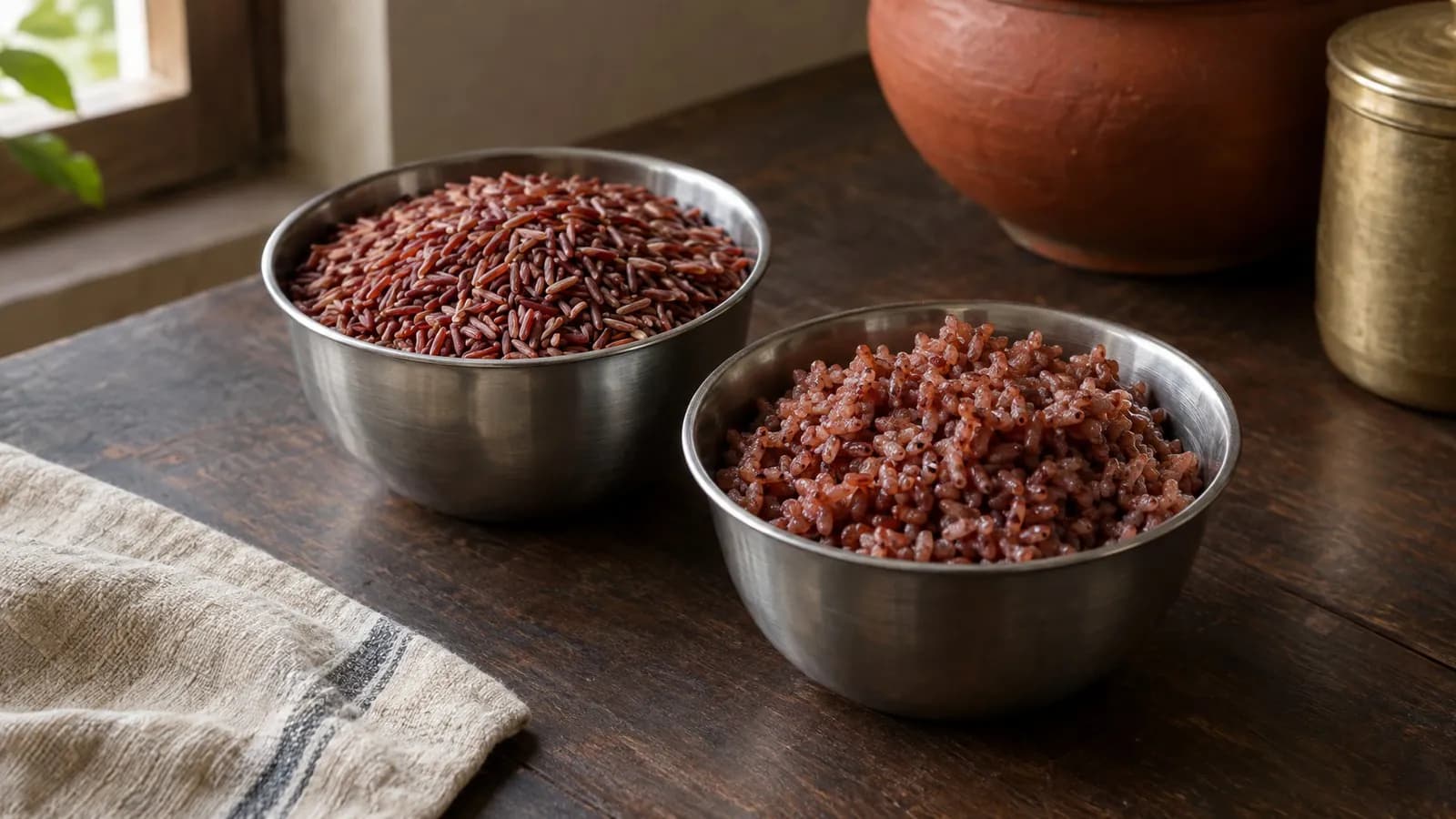
These are the printed GI values for the grains, per the University of Sydney database, with the IFCT 2017 composition behind them. Plain white basmati has one India-tested entry, at a GI of 50; fourteen non-India entries for the same grain run from 50 to 84, averaging 62. Brown rice has one India-tested entry at 58, with eleven other entries from 51 to 95. Red rice carries a mean of 62 across seven entries, all of them from outside India, in a spread of 46 to 76; IFCT 2017 has no red-rice row, so the red rice column of the table shows IFCT's parboiled milled rice, while the GI entries are for unpolished red rice. Read the bands first: low is 55 or below, high is 70 or above. For how each grain cooks and where it fits, see our guide to the types of rice in India.
| Nutrient | White rice (IFCT raw milled rice) | Brown rice (raw) | Red rice (IFCT parboiled milled rice) |
|---|---|---|---|
| Energy (kcal) | 357 | 354 | 352 |
| Protein (g) | 7.9 | 9.2 | 7.8 |
| Fat (g) | 0.5 | 1.2 | 0.6 |
| Carbohydrates (g) | 78 | 75 | 77 |
| Dietary fibre (g) | 2.8 | 4.4 | 3.7 |
| Iron (mg) | 0.7 | 1 | 0.7 |
| Calcium (mg) | 7.5 | 11 | 8.1 |
| Magnesium (mg) | 19 | 94 | 27 |
| Potassium (mg) | 108 | 199 | 142 |
| Sodium (mg) | 2.3 | 3.6 | 3.2 |
| Zinc (mg) | 1.2 | 1.7 | 1.1 |
| Folate (mcg) | 9.3 | 12 | 9.8 |
| Glycemic index (GI) | 50 | 58 | 62 |
Per 100 g raw, edible portion. Composition: IFCT 2017 (ICMR-NIN). GI: University of Sydney GI database. — means not reported. These are average values for the food; the label on a pack gives the values for that product.
Which rice has the lowest glycemic index?
Among the grains in the table, plain basmati wins the low band with its India-tested GI of 50. It is worth pausing on that: a polished white rice holding the lowest number feels counterintuitive, but the single India entry, cooked in a rice cooker with twice its weight of water, is what the database holds, and outside India the same grain averages 62 across fourteen entries. Brown rice follows at 58 with the extra fibre of the whole grain; its one India entry came from pressure-cooked unpolished Bapatla. Red rice at 62 is a medium-band grain on the available entries, all foreign. So for the everyday Indian kitchen the practical low GI rice is basmati, eaten as a measured portion, which the later sections show how to do. For how the grain fares against quinoa, see our quinoa vs rice comparison.
Which rice has the highest glycemic index?
Among the four grains this guide covers, black rice sits highest at 91, the mean of just three entries, none of them from India, in a spread of 64 to 109; its colour alone does not promise a gentle glucose curve. Its USDA record gives 370 kcal per 100 g with 4.2 g of fibre and 3.44 g of fat. In the ICMR-NIN Dietary Guidelines' indicative annexure, plain rice is listed at 78, lemon rice at 79 and curd rice at 65, and the annexure notes that its values are only indicative and may differ with the ingredients and how the dish is made. Indian varieties tested in Chennai tell the same story on the everyday grains: sona masoori, ponni and surti kolam came in at 72, 70 and 77 in one study, all classified as high. If a number is high, portion and pairing matter more, not less.
Why the same rice can test differently: form, country and cooking
Every GI printed above is a mean of specific entries, and entries differ because the rice in the bowl differs; the 2021 international tables of GI values show the same spread across studies. A 2023 review of rice GI names variety, nutrient composition, processing and accompanying factors as things that move the number, and concludes that a rice product's digestibility is process-dependent. Polishing is the surprising non-factor in one Sri Lankan study of basmati: the degree of polishing had no effect on the GI, while red basmati sat in the low band and white basmati in the medium band. Cooling cooked rice and reheating it changes the starch story: in a 2015 trial, cooked white rice cooled at 4 degrees Celsius for 24 hours and reheated measured 1.65 g of resistant starch per 100 g of cooked rice against 0.64 g freshly cooked, and the 15 healthy adults showed a gentler glycemic response. Country matters too: a foreign number is not a promise for the grain in your kitchen.
How to plate rice for a lower glycemic meal
GI is a food number; the meal is what your body sees. Portion first: one katori of cooked rice from 40 g of raw grain is 143 kcal and 31 g of carbohydrate. Then pairing: the guidelines ask that at least 50 percent of the day's cereals be whole grain, and that cereals and pulses meet in a 3:1 ratio, which lifts the protein quality of the meal. Their indicative annexure lists curd rice at 65 and tomato rice at 69, against plain rice at 78. Cooking habits count too: use only enough water for cooking rather than draining off the excess, and avoid repeated washing of rice, which loses some minerals and vitamins. For recipes that pair the grain with dal and vegetables, try curd rice, sambar rice, masala khichdi or jeera rice.
Buying and storing low GI rice
Pick the rice by the grain named in the table, not by a promise on the pack; basmati and brown rice are the two with India-tested low and medium values. Whole grains keep well when they stay dry: the guidelines ask that food grains be dried adequately and stored in airtight containers, to protect them from moisture and from microbes. If sona masoori is your everyday grain, the high GI number is not a reason to quit it; keep the portion measured and the plate-mates dal-heavy. This guide names the entries behind each figure for a reason: a single India test is a different claim from a mean of three foreign tests.
Rice for diabetic patients: what the studies say
GI is one lens on blood glucose, and rice studies add a second. A 2022 systematic review and meta-analysis pooled the cohort evidence: the highest white rice intake was linked with a 16 percent higher risk of type 2 diabetes than the lowest, and above about 300 g of white rice a day, each extra 158 g a day went with a 13 percent higher risk. Brown rice ran the other way, with 11 percent lower risk and 13 percent lower risk for each 50 g a day, though trials swapping brown rice for white gave inconsistent results on risk factors. For pigmented grains, a 2023 review of seventeen randomised trials pooled small reductions with regular intake in fasting glucose (1.60 mg/dL, five trials) and weight (0.23 kg, three trials), with the authors themselves noting the small number of studies. The practical read: grain choice and amount work together, and anyone managing diabetes should set both with their doctor or dietitian. The chawal for weight loss page covers the portion math.
FAQs
Which rice has the lowest glycemic index?
Plain white basmati: its single India-tested entry sits at 50, inside the low band (55 or below). Brown rice follows at 58 with more fibre, and red rice at 62 is medium on foreign entries. Among rice dishes, the ICMR-NIN annexure puts curd rice at 65, below plain rice at 78. Accompanying foods can move the number.
Which rice has low gi index?
Basmati is the rice with a low India-tested value: 50, inside the low band, with unpolished brown rice next at 58 in the medium band. Red rice (62) and black rice (91) test higher, and their entries come from outside India. What you serve with the rice can shift the number further.
Which rice has the highest glycemic index?
Black rice tops the grains in this guide at 91, a mean of three non-Indian entries. Surti kolam measured 77 and sona masoori 72 in the Chennai study, both classified high, and the ICMR-NIN annexure lists lemon rice at 79 against plain rice at 78. High GI is not a ban; it is a portion warning.
What is the glycemic index of rice?
There is no single answer: rice is typically regarded as high or medium-high GI, but the number varies with variety, processing and accompanying factors. The figures here run from India-tested basmati at 50 to black rice at 91, tested outside India, and the ICMR-NIN annexure puts plain rice at 78, with a warning that its values are only indicative.
Which rice is best for diabetic person?
The rice with the lowest tested GI is basmati (50), with brown rice (58) close behind and more fibre; both can be served as measured portions with dal and vegetables. Studies link heavier white rice intake to higher diabetes risk and brown rice to lower risk. Let your doctor or dietitian set the amounts.
Which rice to eat in diabetes?
A measured katori of basmati or brown rice with dal, sabzi and curd follows the guidelines' pattern: the 3:1 cereal-pulse ratio they recommend, plus at least 50 percent of cereals as whole grain. Watch the portion first: one katori from 40 g of raw rice is 143 kcal.
References
- Indian Food Composition Tables (IFCT) 2017, ICMR-National Institute of Nutrition
- Dietary Guidelines for Indians, ICMR-National Institute of Nutrition
- University of Sydney glycemic index database (GI search)
- University of Sydney: about the glycemic index
- USDA FoodData Central
- Atkinson FS, Brand-Miller JC et al. International tables of glycemic index and glycemic load values 2021: a systematic review. Am J Clin Nutr, 2021
- Yu J, Balaji B et al. White rice, brown rice and the risk of type 2 diabetes: a systematic review and meta-analysis. BMJ Open, 2022
- Ngo TV, Kunyanee K et al. Insights into recent updates on factors and technologies that modulate the glycemic index of rice and its products. Foods, 2023
- Somaratne GM, Prasantha BDR, Dunuwila GR, et al. Effect of polishing on glycemic index and antioxidant properties of red and white basmati rice. Food Chem, 2017
- Mendoza-Sarmiento D, Mistades EV, Hill AM. Effect of Pigmented Rice Consumption on Cardiometabolic Risk Factors: A Systematic Review of Randomized Controlled Trials. Curr Nutr Rep, 2023
- Sonia S, Witjaksono F, Ridwan R. Effect of cooling of cooked white rice on resistant starch content and glycemic response. Asia Pac J Clin Nutr, 2015
- Shobana S, Kokila A, Lakshmipriya N, et al. Glycaemic index of three Indian rice varieties. Int J Food Sci Nutr, 2012
Shop this article
Keep reading
Red rice vs brown rice: the fibre, GI and honest verdict
Red rice vs black rice: nutrition, glycemic index and which to choose
Red rice nutrition per 100g: calories, protein, fibre and GI