by COWBERRY

10 minute read
Groundnut oil: names, nutrition, benefits and how to cook with it

Groundnut oil is the cooking oil pressed from peanuts (groundnuts), the seeds of Arachis hypogaea, known as moongphali ka tel in Hindi and peanut oil in much of the world. Everything below runs through its names, nutrition, benefits, side effects, cooking, storage, recipes and buying.
What is groundnut oil
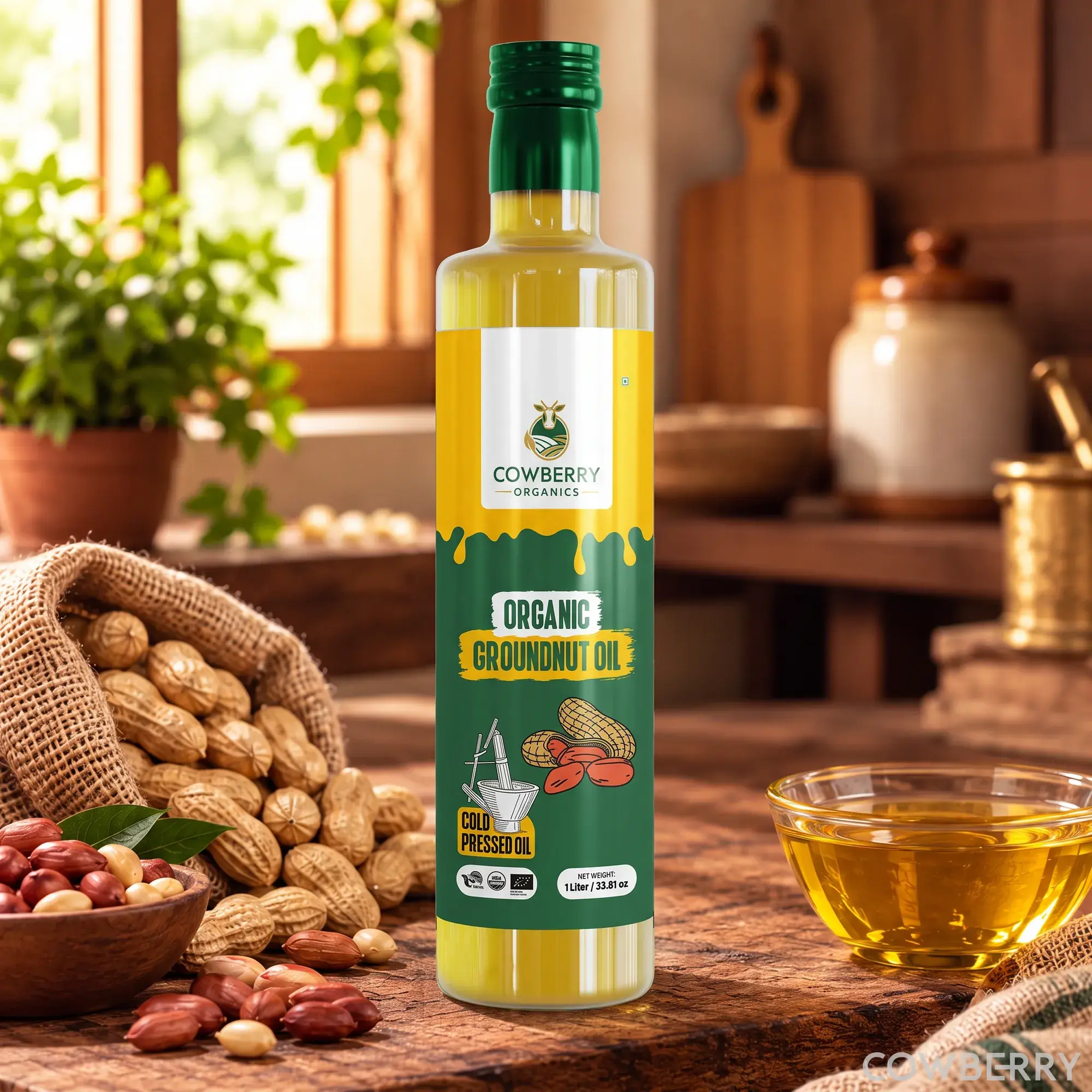
The seed behind the bottle is the groundnut, Arachis hypogaea, a legume a 2014 review places among the world's major oilseed crops, and the oil is pressed from those seeds. India calls the nut groundnut and the bottle moongphali ka tel; much of the world calls both peanut and peanut oil, so what is peanut oil asks about the same oil. At the kitchen level it is a golden cooking fat with a mild, nutty note, made either the cold-pressed way, which the guidelines call kachi ghani, or by refining, and its per-100 g record reads 884 kcal, all of it fat. COWBERRY's own bottle presses organically grown peanuts of Saurashtra (Gujarat) and Andhra Pradesh cold, applies no heat or chemicals and adds nothing afterwards.
Groundnut oil names across India
Groundnut oil kya hai is the same question in Hinglish, and the answer is moongphali ka tel, the Hindi name IFCT 2017 prints for the oil; Urdu shares it. What is peanut oil meets the same bottle from the English side, since peanut and groundnut are two names for one nut, while Sanskrit knows it as bhuchanaka taila. The names table below is the full IFCT 2017 list, from Marathi shengdana tel to Tamil kadalai ennai, and it carries mungfali da tel in Punjabi and china badam tel in Bengali and Assamese, with kadale kaayi enne in Kannada, verusenaga nune in Telugu and kadala enna in Malayalam, so a bottle bought anywhere in the country answers to the same oil.
| Language | Name (romanised) |
|---|---|
| English | Groundnut oil |
| Hindi | Moongphali ka tel |
| Marathi | Shengdana tel |
| Gujarati | Sing tel, Magafali nu tel |
| Punjabi | Mungfali da tel |
| Bengali | China badam tel |
| Odia | China badama tela |
| Assamese | China badam tel |
| Kannada | Kadale kaayi enne, Shenga enne |
| Telugu | Verusenaga nune, Pallila nune |
| Tamil | Kadalai ennai |
| Malayalam | Kadala enna, Nilakkadala enna |
| Urdu | Moongphali ka tel |
| Sanskrit | Bhuchanaka taila |
| Botanical name | Arachis hypogaea |
Source: IFCT 2017 (ICMR-NIN) local-names list. — means no name recorded in the source.
Groundnut oil nutrition per 100g
The table below prints the oil beside cow ghee and mustard oil. Groundnut oil's record is 884 kcal and 100 g of fat per 100 g, its protein, carbohydrate and fibre lines all at 0 g, so every spoon is energy and fatty acids. The fat itself splits 16.9 g saturated, 46.2 g monounsaturated and 32 g polyunsaturated, with 0 mg of cholesterol; oleic acid fills almost the whole monounsaturated column at 44.8 g per 100 g, and linoleic acid, an omega-6 fat, is the entire polyunsaturated column at 32 g, with the omega-3 line reading zero. The components worth naming are 15.7 mg of vitamin E and 207 mg of phytosterols. Mineral-wise the bottle is nearly empty: iron and zinc appear only as traces, and sodium reads 0 mg, so none of the salt in a dish comes from the oil. In spoons, a teaspoon (5 g) carries close to 44 kcal and a tablespoon (15 g) close to 133 kcal, which is what a tempering or a saute pours in. The table's neighbours sit close on energy: cow ghee prints 900 kcal and mustard oil 884 kcal per 100 g, so the choice among them barely moves the day, and the ghee's spoon sums are on the ghee calories per spoon page.
The full per-100 g reading, the tocopherol lines and the spoon sums are on the groundnut oil nutritional value per 100g page.
| Nutrient | Groundnut oil | Cow ghee | Mustard oil |
|---|---|---|---|
| Energy (kcal) | 884 | 900 | 884 |
| Protein (g) | 0 | 0 | 0 |
| Fat (g) | 100 | 100 | 100 |
| Carbohydrates (g) | 0 | 0 | 0 |
| Dietary fibre (g) | 0 | 0 | 0 |
| Iron (mg) | 0 | 0 | 0 |
| Calcium (mg) | 0 | 0 | 0 |
| Magnesium (mg) | 0 | — | 0 |
| Potassium (mg) | 0 | — | 0 |
| Sodium (mg) | 0 | 0 | 0 |
| Zinc (mg) | 0 | — | 0 |
| Folate (mcg) | 0 | — | 0 |
| Vitamin C (mg) | 0 | 0 | 0 |
Per 100 g raw, edible portion. Composition: USDA FoodData Central (SR Legacy), FDC ID 171410, NDB 4042; USDA FoodData Central (SR Legacy), FDC ID 171314, NDB 1323; USDA FoodData Central (SR Legacy), FDC ID 172337, NDB 4583. — means not reported. These are average values for the food; the label on a pack gives the values for that product.
Groundnut oil benefits
The oil's case rests on the kind of fat it carries. Monounsaturated fat leads at 46.2 g per 100 g against 16.9 g of saturates, and the guidelines credit monounsaturated fat with decreasing clot formation and atherogenesis; WHO's 2023 guideline caps the day's saturated fat at 10 percent of energy. A 2014 review calls the fatty acid and antioxidant profile of peanut oil well balanced, a word the oil's vitamin E and phytosterol lines stand behind. The oil also does the general fat job: helping the body take up vitamins A, D, E and K, the fat-soluble four, from the rest of the meal. The cold-pressed route adds one more point: kachi ghani oil is pressed without heat, the guidelines note, so its antioxidants and phytonutrients survive, and that method is the one behind COWBERRY's bottle.
Each benefit, and what the oil does for those vitamins, is covered on the groundnut oil benefits and side effects page.
Groundnut oil side effects and who should limit it
The documented risks are four. A peanut allergy comes first: the guidelines name peanuts among the usual allergy-causing foods and warn that even small amounts can cause severe reactions in some people, and anyone allergic to peanuts should ask a doctor before using the oil. Second, every one of its 32 g of polyunsaturates is omega-6 linoleic acid with no omega-3 beside it, and the guidelines ask that the omega-3 side come from nuts and seeds, soyabeans, grains, millets, green leaves and fenugreek seeds. Third, reheated oil: repeated heating oxidises an oil's polyunsaturates into harmful compounds. Behind that warning sits a 2019 review: cooking oils heated over and over can generate polycyclic aromatic hydrocarbons, some reported as carcinogenic, with several cancers among the associations its collected studies record. Fourth, calories: at 884 kcal per 100 g the bottle is pure fat, and a tablespoon already holds about 133 kcal.
The oil's own cholesterol line is 0 mg; the fat-by-fat argument sits on the is groundnut oil good for cholesterol page.
How to cook with groundnut oil
Groundnut oil suits every station of the Indian kitchen: tadka, saute, shallow fry, the occasional deep fry and raw dressings, where its mild, nutty note carries the lemon and salt. The product notes put a high smoke point on the bottle and count frying, sauteing and deep-frying among the tasks that fit it; sauteing vegetables is the one they single out, because the mild flavour and heat stability suit the pan, though no smoke point temperature appears in any of the records, so none is stated. For everyday meals the guidelines ask cooks to saute, steam, grill, boil or bake, with frying the last choice, and they hold the day's visible fat to 20 to 50 g, four to ten teaspoons per person. Gram for gram, fat gives 9 kcal, and frying's real cost is the extra fat the food soaks up, which the guidelines call the method's main drawback. Method by method, from the first tempering to the baking tin, the peanut oil uses page takes it step by step.
How to store groundnut oil
An unopened bottle belongs somewhere cool and dark, out of direct sunlight, per COWBERRY's product advice, and the guidelines ask buyers to keep to the storage instructions printed on the pack. Heat and light are what that spot keeps out. Once the bottle is open, buy the size the kitchen finishes while the oil is fresh. Used frying oil has its own short rule: filter it, let it finish a curry and consume it within a day or two; it never goes back for a second fry, because used oils deteriorate quickly, the guidelines note.
Groundnut oil recipes to try
Recipes on this site show the oil in its everyday roles. Kanda poha starts with two tablespoons of groundnut oil across four servings, the peanuts fried in it first and the tempering after. Besan chilla uses two tablespoons for its eight chillas, four servings of two chillas each. Poha chivda works three tablespoons through ten servings of the snack mix. On the tawa, moong dal chilla and ragi dosa need only a few drops rubbed on and half a teaspoon trickled around the edge, and in Punjabi chole the onions brown slowly in the oil first, while jowar upma begins with its mustard seeds, urad dal, hing and curry leaves going into hot groundnut oil. Each recipe prints its own amount, and the figures above are what the recipes use, spoon for spoon.
How to buy good groundnut oil
The guidelines spell out what belongs on a pack of oil: its name, its ingredients, its net weight, its brand, the maker's name and address, the date of manufacture, the use-by or expiry date, the storage instructions, the allergen declaration and the shelf-life. Check the FSSAI logo with its licence number, the green dot that marks vegetarian food and the AGMARK mark that oils carry. Oil sold loose from unsealed containers risks adulteration, the guidelines warn, so buy sealed packs from a reliable shop; a label that says pure is making a claim, and label claims are regulated in India. The one home test and the full checklist are on how to identify pure groundnut oil.
COWBERRY's organic cold-pressed groundnut oil is pressed without heat or chemicals from organically grown peanuts and carries the certification India Organic, USDA & EU certified. Choosing between oils is another question: olive oil vs groundnut oil and rice bran oil vs groundnut oil set out each comparison.
FAQs
What is groundnut oil?
Groundnut oil is the oil pressed from groundnuts (peanuts), the seeds of Arachis hypogaea, a legume one 2014 review lists among the world's major oilseed crops. Sold in India as moongphali ka tel and abroad as peanut oil, it is a cooking oil whose record reads 884 kcal and 100 g of fat per 100 g.
How groundnut oil is made?
The seeds are cleaned and the oil pressed out. In the traditional kachi ghani method an expeller presses them with no heat, which keeps the antioxidants and phytonutrients the guidelines describe, though crude-oil compounds can remain; refining removes those, takes away the odour and adds additives while leaving the fatty acids unchanged. COWBERRY's bottle is cold-pressed, no heat or chemicals, nothing added.
Is groundnut oil a seed oil?
Yes: groundnuts are the seeds of Arachis hypogaea, and the oil is pressed from them. Whatever the extraction method, crude or refined, the guidelines put all extracted seed oils in the moderation column; the record reads 884 kcal per 100 g, all of it fat.
Can groundnut oil be used for cooking?
Yes. The product notes set the smoke point high and place frying, sauteing and deep-frying among the tasks the oil handles, with dressings among the cold preparations its mild, nutty flavour carries; no temperature for the smoke point is printed, so none is given. The step-by-step page is peanut oil uses, and the guidelines ask that sauteing, steaming, grilling, boiling and baking come before frying.
Is groundnut oil good for cholesterol?
It carries no cholesterol of its own, at 0 mg per 100 g, and its fat leans monounsaturated, 46.2 g against 16.9 g of saturates, so measured amounts fit inside the visible-fat allowance of 20 to 50 g a day. The full fat-by-fat answer sits on the is groundnut oil good for cholesterol page.
Which groundnut oil is best?
The one whose pack you can verify: a sealed bottle from a reliable shop with the label entries the guidelines require, the FSSAI logo and licence number, the green dot and the AGMARK mark, cold-pressed if you want what pressing without heat preserves. The full checklist and the one home test are on how to identify pure groundnut oil.
Is peanut oil good for health?
As one fat among several, in measured amounts, yes, and the documented risks are the same short list: a peanut allergy, reheated oil and free-poured calories. The full answer, benefit by benefit, is on is peanut oil good for health, the page on the cold-pressed bottle.
What is groundnut oil in hindi?
Moongphali ka tel, the name IFCT 2017 prints for it, and Urdu shares the name. The tables also record the regional forms, shengdana tel in Marathi, magafali nu tel in Gujarati and kadalai ennai in Tamil among them; the names section above has the full list.
References
- Indian Food Composition Tables (IFCT) 2017, ICMR-National Institute of Nutrition
- Dietary Guidelines for Indians, ICMR-National Institute of Nutrition
- USDA FoodData Central (SR Legacy): Oil, peanut, salad or cooking, FDC ID 171410
- Akhtar S, Khalid N, Ahmed I et al. Physicochemical characteristics, functional properties, and nutritional benefits of peanut oil: a review. Crit Rev Food Sci Nutr, 2014
- WHO guideline: saturated fatty acid and trans-fatty acid intake for adults and children (2023)
- Ganesan K, Sukalingam K, Xu B. Impact of consumption of repeatedly heated cooking oils on the incidence of various cancers- A critical review. Crit Rev Food Sci Nutr, 2019
- FSSAI Food Safety and Standards (Advertising and Claims) Regulations 2018, compendium (PDF)
Shop this article
Keep reading
Cold pressed oil benefits: why they survive processing better
Mustard oil vs refined oil: nutrition, cooking and which to choose
Mustard oil omega 3: nutrition, calories and fat per 100g