by COWBERRY

7 minute read
How to identify pure groundnut oil at home with simple tests

How to identify pure groundnut oil at home starts with honesty: exactly one rapid test applies to this oil, and no kitchen check can prove purity on its own. This page gives the official test step by step, what it catches, what to read on the label, and how the groundnut oil guide fits in.
Why groundnut oil gets adulterated, and with what
Groundnut oil sits in the same position as every other edible oil in India: it is sold loose, by the litre, at prices that make mixing tempting. A 2024 review of oil adulteration names the usual offenders: cheaper oils blended in, cottonseed oil, mineral oil and palm olein, all hard to spot at home. The dietary guidelines make the same point from the buyer's side, warning that loose oil from unsealed containers carries the risk of adulteration and telling households to buy oil only from reliable shops. Pure oil, in other words, is as much a supply-chain question as a kitchen one, which is why the test below checks for one specific adulterant and no more.
The one official home test: the butter test for TOCP
The butter test, step by step
The rapid-test guide published under FSSAI's Eat Right India gives exactly one test that applies to groundnut oil: take 2 ml of the oil in a small bowl and add a little amount of yellow butter, still solid. Immediate formation of a red colour means the oil contains TOCP, tri-ortho-cresyl phosphate, a compound that does not belong in edible oil. No colour change, and the oil passes this check. It is a screen for one adulterant, not a certificate of purity.
Why the other oil tests do not apply here
The same DART guide lists two more oil checks: a refrigerator test for coconut oil, which rests on coconut oil solidifying when chilled, and a winterization test meant for refined winterized salad oils. Neither is for groundnut oil, and the DART guide lists no colour, smell or freeze test for groundnut oil, so none is invented. What the fridge does to groundnut oil, or what pure groundnut oil should smell like, is left unclaimed on this page.
Why no kitchen test can prove purity
The butter test catches TOCP and nothing else. A 2024 review of edible-oil adulteration puts the point plainly: the reliable ways to identify what is in an oil are laboratory methods, chromatography and spectroscopy among them, run on high-precision instruments, and it calls consumer awareness the essential complement, not the substitute. That is why this page promises no colour chart and no smell test for groundnut oil: no source lists one. If a blend of cheaper oils is what worries you, the only answer the sources give is the lab. The home test screens for one compound; everything else about an oil's purity is read off the paperwork, which is the next section.
What to read on the label and the bottle
For the rest of the answer, read the label, because the guidelines tell every buyer what a pack of oil must print: the food's name, its ingredients, net weight, brand, maker's name and address, date of manufacture, use-by or expiry date, storage instructions, allergen declaration and shelf-life. Look for the FSSAI logo with the licence number, the green dot that marks a vegetarian food and, for oils, the AGMARK mark, and follow the storage instructions rather than the sales copy. Words such as pure on a label are claims, and claims on food labels in India are regulated, so a seller printing pure is answerable for it rather than free to say it. Buying sealed packs from reliable shops, not loose oil from open tins, closes the loop the guidelines opened in the first section.
Keeping it pure after you buy it
Purity is also a storage question. The guidelines say to follow the storage instructions printed on the pack, and for COWBERRY's bottle the product advice is a cool, dark place out of direct sunlight. Choose a pack size your kitchen will finish before the use-by date on the label, and check that date the way you check the butter test: once at the counter, and once more when the bottle comes home. The home test is a snapshot; storage is what happens in the months after.
How the oil is made matters: cold pressed vs refined
Part of what you are paying for is how the oil left the seed. The guidelines describe kachi ghani, the cold-pressed oil, as pressed without heat so that its antioxidants and phytonutrients survive, while noting it may still hold undesirable compounds of the kind found in crude oil; refining, by contrast, does not alter the fatty acids but modifies the minor components of the oil. On the purity question that distinction is practical: cold-pressed is a method claim, and like the word pure it is a claim the regulations hold the seller to. The fuller contrast is on the cold pressed oil vs refined oil page, and the groundnut oil guide covers the oil in full.
FAQs
How to check groundnut oil purity?
Begin with the one official rapid test: put about 2 ml of the oil in a small bowl, add a little yellow butter that is still solid, and if the mixture turns red at once the oil contains TOCP and should not be used. Beyond that single screen, purity rests on the label, FSSAI logo, licence number, green dot and AGMARK mark, since the DART guide lists no other home test for this oil.
How to check purity of groundnut oil at home?
The home check that applies to groundnut oil is the butter test: about 2 ml of oil plus a little solid yellow butter, and an immediate red colour means TOCP is present. The rest is read, not tested: a sealed pack from a reliable shop, the full label the guidelines require, the FSSAI licence number, the green dot and the AGMARK mark. If the worry is a blend of cheaper oils, the answer is a laboratory, not the kitchen shelf.
Which groundnut oil is best?
Best means what you can verify: a sealed pack from a reliable shop, pressed cold if you want the antioxidants and phytonutrients the guidelines say survive pressing without heat, and a label that carries the maker's name and address, the FSSAI licence number and the green dot. Run the butter test on the first pour, and the bottle has passed every check this page can honestly give it.
How groundnut oil is made?
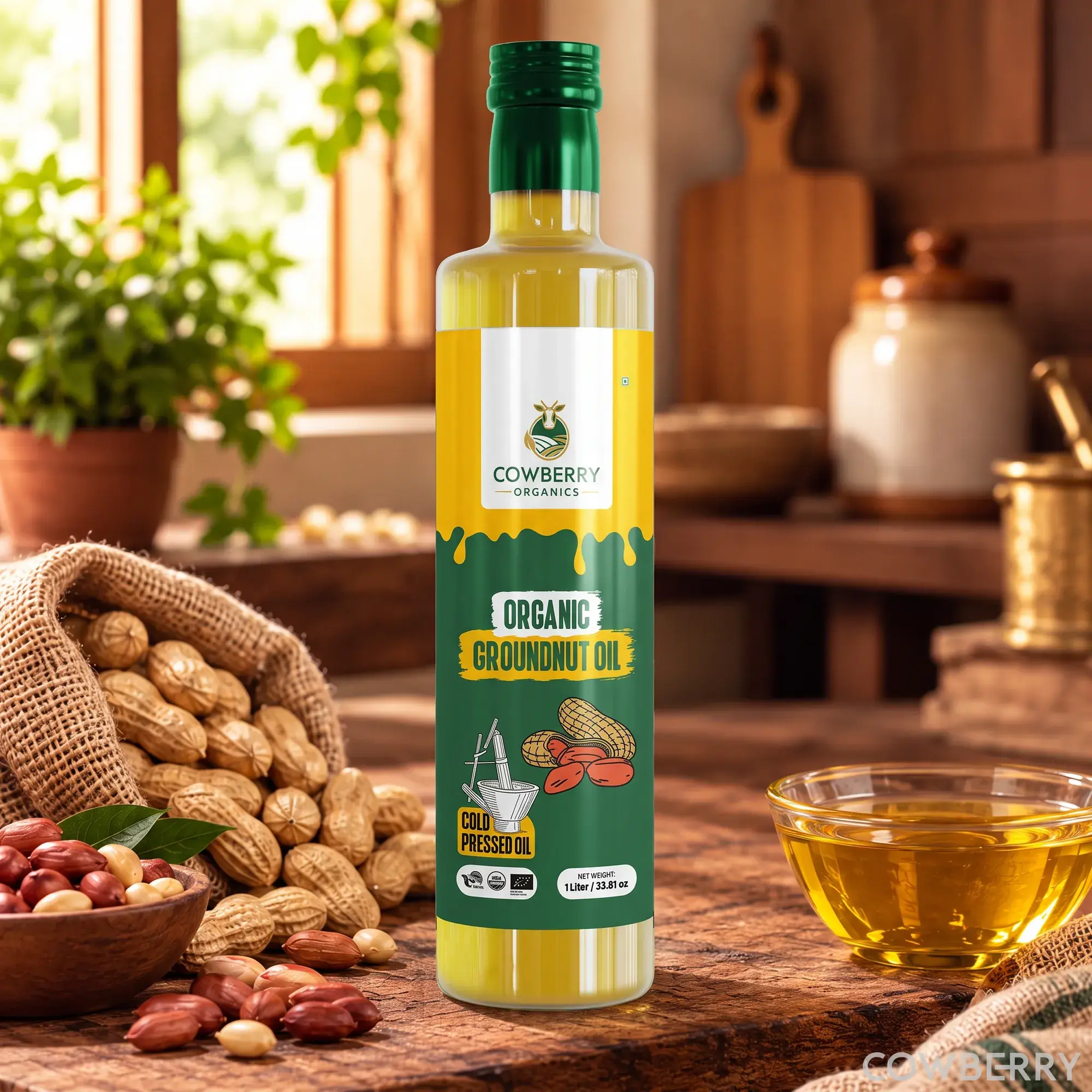
Groundnut oil is pressed from peanuts: traditionally, kachi ghani oil is expeller-pressed without heat, and the guidelines note that this keeps the antioxidants and phytonutrients in the oil while it may still hold undesirable compounds of the kind found in crude oil; refined oil is processed further, which modifies the minor components but not the fatty acids. The COWBERRY bottle is cold-pressed from organically grown peanuts and has nothing added after pressing.
How to identify pure groundnut oil?
Run the one test that applies, then read the label. The test: 2 ml of oil in a bowl with a little solid yellow butter; a red colour appearing immediately means TOCP, and the oil fails. The label: the entries the guidelines require on every pack, the FSSAI logo with its licence number, the green dot and, for oils, the AGMARK mark, bought sealed from a reliable shop rather than loose from an open tin.
Is groundnut oil good for health?
Groundnut oil is a fine everyday fat when it is what the label says it is: pressed from peanuts, with no TOCP, no cheaper oil blended in and a sealed pack from a reliable shop. Health-wise, its fat is mostly monounsaturated, and a 2014 review calls its fatty acid and antioxidant profile well balanced; the amounts that keep it healthy are the guideline's visible-fat limits.
References
- FSSAI DART: Detect Adulteration with Rapid Test, common quick tests for food adulterants at household (Eat Right India)
- Begum A, Jain BP. Adulteration in edible oil (mustard oil) and ghee; detection and their effects on human health. Int J Biochem Mol Biol, 2024
- Dietary Guidelines for Indians, ICMR-National Institute of Nutrition
- Akhtar S, Khalid N, Ahmed I et al. Physicochemical characteristics, functional properties, and nutritional benefits of peanut oil: a review. Crit Rev Food Sci Nutr, 2014
- USDA FoodData Central (SR Legacy): Oil, peanut, salad or cooking, FDC ID 171410
- FSSAI Food Safety and Standards (Advertising and Claims) Regulations 2018, compendium (PDF)
Shop this article
Keep reading
Cold pressed oil benefits: why they survive processing better
Mustard oil vs refined oil: nutrition, cooking and which to choose
Mustard oil omega 3: nutrition, calories and fat per 100g