by COWBERRY

13 minute read
Is peanut oil good for health? 8 cold-pressed groundnut oil benefits

Is peanut oil good for health? It can be, used in measured amounts as one of several fats in a balanced diet. FSSAI lets groundnut oil be labelled as containing MUFA and omega-6 PUFA that help lower cholesterol, and tocopherols, natural antioxidants. It is also pure fat, 884 kcal per 100 g. Here are eight cold-pressed groundnut oil benefits, the side effects and how much to use.
What is cold-pressed groundnut oil?
Groundnut oil, called peanut oil in much of the world, is the oil pressed from the seeds of Arachis hypogaea. A 2014 review of peanut oil in Critical Reviews in Food Science and Nutrition describes the plant as a legume known as both peanut and groundnut, and as one of the world's major oilseed crops. In Hindi and Urdu the oil is moongphali ka tel; the table below gives the IFCT 2017 name in other Indian languages.
Cold-pressed is a word about method. In ICMR-NIN's Dietary Guidelines for Indians, cold-pressed oils go by the Hindi name kachi ghani tel: oils squeezed out of the seed mechanically, in an expeller, with no heat applied along the way. What that method keeps, and what it does not remove, comes up in the benefits and side effects below. For a side-by-side look at the two kinds of oil, read cold pressed oil vs refined oil.
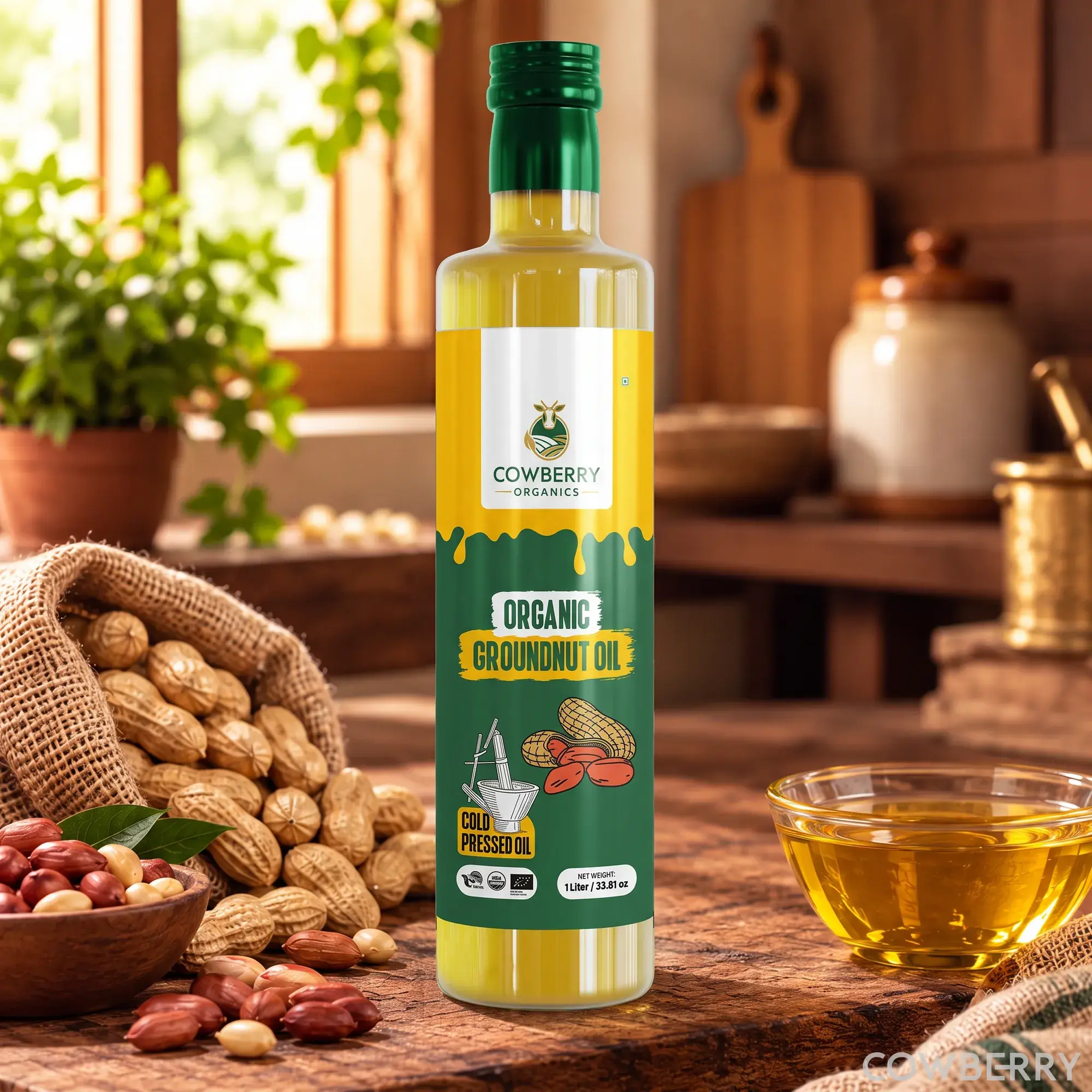
COWBERRY's cold-pressed groundnut oil begins with groundnuts from Saurashtra in Gujarat and from Andhra Pradesh, grown by organic, cow-based methods without synthetic pesticides or fertilizers. The nuts are sun-dried, then pressed by traditional methods without heat or chemicals. The result is a rich golden oil with a deep nutty aroma.
| Language | Name (romanised) |
|---|---|
| English | Groundnut oil |
| Hindi | Moongphali ka tel |
| Marathi | Shengdana tel |
| Gujarati | Sing tel, Magafali nu tel |
| Punjabi | Mungfali da tel |
| Bengali | China badam tel |
| Odia | China badama tela |
| Assamese | China badam tel |
| Kannada | Kadale kaayi enne, Shenga enne |
| Telugu | Verusenaga nune, Pallila nune |
| Tamil | Kadalai ennai |
| Malayalam | Kadala enna, Nilakkadala enna |
| Urdu | Moongphali ka tel |
| Sanskrit | Bhuchanaka taila |
| Botanical name | Arachis hypogaea |
Source: IFCT 2017 (ICMR-NIN) local-names list. — means no name recorded in the source.
Is peanut oil good for health? Benefits 1 to 4, from its fats
The case for groundnut oil rests mostly on the kind of fat it carries.
1. It contains MUFA and omega-6 PUFA
FSSAI's claims regulations list what edible oils may say on labels and in advertisements. For groundnut oil, the permitted wording is that it contains monounsaturated fatty acid (MUFA) and omega-6 polyunsaturated fatty acid (PUFA) that helps lowering of cholesterol. Note the verb: contains, where corn and cottonseed oil may say rich in omega-6. Omega-6 linoleic acid is one of the two essential fatty acids, ICMR-NIN explains; the body cannot make it, so it must come from food. No source we use gives groundnut oil's share of MUFA or PUFA, so this page quotes none.
2. A plant fat to use in place of saturated and trans fats
WHO's 2023 guideline on dietary fats asks adults and children to bring saturated fat down to 10% of total energy. Where saturated fat is cut, WHO makes polyunsaturated fat its strong recommendation as the replacement, with plant-source monounsaturated fat or carbohydrate from fibre-rich foods as conditional options. ICMR-NIN points the same way: limit fats high in saturated fat, such as ghee and butter, and do not cook in vanaspati, which may contain trans fats. Groundnut oil holds both of the unsaturated fats WHO lists, but none of the sources we cite prints its own saturated fat share, so we make no low-saturated-fat claim for it.
3. No cholesterol of its own
There is no dietary cholesterol in groundnut oil. ICMR-NIN says cholesterol in food comes only from animal sources; butter, ghee, whole milk, cream, fatty cheese, fatty meat and eggs supply it, and plant foods carry none. That does not put the oil outside the cholesterol question. The same guidelines explain that the liver makes cholesterol from the carbohydrates and fats in our diet, and that saturated fat raises total and LDL cholesterol in the blood, so the amount of any fat you eat still counts.
4. Tocopherols, natural antioxidants
The second claim FSSAI permits for groundnut oil is that it contains tocopherols, which the schedule calls natural antioxidants. In ICMR-NIN's account, tocopherols sit with tocotrienols and sterols among the minor components of a fat. Most of them are antioxidants that protect the oil itself from rancidity, and they give an oil much of its natural flavour. A 2014 review of peanut oil research describes its fatty acid and antioxidant profile as well balanced. None of our sources states how much tocopherol a spoon of groundnut oil holds.
Cold pressed groundnut oil benefits 5 to 8: from the press to the plate
The next four benefits of cold pressed groundnut oil come from how it is made and how it is used.
5. Pressing without heat keeps its antioxidants
This benefit belongs to the method rather than to groundnut oil as such. ICMR-NIN writes that oils pressed mechanically without heat keep their antioxidants and phytonutrients, because the pressing does not alter the nature of the oil. Refining works differently, the guidelines explain: it leaves the fatty acid composition unchanged but takes away a little of the antioxidants and phytosterols. A cold-pressed and a refined oil from the same seed therefore share their fats and their calories; where they part company is in these minor components, in taste and in how much processing the oil has seen.
6. No additives or preservatives
COWBERRY's product facts state that its groundnut oil has no additives or preservatives, and describe it as raw, natural and minimally processed. The contrast is with refining, which, in ICMR-NIN's words, adds several additives, preservatives included.
7. It helps the body absorb vitamins A, D, E and K
As with any fat, groundnut oil helps the body take up vitamins A, D, E and K, the fat-soluble ones, from the rest of the meal; ICMR-NIN notes that fats promote their absorption. Its note on stir-frying goes further. Cooking cut vegetables fast in a little oil, with no water, holds on to B vitamins, and the added fat improves the uptake of plant compounds, antioxidants and fat-soluble vitamins. A spoon of oil in a vegetable stir-fry is doing nutritional work, not only carrying the tempering.
8. Flavour and a feeling of fullness
Fats add flavour, taste and texture, make a meal more palatable and give a feeling of fullness and satisfaction that delays hunger, ICMR-NIN notes. Cold-pressed groundnut oil brings a flavour of its own: COWBERRY's product facts describe its oil as rich golden in colour, with a deep nutty aroma that comes through in a poha or upma tempering. The fullness comes with calories, though, which is where the numbers below come in.
Groundnut oil nutrition per 100 g and per spoon
For groundnut oil we use the USDA FoodData Central entry for peanut oil used in salads or cooking. Per 100 g it lists 884 kcal and 100 g of fat, with 0 g of protein, carbohydrate and fibre and 0 mg of sodium. Minerals appear only as traces: 0.03 mg of iron and 0.01 mg of zinc. The entry does not say how the oil was pressed, and for calories that makes no difference, since a gram of fat carries the same energy whichever way it left the seed. IFCT 2017, India's food composition tables, lists groundnut oil only in its fatty acid tables, without energy or mineral values, and our reference data has no fatty acid split, so this page gives no saturated, monounsaturated or polyunsaturated percentages.
A 5 g teaspoon of groundnut oil gives about 44 kcal, and a 15 g tablespoon about 133 kcal. Cow ghee, at 900 kcal per 100 g, comes to about 45 kcal a teaspoon, so swapping one for the other changes almost nothing in calories; the spoon-by-spoon comparison is in ghee calories per spoon.
The whole groundnut is a different food. IFCT 2017 gives it 521 kcal, 23.65 g of protein, 10.38 g of fibre and 39.63 g of fat per 100 g, and none of that protein or fibre ends up in the oil. Peanuts are used commercially mainly for oil, notes a 2016 Journal of Food Science and Technology review, and apart from the oil, the by-products of peanut contain proteins, fibres, polyphenols, antioxidants, vitamins and minerals. With no carbohydrate, groundnut oil has no glycaemic index to report.
| Nutrient | Groundnut oil | Groundnuts (whole) | Cow ghee |
|---|---|---|---|
| Energy (kcal) | 884 | 521 | 900 |
| Protein (g) | 0 | 24 | 0 |
| Fat (g) | 100 | 40 | 100 |
| Carbohydrates (g) | 0 | 17 | 0 |
| Dietary fibre (g) | 0 | 10 | 0 |
| Iron (mg) | 0 | 3.4 | 0 |
| Calcium (mg) | 0 | 54 | 0 |
| Magnesium (mg) | 0 | 197 | — |
| Potassium (mg) | 0 | 679 | — |
| Sodium (mg) | 0 | 12 | 0 |
| Zinc (mg) | 0 | 3.2 | — |
| Folate (mcg) | 0 | 91 | — |
| Vitamin C (mg) | 0 | — | 0 |
| Glycemic index (GI) | — | 11 | — |
Per 100 g raw, edible portion. Composition: USDA FoodData Central (SR Legacy), FDC ID 171410, NDB 4042; IFCT 2017 (ICMR-NIN); USDA FoodData Central (SR Legacy), FDC ID 171314, NDB 1323. GI: University of Sydney GI database. — means not reported. These are average values for the food; the label on a pack gives the values for that product.
Groundnut oil side effects and who should limit it
Groundnut oil side effects come mostly from the amount used, from the nut it is pressed from and from how it is heated.
- Calories add up quietly. A tablespoon poured into the kadhai is about 133 kcal of fat, and ICMR-NIN counts cooking oil within a single daily limit for visible fat, set out in the next section.
- Peanut allergy. ICMR-NIN names peanuts among the common allergy-causing ingredients and warns that even small quantities can cause severe reactions in some people. It also lists allergens among the unwanted compounds of crude oil and says cold-pressed oils can contain the same compounds. If you are allergic to peanuts, do not use groundnut oil without your doctor's advice.
- What refining would have removed. The guidelines' list of those crude-oil compounds also includes free fatty acids, gums, waxes, pesticide residues and aflatoxins. That is one reason they ask for every extracted seed oil, crude or refined, to be used in moderation. COWBERRY's groundnuts are grown without synthetic pesticides or fertilizers and sun-dried before pressing, and the moderation advice applies all the same.
- Omega-6 needs a partner. ICMR-NIN asks people to moderate oils high in omega-6 and to eat foods that supply omega-3 ALA, such as nuts and seeds, soyabeans, millets, green leafy vegetables and fenugreek seeds. Its table of omega-3 sources lists mustard or rapeseed, soyabean, canola and flaxseed oils; groundnut oil is not on it. Pairing groundnut oil with an oil such as mustard, one for some dishes and one for others, fits the guidelines' call for a variety of oilseeds. See mustard oil benefits.
- Reheating. Heating oil again and again oxidises its polyunsaturated fat into harmful compounds, the guidelines warn. Strain oil left over from frying, cook it into a curry within two days, keep it apart from the fresh bottle and do not deep-fry in it a second time.
COWBERRY's product facts call the oil's smoke point high, but no source we rely on prints a temperature for it, so this page states none. If you have a peanut allergy, high cholesterol or heart disease, your oil and its amount are worth checking first, so talk to your doctor or dietitian.
How much groundnut oil to use a day
ICMR-NIN gives no separate figure for groundnut oil. Its limit is for visible fat, meaning the oils, vanaspati, butter and ghee used in cooking or added at the table, and it runs from 20 to 50 g per person a day, roughly 4 to 10 teaspoons, depending on how active you are:
| Activity | Women | Men |
|---|---|---|
| Sedentary | 20 g | 30 g |
| Moderate | 30 g | 40 g |
| Heavy | 40 g | 50 g |
In groundnut oil, a 20 g day comes to about 177 kcal and a 30 g day to about 265 kcal. Ghee and butter share the same allowance, and the guidelines would hold them to 1 or 2 teaspoons a day; ghee vs oil explains where each one fits best.
A family example shows how quickly the limit fills. The kanda poha recipe on this site uses 2 tablespoons of groundnut oil for four servings, which is half a tablespoon a plate, about 66 kcal, before lunch and dinner are cooked. To stay inside the limit, the guidelines suggest steaming, boiling, grilling, baking or a quick saute in place of frying where you can. A measuring spoon beside the stove also helps more than guessing from the bottle.
Peanut oil uses in an Indian kitchen
Peanut oil uses in Indian cooking begin with the tadka, and a few recipes on this site show the range:
- Tempering: in kanda poha the raw peanuts are fried in the oil first, and the mustard seeds, curry leaves, green chillies and hing follow in the same oil. Jowar upma starts the same way, with mustard seeds, urad dal, hing and curry leaves in hot groundnut oil.
- On the tawa: for moong dal chilla and ragi dosa, a few drops rubbed over the hot tawa, then half a teaspoon trickled around the edge, are all each one needs.
- Masala base: the onions for Punjabi chole are browned slowly in groundnut oil before the ginger-garlic paste goes in.
- Cold: a spoonful in a salad dressing, where its nutty taste comes through without heat.
Keep the bottle closed and store it in a cool, dark place away from direct sunlight, as COWBERRY's product facts advise.
FAQs
Is cold pressed groundnut oil good for health?
It can be, as one of the fats in a balanced diet and in measured amounts. ICMR-NIN notes that oils pressed without heat keep their antioxidants and phytonutrients, and the claims FSSAI permits for it cover MUFA, omega-6 PUFA and tocopherols. It remains pure fat, 884 kcal per 100 g, so keep it inside your daily visible-fat limit and use other oils alongside it.
Does groundnut oil have protein?
No. The USDA figures show 0 g of protein, carbohydrate and fibre per 100 g of peanut oil; it is entirely fat. The protein stays in the nut. IFCT 2017 gives whole groundnuts 23.65 g of protein and 10.38 g of fibre per 100 g, and ICMR-NIN counts roasted or boiled peanuts among nutritious snack options. For protein, eat the groundnuts themselves and keep the oil for cooking.
What is groundnut oil in Hindi?
In Hindi, groundnut oil is moongphali ka tel, and Urdu uses the same name. IFCT 2017 also records shengdana tel in Marathi, sing tel or magafali nu tel in Gujarati, mungfali da tel in Punjabi, china badam tel in Bengali, kadalai ennai in Tamil, verusenaga nune in Telugu, kadala enna in Malayalam and kadale kaayi enne in Kannada. ICMR-NIN's guidelines call cold-pressed oils kachi ghani tel.
Can groundnut oil be used for deep frying?
Yes. COWBERRY's product facts describe groundnut oil as having a high smoke point that suits frying, though none of our sources gives a temperature for it. ICMR-NIN's advice is about frying habits: fry less often, and never reuse oil for a second round of deep frying, because repeated heating forms harmful oxidised compounds. Strain what is left and use it in a curry within two days.
Is groundnut oil a seed oil?
Yes. It is pressed from the seeds of the groundnut plant, a legume that the 2014 peanut oil review places among the world's major oilseed crops. ICMR-NIN's guidelines say that all extracted seed oils, crude or refined, should be used in moderation, because extraction can leave undesirable substances in them, and that includes cold-pressed groundnut oil.
Is groundnut oil good for cholesterol?
As a plant oil it carries no cholesterol, and FSSAI's permitted label wording credits its MUFA and omega-6 PUFA with helping to lower cholesterol. WHO's 2023 guideline strongly recommends polyunsaturated fat in place of saturated fat, and plant monounsaturated fat conditionally. More is not better, though: at 884 kcal per 100 g, it counts toward your visible-fat limit. If your cholesterol is high or you take medicine for it, talk to your doctor or dietitian.
References
- FSSAI Food Safety and Standards (Advertising and Claims) Regulations 2018, compendium (PDF)
- Dietary Guidelines for Indians, ICMR-National Institute of Nutrition
- WHO guideline: saturated fatty acid and trans-fatty acid intake for adults and children (2023)
- Akhtar S, Khalid N, Ahmed I et al. Physicochemical characteristics, functional properties, and nutritional benefits of peanut oil: a review. Crit Rev Food Sci Nutr, 2014
- Arya SS, Salve AR, Chauhan S. Peanuts as functional food: a review. J Food Sci Technol, 2016
- USDA FoodData Central
- Indian Food Composition Tables (IFCT) 2017, ICMR-National Institute of Nutrition
- University of Sydney glycemic index database (GI search)
Shop this article
Keep reading
Cold pressed oil benefits: why they survive processing better
Mustard oil vs refined oil: nutrition, cooking and which to choose
Mustard oil omega 3: nutrition, calories and fat per 100g