by COWBERRY

7 minute read
Groundnut oil nutritional value per 100g: calories and fat

Groundnut oil nutritional value per 100g is 884 kcal and 100 g of fat, with protein, carbohydrate and fibre all at 0 g, as the USDA FoodData Central record for peanut oil prints it. This page gives the full table, the fat split and the per-spoon figures, with the groundnut oil hub for the oil itself.
Groundnut oil nutrition facts per 100g: the table
The groundnut oil row is the USDA FoodData Central record for peanut oil used in salads or cooking: 884 kcal per 100 g, of which all 100 g is fat, with protein, carbohydrate and fibre at 0 g. India's food composition tables, IFCT 2017, print groundnut oil only inside the fatty-acid tables, so no energy, mineral or vitamin row exists there, and the USDA record carries the full composition below. Beside the oil sit the two other fats with printed rows in the same reference set: cow ghee at 900 kcal per 100 g and mustard oil at 884 kcal.
Three things matter when you read the table. The figures are per 100 g of oil, while a kitchen measures in spoons, so the per-spoon sums in the next section do the conversion. The zeros are not missing data: an oil is fat, with no protein, carbohydrate or fibre to report. And the pressing method is not part of the record; its numbers describe the oil as sold.
| Nutrient | Groundnut oil | Cow ghee | Mustard oil |
|---|---|---|---|
| Energy (kcal) | 884 | 900 | 884 |
| Protein (g) | 0 | 0 | 0 |
| Fat (g) | 100 | 100 | 100 |
| Carbohydrates (g) | 0 | 0 | 0 |
| Dietary fibre (g) | 0 | 0 | 0 |
| Iron (mg) | 0 | 0 | 0 |
| Calcium (mg) | 0 | 0 | 0 |
| Magnesium (mg) | 0 | — | 0 |
| Potassium (mg) | 0 | — | 0 |
| Sodium (mg) | 0 | 0 | 0 |
| Zinc (mg) | 0 | — | 0 |
| Folate (mcg) | 0 | — | 0 |
| Vitamin C (mg) | 0 | 0 | 0 |
Per 100 g raw, edible portion. Composition: USDA FoodData Central (SR Legacy), FDC ID 171410, NDB 4042; USDA FoodData Central (SR Legacy), FDC ID 171314, NDB 1323; USDA FoodData Central (SR Legacy), FDC ID 172337, NDB 4583. — means not reported. These are average values for the food; the label on a pack gives the values for that product.
Groundnut oil calories per 100g and per spoon
Groundnut oil calories per 100g come to 884 kcal, and smaller amounts scale straight down. A teaspoon (5 g) holds about 44 kcal and a tablespoon (15 g) about 133 kcal; a tadka spoon for the family dal is the 44 kcal figure, and the two tablespoons that cook kanda poha across four servings come to half a tablespoon a plate, about 66 kcal. Gram for gram, fat gives 9 kcal, as the dietary guidelines print it, and the oil's 884 kcal per 100 g is the record's own measure for its 100 g of fat.
Cow ghee prints 900 kcal per 100 g against the oil's 884 kcal, so a switch between the two barely moves the day's energy, and the guidelines count both inside one visible-fat allowance of 20 to 50 g a day; the spoon-by-spoon ghee arithmetic is on the ghee calories per spoon page. Frying adds one more cost: the guidelines name the extra fat a fried food takes on as the method's main drawback.
The fat split: saturated, monounsaturated and polyunsaturated
Per 100 g, groundnut oil carries 16.9 g of saturated fat, 46.2 g of monounsaturated fat and 32 g of polyunsaturated fat, as the USDA record prints them. The monounsaturated column is nearly all oleic acid, at 44.8 g, and the polyunsaturated column is entirely linoleic acid, 32 g of omega-6 fat, with the omega-3 line at 0 g. Cholesterol reads 0 mg, which fits the guidelines' point that cholesterol is found only in animal-source foods.
The guidelines read the two kinds of fat as pulling in opposite directions: monounsaturated fat is credited with decreasing clot formation and atherogenesis, while saturated fat is listed for raising serum total and LDL-cholesterol, increasing inflammation and favouring clot formation. Groundnut oil leans monounsaturated at 46.2 g against 16.9 g, but the 16.9 g still counts toward the day's saturated-fat line. The cholesterol question in full is on is groundnut oil good for cholesterol.
Vitamin E, phytosterols and the mineral small print
Three lines in the USDA record carry the components worth naming. Vitamin E (alpha-tocopherol) reads 15.7 mg per 100 g, with gamma-tocopherol at 15.9 mg and the beta and delta forms at 0.46 mg and 1.37 mg; phytosterols, the plant sterols, read 207 mg. A 2014 review of peanut oil calls the oil's fatty acid and antioxidant profile well balanced.
The minerals are trace-level: iron 0.03 mg and zinc 0.01 mg per 100 g, with calcium, magnesium, potassium and sodium at 0 mg. The oil adds no meaningful minerals to a meal, and the 0 mg of sodium means the salt in the food is the salt you add. The same record prints 0 g of protein: the protein groundnuts are known for stays in the nut, at 23.65 g per 100 g of whole groundnuts in IFCT 2017, not in the bottle.
Glycemic index: why no figure applies
Groundnut oil has no glycemic index figure, and none is given here. The University of Sydney defines the glycemic index as a ranking of carbohydrates by the extent to which they raise blood sugar levels after eating, and the oil's carbohydrate reads 0 g per 100 g, so there is nothing to rank. What the oil does add to a counted plate is energy and fat, and the 884 kcal per 100 g counts in full, so the oil is portioned like any other fat rather than ignored. What each component does, benefit by benefit, is on the groundnut oil benefits and side effects page, and the groundnut oil hub carries the oil's names and storage.
FAQs
Does groundnut oil have protein?
No. The record prints 0 g of protein per 100 g, and 0 g of carbohydrate and fibre beside it, so the oil is fat and little else. The protein groundnuts are known for stays in the nut, which carries 23.65 g per 100 g in IFCT 2017, so take the oil for cooking and the groundnuts themselves, or the dal on the plate, for protein.
Is groundnut oil good for diabetes and cholesterol?
For cholesterol: the record prints 0 mg of cholesterol per 100 g and 46.2 g of monounsaturated fat against 16.9 g of saturates, so measured amounts fit inside the visible-fat allowance. For diabetes: the oil's carbohydrate is 0 g per 100 g and no glycemic index figure applies, so a diabetic kitchen counts its 884 kcal per 100 g like any other fat. The amount that suits one person's diabetes care is a doctor's or dietitian's answer.
Is groundnut oil a seed oil?
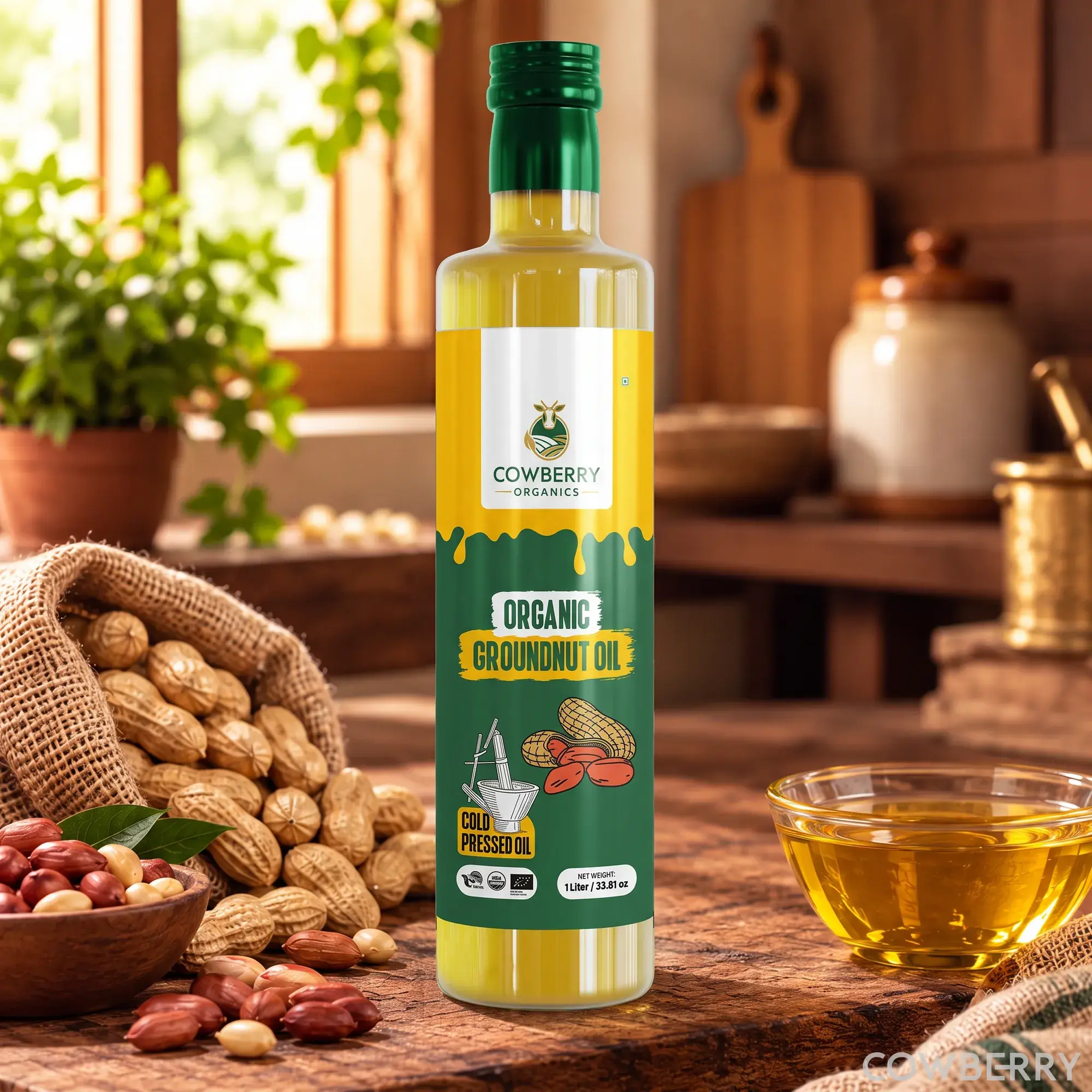
Yes: it is pressed from groundnuts, the seeds of Arachis hypogaea, the botanical name IFCT 2017 prints. The guidelines' rule covers every extraction method: crude or refined, all extracted seed oils are for moderate use. COWBERRY's bottle is cold-pressed from the seeds, pressed without heat or chemicals.
Can groundnut oil be used for deep frying?
Yes. The product notes describe a high smoke point and list deep frying among the uses it suits, without printing a smoke point temperature, so none is given. What follows from the guidelines is about the leftover, not the method: oil used once for frying is filtered, may finish a curry and is consumed within a day or two, never used for a second fry. A tablespoon still holds about 133 kcal whichever way the food is cooked.
Is groundnut oil healthy?
Yes, as one of several fats, in measured amounts: 46.2 g of monounsaturated fat against 16.9 g of saturates, 0 mg of cholesterol and 15.7 mg of vitamin E per 100 g are the figures behind that reading. The other half of the record is 884 kcal per 100 g, all of it fat, so the amount you pour, not the bottle, settles the reading.
Which groundnut oil is good for health?
The one whose label you can check: the maker's name and address, the FSSAI logo with its licence number and the green dot, bought sealed rather than loose from an open tin. Cold-pressed or refined, the guidelines note that refining alters the minor components of an oil, not its fatty acids, so the fat the bottle holds is the same fat either way; the method-by-method contrast is on the cold pressed oil vs refined oil page.
References
- Indian Food Composition Tables (IFCT) 2017, ICMR-National Institute of Nutrition
- Dietary Guidelines for Indians, ICMR-National Institute of Nutrition
- USDA FoodData Central (SR Legacy): Oil, peanut, salad or cooking, FDC ID 171410
- University of Sydney: about the glycemic index
- Akhtar S, Khalid N, Ahmed I et al. Physicochemical characteristics, functional properties, and nutritional benefits of peanut oil: a review. Crit Rev Food Sci Nutr, 2014
Shop this article
Keep reading
Cold pressed oil benefits: why they survive processing better
Mustard oil vs refined oil: nutrition, cooking and which to choose
Mustard oil omega 3: nutrition, calories and fat per 100g