by COWBERRY

8 minute read
Groundnut oil side effects, benefits and how much is safe

Groundnut oil side effects come from four places: a peanut allergy, its omega-6 line with no omega-3 beside it, reheated oil and free-poured calories. For most people, in measured amounts, it is an ordinary cooking fat, and the benefits below come from the same composition record; the groundnut oil hub covers the oil itself.
Groundnut oil benefits, one component at a time
The benefits sit in the oil's components, so this section takes them one by one, with the numbers from the USDA FoodData Central record for peanut oil.
Mostly monounsaturated fat
Per 100 g the oil carries 46.2 g of monounsaturated fat against 16.9 g of saturated fat and 32 g of polyunsaturated fat, a monounsaturated lead of about 2.7 to 1. The guidelines assign the monounsaturated share one direction, decreasing clot formation and atherogenesis, and the saturated share the other: raising serum total and LDL-cholesterol, adding inflammation and enhancing the tendency of clots to form. WHO's 2023 guideline caps saturated fat at 10 percent of daily energy.
No cholesterol of its own
The same record prints 0 mg of cholesterol per 100 g, and the guidelines state that cholesterol is found only in animal-source foods, so the oil adds none to the plate. The honest second half: the guidelines tie the blood reading to the day's saturated fat, not to this one bottle, and the oil's 16.9 g of saturates simply joins that total.
Vitamin E and phytosterols in the bottle
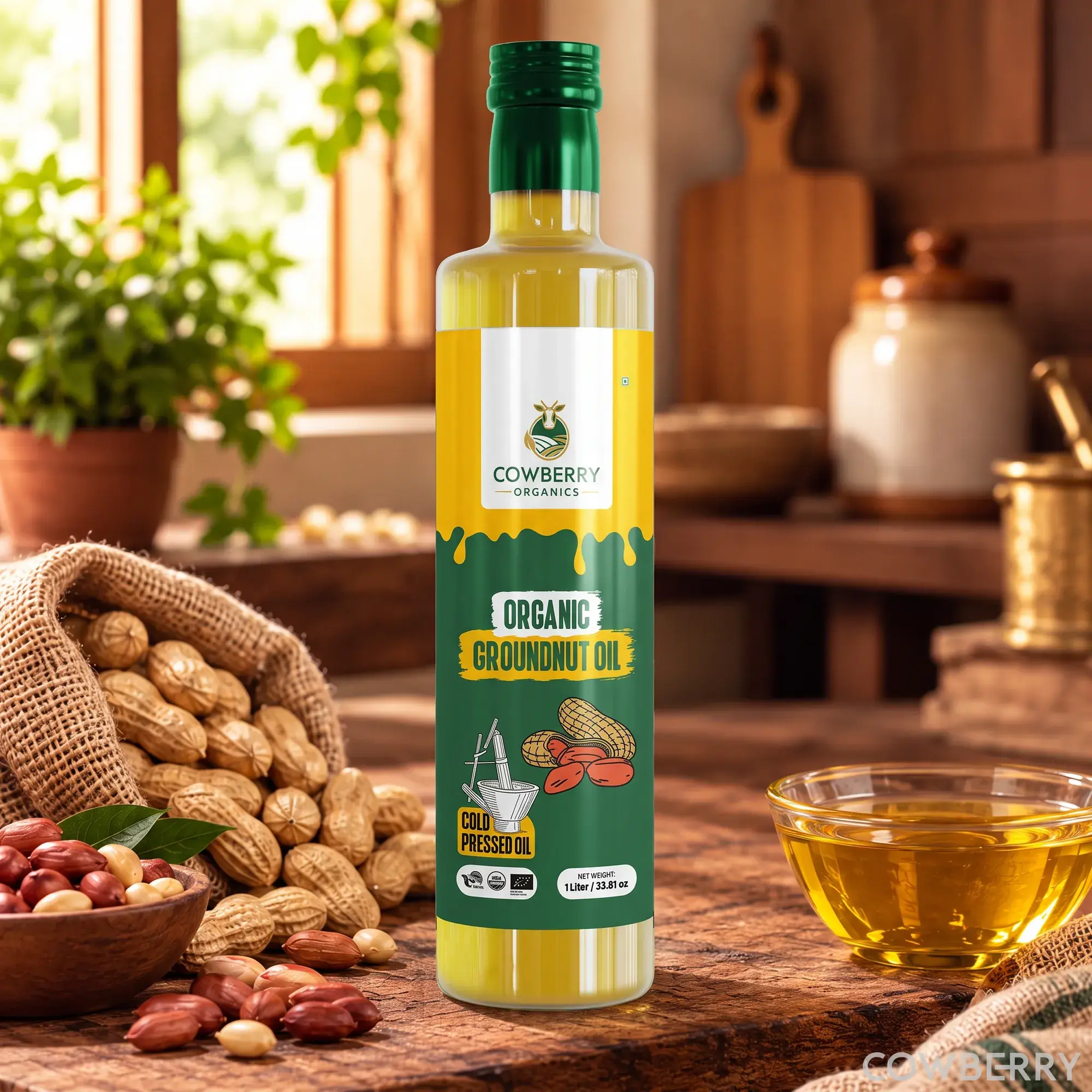
The oil carries 15.7 mg of vitamin E (alpha-tocopherol) and 207 mg of phytosterols per 100 g, and a 2014 review sums the profile up as well balanced in fatty acids and antioxidants. These components travel with the fat rather than being the fat, and the cold-pressed question enters here: the guidelines describe kachi ghani oil as pressed without heat so its antioxidants and phytonutrients survive, and COWBERRY's groundnut oil is cold-pressed from organically grown peanuts with no heat or chemicals.
A cooking fat that carries flavour and fat-soluble vitamins
Like any fat, the guidelines note, groundnut oil promotes the absorption of the fat-soluble vitamins A, D, E and K from the rest of the meal, and fats contribute energy, texture, flavour and palatability and a feeling of fullness that delays hunger. The oil's own note is mild and nutty, which the product notes say suits salad dressings and cold preparations as well as the stove.
Groundnut oil side effects: what they are and who should limit it
For most people, groundnut oil in measured amounts is an ordinary cooking fat. The side effects below are the documented ones, and each is attached to who should limit the oil and why.
- A peanut allergy. The dietary guidelines list peanuts among the common allergy-causing ingredients and warn that consuming even small quantities can cause severe reactions in some people. They also list allergens among the undesirable compounds crude vegetable oils may carry, and note that cold-pressed (kachi ghani) oils may hold similar compounds. Anyone allergic to peanuts should ask a doctor before using the oil.
- Omega-6 without omega-3. All 32 g of the oil's polyunsaturates are linoleic acid, an omega-6 fat, and the omega-3 line in the record reads zero. The guidelines ask people to moderate the use of oils high in omega-6 polyunsaturates and to cover the omega-3 need from nuts and seeds, soyabeans, grains and millets, green leafy vegetables and fenugreek seeds; their table of vegetable oils that supply alpha-linolenic fat lists mustard or rapeseed, soyabean, canola and flaxseed, and groundnut oil is not on it. Pairing the oil with those foods keeps the balance on the plate.
- Reheated oil. The guidelines warn that repeated heating oxidises the polyunsaturated fat in an oil into harmful compounds and may raise the risk of cardiovascular diseases and cancer, and a 2019 review of repeatedly heated cooking oils reports polycyclic aromatic hydrocarbons, some of them carcinogenic, with associations with lung, colorectal, breast and prostate cancers in the studies it collected. The household rule: oil used for frying is filtered, kept for curry preparation only and consumed in a day or two, never put through a second fry.
- Calories that add up quietly. At 884 kcal per 100 g, a free-poured spoon here and a ladle there fills the day's visible-fat allowance of 20 to 50 g quietly, and a tablespoon is already about 133 kcal. The measuring tool is the spoon, not the bottle.
- Saturates still count. The oil's 16.9 g of saturated fat per 100 g is a real part of the profile, not a token one, and it joins the day's saturated-fat total like any other fat's.
The cholesterol detail is on is groundnut oil good for cholesterol.
How much groundnut oil per day
The guidelines give no separate figure for groundnut oil; the oil sits inside the allowance for visible fat, the oils and fats used in cooking or added at the table, which runs 20 to 50 g per person a day, set by activity, four to ten teaspoons. Sedentary adults sit at the lower end, 20 g a day for women and 30 g for men; adult men in moderate and heavy activity may take up to 40 g and 50 g, and adult women up to 30 g and 40 g. In groundnut oil, a 20 g day is about 177 kcal and a 30 g day about 265 kcal; a teaspoon (5 g) is about 44 kcal and a tablespoon (15 g) about 133 kcal. Ghee and butter share the same allowance and are held to 1 to 2 teaspoons a day, or avoided where possible; for a 2000 kcal day, the guidelines say not more than 27 to 30 g of visible fat is needed.
The spoon is the control: pour from a measuring spoon, not from the bottle, and the day stays countable. The per-spoon table is on the groundnut oil nutritional value per 100g page.
How to use groundnut oil so the side effects stay small
Method beats amount for most of the side effects above. For everyday cooking the guidelines list sauteing, steaming, grilling, boiling and baking to be used instead of frying, and their frying rules are about any oil: heat it once, filter what is left, and let it finish a curry within a day or two rather than return to the kadhai. The bottle belongs closed and out of the light: COWBERRY's product advice is to store it cool and dark, away from direct sunlight,.
Recipes that use the oil inside these habits: kanda poha takes two tablespoons across four servings, besan chilla two tablespoons for the eight chillas, and poha chivda stretches three tablespoons across ten servings. The method-by-method page is peanut oil uses, and the groundnut oil hub guide covers the oil itself, names and all.
FAQs
Why groundnut oil is bad for you?
The documented risks attach mainly to who uses the oil and how. They are a peanut allergy, since the oil is pressed from peanuts; repeated heating, which oxidises its polyunsaturates into harmful compounds; and free-poured calories, at 884 kcal per 100 g. Measuring the amount and finishing leftover frying oil in a curry within a day or two, as the guidelines advise, deals with the last two; the allergy risk stays for anyone allergic to peanuts.
Does groundnut oil increase cholesterol?
Not by what it contains: the record's cholesterol line reads 0 mg, and the guidelines note that cholesterol is found only in animal-source foods. Saturated fat is known to raise serum total and LDL-cholesterol, the guidelines say, and the oil contributes 16.9 g of saturates per 100 g, so the working answer is to count it inside the WHO line of 10 percent of daily energy rather than fear the bottle.
Is groundnut oil good for health?
In measured amounts, as one fat among several, yes: 46.2 g of monounsaturated fat against 16.9 g of saturates per 100 g, 0 mg of cholesterol and 15.7 mg of vitamin E are the numbers behind that reading. It remains pure fat, 884 kcal per 100 g, so the portion decides. The fuller argument for the cold-pressed bottle is on the is peanut oil good for health page.
Can groundnut oil be used for cooking?
Yes, across the Indian stove. The product notes describe a high smoke point that suits frying, sauteing and deep frying, and a mild, nutty flavour for dressings and cold preparations, though no smoke point temperature is printed, so none is given. The guidelines ask for sauteing, steaming, grilling, boiling or baking in place of frying where possible, and for every oil to stay inside the visible-fat allowance.
Is groundnut oil good for diabetic patient?
It brings no carbohydrate to the plate, at 0 g per 100 g, and no glycemic index figure applies to an oil. What a diabetic kitchen still counts is energy: 884 kcal per 100 g, and the oil sits inside the same visible-fat allowance as any other fat. Ask your doctor or dietitian how much fat your own diabetes plan allows.
Difference between groundnut oil and refined oil?
The seed is the same; the process differs. Refining leaves the fatty acids unchanged but removes the unwanted compounds of crude oil, takes away the odour and adds additives, preservatives among them, while cold-pressed (kachi ghani) oil is pressed without heat and keeps its antioxidants and phytonutrients, though it may still hold crude-oil compounds. The USDA record reads 884 kcal per 100 g.
References
- Indian Food Composition Tables (IFCT) 2017, ICMR-National Institute of Nutrition
- Dietary Guidelines for Indians, ICMR-National Institute of Nutrition
- WHO guideline: saturated fatty acid and trans-fatty acid intake for adults and children (2023)
- Akhtar S, Khalid N, Ahmed I et al. Physicochemical characteristics, functional properties, and nutritional benefits of peanut oil: a review. Crit Rev Food Sci Nutr, 2014
- USDA FoodData Central (SR Legacy): Oil, peanut, salad or cooking, FDC ID 171410
- Ganesan K, Sukalingam K, Xu B. Impact of consumption of repeatedly heated cooking oils on the incidence of various cancers- A critical review. Crit Rev Food Sci Nutr, 2019
Shop this article
Keep reading
Cold pressed oil benefits: why they survive processing better
Mustard oil vs refined oil: nutrition, cooking and which to choose
Mustard oil omega 3: nutrition, calories and fat per 100g