by COWBERRY

6 minute read
Rice bran oil vs groundnut oil: nutrition, taste and the verdict

Rice bran oil vs groundnut oil is a contest between an oil the guidelines credit with oryzanol and tocotrienols, and an oil pressed from peanuts. What separates them on paper is one named claim, and on the tongue it is taste. Here are the documented numbers, and the gaps; the groundnut oil hub guide has the oil's names and nutrition.
Where each oil comes from
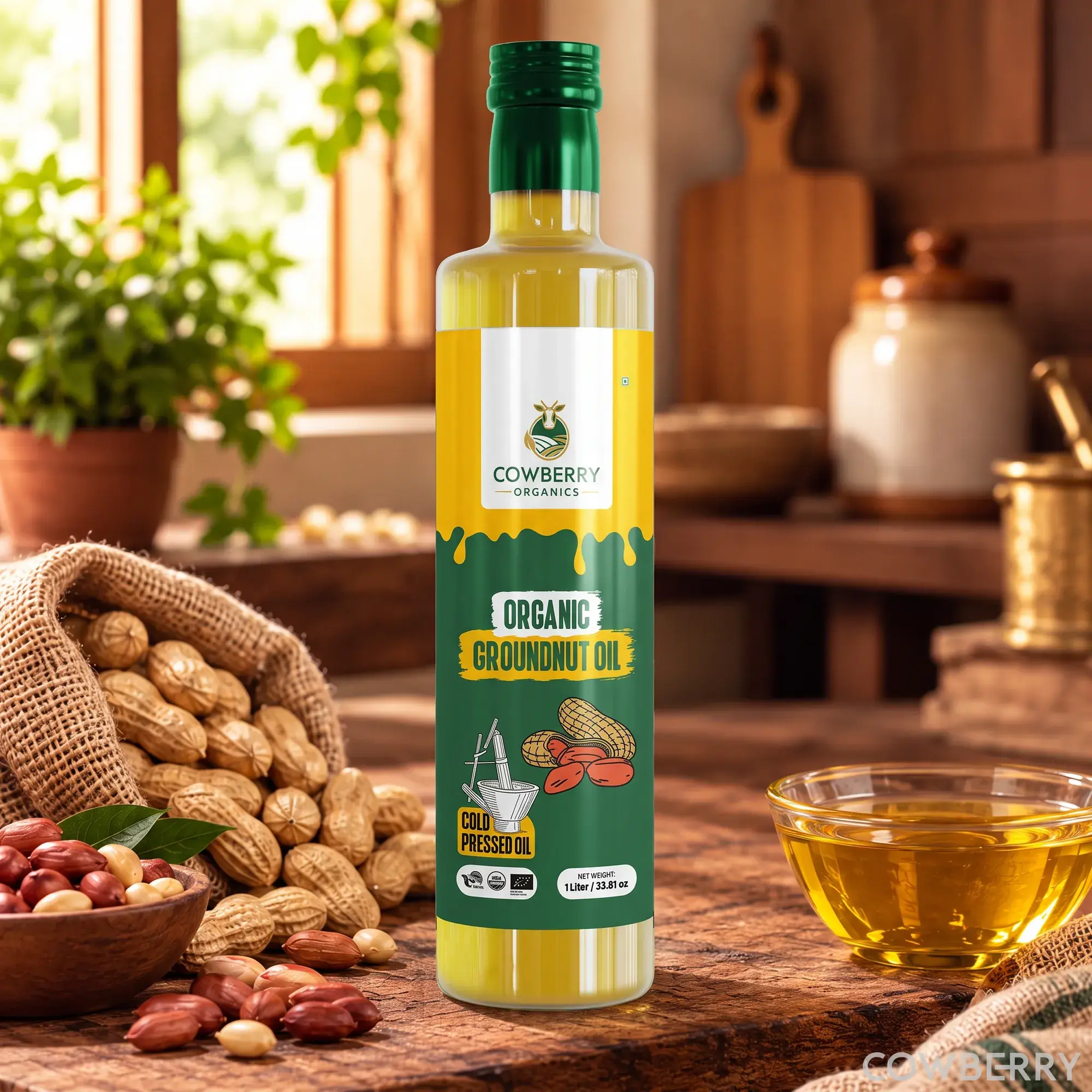
Groundnut oil is pressed from peanuts: the COWBERRY bottle is cold-pressed, with the peanuts organically grown in Saurashtra (Gujarat) and Andhra Pradesh. The guidelines print both oils in the same chart of vegetable-oil fatty acid composition (Figure 7.2), so the two share a page in the official picture of Indian cooking fats. On origin, the guidelines go no further for rice bran oil than that chart entry; the documented detail belongs to groundnut oil.
Nutrition: the numbers side by side
The documented side of this comparison is groundnut oil: the USDA record prints 884 kcal per 100 g, of which 100 g is fat, with protein, carbohydrate and fibre all at 0 g. No composition figures are printed for rice bran oil, so its column in the table stays empty on purpose. The side-by-side below is built from the points this page can actually source; the USDA record for groundnut oil follows it.
| Point | Groundnut oil | Rice bran oil |
|---|---|---|
| Pressed from | Peanuts, cold-pressed without heat or chemicals in the COWBERRY bottle | Listed in the guidelines' oil chart; origin not described |
| Composition | 884 kcal per 100 g, all of it fat | No composition figures printed |
| Saturates | 16.9 g per 100 g | Not printed |
| Monounsaturates | 46.2 g per 100 g | Not printed |
| Cholesterol | 0 mg per 100 g | None expected: the guidelines say cholesterol is found only in animal-source foods |
| GI | Not printed; oils carry no carbohydrate | Not printed; oils carry no carbohydrate |
| Standout component | None named in the guidelines | Oryzanol and tocotrienols, which the guidelines say reduce blood cholesterol |
| Nutrient | Groundnut oil |
|---|---|
| Energy (kcal) | 884 |
| Protein (g) | 0 |
| Fat (g) | 100 |
| Carbohydrates (g) | 0 |
| Dietary fibre (g) | 0 |
| Iron (mg) | 0 |
| Calcium (mg) | 0 |
| Magnesium (mg) | 0 |
| Potassium (mg) | 0 |
| Sodium (mg) | 0 |
| Zinc (mg) | 0 |
| Folate (mcg) | 0 |
| Vitamin C (mg) | 0 |
Per 100 g raw, edible portion. Composition: USDA FoodData Central (SR Legacy), FDC ID 171410, NDB 4042. — means not reported. These are average values for the food; the label on a pack gives the values for that product.
The rice bran claim: oryzanol and tocotrienols
The one documented difference belongs to rice bran oil: the guidelines state that oryzanol and tocotrienols in rice bran oil reduce blood cholesterol. The guidelines single out no component of groundnut oil, so the honest summary is that one oil carries a named component with a named effect, while the other's case rests on its fat profile. That profile is documented: 46.2 g of monounsaturates beside 16.9 g of saturates and 32 g of polyunsaturates per 100 g. On the shared rules, both oils fall under the same guideline lines: cholesterol is found only in animal-source foods, and every gram of fat or oil gives 9 kcal, so the guidelines ask for oils in moderation.
Taste, and the smoke question
The COWBERRY product notes describe groundnut oil's mild, nutty flavour, which works in salad dressings and cold preparations, and a high smoke point, which suits frying, sauteing and deep frying. No taste description is printed for rice bran oil, and no smoke point temperature is printed for either oil, so no figures are given. The guidelines add one general line that matters here: the natural flavour of an oil is largely due to its minor components, and refining modifies those components. The nutty note is documented for groundnut oil; for the other bottle, it is unstated.
Cooking fit and the frying rules
The COWBERRY product notes put frying, sauteing and deep frying inside the uses a high smoke point suits, and for daily cooking the guidelines favour sauteing, steaming, grilling, boiling or baking over frying, with visible fat held to 20 to 50 g per person a day, the figure set by energy needs. The repeated-heating rule is shared by both bottles because it is a rule about oil, not about origin: the guidelines say repeated heating of cooking oil generates harmful oxidative (polar) compounds that must be avoided, and a 2019 review of repeatedly heated cooking oils records polycyclic aromatic hydrocarbons, some reported as carcinogenic, and lists lung, colorectal, breast and prostate cancers among the outcomes tied to them in its collected studies. A teaspoon (5 g) holds roughly 44 kcal and a tablespoon (15 g) roughly 133, and the guidelines give the same nine kcal a gram for any fat or oil.
The verdict: which to choose
The contest is unequal only because the documentation is unequal: rice bran oil carries one named claim, that oryzanol and tocotrienols in it reduce blood cholesterol, while everything this page says about groundnut oil is documented in full, from its 46.2 g of monounsaturates to the mild nutty taste its product notes describe. For an Indian kitchen, groundnut oil is the oil whose facts this page can give in full; for rice bran oil, check its figures elsewhere. Three lines for the verdict:
- Named component with a named effect: rice bran oil, per the guidelines.
- Documented profile, taste and high-heat uses: groundnut oil.
- Either way: keep visible fat within the guidelines' 20 to 50 g a day, set by your energy needs, and saute more than you fry.
For the shortlist of cooking fats, see the low cholesterol oil page, and the groundnut oil hub guide has the oil's names and nutrition.
FAQs
Difference between groundnut oil and rice bran oil?
Groundnut oil is pressed from peanuts, cold-pressed without heat or chemicals in the COWBERRY bottle; for rice bran oil, the guidelines print its chart entry among vegetable oils and one named effect, that its oryzanol and tocotrienols reduce blood cholesterol. On composition, groundnut oil's record reads 884 kcal and 100 g of fat per 100 g, of which 16.9 g are saturates and 46.2 g monounsaturates; no composition figures are printed for rice bran oil.
Does groundnut oil cause cholesterol?
The USDA record prints 0 mg of cholesterol per 100 g, and the guidelines note that cholesterol is found only in animal-source foods, so the oil itself contains none. The WHO guideline's concern is saturated fat, at 10 percent of energy or less; groundnut oil's saturates read 16.9 g per 100 g.
Does groundnut oil increase cholesterol?
Not by what it contains, since it has no cholesterol to add; the risk lives in the day's saturated fat. The guidelines list what saturates do: they raise serum total and LDL-cholesterol, add inflammation and ease clot formation, and the 2023 WHO guideline recommends 10 percent or less of energy from saturated fat, with high-certainty evidence that lowering saturated fat reduces LDL cholesterol.
What is groundnut oil in hindi?
The Hindi name printed in IFCT 2017 is moongphali ka tel, and the same source carries the regional names: shengdana tel in Marathi, kadalai ennai in Tamil and sing tel in Gujarati, among others. Whichever name the bottle carries, the oil inside is the same: pressed from groundnuts, 100 percent fat at 884 kcal per 100 g.
Is groundnut oil good for diabetic patient?
The USDA record prints 0 g of carbohydrate per 100 g, and no GI is printed for the oil. Energy still counts: 884 kcal per 100 g, within an ICMR-NIN allowance of 20 to 50 g of visible fat a day that depends on energy needs. Talk to your doctor or dietitian about the amount of oil that suits your own diabetes care.
References
- Indian Food Composition Tables (IFCT) 2017, ICMR-National Institute of Nutrition
- Dietary Guidelines for Indians, ICMR-National Institute of Nutrition
- WHO guideline: saturated fatty acid and trans-fatty acid intake for adults and children (2023)
- USDA FoodData Central (SR Legacy): Oil, peanut, salad or cooking, FDC ID 171410
- Ganesan K, Sukalingam K, Xu B. Impact of consumption of repeatedly heated cooking oils on the incidence of various cancers- A critical review. Crit Rev Food Sci Nutr, 2019
Shop this article
Keep reading
Cold pressed oil benefits: why they survive processing better
Mustard oil vs refined oil: nutrition, cooking and which to choose
Mustard oil omega 3: nutrition, calories and fat per 100g