by COWBERRY

6 minute read
Olive oil vs groundnut oil: nutrition and which to choose

Olive oil vs groundnut oil is easy to ask and only half answerable with printed numbers: groundnut oil has a full record, while no olive oil composition figures are printed here. This page gives those numbers and says plainly where the gaps are; the groundnut oil hub guide carries the oil's names, nutrition and benefits.
Where each oil comes from
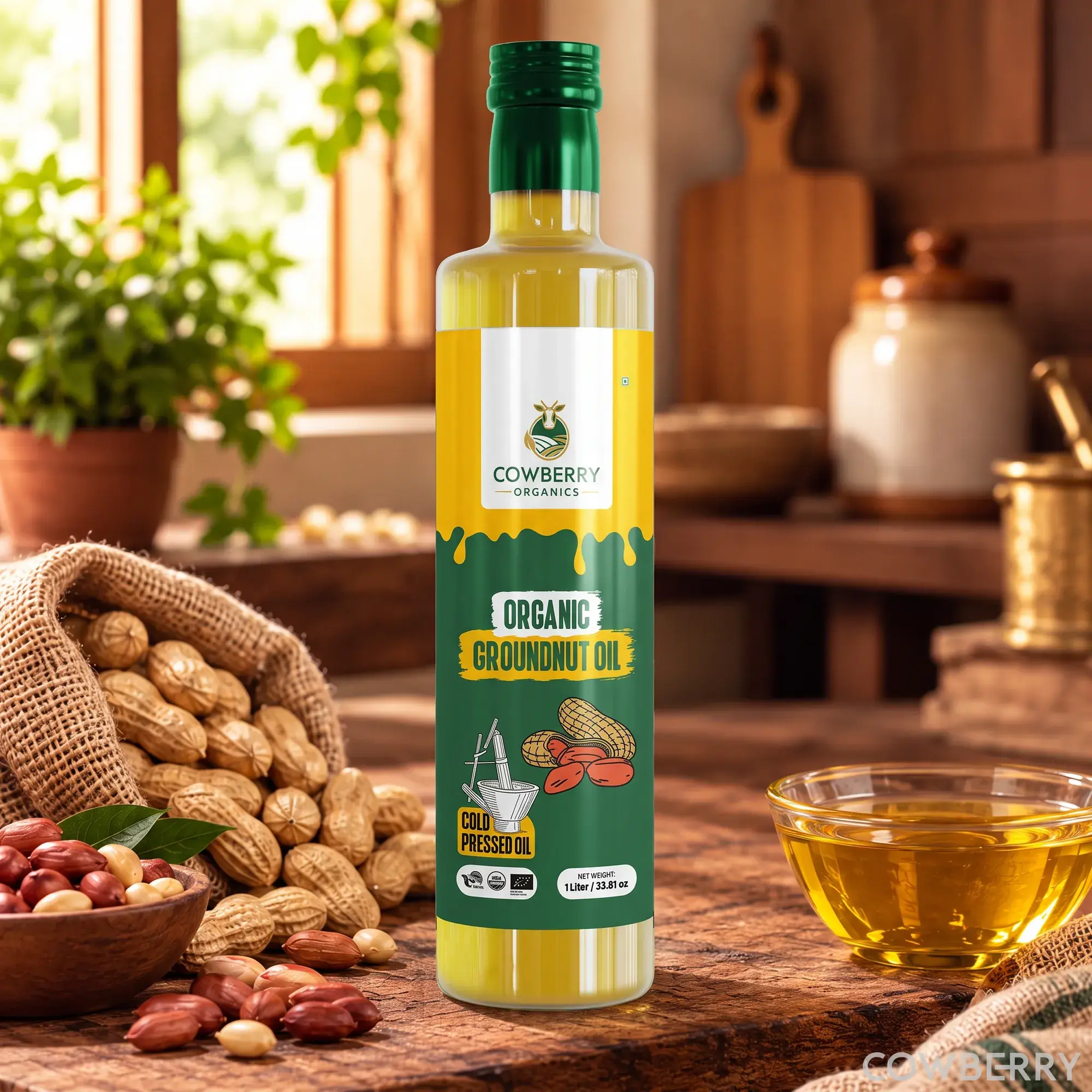
Groundnut oil is pressed from peanuts: COWBERRY's bottle is cold-pressed from organically grown peanuts of Saurashtra (Gujarat) and Andhra Pradesh, with no heat or chemicals in the pressing. Olive oil is pressed from the fruit of the olive tree; the dietary guidelines mention olive among the fruits whose oil is extracted by mechanical expelling. The same guidelines say cold-pressed (kachi ghani) oils keep antioxidants and phytonutrients because no heat is applied, while still containing undesirable compounds similar to crude oil.
Nutrition: the numbers side by side
For groundnut oil, the USDA FoodData Central record prints 884 kcal per 100 g, 100 g of fat and 0 g of protein, carbohydrate and fibre, which is why the oil contributes energy and fatty acids and little else of note. For olive oil, no composition figures are printed, so the olive column below stays empty rather than borrow a number. The side-by-side below compares the two oils on everything else this page can source; the USDA record for groundnut oil follows it.
| Point | Groundnut oil | Olive oil |
|---|---|---|
| Pressed from | Peanuts, cold-pressed in the COWBERRY bottle | The olive fruit, by mechanical expelling |
| Composition | 884 kcal, 100 g of fat per 100 g | No figures printed |
| Saturates | 16.9 g per 100 g | No figure printed |
| Monounsaturates | 46.2 g per 100 g | No figure printed |
| Cholesterol | 0 mg per 100 g | None expected: the guidelines say plant foods have no cholesterol |
| GI | Not printed; an oil has no carbohydrate | Not printed; an oil has no carbohydrate |
| Nutrient | Groundnut oil |
|---|---|
| Energy (kcal) | 884 |
| Protein (g) | 0 |
| Fat (g) | 100 |
| Carbohydrates (g) | 0 |
| Dietary fibre (g) | 0 |
| Iron (mg) | 0 |
| Calcium (mg) | 0 |
| Magnesium (mg) | 0 |
| Potassium (mg) | 0 |
| Sodium (mg) | 0 |
| Zinc (mg) | 0 |
| Folate (mcg) | 0 |
| Vitamin C (mg) | 0 |
Per 100 g raw, edible portion. Composition: USDA FoodData Central (SR Legacy), FDC ID 171410, NDB 4042. — means not reported. These are average values for the food; the label on a pack gives the values for that product.
Fat profile: why the monounsaturated share matters
What separates the two oils is the kind of fat. The groundnut figures above show 46.2 g of monounsaturates against 16.9 g of saturates per 100 g, with polyunsaturates at 32 g. The guidelines credit monounsaturated fat with reducing clot formation and atherogenesis, while saturated fat is listed as raising serum total and LDL-cholesterol and inflammation and favouring clot formation. WHO's 2023 guideline sets the saturated fat line at 10 percent of daily energy, with lowering saturates shown to reduce LDL cholesterol on high-certainty evidence. A 2014 review of peanut oil describes its fatty acid and antioxidant profile as well balanced. Because no olive oil numbers are printed, the comparison ends with groundnut oil's profile and the shared rules both oils live under.
Taste, and the smoke question
For groundnut oil the product notes are specific on taste and heat: mild and nutty in salad dressings and cold preparations, with a high smoke point suited to frying, sauteing and deep frying. No smoke point temperature is printed for either oil, so no figure is given. No taste description is printed for olive oil either, so the comparison is one-sided: the product notes describe groundnut oil's mild, nutty taste, and olive oil's is not described here. Taste is a personal call this page cannot settle for you.
Cooking fit: which oil for which dish
The product notes for groundnut oil name frying, sauteing and deep frying as uses its high smoke point suits, with dressings among the cold preparations its nutty flavour carries. For everyday meals the guidelines name sauteing, steaming, grilling, boiling and baking as methods to use instead of frying, and say visible fat (cooking oil) must be limited to 20 to 50 g, or 4 to 10 teaspoons, per person a day depending on energy needs. On repeated heating the rules are the same for both oils, because they are rules about any oil: the guidelines call the oxidative (polar) compounds that repeated heating generates harmful, and the 2019 review on repeatedly heated oils reports polycyclic aromatic hydrocarbons, some of them carcinogenic, alongside associations with lung, colorectal, breast and prostate cancers. In spoon terms, a teaspoon (5 g) of the oil is about 44 kcal and a tablespoon (15 g) about 133 kcal.
The verdict: which to choose
Only groundnut oil can be documented here: its profile, its high-heat uses and its mild, nutty taste are printed, while olive oil's numbers are not, so no head-to-head claim can be made for either side. If you cook Indian food at high heat, the groundnut oil facts are the ones this page can vouch for; for olive oil, look up its figures yourself. The verdict, in three lines:
- Documented for this kitchen: groundnut oil.
- Olive oil: no composition or smoke point figures printed.
- Either way: measure the spoons, saute more than you fry, and keep the day's visible fat within the guidelines' 20 to 50 g, set by your energy needs.
The low cholesterol oil page shortlists the cooking fats worth keeping; the groundnut oil hub guide rounds out the oil itself.
FAQs
Difference between groundnut oil and olive oil?
Groundnut oil is pressed from peanuts and, in the COWBERRY bottle, cold-pressed without heat or chemicals; olive oil is pressed from the olive fruit by mechanical expelling. The documented numbers belong to groundnut oil: 884 kcal and 100 g of fat per 100 g, 16.9 g of saturates against 46.2 g of monounsaturates. No composition or smoke point figures are printed for olive oil, so the rest of the difference is taste.
Why groundnut oil is bad for you?
The honest list is short: it is 100 percent fat at 884 kcal per 100 g, so unmeasured pours crowd the day's calories, and repeated heating of cooking oil produces harmful oxidative compounds. According to the guidelines, used frying oil may go into a curry but should not be used for frying again, and should be consumed in a day or two. They also say seed oils should be used in moderation.
Is groundnut oil a seed oil?
Strictly, it is pressed from groundnuts, the seeds of the Arachis hypogaea plant, so the answer is yes in the botanical sense. What matters in the kitchen is the method: the COWBERRY bottle is cold-pressed, and the guidelines describe cold-pressed (kachi ghani) oils as obtained by mechanical pressing without heat.
Can groundnut oil be used for cooking?
Yes, and the product notes are specific: a high smoke point that suits frying, sauteing, high-heat cooking and deep frying, plus a mild, nutty flavour for salad dressings and cold preparations. The guidelines say to use sauteing, steaming, grilling, boiling or baking instead of frying, and limit visible fat of any kind to 20 to 50 g a day, depending on energy needs.
Is groundnut oil healthy?
Of its 100 g of fat, 46.2 g are monounsaturated, which the guidelines say decreases clot formation and atherogenesis, and 16.9 g are saturated; its cholesterol reads 0 mg. It is still 884 kcal per 100 g, and the guidelines limit visible fat to 20 to 50 g a day depending on energy needs, so measure it.
Does groundnut oil have protein?
No. The USDA record prints 0 g of protein per 100 g, with 0 g of carbohydrate and fibre as well; groundnut oil is essentially all fat. On the plate, then, it brings energy and fatty acids, not the protein groundnuts themselves are known for, so count it under fats, not foods.
References
- Indian Food Composition Tables (IFCT) 2017, ICMR-National Institute of Nutrition
- Dietary Guidelines for Indians, ICMR-National Institute of Nutrition
- WHO guideline: saturated fatty acid and trans-fatty acid intake for adults and children (2023)
- Akhtar S, Khalid N, Ahmed I et al. Physicochemical characteristics, functional properties, and nutritional benefits of peanut oil: a review. Crit Rev Food Sci Nutr, 2014
- USDA FoodData Central (SR Legacy): Oil, peanut, salad or cooking, FDC ID 171410
- Ganesan K, Sukalingam K, Xu B. Impact of consumption of repeatedly heated cooking oils on the incidence of various cancers- A critical review. Crit Rev Food Sci Nutr, 2019
Shop this article
Keep reading
Cold pressed oil benefits: why they survive processing better
Mustard oil vs refined oil: nutrition, cooking and which to choose
Mustard oil omega 3: nutrition, calories and fat per 100g