by COWBERRY

7 minute read
Is groundnut oil good for cholesterol? Fats and how much to use

Is groundnut oil good for cholesterol? It contains no cholesterol itself, and most of its fat is the monounsaturated kind, which the guidelines credit with decreasing clot formation, but it is still 100 g of fat per 100 g, so the amount you pour decides the answer. Here are the fat numbers, the guideline limits and how much to use, with the groundnut oil guide for the oil itself.
Short answer: is groundnut oil good for cholesterol?
It can fit, in measured amounts, mainly because of what it does not carry. Groundnut oil has 0 mg of cholesterol per 100 g, and the dietary guidelines say cholesterol comes only from animal-source foods, which a plant oil is not. Most of its fat is monounsaturated: 46.2 g of MUFA per 100 g against 16.9 g of saturates and 32 g of polyunsaturates. The guidelines credit MUFA with decreasing clot formation and atherogenesis, while saturated fat, they say, enhances the tendency of clots to form. The catch is the last number: the oil is 100 g of fat per 100 g, so good for cholesterol means good in the amount you use, not in unlimited quantity.
Does groundnut oil increase cholesterol?
Not by itself, because the oil contains no cholesterol: the USDA record for peanut oil prints 0 mg per 100 g, and the guidelines place cholesterol in animal-source foods alone. They say saturated fat is known to raise serum total and LDL-cholesterol levels, increase inflammation and enhance the tendency of clots to form. Groundnut oil carries 16.9 g of saturates per 100 g, modest next to its 46.2 g of monounsaturates. The WHO guideline for 2023 asks adults and children to take no more than 10 percent of daily energy as saturated fat, and 1 percent as trans fat; the saturates in groundnut oil count toward that limit. WHO grades the evidence as high certainty that lowering saturated fat intake reduces LDL cholesterol.
What the numbers say: fat profile, calories and micronutrients
The table below comes from USDA FoodData Central, which lists the oil under its salad-or-cooking entry. Read it as fat and almost nothing else: 884 kcal, 100 g of fat, and zeroes for protein, carbohydrate, fibre and sodium, apart from traces of iron (0.03 mg) and zinc (0.01 mg). Two entries in the same record matter most for this page: cholesterol reads 0 mg, and phytosterols (plant sterols) read 207 mg per 100 g. Vitamin E comes to 15.7 mg. No GI is printed for groundnut oil, and none is given here, because an oil has no carbohydrate to digest. The groundnut oil guide covers the oil itself, and the groundnut oil nutritional value per 100g page has the per-spoon figures.
| Nutrient | Groundnut oil |
|---|---|
| Energy (kcal) | 884 |
| Protein (g) | 0 |
| Fat (g) | 100 |
| Carbohydrates (g) | 0 |
| Dietary fibre (g) | 0 |
| Iron (mg) | 0 |
| Calcium (mg) | 0 |
| Magnesium (mg) | 0 |
| Potassium (mg) | 0 |
| Sodium (mg) | 0 |
| Zinc (mg) | 0 |
| Folate (mcg) | 0 |
| Vitamin C (mg) | 0 |
Per 100 g raw, edible portion. Composition: USDA FoodData Central (SR Legacy), FDC ID 171410, NDB 4042. — means not reported. These are average values for the food; the label on a pack gives the values for that product.
How much groundnut oil a day, and how to use it
India's dietary guidelines have no separate figure for groundnut oil; it falls inside the daily allowance for visible fat, their term for the oils, ghee, butter and vanaspati used in cooking or added at the table. That allowance runs 20 to 50 g per person a day, roughly 4 to 10 teaspoons, and the guidelines put it at 27 to 30 g on a 2000 kcal day. For sedentary adults the limit is 20 g for women and 30 g for men, and it is higher for people who are more active. In spoon terms, a teaspoon of the oil (5 g) carries about 44 kcal and a tablespoon (15 g) about 133 kcal. How matters as much as how much: the guidelines prefer sauteing, steaming, grilling, boiling or baking to frying, and oil used for frying should not be fried in again; filtered, it may finish a curry, and it should be consumed in a day or two.
Groundnut oil, ghee and other fats: where each sits
Groundnut oil is mostly unsaturated fat, as the numbers above show. Ghee and butter the guidelines would hold to 1 to 2 teaspoons a day or avoid, if possible, and they list coconut oil, palm oil, ghee and butter among the foods that contain saturated fat. The WHO replacements point the same way: swap saturated fat for polyunsaturated fat (strong recommendation) or monounsaturated fat from plant sources (conditional), and keep trans fat to 1 percent of energy or less; the Indian guidelines name vanaspati as a source of trans fat and say it should be avoided. Repeatedly heated oil is a concern for another reason: the guidelines say repeated heating generates harmful oxidative (polar) compounds, and a 2019 review says repeatedly heated cooking oils can generate polycyclic aromatic hydrocarbons, some reported as carcinogenic, and links heavy use to several cancers. A measured amount of groundnut oil in food that is sauteed, steamed or baked is consistent with these guideline lines; the shortlist of oils worth choosing is on the low cholesterol oil page.
Talk to your doctor or dietitian
Cholesterol is managed by much more than one bottle of oil: age, weight, smoking, activity, family history and medicines all sit inside the same equation. If you have high LDL cholesterol, high triglycerides, diabetes, heart disease or a family history of early heart trouble, do not set your fat allowance from a web page; bring your latest lipid report to your doctor and ask what share of saturated fat your day can hold, and let a dietitian translate that into oils, spoons and portions. Before changing the fats in your kitchen, talk to your doctor or dietitian.
FAQs
Does groundnut oil contain cholesterol?
No. The USDA record for peanut oil lists 0 mg of cholesterol per 100 g, and in the dietary guidelines cholesterol belongs to animal-source foods only, so a plant oil carries none. What the oil does contain is 100 g of fat per 100 g, mostly monounsaturated, so the cholesterol question is really about how much saturated fat your whole day holds.
Is peanut oil good for health?
It can be, in measured amounts as one of several fats. A 2014 review calls peanut oil's fatty acid and antioxidant profile well balanced, and the guidelines say monounsaturated fat decreases clot formation and atherogenesis. It is also 884 kcal per 100 g, so the value lies in using it within your visible-fat allowance, not in pouring more of it.
Is groundnut oil good for cholesterol?
It can fit, in measured amounts. It carries no cholesterol, and most of its fat is monounsaturated, which the guidelines say decreases clot formation and atherogenesis, while its saturated share is 16.9 g per 100 g. The catch is quantity: the oil is 100 g of fat per 100 g, so count it inside your visible-fat limit, 20 to 50 g a day for all cooking oils and fats, depending on activity.
Can groundnut oil increase cholesterol?
On its own, no, because it contains no cholesterol; the risk lies in the day's total saturated fat, not in one oil. WHO's 2023 guideline sets the line at 10 percent of energy from saturated fat and 1 percent from trans fat, with the LDL-cholesterol evidence graded high certainty, and the guidelines list the saturates' harms as higher serum total and LDL-cholesterol, more inflammation and easier clot formation.
Is groundnut oil good for diabetes and cholesterol?
For cholesterol, the answer is the one above: measured amounts fit, because the oil adds no cholesterol and its fat is mostly monounsaturated. For diabetes, the oil has 0 g of carbohydrate and no GI is printed for it; the part to watch is its 884 kcal per 100 g, and your doctor or dietitian can say how much fat suits you.
Is cold pressed groundnut oil good for health?
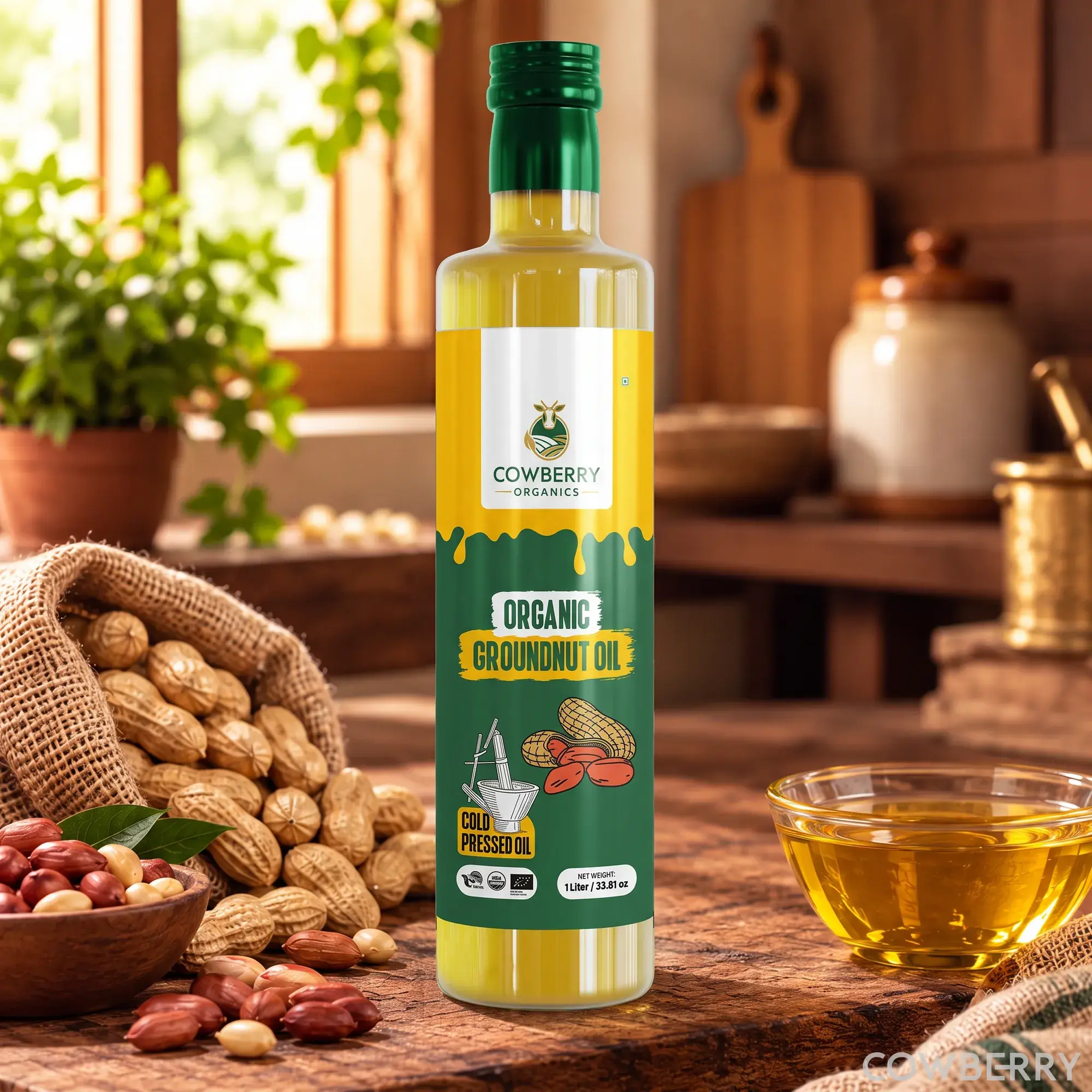
The guidelines explain that cold-pressed (kachi ghani) oil is obtained by pressing without heat, so antioxidants and phytonutrients are preserved, though it can still carry the undesirable compounds found in crude oil. For the benefits and side effects, see benefits of cold-pressed groundnut oil.
References
- Indian Food Composition Tables (IFCT) 2017, ICMR-National Institute of Nutrition
- Dietary Guidelines for Indians, ICMR-National Institute of Nutrition
- WHO guideline: saturated fatty acid and trans-fatty acid intake for adults and children (2023)
- USDA FoodData Central (SR Legacy): Oil, peanut, salad or cooking, FDC ID 171410
- Akhtar S, Khalid N, Ahmed I et al. Physicochemical characteristics, functional properties, and nutritional benefits of peanut oil: a review. Crit Rev Food Sci Nutr, 2014
- Ganesan K, Sukalingam K, Xu B. Impact of consumption of repeatedly heated cooking oils on the incidence of various cancers- A critical review. Crit Rev Food Sci Nutr, 2019
Shop this article
Keep reading
Cold pressed oil benefits: why they survive processing better
Mustard oil vs refined oil: nutrition, cooking and which to choose
Mustard oil omega 3: nutrition, calories and fat per 100g