by COWBERRY

6 minute read
10 bajra recipes: roti, khichdi, upma, laddu, and more

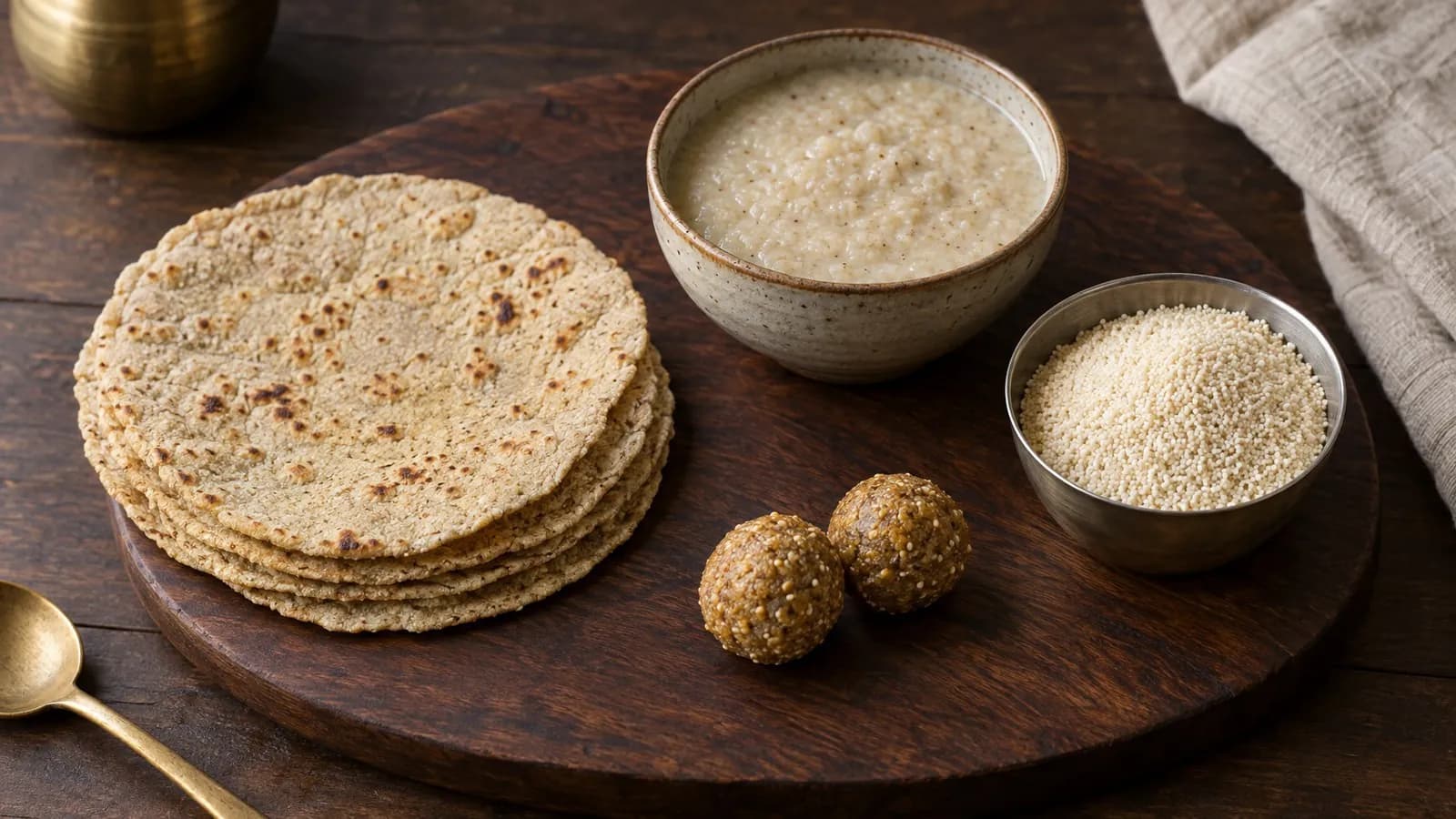
These bajra recipes take pearl millet through a full day of Indian meals: upma, porridge and dosa at breakfast, roti, methi roti and khichdi at dinner, thepla and rab as lighter plates, a sprouted salad, and laddu to end sweet. Four dishes have full step-by-step pages; six carry a two-line method. New to the grain? The bajra hub covers what bajra is and how to cook with it.
Cooking with bajra: whole grain or flour
All ten pearl millet recipes below split on one choice: whole bajra or bajra flour. The whole grain goes into the khichdi and the sprouted salad, where it is soaked first and then cooked soft; the flour goes into everything else, where it is kneaded, whisked, roasted or steamed. Two habits make the flour behave. For anything liquid — porridge, dosa, rab — start the flour in cold water and stir that into the boiling pot, or it clumps the moment it lands. For anything shaped — roti, thepla — use hot water for the dough: without gluten to stretch, a warm dough is what keeps a bajra roti whole while you pat it.
Per 100 g, the grain gives 348 kcal, 10.96 g of protein and 11.49 g of fibre (IFCT 2017). Four of the ten dishes have full step-by-step pages on this site; the other six carry a two-line method below that you can cook from directly.
Bajra breakfast recipes
Breakfast is where bajra flour shows its speed: each of the three dishes below replaces something already on the table — porridge for oats, upma for rava upma, dosa for the rice version.
Bajra upma
A flour upma, not a rava one: the bajra flour is dry-roasted until it smells nutty, then steamed in a tempering of mustard seeds, cumin, urad dal, chana dal, onion and vegetables until soft and crumbly. Ten minutes of prep and 25 minutes of cooking; the pot serves three at about 250 kcal a serving. Full method: bajra upma.
Bajra porridge
Whisk 1/2 cup bajra flour into 1 cup of cold water, then stir the slurry into 3 cups of boiling water and simmer for about 8 minutes, stirring, until thick and free of any raw taste. Sweeten with jaggery or salt it, and loosen with warm milk or buttermilk.
Bajra dosa
Whisk 1 cup bajra flour with 1.5 cups of water, salt and a pinch of cumin into a thin pouring batter, then cook thin dosas on a hot tawa with a little oil — crisp edges, no soaking and no fermenting. Serve with chutney.
Bajra roti, khichdi and main meals
The main-meal half of the list: the two classics with full pages, and three everyday variations that need no measuring beyond the dough.
Bajra roti
A hot-water dough patted flat with the palms — bajra has no gluten to roll — cooked on the tawa and finished over an open flame with ghee on top. From dough to plate about 45 minutes; the batch makes six rotis of 40 g of flour each, and a serving of two rotis with its ghee comes to about 368 kcal. Full method: bajra roti.
Bajra khichdi
Whole bajra, soaked overnight and cracked in the mixer, goes into the pressure cooker with split moong dal and cooks until creamy; ghee, cumin and hing finish the pot. Twenty minutes of prep and 45 minutes of cooking once the grain has soaked; the pot serves four at about 323 kcal a serving. Full method: bajra khichdi.
Methi bajra roti
Knead a big handful of chopped fresh methi — washed and squeezed dry — and a pinch of salt into the hot-water bajra dough, then pat and cook the rotis as usual. The methi flecks dark green through the roti and carries the flavour.
Bajra thepla
Knead bajra flour with curd, salt, turmeric and a little oil into a soft dough, rest it briefly, then pat small balls into thin rounds and cook them on the tawa with a little oil until flecked brown. The curd keeps them soft, and they pack well for a lunchbox.
Bajre ki rab
Whisk bajra flour into churned buttermilk and cook on low, stirring steadily, until the mixture thickens to a soft, drop-consistency; season with salt and cumin. Serve it warm in a bowl.
Bajra snacks and sweets
The sweet end of the list is the laddu, which has a full page, and the sprouted salad, which uses the whole grain instead of the flour.
Bajra laddu
The flour is roasted in ghee till nutty, a hot one-string jaggery syrup goes over it, and the still-warm mix is rolled with crushed groundnuts and cardamom. A cup of flour yields 12 laddus in about 45 minutes, at about 118 kcal each. Full method: bajra laddu.
Sprouted bajra salad
Soak whole bajra overnight, drain it and tie it in a damp cloth, rinsing twice a day until tiny sprouts show; steam the sprouts until soft, then toss with onion, tomato, cucumber, lemon and salt.
The ten pearl millet recipes, day by day
Spread across a week, the ten pearl millet recipes look like this: porridge or upma on weekday mornings, the dosa when there is time, roti or khichdi at dinner, thepla or rab on a light evening, the sprouted salad when the grain is sprouting, and a laddu after a meal that should end sweet. Mix the two-line methods with the four full pages — the recipe pages carry step timings and exact measures. Names, nutrition, storage and buying notes for the grain are on the bajra hub.
FAQs
Does bajra have gluten?
No. Bajra is pearl millet, a gluten-free grain, and gluten belongs to wheat, barley and rye. None of the ten recipes on this page uses wheat, barley or rye — the grain and the flour carry every dish, with moong dal in the khichdi. For anything bought — a blended flour, a spice mix — look for wheat, barley or rye on the label; the label decides.
Is bajra good for weight loss?
As a swap, not an extra: bajra gives 348 kcal per 100 g with 11.49 g of fibre, and one roti comes to 139 kcal before ghee. The ghee-and-jaggery dishes — the laddu at 118 kcal a piece — belong to the sweet end of the week, not the daily plate. Portions and evidence: is bajra good for weight loss.
What is bajra?
Bajra is pearl millet, the grain all ten recipes here are built on, sold whole or as flour. It contains no gluten, which is why its rotis are patted rather than rolled. For the flour: hot water for the dough, and a cold-water start for porridge. The grain's nutrition per 100 g and its other names are on the hub.
Does bajra have protein?
Yes: 10.96 g per 100 g (IFCT 2017), about 4.4 g in one 40 g roti. The khichdi stacks moong dal on top of the grain, which rounds the protein out — millet protein is low in lysine, and pulses carry what it misses.
Can bajra roti cause constipation?
Bajra roti is high in fibre — 11.49 g per 100 g, about 4.6 g in one roti — and the Dietary Guidelines name dietary fibre as important for proper bowel function, with a role in reducing constipation. Drink plenty of water with the meal, and if the grain is new to you, add it to your meals gradually.
References
Shop this article
Keep reading
Rajma recipe: 5 ways to cook rajma beans at home
Dalia recipes: 10 easy broken wheat dishes from khichdi to laddu
Amaranth recipes: 8 rajgira dishes from roti to ladoo