by COWBERRY

7 minute read
Sajjalu in English is pearl millet: bajra names in Indian languages

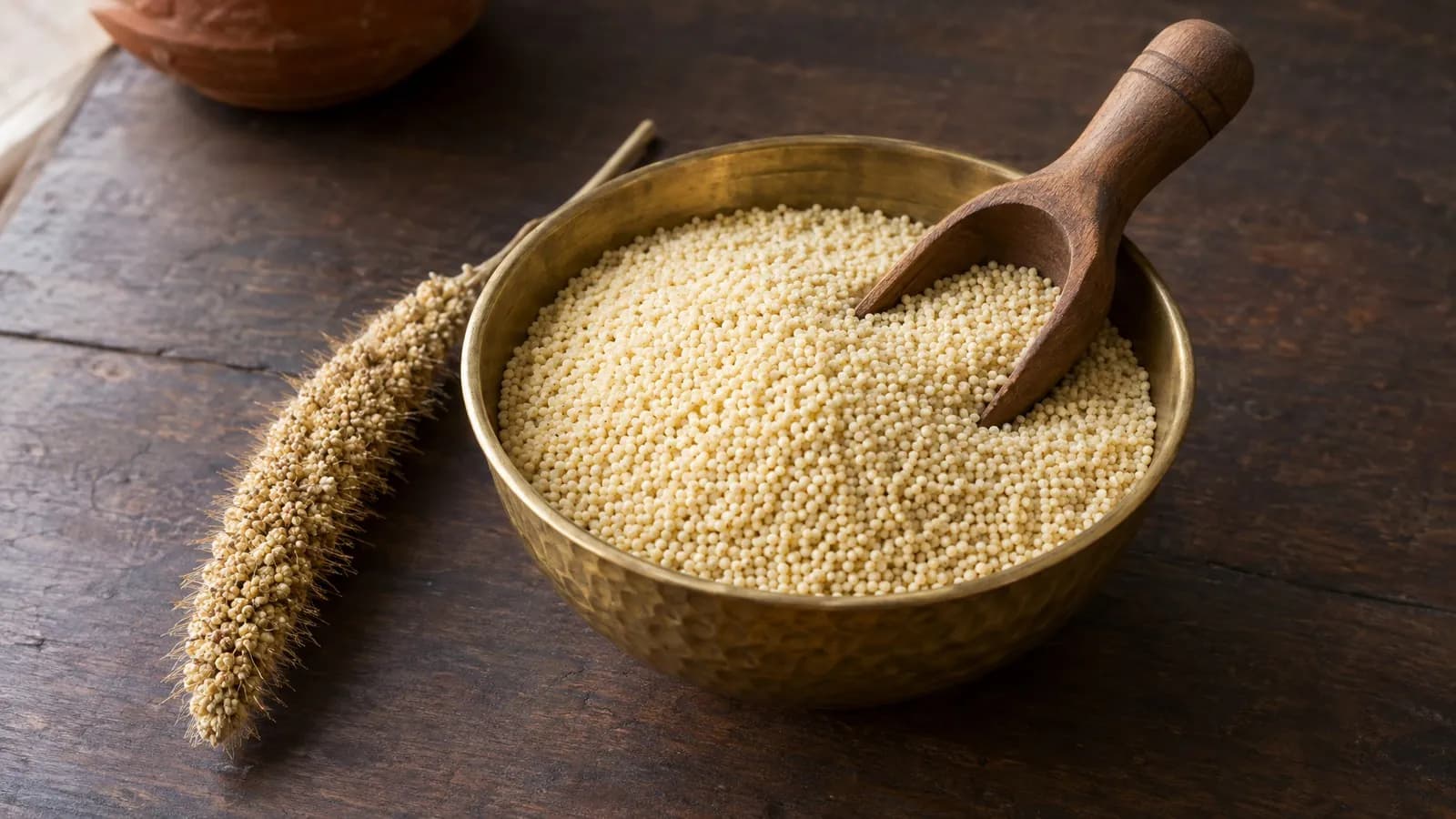
Sajjalu in English is pearl millet, the grain known across North India as bajra and printed as Pennisetum typhoideum in IFCT 2017. Sajje (Kannada), kambu (Tamil), kambam (Malayalam) and bajri (Gujarati, Marathi) are the same grain. This page lists every name by language from the IFCT 2017 and ICAR-IIMR lists, the grains it is confused with, and where it grows.
Quick answer: bajra, sajjalu, sajje and kambu in English and every Indian language
One line per language, then the full table. Hindi, Punjabi, Bengali, Odia and Urdu: bajra. Assamese: baajra. Gujarati and Marathi: bajri (IFCT 2017 prints bajra for Marathi; the ICAR-IIMR list gives bajri). Kannada: sajje, also written sajjai. Telugu: sajjalu, or sajja on the ICAR-IIMR page. Tamil: kambu. Malayalam: kambam, also written kamboo. English: pearl millet. Botanical name: Pennisetum typhoideum in IFCT 2017. Sanskrit: no name recorded in either source. Bajra atta in English is simply pearl millet flour.
The table below is built from the IFCT 2017 local-names entry for bajra (food code A003). Notes under it add the spellings the ICAR-Indian Institute of Millets Research uses where they differ, and put pearl millet in place of IFCT's English entry, bajra.
| Language | Name (romanised) |
|---|---|
| English | Pearl millet |
| Hindi | Bajra |
| Marathi | Bajra, Bajri |
| Gujarati | Bajri |
| Punjabi | Bajra |
| Bengali | Bajra |
| Odia | Bajra |
| Assamese | Baajra |
| Kannada | Sajje, Sajjai |
| Telugu | Sajjalu, Sajja |
| Tamil | Kambu |
| Malayalam | Kambam, Kamboo |
| Urdu | Bajra |
| Sanskrit | — |
| Botanical name | Pennisetum typhoideum |
Source: IFCT 2017 (ICMR-NIN) local-names list. — means no name recorded in the source.
English: IFCT 2017 prints ‘Bajra’; ‘Pearl millet’ per ICAR-Indian Institute of Millets Research, millets information page (vernacular names). Marathi ‘Bajri’: ICAR-Indian Institute of Millets Research, millets information page (vernacular names). Kannada ‘Sajjai’: Nutritional and health benefits of millets, ICAR-Indian Institute of Millets Research (PDF). Telugu ‘Sajja’: ICAR-Indian Institute of Millets Research, millets information page (vernacular names). Malayalam ‘Kamboo’: Nutritional and health benefits of millets, ICAR-Indian Institute of Millets Research (PDF).
Botanical and English name: pearl millet, Pennisetum typhoideum
The bajra English name is pearl millet. IFCT 2017 prints the botanical name as Pennisetum typhoideum, and that is the name used on this site; ICAR-IIMR and the 2021 Satyavathi review list the same species as Pennisetum glaucum, so both names point to one plant. It belongs to the grass family, like wheat and rice.
Its home is Africa: ICAR-IIMR places its origin in central tropical Africa, and says farmers in Africa and on the Indian subcontinent have raised it since prehistoric times. It has a name in every language on the IFCT list except Sanskrit, for which neither IFCT nor ICAR-IIMR records one. Bajra atta in English is pearl millet flour, bajra roti or rotla is pearl millet flatbread, and the IFCT 2017 nutrition figures for bajra, 10.96 g protein and 6.42 mg iron per 100 g, applies to every one of these names because they are one grain.
Bajra names by region: Hindi, Telugu, Kannada, Tamil and more
Hindi and Punjabi: bajra, the name used across the north: bajre ki roti, bajre ki khichdi, bajre ki raab. What is pearl millet in Hindi is therefore simply bajra.
Gujarati and Marathi: bajri. Gujarat's thick hand-patted rotlo is bajri no rotlo, eaten with garlic chutney and ringan no olo; Maharashtra's thinner bhakri is bajrichi bhakri, eaten with pithla or thecha. IFCT 2017 prints bajra for Marathi, so the table carries both.
Telugu: sajjalu in IFCT 2017 and the ICAR-IIMR booklet, and the word behind searches such as bajra meaning in Telugu or bajra in Telugu name; the ICAR-IIMR page prints sajja. Sajja rotte is the flatbread of Telangana and Rayalaseema.
Kannada: sajje (sajjai in the IIMR booklet). Sajje rotti with yengai, the stuffed brinjal of north Karnataka, is a common pairing there.
Tamil: kambu. Kambu koozh, the fermented porridge drunk cold with buttermilk, is a summer drink in Tamil Nadu; kambu dosai and kambu adai are newer breakfast uses.
Malayalam: kambam, also written kamboo. Bengali, Odia and Urdu: bajra. Assamese: baajra.
Often confused with jowar, ragi and other millets
Bajra vs jowar: jowar is sorghum, a different plant with a bigger, flatter, chalk-white or cream grain that gives a white bhakri; bajra grain is smaller, rounder and grey-gold, and its roti is grey. In Telugu the pair is jonna (jowar) and sajjalu (bajra); in Kannada jola and sajje; in Tamil cholam and kambu. Jowar has its own jowar hub.
Bajra vs ragi: ragi (finger millet, nachni) is a tiny red-brown seed, one of the small millets; it is the calcium millet, while bajra, with 6.42 mg iron per 100 g, is the iron one. The ragi hub covers it.
Pearl millet vs foxtail millet: foxtail millet (kangni, kakum, navane, korra, tenai) is a small, pale yellow husked grain cooked like rice; pearl millet is larger, grey and mostly milled into flour. ICAR-IIMR notes that in the United States the only millet of significance is proso millet, grown mostly for bird seed. Every millet commonly grown in India is compared on the types of millets page.
Where bajra grows in India
In India bajra is a rain-fed crop of the dry west. ICAR-IIMR names it the primary crop of the desert regions of Rajasthan, with sorghum grown alongside; in eastern Rajasthan and Gujarat the order flips, and sorghum leads. Rainfall decides much of this: IIMR notes that sorghum predominates where annual rainfall passes 400 mm, while pearl millet rivals it where it is around 350 mm. Worldwide it covers about 30 million hectares in the arid and semi-arid tropics of Asia and Africa, almost half of all millet production, according to Satyavathi and colleagues' 2021 review in Frontiers in Plant Science.
Why Rajasthan? Drought, poor soil, heat and even saline ground suit pearl millet, ICAR-IIMR notes, and it grows where maize or wheat would not survive. The Satyavathi review adds a deep root system that keeps it alive under water scarcity, good growth in low-nutrient soils and less need for chemical fertiliser, and describes it as a climate-resilient nutricereal rich in iron and zinc. For nutrition, benefits and side effects, see the bajra hub; the grain's two everyday dishes have their own recipes, bajra roti and bajra khichdi.
FAQs
What is sajjalu in English?
Pearl millet. Sajjalu is the Telugu name for the grain called bajra in Hindi, sajje in Kannada and kambu in Tamil; IFCT 2017 prints its botanical name as Pennisetum typhoideum. Sajja rotte, the Telangana flatbread, is the same dish as bajre ki roti in Rajasthan.
What is pearl millet in Hindi?
Bajra. Pearl millet is the English name and bajra the Hindi one, used unchanged in Punjabi, Bengali, Odia and Urdu. Bajra atta is pearl millet flour and bajre ki roti is pearl millet flatbread. Gujarati and Marathi say bajri.
What is bajra called in Telugu and Kannada?
Sajjalu in Telugu (sajja on the ICAR-IIMR page) and sajje in Kannada (also written sajjai). Both mean pearl millet. Sajja rotte and sajje rotti are the Telugu and Kannada versions of bajra roti, eaten with chutney or stuffed brinjal.
What is the difference between pearl millet and foxtail millet?
They are different plants. Pearl millet (bajra) is a larger grey-gold grain, mostly milled into flour for roti and rotla or cooked whole as khichdi. Foxtail millet (kangni, navane, korra, tenai) is a small pale yellow grain that is husked and cooked whole like rice or upma. Both are gluten-free; bajra is the one with 6.42 mg iron per 100 g in IFCT 2017.
What is bajra atta in English?
Pearl millet flour. Bajra atta is whole pearl millet ground to a pale grey flour, sold in English as pearl millet flour or bajra flour. Because it has no gluten it is kneaded with hot water and patted by hand, and because its fat turns rancid, it keeps only briefly once milled.
Is pearl millet and bajra same?
Yes. Pearl millet is the English name and bajra the Hindi one for a single grain, Pennisetum typhoideum in IFCT 2017. Bajri (Gujarati, Marathi), sajje (Kannada), sajjalu (Telugu), kambu (Tamil) and kambam (Malayalam) are the same grain in other languages, listed with their sources in the table above.
References
- Indian Food Composition Tables (IFCT) 2017, ICMR-National Institute of Nutrition
- ICAR-Indian Institute of Millets Research: millets information and vernacular names
- Nutritional and health benefits of millets, ICAR-Indian Institute of Millets Research (PDF)
- Satyavathi CT, Ambawat S, Khandelwal V et al. Pearl millet: a climate-resilient nutricereal for mitigating hidden hunger and provide nutritional security. Front Plant Sci, 2021
Shop this article
Keep reading
Foxtail millet vs quinoa: nutrition, taste and which to choose
Foxtail millet in Kannada, Hindi, Tamil and other Indian names
10 benefits of kangni (foxtail millet) and its side effects