by COWBERRY

7 minute read
What Is Jaggery Powder? How It Is Made and How It Differs From Gur

What is jaggery powder? It is set jaggery milled into a fine, dry granule: the same boiled cane juice as a block of gur, scraped, sieved and dried so it pours and dissolves fast. The milling changes form, not numbers: 354 kcal and 4.63 mg iron per 100 g (IFCT 2017). Here is how the powder is made, how it differs from block jaggery, and when to pick it.
What is jaggery powder?
Jaggery powder is block jaggery in loose, dry form, and the one entry IFCT 2017 prints covers both: 354 kcal, 84.9 g carbohydrate, 1.9 g protein, 0.16 g fat, 4.63 mg iron, 107 mg calcium, 115 mg magnesium and 488 mg potassium per 100 g, with fibre not reported. Nothing is added to turn a block into powder; the set mass is simply broken down and dried. COWBERRY's own description puts it in maker's words: the powder is finely crushed from pure traditional jaggery, one made from natural sugarcane juice. The cane jaggery behind both forms is covered in the jaggery hub.
The 2022 Sugar Tech review by Rao and Singh records the shift: powdered, granular and liquid jaggery are now made to replace refined white sugar in bakery products, chocolates, confectionery and beverages. In an Indian kitchen powder finds the same jobs in tea, batters and sweets.
How jaggery powder is made
The review sets out a standardised powder method. The juice is heated to a striking point of 120 to 122 °C, two degrees past the 118 to 120 °C that solid jaggery stops at. Off the heat, the hot mass goes from the pan onto a metal or wooden platform, where it sits unstirred so crystals form. Once the lump has set, workers scrape it into powder with wooden scrapers, sieve it, and dry it to 1 to 2% moisture before it is stored. That low moisture is the point of the whole exercise: the review credits it for the powder's better keeping.
Compare the block. Solid jaggery is clarified juice boiled to its striking point, cooled and moulded into shapes, and FSSAI caps its moisture at 7%. Powder, dried to 1 to 2%, sits well under that cap, which is what makes it pour instead of clump. The full cane-to-block story is on how jaggery is made.
Jaggery powder vs block jaggery: what changes
Nothing chemical changes; the moisture does. A block can hold up to 7% water under FSSAI's cane-jaggery standard, while the powder method dries the same jaggery to 1 to 2%. Less water means two kitchen-level differences. The powder dissolves fast: COWBERRY calls its powder instantly dissolvable, where its cubes, the small block form, dissolve easily. And the powder measures by the spoon: a level teaspoon is 5 g, so a recipe can be adjusted in steps of 5 g, where a block asks for grating or melting.
One number to keep straight: a teaspoon of powder gives about 18 kcal and 4.2 g of carbohydrate, and two teaspoons, the amount a cup of jaggery tea takes, give 35 kcal and 8.5 g. The longer arithmetic behind those spoon figures is on jaggery calories.
Where the powder wins: drinks, baking and batters
Stirring is where the powder wins. In hot tea or milk the fine grain disappears without waiting, and it blends into cold drinks with a quick whisk; the jaggery tea recipe takes 2 teaspoons (10 g) a cup, and panakam and jaggery water mix powder straight into water. In baking and batters it disperses evenly, and the review notes the powder form was made to replace refined white sugar in bakery products, chocolates, confectionery and beverages.
For sweets, a laddu or murabba needs the jaggery melted or worked in either way: the jaggery laddu and amla murabba with jaggery recipes take the powder as the sweetener. The everyday version of all of this is the jaggery uses page.
How to store jaggery powder so it stays loose
The powder's fine grain is also its weak point: far more surface touches the air than a block shows, so damp air cakes it into lumps. Keep it in a sealed, airtight jar kept cool and dry, which is COWBERRY's own printed advice for its powder, and dip in only a dry spoon. The same review's keeping logic applies: the powder is dried to 1 to 2% moisture so it stores well, but that head start is lost the moment the jar stands open in a steamy kitchen.
If a jar of powder has caked, it is still usable: break the lumps up with a spoon and keep the jar sealed after. A block that hardens can be grated, but the powder's job is to skip all that, so it pays to keep it dry. More on keeping any form of gur is on how to store jaggery.
When to pick powder over cubes: a quick guide
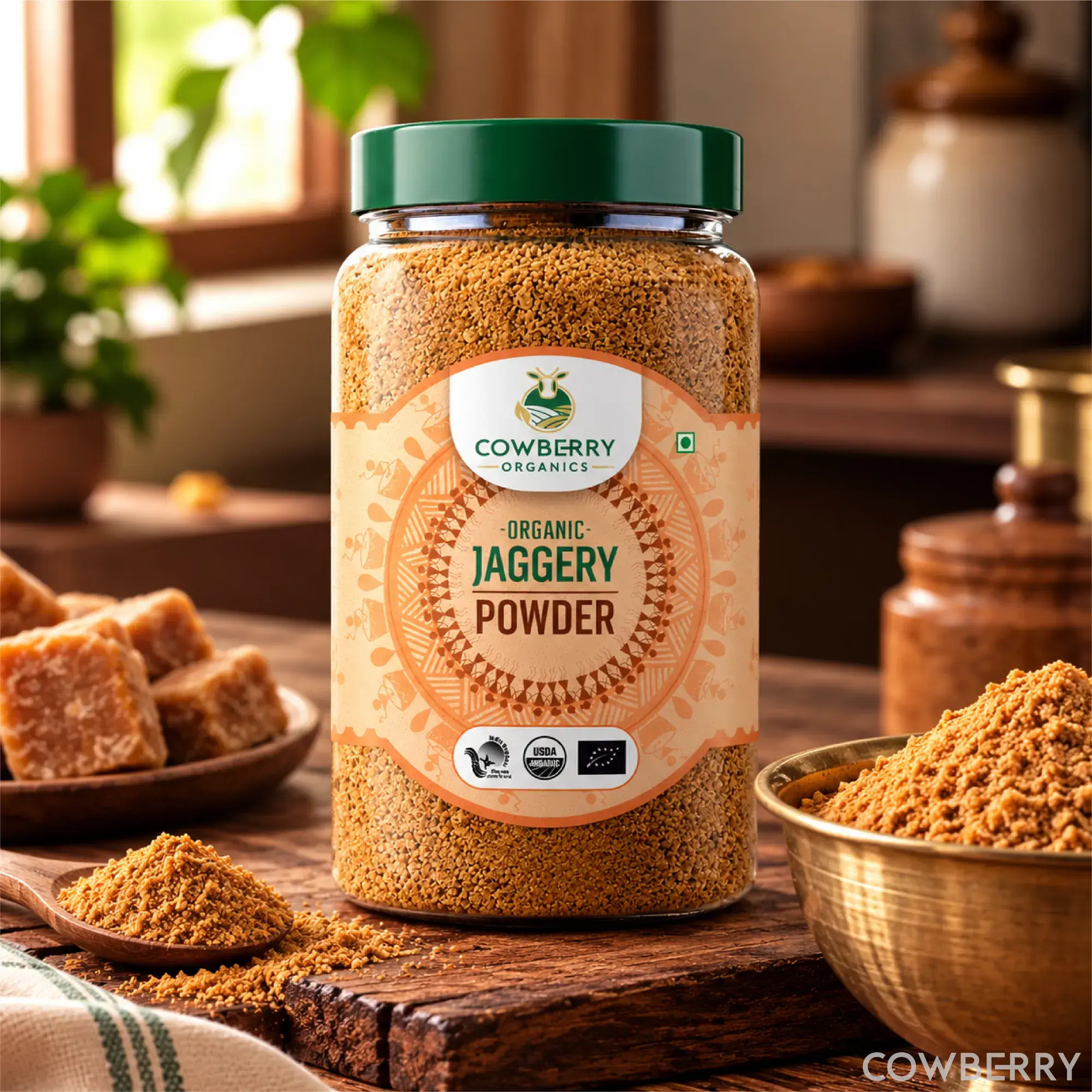
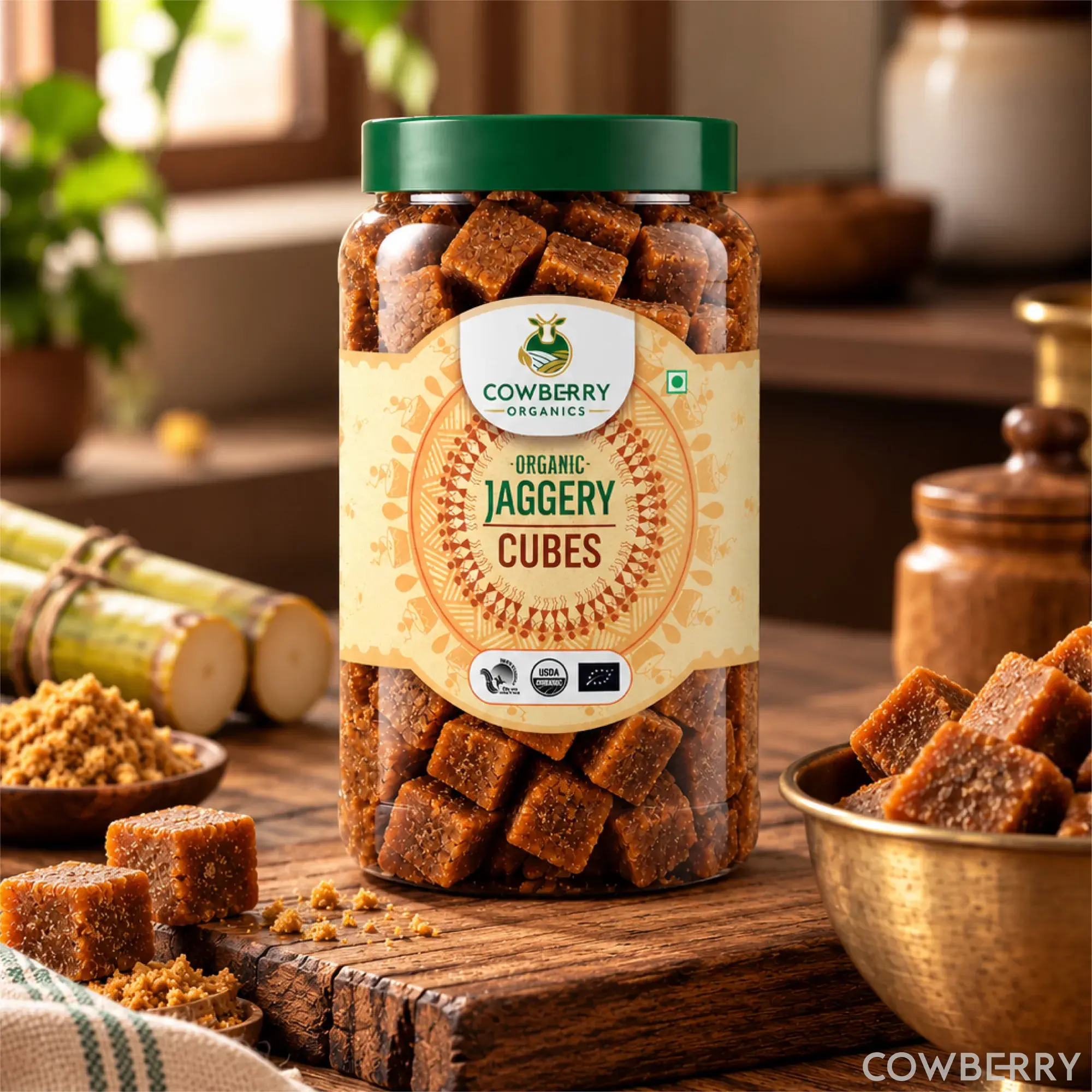
Choose powder when speed and measuring matter: tea and coffee by the spoon, batters and doughs, sprinkling over desserts, and any recipe that lists jaggery in grams. Choose cubes or blocks when the jaggery will be melted slowly into a syrup for chikki-style sweets, or grated, or simply eaten as a piece with the meal. COWBERRY sells both: its Organic Jaggery Powder is the fine, instantly dissolvable form, and its Organic Jaggery Cubes the small block form that dissolves easily.
Both are the same cane jaggery under the numbers, so the choice is convenience, not nutrition. Whichever you keep, the Dietary Guidelines for Indians still count it as added sugar, one of the list that includes table sugar and honey. More recipes than this page can hold are in the jaggery recipes roundup, and the kind-by-kind comparison lives on palm jaggery and which jaggery is best.
FAQs
What is jaggery powder made of?
Of one thing: jaggery. Plain jaggery powder is set jaggery from sugarcane juice, broken down and dried, with nothing mixed in; COWBERRY describes its powder as finely crushed from pure traditional jaggery made from natural sugarcane juice. A clean label names jaggery or sugarcane juice and nothing else, and added colour is banned in cane jaggery by FSSAI.
How jaggery powder is made?
The juice is boiled to a striking point of 120 to 122 °C, then the hot mass is cooled on a metal or wooden platform and left unstirred to crystallise. The set lump is scraped into powder with wooden scrapers, sieved, and dried down to a moisture of 1 to 2% before it is stored, which is what Rao and Singh credit for the powder's better keeping. That is the method Rao and Singh standardise in Sugar Tech, 2022.
Difference between jaggery and jaggery powder?
Form, not substance. The same cane jaggery sits in both, and IFCT 2017 prints one entry for the two: 354 kcal and 4.63 mg iron per 100 g. The block keeps up to 7% moisture under FSSAI's standard, the powder is dried to 1 to 2%, which is why it pours, dissolves fast and measures by the spoon.
How to identify pure jaggery powder?
Read the pack first: the ingredient should be jaggery or sugarcane juice alone. FSSAI's cane-jaggery standard allows no added colour and caps sulphites at 50 mg per kg. Dry, free-flowing grains that taste of molasses and caramel are what you want; the chalk test and the rest of the home checks are on how to identify pure jaggery.
What is jaggery powder?
Jaggery powder is set jaggery milled fine: cane juice boiled until it sets, then scraped, sieved and dried to 1 to 2% moisture so it stays loose and dissolves fast. It is the same food as block gur under IFCT 2017's numbers, in a form made for spoons, shakers and baking. COWBERRY's own powder is finely milled, with no chemical clarifying agents or additives in it.
References
- Rao GP, Singh P. Value addition and fortification in non-centrifugal sugar (jaggery), Sugar Tech 2022: full text on PubMed Central (PMC8314846)
- FSSAI: Food Products Standards and Food Additives Regulations compendium (Version XXII, 02.03.2022): 2.8.4 Gur or Jaggery
- Indian Food Composition Tables (IFCT) 2017, ICMR-National Institute of Nutrition
- Dietary Guidelines for Indians, ICMR-National Institute of Nutrition
Shop this article
Keep reading
Raw Sugar vs Brown Sugar: Is Demerara the Same Thing?
Does honey contain sugar? Carbs per 100g and the WHO sugar limit
Date Jaggery (Khejur Gur in English): Types, Forms and How to Use It