by COWBERRY

8 minute read
Palm Jaggery: Types, Taste, Uses and How It Differs From Cane Jaggery

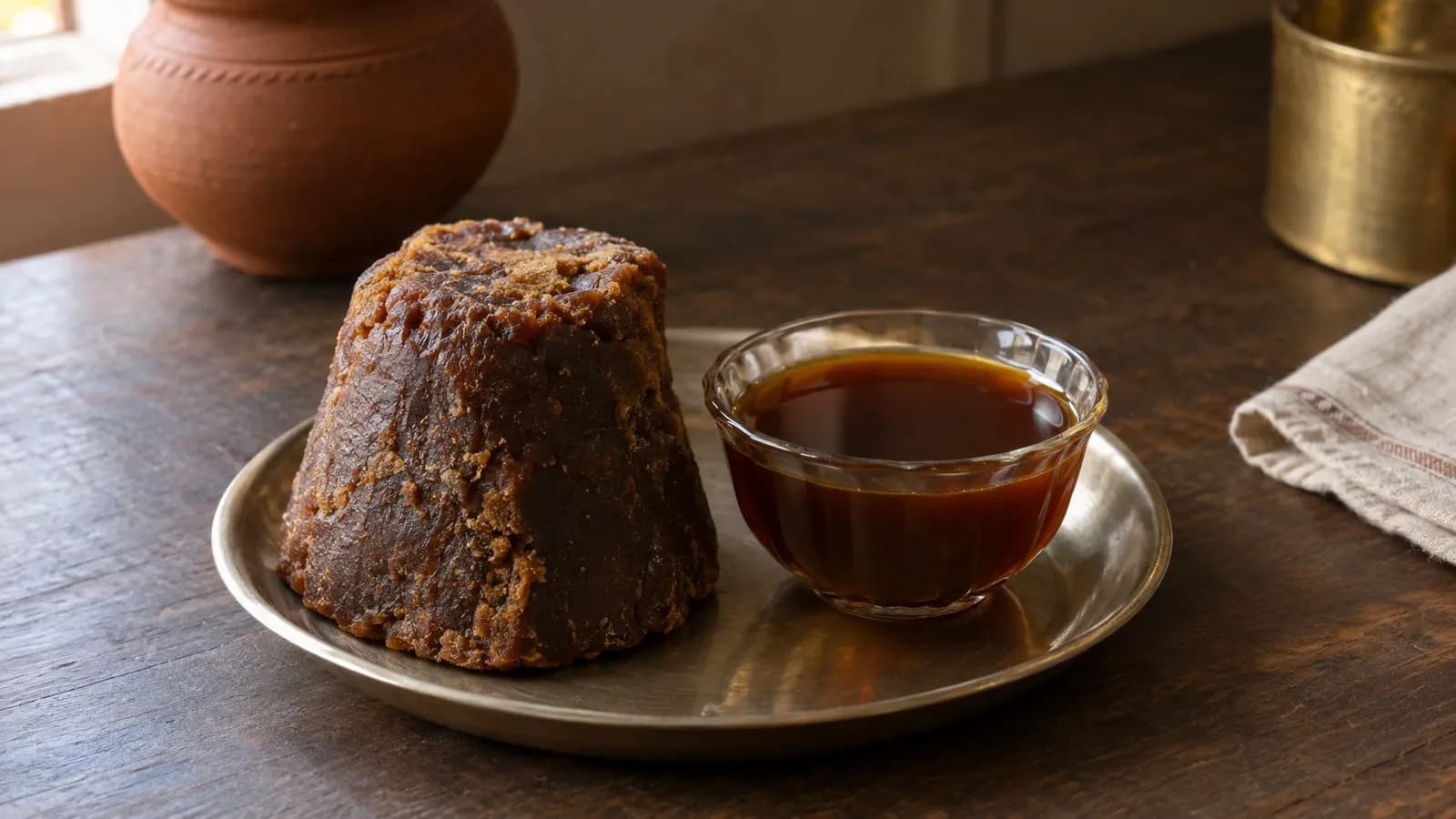
Palm jaggery is gur boiled from palmyra or coconut palm juice rather than sugarcane juice, and FSSAI's food standards give it a category of its own, sitting beside the date palm's jaggery. The palmyra kind is sold as karupatti, the date kind as khejur gur. This guide sets out the three kinds, how they differ from cane jaggery, and how to buy and use them.
What is palm jaggery? The three palms behind it
FSSAI's standard for gur or jaggery defines the food as the product obtained by boiling or processing juice extracted from the palmyra palm, the date palm or the coconut palm. One level down, its food category system splits that into three: cane jaggery from sugarcane, palm jaggery of the palmyra or coconut palm, and a date palm jaggery of its own. The two palm kinds and the date kind all answer to the one general standard, while the category system gives the date kind a category of its own.
The standard that the palm kinds fall under is the general gur standard, and its numbers are the only ones it gives them: at least 90% total sugars expressed as invert sugar, of which sucrose makes up at least 60%; no more than 2% extraneous matter and 6% total ash; and, for any gur that is not liquid or semi-liquid, at most 10% moisture.
Palm tree jaggery: karupatti, khejur gur and the coconut palm
Three palms feed the Indian jaggery pot, and the names in common use sort them out.
- Palmyra palm: the palm behind karupatti, and the first palm in FSSAI's palm jaggery category.
- Coconut palm: the second palm in that category; its juice, boiled down, is also palm jaggery in law.
- Date palm: khejur gur, also searched as nolen gur, and a category of its own under FSSAI's numbering, with its own guide to date jaggery.
IFCT 2017, FSSAI's standard and the Sugar Tech review carry no tasting notes for the three kinds. IFCT 2017 holds one jaggery entry, for cane jaggery, which keeps every number on this page honest about what it measures. The claims made for the palm kinds are weighed on palm jaggery benefits.
Palm jaggery vs sugar cane jaggery: source, standards and numbers
The split starts at the plant. Cane jaggery is boiled juice of sugarcane, Saccharum officinarum; palm jaggery is the boiled juice of those two palms, and date jaggery that of the date palm. The standards then part ways on the numbers. Cane jaggery must hold at least 70% sucrose and at most 7% moisture, with at least 90% total sugars and at most 20% reducing sugars; the general gur standard that covers the palm kinds asks at least 60% sucrose, the same 90% total sugars, and up to 10% moisture in anything that is not liquid or semi-liquid.
On composition the honest difference is that IFCT 2017 carries figures for cane jaggery and none for the palm kinds. Cane jaggery gives 354 kcal, 84.9 g carbohydrate, 4.63 mg iron and 107 mg calcium per 100 g, and the full entry sits in the jaggery hub; for palm jaggery there are no composition numbers, because IFCT 2017 has no palm jaggery entry. One cap is shared: sulphites left in any gur, the palm kinds included, may not pass 50 mg per kg. Picking between the kinds is the question our guide to which jaggery is best takes on.
How palm jaggery is made
The law's one-line method: palm jaggery is the product obtained by boiling or processing juice pressed out of or extracted from the palmyra or coconut palm. FSSAI's standard stops there; it does not describe boiling temperatures or moulds for any gur, and its only named clarifying agent is food-grade sodium bicarbonate. The fuller walk-through that exists is for cane jaggery. Rao and Singh's Sugar Tech review of 2022 follows cane juice through clarification and boiling to a striking point of 118 to 120 °C, then cooling and moulding, and it notes that jaggery's make-up varies widely with the cane variety, the climate, the farming and the processing methods a maker uses. The same review says poor hygiene in manufacturing, excessive chemicals used to get attractive colours and poor storability limit the acceptance of jaggery products.
For the palm kinds the standard gives only the one-line method above, with its 90% total sugars and 10% moisture limits. Neither FSSAI's standard nor the review gives a boiling temperature for palm sap, so none is quoted.
Palm jaggery nutrition: what is on record and what is not
IFCT 2017 carries a single jaggery entry, and it is cane jaggery: 354 kcal, 84.9 g carbohydrate, 1.9 g protein, 0.16 g fat, 4.63 mg iron, 107 mg calcium, 115 mg magnesium, 488 mg potassium, 25.38 mg sodium, 0.45 mg zinc and 14.4 mcg folate per 100 g. Palm jaggery has no entry of its own, and the GI tables hold no figure for it. So palm jaggery goes without composition numbers and without a GI figure; borrowing cane jaggery's numbers and passing them off as palm's would be guessing, not measuring.
What is on record for every kind of gur is its place in the diet. The Dietary Guidelines for Indians place jaggery on the added-sugar list beside table sugar and honey, so palm jaggery shares that day's allowance for added sugar rather than escaping it. A 10 g piece of cane jaggery works out to 35 kcal and 0.46 mg iron; for the palm kinds the honest arithmetic is simpler: count them as sugar and keep the piece small.
Palm jaggery how to use: drinks, sweets and preserves
The recipes below call for jaggery and are written for cane gur. In drinks it melts into hot liquid: the jaggery tea recipe stirs 2 teaspoons (10 g) into each cup, and jaggery water and panakam are built on the same dissolve-and-drink idea. In sweets it is grated in or melted to syrup: jaggery laddu, ukadiche modak, gur roti and thekua all name jaggery as their sweetener. Preserves take it too, as in amla murabba with jaggery.
Two kitchen habits help. Weigh or grate the jaggery a recipe calls for instead of judging by eye, since a solid piece hides its weight; and where a recipe was written for cane jaggery, start with the amount it states and adjust to your own taste. The fuller list is the jaggery recipes roundup, and the free-flowing cane form has its own page on jaggery powder.
How to buy and store palm jaggery
Check it against the standard. Every palm jaggery should clear the general gur standard: at least 90% total sugars and 60% sucrose, at most 10% moisture in the solid kinds, and no more than 50 mg per kg of sulphites left in it. FSSAI's ban on added colour is written for cane jaggery, so for the palm kinds the sulphite cap and what the maker states about its process carry the weight.
Read the pack. The ingredient should be the palm juice itself. Where organic is claimed on the label, the certification mark should be there too; FSSAI's claims rules let the word natural sit only on one food with nothing added. Store it dry. Keep palm jaggery dry, in a sealed jar in a cool, dry cupboard, the way COWBERRY advises for its own jaggery, and lift out only what you need with a dry spoon.
COWBERRY's jaggery range is cane jaggery: sugarcane from Kolhapur and Maharashtra's traditional cane belt, cooked slowly with no chemical clarifying or artificial additives, and both carry the India Organic, USDA & EU certified mark — the Organic Jaggery Powder and the Organic Jaggery Cubes.
FAQs
Difference between jaggery and palm jaggery?
Cane jaggery is boiled from sugarcane juice, while palm jaggery is boiled from palmyra or coconut palm juice, and date jaggery from date palm juice. FSSAI keeps the three as separate categories. The difference that can be checked is the source plant and the standard: IFCT 2017's sole jaggery entry is cane jaggery, so the palm kinds have no recorded figures to compare.
Is palm jaggery good for diabetes?
Nothing on record sets palm jaggery apart: the GI tables carry no figure for jaggery, IFCT 2017 holds no composition entry for the palm kinds, and the Dietary Guidelines for Indians list jaggery among added sugars. Count it in the day's carbohydrate like any other sugar. Whether even a small amount fits your plan is a question to settle with your doctor or dietitian.
How to identify pure palm jaggery?
Start from the standard every palm jaggery must meet: at least 90% total sugars and 60% sucrose, at most 10% moisture in the solid kinds, and sulphites no higher than 50 mg per kg. Then read the pack: the ingredient should be palm juice, and an organic claim should come with a certification mark. The home tests for jaggery sit on the how to identify pure jaggery page.
Is jaggery good for health?
Better than refined white sugar in one narrow sense: cane jaggery keeps 4.63 mg iron, 107 mg calcium and 488 mg potassium per 100 g, minerals that refining strips away. In every other sense it is sugar, and India's dietary guidelines count jaggery among added sugars. Use it in place of white sugar, not on top of it.
How to identify pure nolen gur?
Nolen gur is a name used for date jaggery, also called khejur gur, and FSSAI gives date jaggery a category of its own. Check it the way you would any gur: the standard's limits, a label that names date palm juice, and a certification mark where organic is claimed. Its season and uses are on the date jaggery page, and the tests on how to identify pure jaggery.
What is jaggery?
Jaggery is cane or palm juice boiled and concentrated, and IFCT 2017 lists its Hindi name as gud. FSSAI's definition covers sugarcane, palmyra palm, date palm and coconut palm juice. The composition figures on this site are for cane jaggery, and the full story, names, nutrition and benefits included, is on the jaggery hub.
References
- FSSAI: Food Products Standards and Food Additives Regulations compendium (Version XXII, 02.03.2022): 2.8.4 Gur or Jaggery
- Rao GP, Singh P. Value addition and fortification in non-centrifugal sugar (jaggery), Sugar Tech 2022: full text on PubMed Central (PMC8314846)
- Indian Food Composition Tables (IFCT) 2017, ICMR-National Institute of Nutrition
- Dietary Guidelines for Indians, ICMR-National Institute of Nutrition
- FSSAI Food Safety and Standards (Advertising and Claims) Regulations 2018, compendium (PDF)
Shop this article
Keep reading
Raw Sugar vs Brown Sugar: Is Demerara the Same Thing?
Does honey contain sugar? Carbs per 100g and the WHO sugar limit
Date Jaggery (Khejur Gur in English): Types, Forms and How to Use It