by COWBERRY

7 minute read
Which Jaggery Is Best? Colour, Type and Process Compared

Which jaggery is best? The honest answer is that no single kind wins on every count, so the choice runs on the job: a clean golden-to-dark cane jaggery for everyday tea and cooking, powder for stirring in, cubes or blocks for sweets, and the palm kinds where a household or a recipe prefers them. This guide compares colour, type and process, and what each one actually tells you.
Which jaggery is best? The short answer
Match the jaggery to the job, and the job decides the kind.
- Everyday tea, dal and cooking: plain cane jaggery with a clean label, powder for speed or a block to grate.
- Sweets: cubes or a block that melts into syrup, or powder that mixes straight into flour.
- Where the palm taste is wanted: palmyra (karupatti) or coconut palm jaggery, or date jaggery, each covered by its own guide.
Two rules outrank the rest. First, read the process: FSSAI's cane standard forbids added colour and caps sulphites at 50 mg per kg, and the review counts heavy chemical use for an attractive colour among the things that have held jaggery back. Second, remember that every kind of gur counts as added sugar, so the amount matters as much as the kind.
Jaggery yellow vs brown: what colour tells you
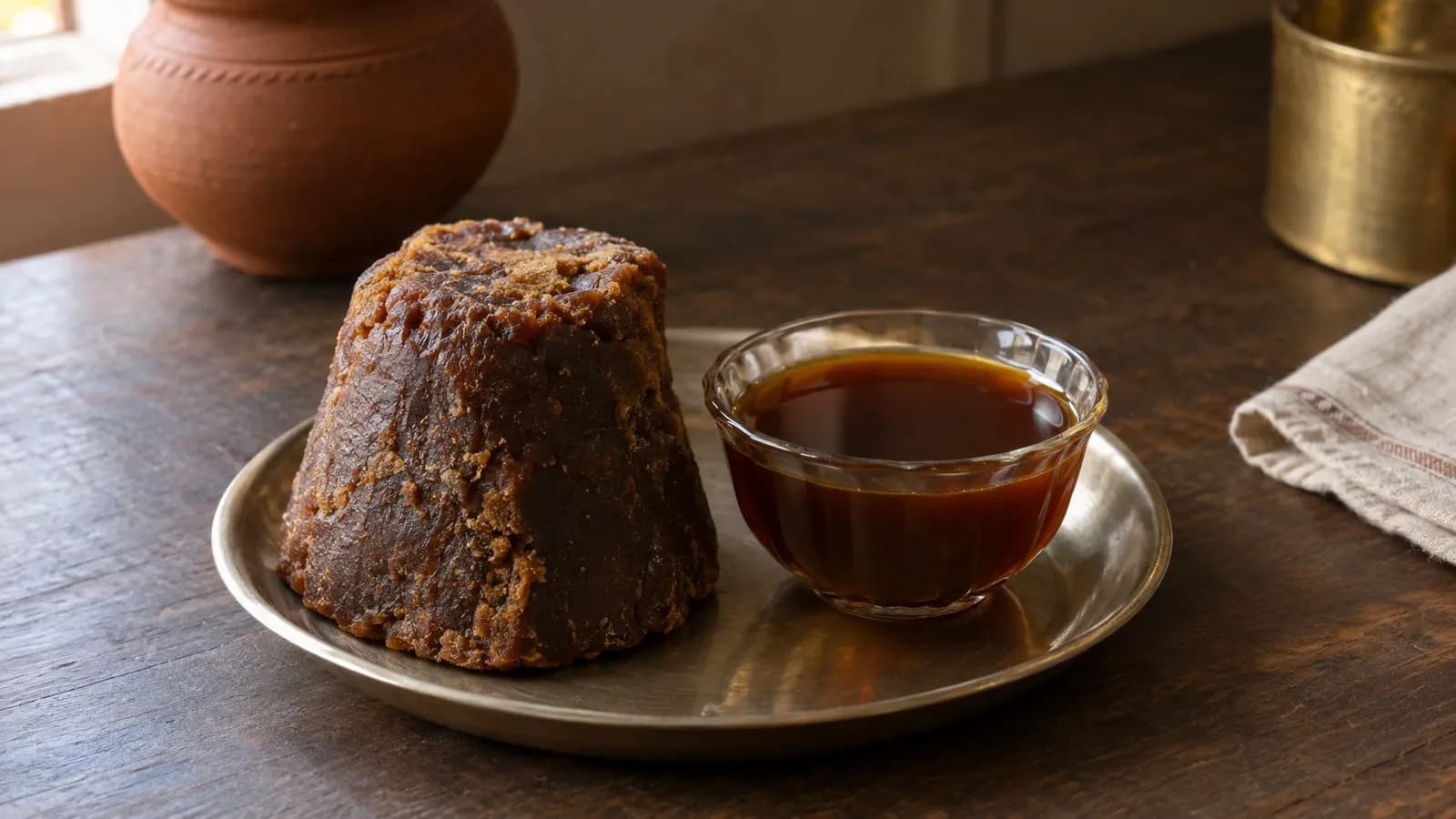
Cane jaggery is sold in shades from pale golden to deep brown, and the shade alone settles little. What darkens jaggery is the molasses the boiling leaves around the sugar crystals, which Rao and Singh describe as enclosing the crystals in a residue of molasses; the same review lists cane variety, climate, the chemicals and clarificants used and the processing method among the reasons jaggery's make-up varies, colour included. A pale, bright yellow block is no proof of anything, and a dark one is no proof either: FSSAI forbids added colour in cane jaggery outright, but the measured guard is the sulphite cap of 50 mg per kg, not the shade.
So judge by taste instead: jaggery should taste of molasses and caramel, and a bitter, soapy or chemical aftertaste is the warning sign. Colour is the packaging, not the product.
Black jaggery benefits: what the dark block carries and what it does not
Black jaggery is the deepest end of the same range, not a different food, and IFCT 2017 has no separate entry for it. The one jaggery entry in IFCT 2017 covers cane jaggery as a whole: 354 kcal, 84.9 g carbohydrate, 4.63 mg iron, 107 mg calcium, 115 mg magnesium and 488 mg potassium per 100 g. A dark block shows more of the molasses the boiling leaves in, and that residue is where the review locates the vitamin and mineral constituents of the juice; but the figures belong to the whole entry, and IFCT 2017 prints one iron figure for cane jaggery as a whole, so a darker block gets no more iron on paper than a golden one.
What the same sources do state is the honest frame: jaggery keeps the minerals of the juice that refining strips away, and the review calls it a healthy sugar that preserves most of the juice's nutrients, while the Dietary Guidelines for Indians still list it among added sugars. Use black jaggery the way any gur deserves: as a swap for white sugar, in an amount that fits the day.
Which jaggery is best for health: cane, palm or date
On paper, the question has no winner. IFCT 2017 records one jaggery entry, and it is cane jaggery: it lists no composition figures for the palm and date kinds, and the GI database lists no GI figure for jaggery at all. So the health comparison between kinds cannot be made with those numbers, and none will be invented. The numbers that do exist are laid out on jaggery calories, and the cane kind's full profile is on the jaggery hub.
What the guidelines state is the shared bottom line. The Dietary Guidelines for Indians count jaggery among added sugars, alongside table sugar and honey, and its plate for a 2000 kcal day keeps sugar to 25 to 30 g a day; 25 g of cane jaggery is 89 kcal. Whoever the eater, the guidelines' advice is the same: keep added sugar small, or drop it altogether, since it adds no nutritive value other than calories.
Powder, cubes or blocks: matching the form to the job
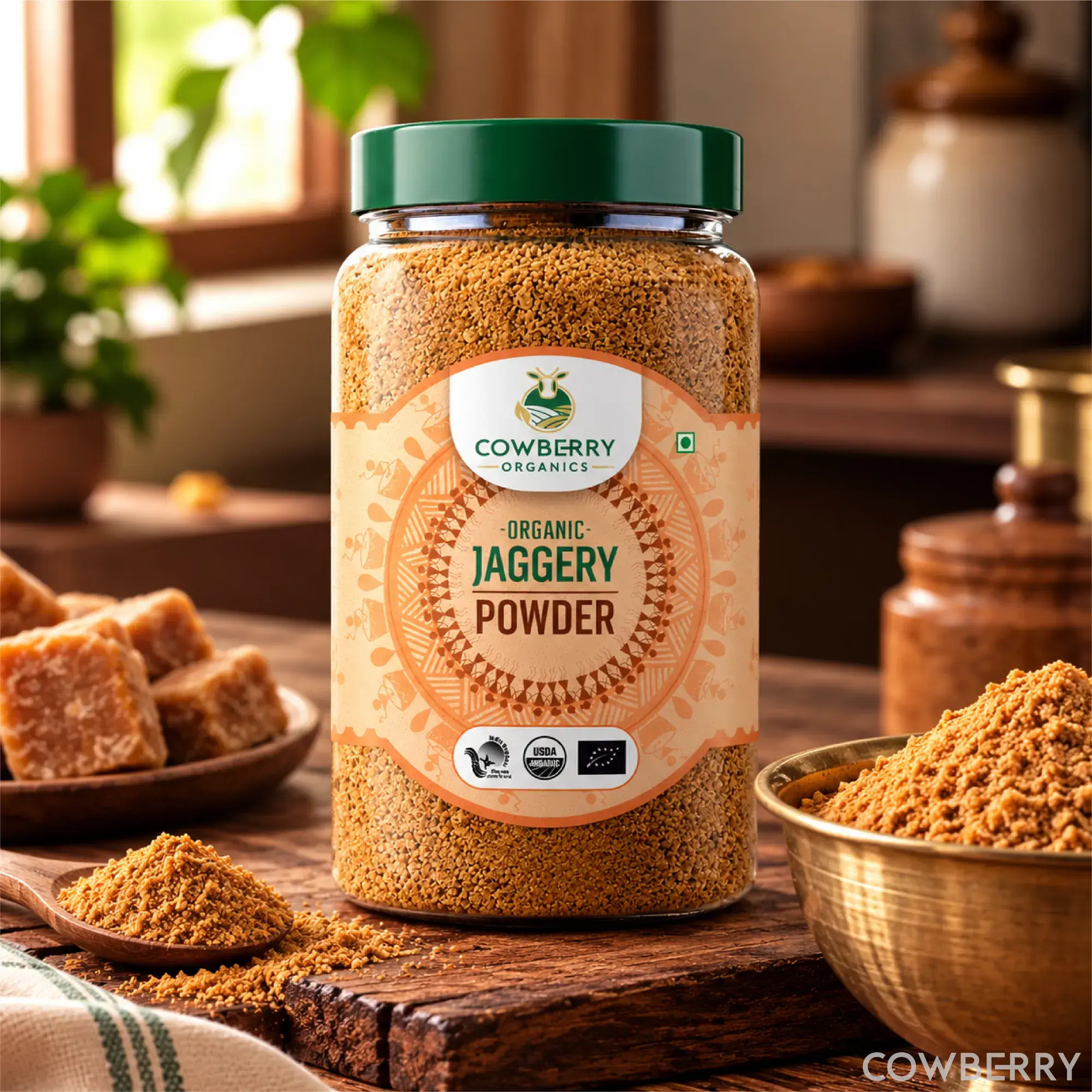
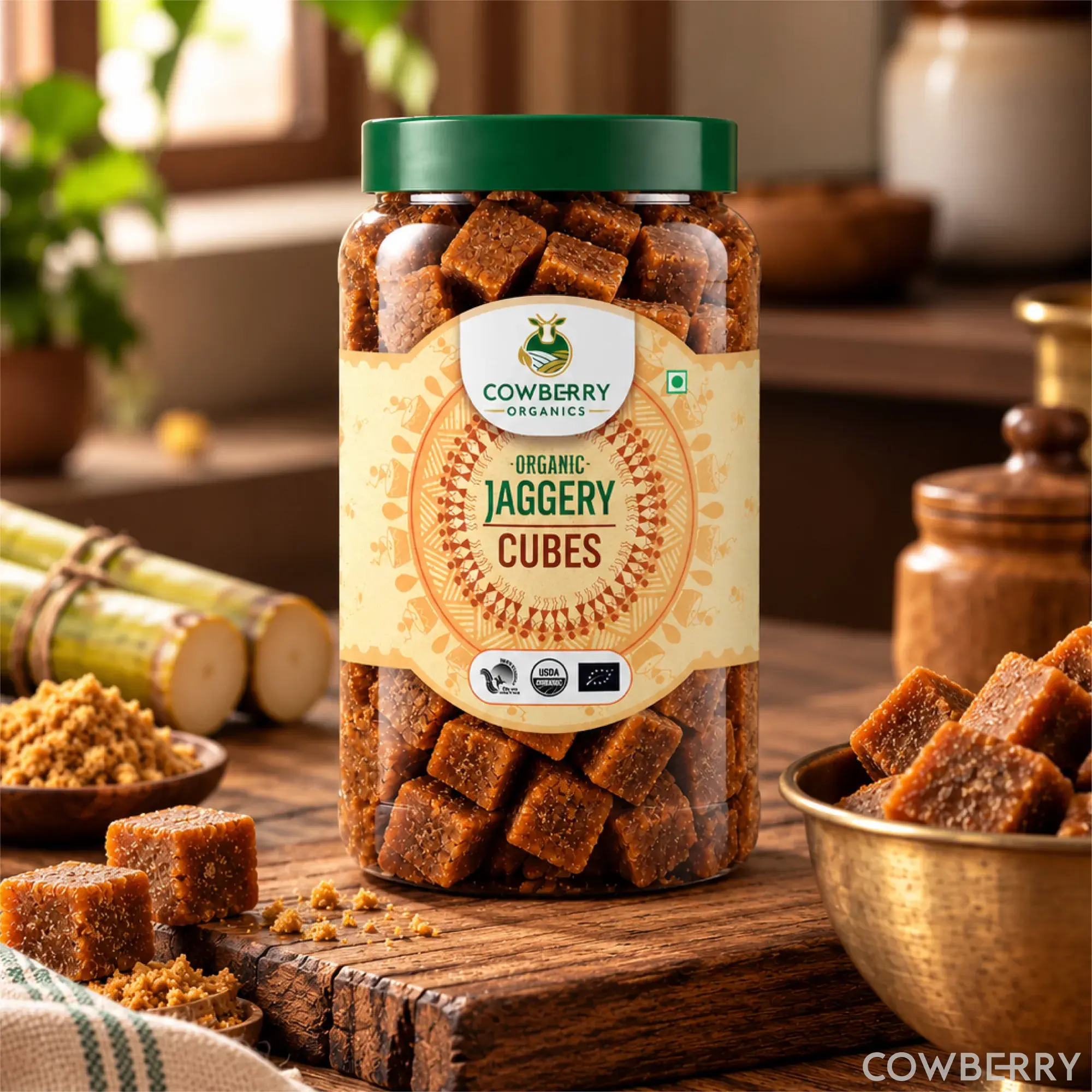
The form changes nothing in the numbers but plenty in the kitchen. Powder is the fastest worker: COWBERRY calls its powder instantly dissolvable, and a level teaspoon weighs 5 g, which makes tea, coffee, batters and baking easy to measure. Cubes dissolve easily rather than instantly and suit being dropped into hot milk or melted into syrup; a block grates into flour for sweets and stores well. If one jar must do everything, powder plus a small block covers the everyday plus the sweets; the two forms of COWBERRY's cane jaggery are compared line by line on jaggery powder.
For drinks, start with the jaggery tea recipe's 2 teaspoons (10 g) a cup, and for the sweets shelf the jaggery recipes roundup lists what each form does best.
How the process decides quality, and what to read on the pack
Most of what makes one jaggery better than another happened before it reached the shop. Rao and Singh put it bluntly: poor hygiene in making, excessive chemicals for an attractive colour and poor storability have limited jaggery's acceptance. FSSAI's cane standard turns that into numbers: 70% sucrose or more, total sugars 90% or more, moisture 7% or less, no added colour, and sulphites capped at 50 mg per kg; if sodium bicarbonate was used in clarification, it must be food grade. A pack that states its process, and whose label lists sugarcane juice or jaggery alone, is the one to take home.
An organic claim is only as good as its mark: look for the certification logo on the pack, and remember FSSAI's claims rules allow natural only on a single food, and only when nothing is added. COWBERRY's cane jaggery grows in Kolhapur and Maharashtra's traditional cane belt; the juice is slow-cooked with no chemical clarifying agents or artificial additives, and the range holds the India Organic, USDA & EU certified mark — the Organic Jaggery Powder and the Organic Jaggery Cubes. The home tests sit on the how to identify pure jaggery page, and the palm kinds get their own comparison on palm jaggery.
FAQs
Which jaggery is best?
For most kitchens the answer is a plain cane jaggery whose label names one ingredient, sugarcane juice, in whatever shape the job needs: powder for tea and baking, cubes or a block for sweets. Colour decides nothing on its own, and no kind wins on the numbers, so the best jaggery is the one whose process you can read and whose amount you control.
Which jaggery is good for health?
The numbers give no winner among kinds: IFCT 2017 records one jaggery entry, for cane jaggery, at 354 kcal and 4.63 mg iron per 100 g, and it lists none for the palm kinds. Every kind counts as added sugar under the Dietary Guidelines for Indians, so the sensible choice is the smallest amount, used as a swap for white sugar.
Which jaggery powder is best?
A powder whose label reads sugarcane juice alone, ground fine enough to pour and free of lumps. FSSAI's cane standard bans added colour and holds sulphites to 50 mg per kg, so a powder that passes those, pours without clumping and tastes of molasses and caramel is the one to buy. COWBERRY's own powder is finely milled and made without chemical clarifying agents or additives.
Which jaggery powder is good?
For tea, coffee and batters, pick a fine powder that dissolves fast; COWBERRY describes its own as instantly dissolvable. For sweets that need melting, a cube or block does the same job without the clumping risk, since powder caked by damp air is the one real nuisance of the form. Either way, the ingredient list should stop at jaggery.
Which jaggery is good?
One with a short label and a stated process. Cane jaggery suits everyday use; the palm kinds, karupatti from the palmyra palm and the date palm's khejur gur, are the choice when their character is what a dish or a home prefers; the two have their own guides on palm jaggery and date jaggery. Whichever kind, keep the amount within the day's added-sugar allowance.
References
- Indian Food Composition Tables (IFCT) 2017, ICMR-National Institute of Nutrition
- Rao GP, Singh P. Value addition and fortification in non-centrifugal sugar (jaggery), Sugar Tech 2022: full text on PubMed Central (PMC8314846)
- FSSAI: Food Products Standards and Food Additives Regulations compendium (Version XXII, 02.03.2022): 2.8.4 Gur or Jaggery
- Dietary Guidelines for Indians, ICMR-National Institute of Nutrition
- FSSAI Food Safety and Standards (Advertising and Claims) Regulations 2018, compendium (PDF)
Shop this article
Keep reading
Raw Sugar vs Brown Sugar: Is Demerara the Same Thing?
Does honey contain sugar? Carbs per 100g and the WHO sugar limit
Date Jaggery (Khejur Gur in English): Types, Forms and How to Use It