by COWBERRY

8 minute read
Which toor dal is best: oily, plain, polished or unpolished

Which toor dal is best turns on two shelves at the mill: polished against unpolished, and plain against oily. Below, each pair is sorted and matched to the dishes it suits, from sambar to everyday dal. The toor dal hub covers the dal itself.
The toor dal shelf: plain, oily, polished and unpolished
Toor dal reaches the shelf as one seed in different finishes. The seed is the pigeon pea, Cajanus cajan, and the dal on sale is that seed cleaned, dehusked and split; IFCT 2017 files the food under the name red gram. The FAO describes pulses as the dry, edible seeds of leguminous plants, and toor is one of them.
The finishes split into two pairs. The first pair is polished against unpolished: a polishing step at the mill usually gives the dal a gloss, while unpolished dal keeps its own dull golden colour and often carries a scatter of fine dal powder at the base. The second pair is plain against oily, and it describes the method behind that gloss: polishing at the mill can use water, a little edible oil, or leather. An oily toor dal is the one finished with oil, and a plain toor dal skips the oil, whether it was water-polished, leather-polished or not polished at all. Every pack sits somewhere in those two pairs, and the sections below sort out which finish belongs in which pot.
Toor dal oily vs plain: what the gloss means
Toor dal oily vs plain is a question about the last step at the mill. The oily type is the one polished with oil; the plain type is the one that skips it. What the oil is for is shine: an oily pack usually looks brighter and glossier, while a plain, unpolished pack usually looks duller and slightly uneven, often with fine dal powder settled at the bottom.
Nutritionally, IFCT 2017 gives one composition for toor dal, not separate entries for oily and plain, so no difference in numbers can be quoted between them. What the Dietary Guidelines do cover is polishing in general: the Dietary Guidelines place highly polished dal in the processing group that polished rice and maida share, where nutrient losses stay small but some fibre is also lost. Unpolished dal asks for a rinse before cooking because of the powder it carries; either type benefits from a quick rinse before the pot.
Toor dal unpolished vs polished: what the mill takes off
Toor dal unpolished vs polished is the question behind every pack on the shelf. Unpolished means the dal left the mill as it was split: its own dull golden colour, slightly uneven pieces, and often fine dal powder settled at the base. Polished means a finishing step was added, using water, oil or leather, to give the dal shine and an even look.
The difference in the guidelines is small but real. The Dietary Guidelines' table on processing groups puts whole dal in the group whose nutrient losses are minimal. Highly polished dal lands in the next group, alongside polished rice and maida: the losses stay small, but some fibre is also lost. That fibre is part of what makes pulses useful food, and toor dal carries 9.1 g of it per 100 g of dry dal in IFCT 2017's entry; a 2014 review of pulses counts pulses among foods that are high in fibre with a low glycemic index.
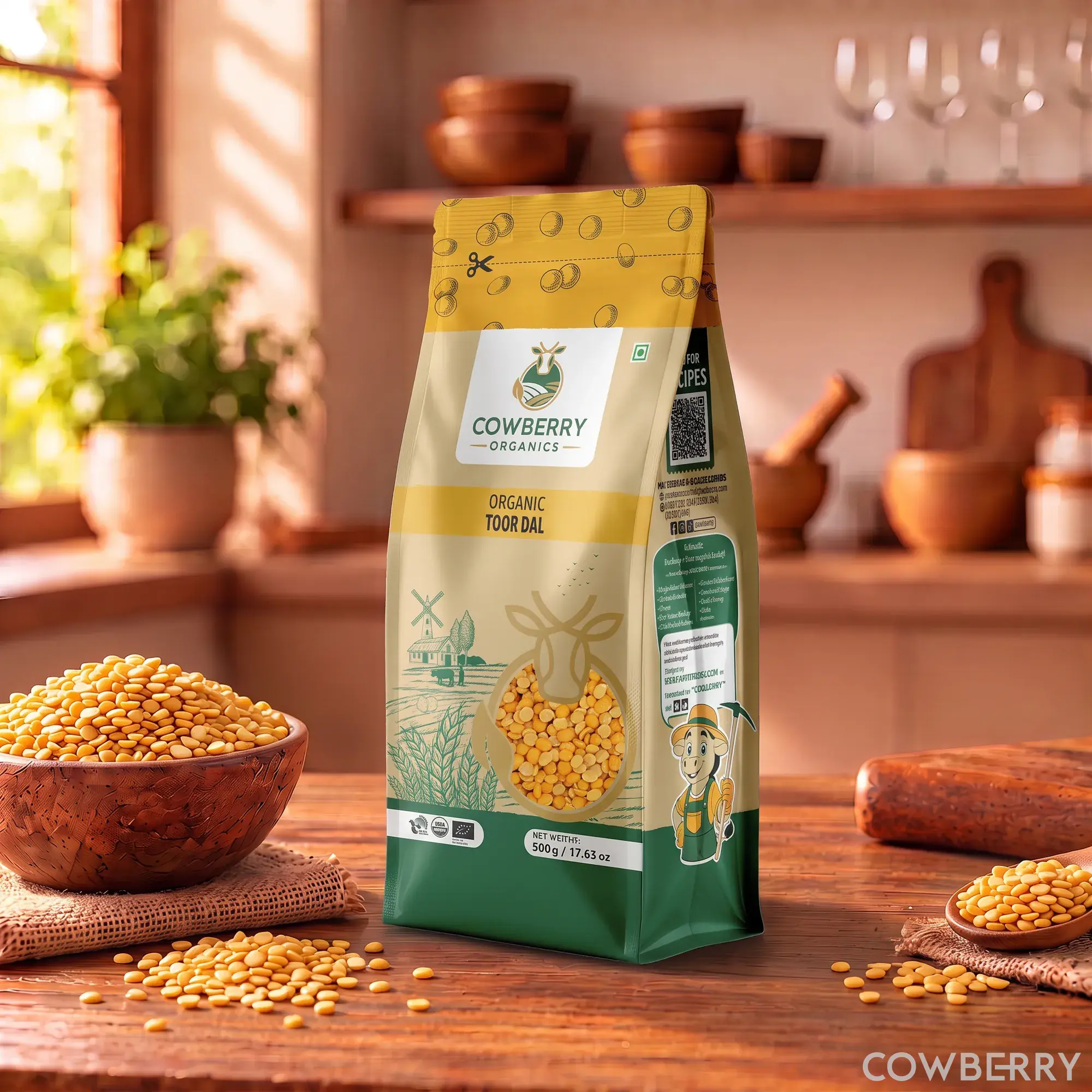
The practical trade: polished dal looks even and bright, while unpolished dal looks plainer and asks for a rinse because of the powder. COWBERRY's toor dal is unpolished, gently processed without water, oil or leather polishing. The table below carries the per-100 g numbers.
| Nutrient | Toor dal (split), raw |
|---|---|
| Energy (kcal) | 331 |
| Protein (g) | 22 |
| Fat (g) | 1.6 |
| Carbohydrates (g) | 55 |
| Dietary fibre (g) | 9.1 |
| Iron (mg) | 3.9 |
| Calcium (mg) | 72 |
| Magnesium (mg) | 119 |
| Potassium (mg) | 1395 |
| Sodium (mg) | 18 |
| Zinc (mg) | 2.6 |
| Folate (mcg) | 108 |
| Glycemic index (GI) | 20 |
Per 100 g raw, edible portion. Composition: IFCT 2017 (ICMR-NIN). GI: University of Sydney GI database. — means not reported. These are average values for the food; the label on a pack gives the values for that product.
Toor dal yellow: why colour is a clue
Toor dal yellow is the colour buyers reach for: the dal is sold as the yellow lentil used in Indian cooking for making dal, sambar and curries. Where the yellow comes from matters. Unpolished dal keeps the seed's own golden colour, and polishing adds a bright, even gloss on top of it. One flat, bright yellow across the whole pack may point to polish; a duller yellow is usually how unpolished dal looks, and some dal powder at the base of an unpolished pack is usually just powder.
Colour, then, is a first filter rather than a verdict: matte and slightly uneven usually means less finishing at the mill. Whatever the colour on the pack, the dal inside answers to many names, from arhar in Hindi to Turdal in Marathi, all of them on the toor dal names page.
Which toor dal for sambar and dal tadka
Sambar is a classic toor dal dish, and the pot wants a dal that cooks down to a smooth, thick pour. Plain toor dal, polished or unpolished, does that job, and the same dal finishes dal tadka. Nothing in the Dietary Guidelines ties dish choice to the polishing method, so the recipes on this site simply start from plain toor dal: sambar, dal tadka, toor dal (arhar dal) and toor dal khichdi, all washed and boiled or pressure cooked until the dal falls completely soft. The toor dal recipes roundup has the rest.
Growing regions: Latur, Gujarat and the name on the pack
Two names keep coming up in the region question: Latur, in Maharashtra, and Gujarat. Packs carry region names as a signal of origin, and buyers ask for a winner between them. The straight answer is that the Dietary Guidelines do not put Latur toor above Gujarat toor, and no ranking is given here. COWBERRY's toor dal, for its part, comes from Andhra Pradesh, Karnataka and Maharashtra, grown with cow-based farming. A pack that prints its growing region tells you the dal's origin.
The region label, then, is information to weigh, not a badge of quality. The checks that matter more are the ones in the buying section below: the look of the dal, the finish at the mill, and the pack's own words. A region name is a pack word like any other; match it against the dal inside.
How to buy and store toor dal
Finish first. Prefer a matte, unpolished dal; a glossy, even shine points to polishing, and unpolished packs carry a little dal powder, which is normal.
Colour. A duller yellow is usually how unpolished dal looks; a single flat, bright yellow may suggest polish.
Pack words. India's advertising and claims regulations set conditions for adjectives like natural, fresh and pure, so read pack words as descriptions, not certification. On COWBERRY's pack the certification is printed: India Organic, USDA & EU certified.
Region and dates. A pack that names its growing region is stating the dal's origin, and the packing date is worth checking.
Storage. The rules for toor are the ones for dry food grains: the Dietary Guidelines say food grains should be dried adequately and kept in airtight containers to protect them from moisture and the microbes that grow in it, and the product guidance matches that, storing toor dal in an airtight container in a cool, dry place, away from sunlight, to preserve its freshness.
Which toor dal for you
In one line each: plain, unpolished toor for everyday dal, sambar and khichdi, where the dal itself does the work; polished or oily toor when a glossy, even look matters, keeping in mind that the guidelines say highly polished dal loses some fibre. IFCT 2017 gives one composition for toor dal, not four, so the numbers above apply to the dal itself.
The choice, then, is a kitchen choice: match the finish to the dish and the household. The toor dal hub takes the dal from names to nutrition; toor dal for diabetes covers the GI side for blood sugar, and toor dal for weight loss has the calorie arithmetic.
FAQs
Which toor dal is best?
The one that matches the pot and the finish you want. For everyday dal, sambar and khichdi, plain unpolished toor is the straightforward pick: nothing added at the mill, and no polishing, which the Dietary Guidelines link to some fibre loss in highly polished dal. If a bright, even, glossy look matters more, polished toor is the alternative. The dish and the household decide.
Which toor dal is best for sambar?
Plain toor dal, polished or not: sambar needs a dal that cooks to a thick, smooth pour. Unpolished dal needs a rinse for its powder before it goes into the pot; either way, cook it until it falls completely soft, and the sambar base does the rest.
Which toor dal is best, polished or unpolished?
Unpolished, going by the Dietary Guidelines. The Dietary Guidelines put highly polished dal in the processing group that loses some fibre, while whole dal sits in the group with minimal losses. Against that, unpolished toor keeps its own golden colour and carries nothing extra from the mill, at the cost of a rinse for the dal powder.
Which toor dal is best, Latur or Gujarat?
The Dietary Guidelines do not put one above the other, and no winner is given here. They do not compare Latur toor with Gujarat toor; COWBERRY's toor dal comes from Andhra Pradesh, Karnataka and Maharashtra. Judge a pack by the dal inside and the finish at the mill, not by the region alone.
What is arhar dal?
Arhar dal is toor dal under its Hindi name, the split, dehusked seed of the pigeon pea, Cajanus cajan; IFCT 2017 files the food as red gram and prints arhar among its local names. The same dal also answers to tur, and the names page lists every name in every language.
References
- Indian Food Composition Tables (IFCT) 2017, ICMR-National Institute of Nutrition
- Dietary Guidelines for Indians, ICMR-National Institute of Nutrition
- FSSAI Food Safety and Standards (Advertising and Claims) Regulations 2018, compendium (PDF)
- Mudryj AN, Yu N, Aukema HM. Nutritional and health benefits of pulses. Appl Physiol Nutr Metab, 2014
- FAO: World Pulses Day (pulses and their role in diets)
Shop this article
Keep reading
Green gram plant: crop, varieties and how it grows in India
Rajma vs lobia: difference, nutrition and which to choose
Rajma plant: how rajma is grown in India (it is not a tree)