by COWBERRY

7 minute read
Chai patti nutrition: calories and nutrients per 100g

Chai patti nutrition is an honest page: IFCT 2017 and the USDA tables print no composition for dry tea leaves, so there are no per-100g numbers to quote for the leaf itself. What they do print is what a cup is built from — sugar, jaggery and caffeine. The chai patti hub gathers every tea page together.
Chai patti nutrition per 100g: the honest answer
The honest answer to chai patti nutrition per 100g is that the cited tables print none. The Indian Food Composition Tables (IFCT 2017) do not list tea leaves at all, the USDA database records only brewed and ready-to-drink tea rather than the dry leaf, and the glycemic index lists have no entry for a plain cup. So no invented per-100g figures are given for the leaf; only what those tables record is quoted.
What a sweet, milky cup is actually built from does have printed numbers in IFCT 2017, and those belong in the table below: white sugar and jaggery, the two sweeteners an Indian kitchen stirs into chai. Everything else on this page follows from them, plus one printed range for caffeine.
| Nutrient | White sugar | Jaggery (cane) |
|---|---|---|
| Energy (kcal) | 387 | 354 |
| Protein (g) | 0 | 1.9 |
| Fat (g) | 0 | 0.2 |
| Carbohydrates (g) | 100 | 85 |
| Dietary fibre (g) | 0 | — |
| Iron (mg) | 0.1 | 4.6 |
| Calcium (mg) | 1 | 107 |
| Magnesium (mg) | 0 | 115 |
| Potassium (mg) | 2 | 488 |
| Sodium (mg) | 1 | 25 |
| Zinc (mg) | 0 | 0.5 |
| Folate (mcg) | 0 | 14 |
| Vitamin C (mg) | 0 | — |
| Glycemic index (GI) | 70 | — |
Per 100 g raw, edible portion. Composition: USDA FoodData Central (SR Legacy), FDC ID 169655, NDB 19335; IFCT 2017 (ICMR-NIN). GI: University of Sydney GI database. — means not reported. These are average values for the food; the label on a pack gives the values for that product.
Chai patti calories: the plain cup, the milky cup
A plain cup of black tea adds almost nothing to the day's energy, because the brew is mostly water; that claim has to stay in words, since IFCT 2017 and the USDA tables print no dry-leaf record and no number for the brew.
Chai patti calories arrive with the spoonfuls. The chai recipe sweetens each cup with 1.5 teaspoons of sugar, which comes to 29 kcal and 7.5 g of carbohydrate per cup, every kcal from the sugar alone; milk adds more on top, but IFCT 2017 and the USDA tables print no per-cup milk figure, so the honest count is what you pour. The spiced masala chai uses two teaspoons a cup, about 39 kcal and 10.0 g of carbohydrate from the sugar, with the milk again beyond the printed numbers.
Sugar and jaggery: the part of the cup with numbers
The table above carries the two sweeteners, and their per-100g figures do the work. White sugar is 387 kcal per 100 g and almost pure carbohydrate, with zero protein, fat and fibre; its printed glycemic index is 70. Jaggery (cane) is 354 kcal per 100 g with 84.87 g of carbohydrate, and it brings the minerals sugar lacks: 4.63 mg iron, 107 mg calcium, 115 mg magnesium and 488 mg potassium per 100 g, all from the IFCT 2017 tables.
Scaled to the spoon, a level 5 g spoonful of white sugar is roughly 19 kcal, and the same spoon of jaggery roughly 18 kcal, so two spoonfuls of either are what really change a cup's arithmetic. The leaf behind the cup stays outside that arithmetic, because IFCT 2017 and the USDA tables have no entry for it.
Caffeine: the one number the guidelines print for the cup
Caffeine is the one figure the Dietary Guidelines print for the drink itself. The Dietary Guidelines for Indians put a 150 ml cup of tea at 30-65 mg of caffeine, below the 80-120 mg printed for a cup of brewed coffee and next to the 50-65 mg of instant coffee. The same guidelines advise moderation, so the day's caffeine total stays below the tolerable limit of 300 mg, and they add one printed caution: excessive tea is to be avoided, on account of the caffeine it carries.
That range belongs to the cup, not to the grade: the Dietary Guidelines print no split between CTC, orthodox or dust tea, so all of them sit on the same 30-65 mg. Caffeine per cup, cup by cup, the count lives on how much caffeine is in tea, and pregnancy carries its own separate limit, printed on chai patti in pregnancy.
Chai patti glycemic index: no number in the GI database
There is no printed glycemic index for chai patti or for a plain cup of tea: the glycemic index database passes tea by entirely, so no GI figure exists to quote for the leaf or the brew. What carries a printed GI is the sugar stirred in afterwards: white sugar sits at 70, a mean of twenty-five published entries, while jaggery has no GI entry of its own in the glycemic index database.
That is why the sweetener matters more for blood sugar than the tea itself. A plain cup, mostly water with nothing added, carries neither energy nor a GI number; the response follows what goes into the cup after brewing.
CTC tea nutrition facts, orthodox and loose leaf: the same blank entry
CTC tea nutrition facts look the same as every other tea's: no printed composition. CTC pellets, orthodox whole leaves, dust tea and tea bags all come from the same dry leaf, and none of the forms has a nutrition entry in IFCT 2017 or a dry-leaf record in the USDA tables, so loose leaf tea calories cannot honestly be quoted per 100 g for any of them. The differences between the forms are processing and packing, not printed numbers: what is CTC tea and what is orthodox tea walk the two routes, and loose leaf tea vs tea bags lines up the packings.
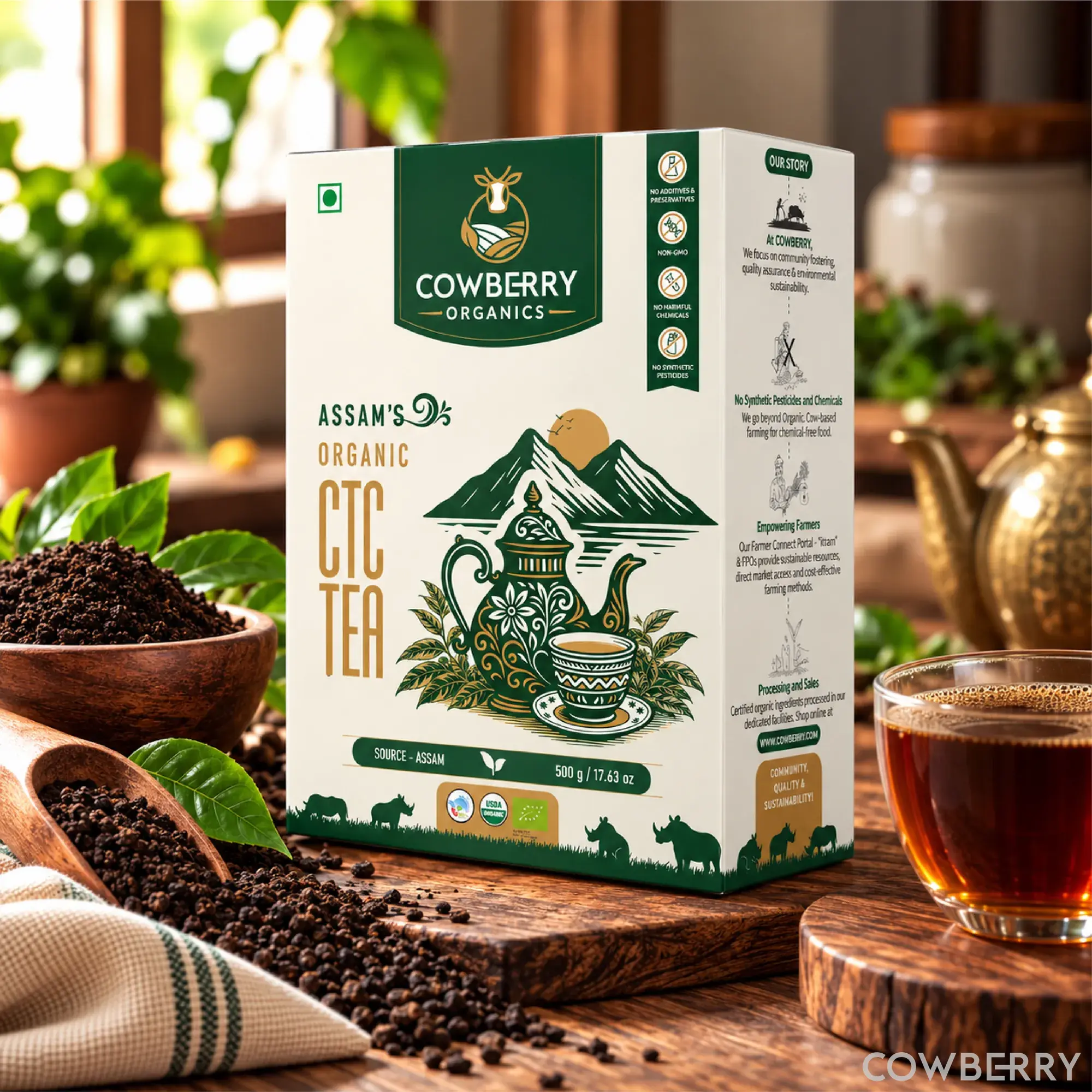
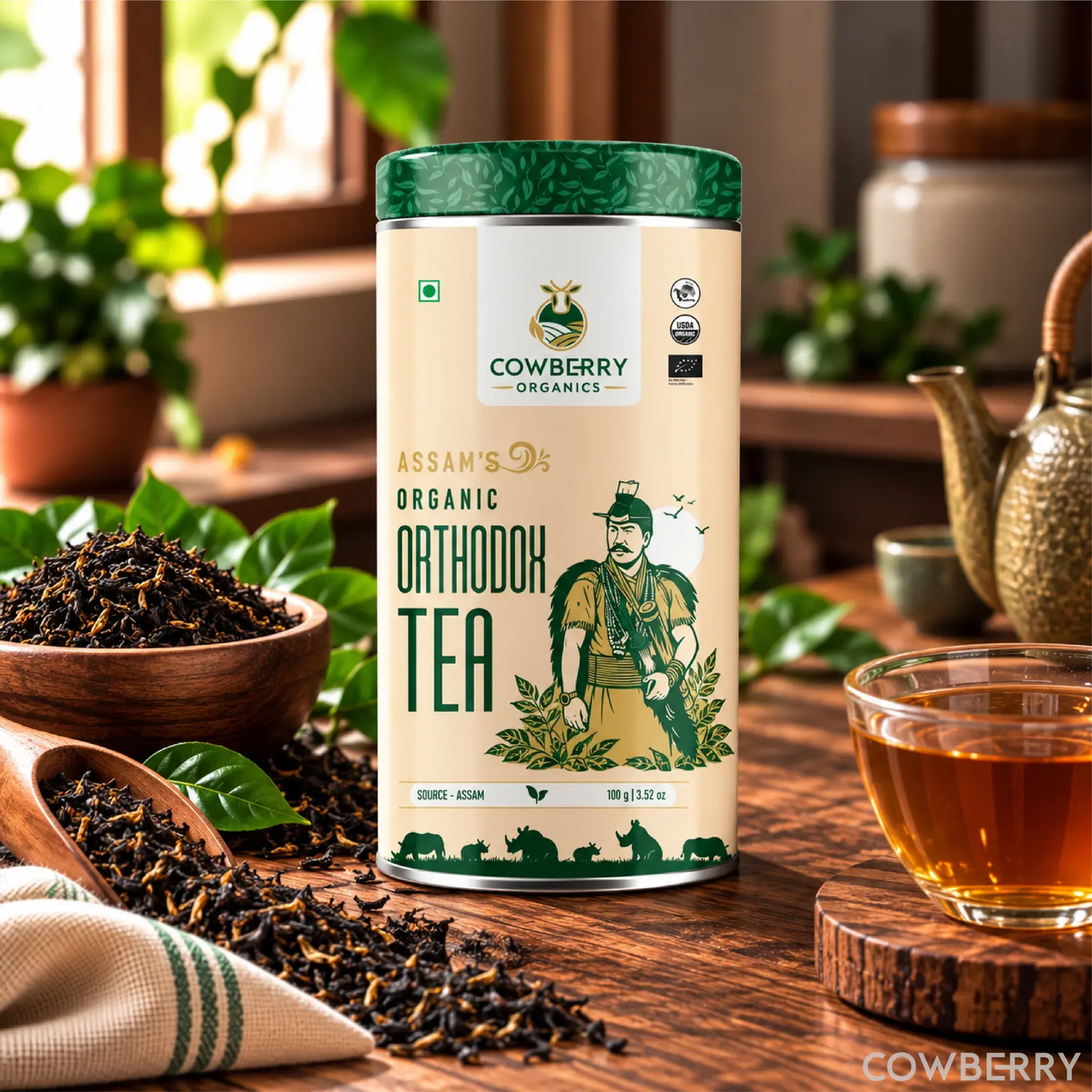
For the leaf itself, then, buy on how it is grown and processed, not on numbers no cited table prints. COWBERRY's teas come from organic Assam gardens: the CTC leaf is crushed, torn and curled into small pellets and sealed air-tight right after processing, while the orthodox leaf is hand-picked and rolled whole the traditional way. For the rest of the leaf's story, start at the chai patti hub.
Choosing chai patti: what to check before buying
Since the leaf itself has no printed nutrition entry, the buying checks are about the leaf and the pack. Look for the tea's origin and processing on the label — Assam CTC pellets for the everyday milky pot, hand-picked whole rolled leaves for a plain cup — and match the pack size to how fast your kitchen finishes it. COWBERRY packs its CTC black tea in 500 g and 1 kg sizes and the orthodox whole leaf in a 100 g pack, and each carries that India Organic, USDA & EU certified mark; the leaf is grown without synthetic pesticides.
Once the pack is open, storage decides what the leaf keeps: keep it airtight, dark, cool and dry, away from the hob and any strong smells, as does chai patti expire explains. For the recipes that put the leaf to work, the roundup of loose leaf tea recipes has the pot covered.
FAQs
Does chai patti have caffeine?
Yes. In a 150 ml cup of tea the guidelines print 30 to 65 mg of caffeine, and they advise moderation so the day's caffeine stays inside the printed tolerable limit of 300 mg. The caffeine is in the leaf, and the Dietary Guidelines print no split between CTC, orthodox or dust tea, so every grade sits on the same range.
Does CTC tea have caffeine?
Yes, on the same printed range as every tea: 30 to 65 mg in a 150 ml cup, per the Dietary Guidelines for Indians. The crush-tear-curl processing changes the leaf's form, not its caffeine. A cup-by-cup run-down of every drink sits on how much caffeine is in tea.
What is CTC tea?
CTC tea is black tea built by the Crush, Tear and Curl route: leaf crushed, torn and curled into small, even pellets that brew fast and strong, and it is the grade to reach for when brewing milky chai. COWBERRY's CTC tea comes from Assam leaf and is sealed air-tight right after processing. More on what is CTC tea.
Which loose leaf tea is best?
By the cup you want: CTC granules brew the strong, bold cup for milky chai, while rolled whole orthodox leaves steep a smoother, plainer cup, and neither IFCT 2017 nor the USDA tables separates them, because no printed numbers exist for either. For the everyday pot the pellets win; for the plain cup, the whole leaf. Which loose leaf tea is best compares the shelf.
Does orthodox tea have caffeine?
Yes. Orthodox tea is black tea, and the printed range for a 150 ml cup of tea is 30 to 65 mg of caffeine, per the Dietary Guidelines for Indians, with no printed split between orthodox and CTC. The rolling changes the leaf's shape and the cup's smoothness, not the caffeine.
References
Shop this article
Keep reading
Coffee vs tea: caffeine, benefits and which is better
Coffee calories per 100g: powder, beans and filter coffee
Coffee in pregnancy: how much caffeine is safe