by COWBERRY

13 minute read
India Organic logo, Jaivik Bharat, USDA and EU labels explained

The India Organic logo on a pack says the food was certified under NPOP, the National Programme for Organic Production. Jaivik Bharat is FSSAI's unified logo for organic food, the USDA seal and the EU leaf are the American and European marks, and words such as 'natural' or 'chemical-free' are claims, not certification. This guide explains each one and shows how to check it.
What does organic mean on a food pack?
On a food pack, organic is a statement about how the food was produced, backed by a certificate. FSSAI's Jaivik Bharat portal defines organic foods as products of holistic agricultural practices that focus on biodiversity, soil health and chemical-free inputs, with an environmentally and socially responsible approach, produced in accordance with organic production standards. The last part carries the weight: there is a written standard, and certification is what assures that a food complies with it.
The portal is plain about why this matters. Mislabelling happens when a food business marks a product as organic while it contains non-organic ingredients, or when the organic production standards were not followed in making it. That is why it is worth checking whether food labelled organic is what it says.
In India, the portal explains, organic food may be certified under NPOP or under PGS-India, and the Food Safety and Standards (Organic Foods) Regulations, 2017 are based on the standards of those two systems. ICMR-NIN's Dietary Guidelines for Indians give two conditions a shopper can hold a pack to: when a food is free of all artificial preservatives, flavours and colours, and its ingredients are free from pesticides and chemical fertilisers, the label can state 100% organic and carry the Jaivik Bharat logo approved by FSSAI.
Organic is not a statement about calories, protein or taste. Organic ragi and conventional ragi are the same grain. What differs is how each was grown and handled, and whether anyone other than the seller has checked.
India Organic logo: what NPOP certification covers
India Organic is the logo that goes with certification under NPOP, the National Programme for Organic Production. On a pack of dal, flour or spice it says that the food was produced to the NPOP standards and that a certification body has confirmed it.
Two details from FSSAI's portal are worth knowing. First, certification under NPOP is carried out by accredited certification bodies; the portal counts 28 of them and links to the list. Second, the Indian Organic Integrity Database at the heart of the portal was developed jointly by FSSAI, APEDA and PGS-India. It holds information on organic food standards, certification processes, food businesses, their products and the areas where those products are sold.
PGS-India, the second route
PGS-India is the other system under which organic food may be certified in India. It is a participatory system organised through Regional Councils, of which the portal counts 562. FSSAI's organic food regulations draw on its standards alongside those of NPOP.
Where to read more
How a farm moves through certification is covered in earlier posts and is not repeated here. Start with India's organic certification system, then the NPOP standards in brief, what is allowed and what is forbidden and the certification journey from farm to market.
Jaivik Bharat logo: the FSSAI mark for organic food
Jaivik Bharat is the unified logo for organic products. FSSAI's portal describes it as an identity mark that distinguishes organic products from non-organic ones, with the tagline 'Jaivik Bharat' at the bottom to signify organic food from India, and says the logo communicates adherence to the national organic standards.
'Unified' is the useful word: the portal presents one logo for organic products, while the food itself may be certified under NPOP or under PGS-India. A logo cannot name the certifier, though. For that, read the rest of the pack or search the portal.
The portal calls itself a regulatory portal, and its search is open to any shopper: by product, by company, or by licence or registration number.
USDA organic meaning and the EU organic leaf
USDA organic
The USDA organic seal belongs to the National Organic Program (NOP) of the United States Department of Agriculture. USDA describes the NOP as a federal regulatory programme that develops and enforces consistent national standards for organically produced agricultural products sold in the United States. The NOP accredits third-party organisations to certify that farms and businesses meet those standards, and the certifiers and USDA enforce them together.
The standards sit in the USDA organic regulations, 7 CFR Part 205, which include prohibited practices, requirements and the National List of Allowed and Prohibited Substances. The programme was established by the Organic Foods Production Act of 1990. Among the NOP's public resources are an Organic Integrity Database and a lookup of the certification status of organic farms and businesses.
The EU organic leaf
The European Commission says the EU organic logo can be used only on products certified as organic by an authorised control agency or body, which means they have met strict conditions on how they are produced, processed, transported and stored. A product must contain at least 95% organic ingredients and respect further strict conditions for the remaining 5%, and the same ingredient cannot be present in both organic and non-organic form.
Next to the logo, the pack must show the code number of the control body and the place where the agricultural raw materials were farmed, given as EU or non-EU agriculture. The logo is compulsory on pre-packaged food produced and sold as organic within the EU, and optional on imported products that conform to the EU rules on the import of organic goods. It cannot be used on products in conversion, where organic methods have only just been introduced.
Why they appear on Indian packs
An Indian product that carries the USDA seal or the EU leaf has been certified to that scheme's own standards, by a certifier the NOP accredits or by an authorised control agency or body. Each mark covers its own scheme, so read any Indian mark on the same pack as a separate certification.
Organic vs natural, chemical-free and other label words
Everything else on a pack is a claim, which FSSAI's Advertising and Claims Regulations, 2018 define as any representation that states, suggests or implies that a food has particular qualities relating to its origin, nutritional properties, nature, processing, composition or otherwise. Claims must be truthful, unambiguous, meaningful and not misleading.
Natural
'Natural' is allowed for a single food from a recognised source (plant, animal, microorganism or mineral) that has had nothing added and only the processing that makes it suitable for human consumption, such as roasting, freezing or fermentation. A composite food may only be described as 'made from natural ingredients', and 'natural goodness', 'naturally better' and 'nature's way' are barred. ICMR-NIN adds that the term is often used rather loosely, at times for one or two natural ingredients in a mix.
Chemical-free and pesticide-free
Neither phrase is among the words Schedule V of the regulations attaches conditions to. Both fall under the general principles, and the regulations bar claims that give rise to doubt or suspicion about the safety of similar food or that may arouse fear. Neither phrase says that a farm was certified.
Farm fresh, pure, real and traditional
'Fresh' is kept for products that are only washed, peeled, chilled, trimmed, cut or otherwise made safe without altering their basic characteristics, and not if that processing extends shelf life. 'Pure' is for a single-ingredient food with nothing added that is free from avoidable contamination. 'Authentic', 'genuine' and 'real' need the label to clarify in what way the overall quality is tangibly justified. 'Traditional' needs a recipe, formulation or processing method that has existed substantially unchanged for a generation, thirty years.
No preservatives
A no-added-additive claim needs the additive to be absent from the food and every ingredient, allowed in that kind of product, and not replaced by another additive that gives the food equivalent characteristics.
Brand names
A brand name or trade mark with an adjective such as natural, pure or real, if likely to mislead, needs a disclaimer in type not less than 3 mm saying it is only a brand name or trade mark and does not represent the food's true nature.
Why none of these is organic
Organic rests on a production standard, certification against it and a record that can be looked up; the words above rest on the seller's statement. A food can be natural without being organic.
Other logos on a pack that are not organic marks
ICMR-NIN's guidelines list the symbols a shopper meets on Indian packs. Each does a job; none of them is an organic mark.
- FSSAI logo with licence number: indicates that the manufacturer is licensed by the regulator. The claims regulations add that the logo and licence number, although a mandatory declaration, must not be used to make a claim or to promote a food.
- AGMARK: on agricultural products such as vegetable oil, pulses, cereals, spices, honey, fruits and vegetables, it indicates the quality of the product.
- ISI mark: currently mandatory on packaged drinking and mineral water and on certain processed foods.
- Green dot and brown triangle: a green dot in a green square marks vegetarian food; a brown triangle in a brown square marks non-vegetarian food.
- Vegan logo: for foods with no ingredients, additives or processing aids of animal origin, milk and honey included.
- Fortified logo: essential nutrients such as vitamins and minerals have been added to the food.
A pack can carry several of these and still not be organic, and an organic pack carries them as well as its organic mark.
Organic certification in India: what a pack must show and how to check it
Start with what any packed food carries. According to ICMR-NIN's guidelines, a food label displays the name of the food, the list of ingredients, the net weight, the brand name, the name and address of the manufacturer, the date of manufacture, the use-by or expiry date, storage instructions and an allergen declaration. Ingredients are listed in descending order, with the one used in the highest quantity first. A food sold as organic adds its certification mark to all of this.
Then check the organic claim itself. It takes a few minutes.
- Find the organic logo on the pack: India Organic or Jaivik Bharat, and the USDA seal or EU leaf where the product carries them.
- Note the company name and the FSSAI licence number from the pack.
- Open FSSAI's Jaivik Bharat portal and search the Indian Organic Integrity Database by product, by company, or by licence or registration number.
- For the EU leaf, look next to the logo for the code number of the control body and the line that says where the raw materials were farmed.
- For the USDA seal, the National Organic Program publishes the certification status of organic farms and businesses.
- If a pack says organic in words and shows no certification mark, read it as a claim and ask the seller which body certified the product.
A seller with a certificate will be able to name the certification body and show the document. If the answer is a description of the farm instead, you have your answer.
How COWBERRY labels its products
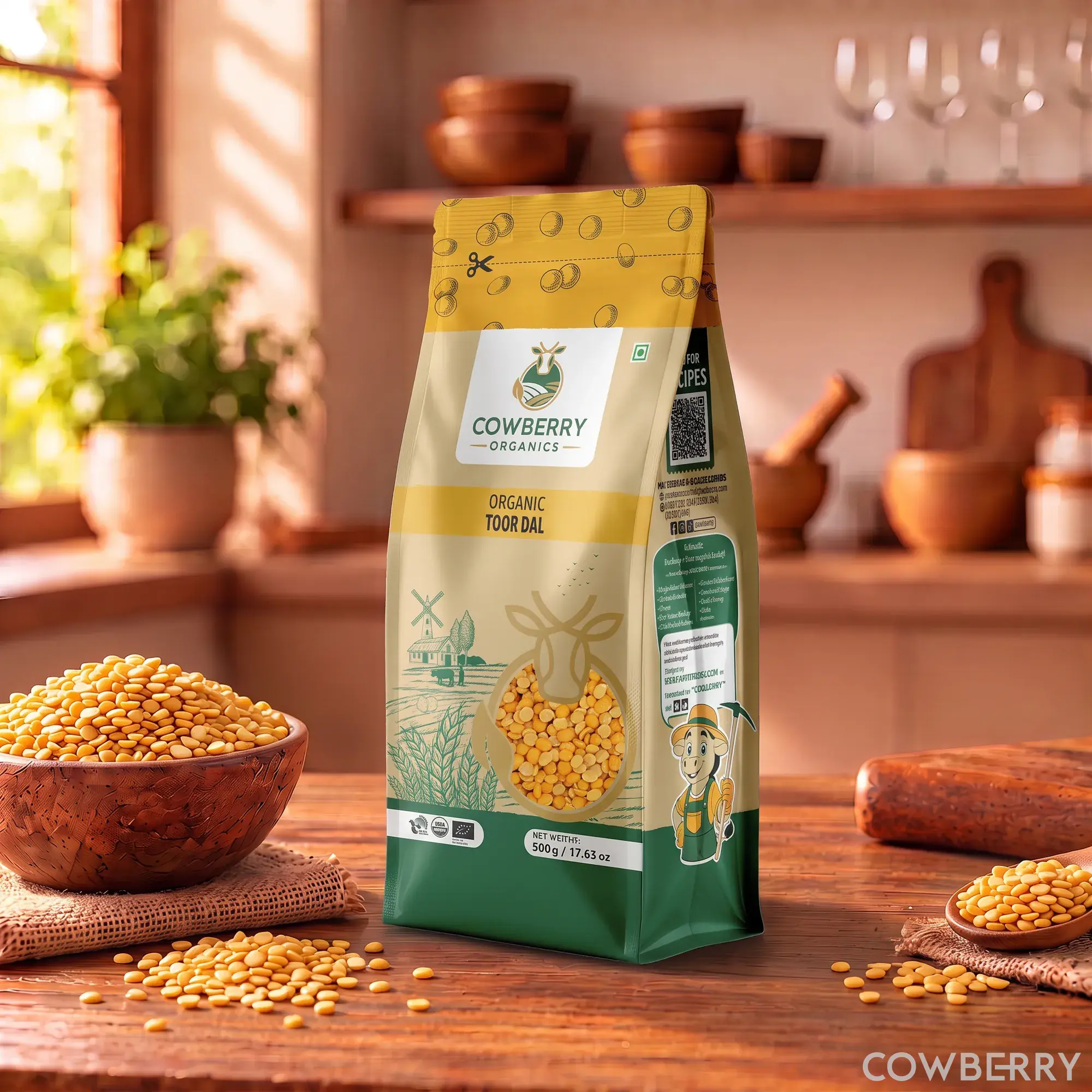
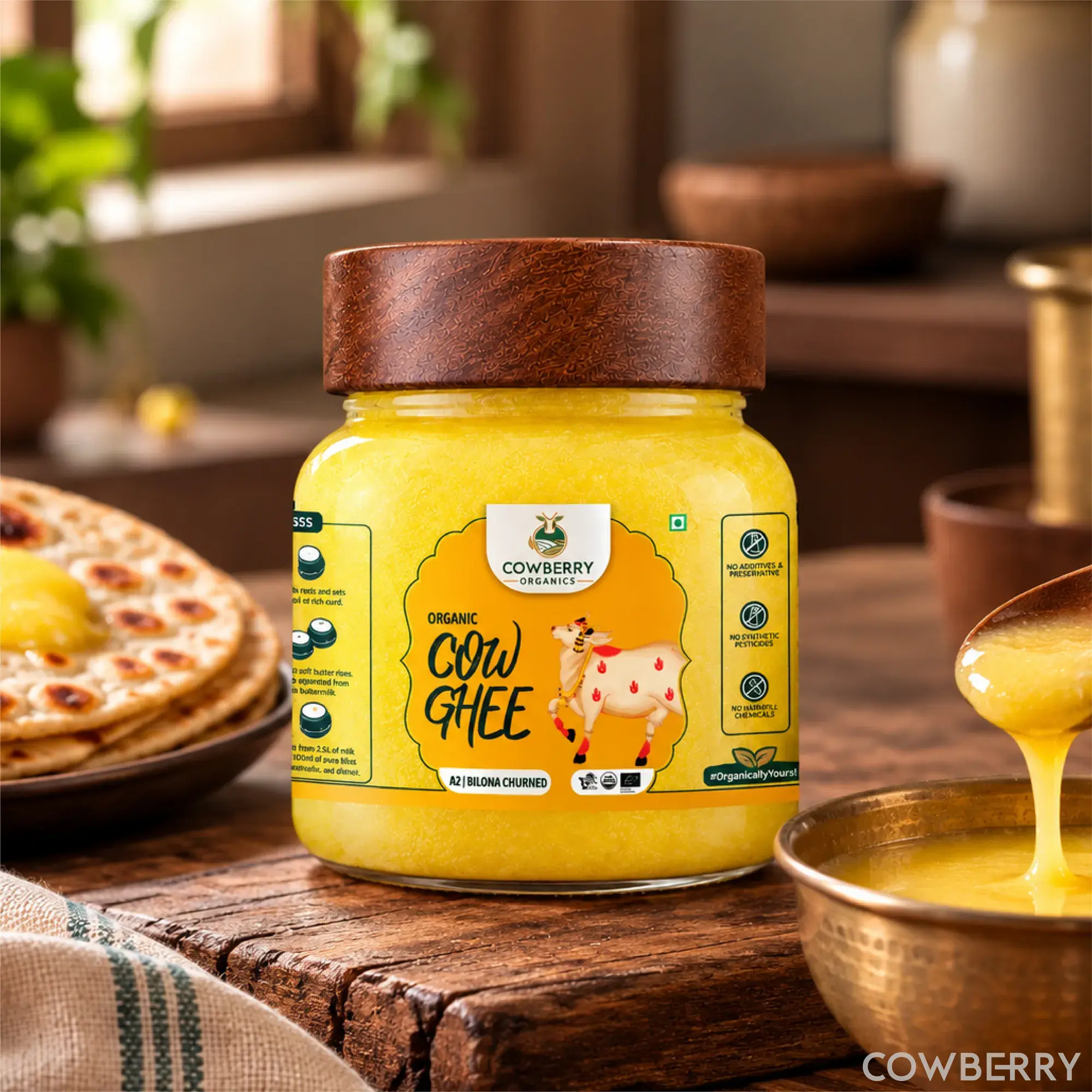
COWBERRY's organic range is India Organic, USDA & EU certified. It covers staples such as organic toor dal, organic A2 cow ghee, organic ragi flour, organic sharbati wheat flour and organic turmeric powder.
Two products are labelled natural and not organic. Natural Himalayan pink salt is a mineral, and organic standards are written for agricultural products. Natural hing powder is processed in Madhya Pradesh and is sold as natural. Neither makes an organic claim.
Beyond the certification line, each product states where it comes from and how it is made. The toor dal is grown with cow-based farming in Andhra Pradesh, Karnataka and Maharashtra and is unpolished, with no water, oil or leather polish. The ghee is made by the bilona method from the A2 milk of Gir cows in Gujarat. The ragi flour is stone-ground from ragi grown in Karnataka and the Western Ghats.
For the foods themselves, read the guides to ragi, toor dal and bilona ghee, and to cook with them, try dal tadka or the ragi recipes. For what a home check can and cannot tell you about purity, see the turmeric adulteration test and the pure honey test.
FAQs
What does the India Organic logo mean?
The India Organic logo means the food was certified under NPOP, India's National Programme for Organic Production, by an accredited certification body. FSSAI's organic food regulations are based on the NPOP and PGS-India standards. The logo speaks about how the food was produced and checked, not about its nutrition or taste.
What is the Jaivik Bharat logo?
Jaivik Bharat is FSSAI's unified logo for organic products. FSSAI's portal describes it as an identity mark that sets organic products apart from non-organic ones, with the tagline 'Jaivik Bharat' at the bottom signifying organic food from India. The same portal lets you search organic products by name, company or licence number.
Is natural the same as organic?
No. Organic means the food was produced to an organic standard and certified under NPOP or PGS-India. 'Natural' is a claim: FSSAI's claims regulations allow it for a single food with nothing added that has had only the processing needed to make it suitable to eat. The word natural does not come with a certificate.
How do I check an organic certificate?
Note the company name and FSSAI licence number on the pack, then search FSSAI's Jaivik Bharat portal, which holds the Indian Organic Integrity Database and can be searched by product, company, or licence or registration number. For an EU leaf, look for the control body's code number next to the logo. You can also ask the seller which body certified the product.
What is organic atta?
Organic atta is wheat flour milled from wheat that was grown and handled to organic production standards and certified under NPOP or PGS-India. The word describes the farming and the certificate, not the milling: chakki atta, whole wheat atta and multigrain atta can each be organic or not. On the pack, look for the certification mark.
What is organic millet?
Organic millet is any millet, such as ragi, jowar, bajra or foxtail millet, grown and handled to organic production standards and certified. It is the same grain as conventional millet; the difference lies in how it was farmed and who has checked. For the grains themselves, see the types of millets in India.
Are all spices organic?
No. A spice is organic only when it was grown and processed to organic production standards and certified for it. A spice pack without a certification mark is not being sold as organic, whatever else the label says. Words such as natural, pure or farm fresh are claims under FSSAI's claims regulations, not certification.
Do spices need to be organic?
No rule says spices must be organic; it is the buyer's choice. What ICMR-NIN's dietary guidelines advise for spices is to prefer whole spices, because powdered spices are more likely to be adulterated, and always to buy certified products. An organic certificate is one such check on how a spice was grown and handled.
References
- FSSAI Jaivik Bharat: organic food portal (India Organic and Jaivik Bharat logos)
- FSSAI Food Safety and Standards (Advertising and Claims) Regulations 2018, compendium (PDF)
- Dietary Guidelines for Indians, ICMR-National Institute of Nutrition
- USDA Agricultural Marketing Service: National Organic Program
- USDA Agricultural Marketing Service: organic regulations
- European Commission: the EU organic logo
Shop this article
Keep reading
Do spices need to be organic? Which foods are worth buying organic

The Future of Digital Traceability in Organics