by COWBERRY

9 minute read
11 ragi recipes: breakfast, lunch, snacks and sweets

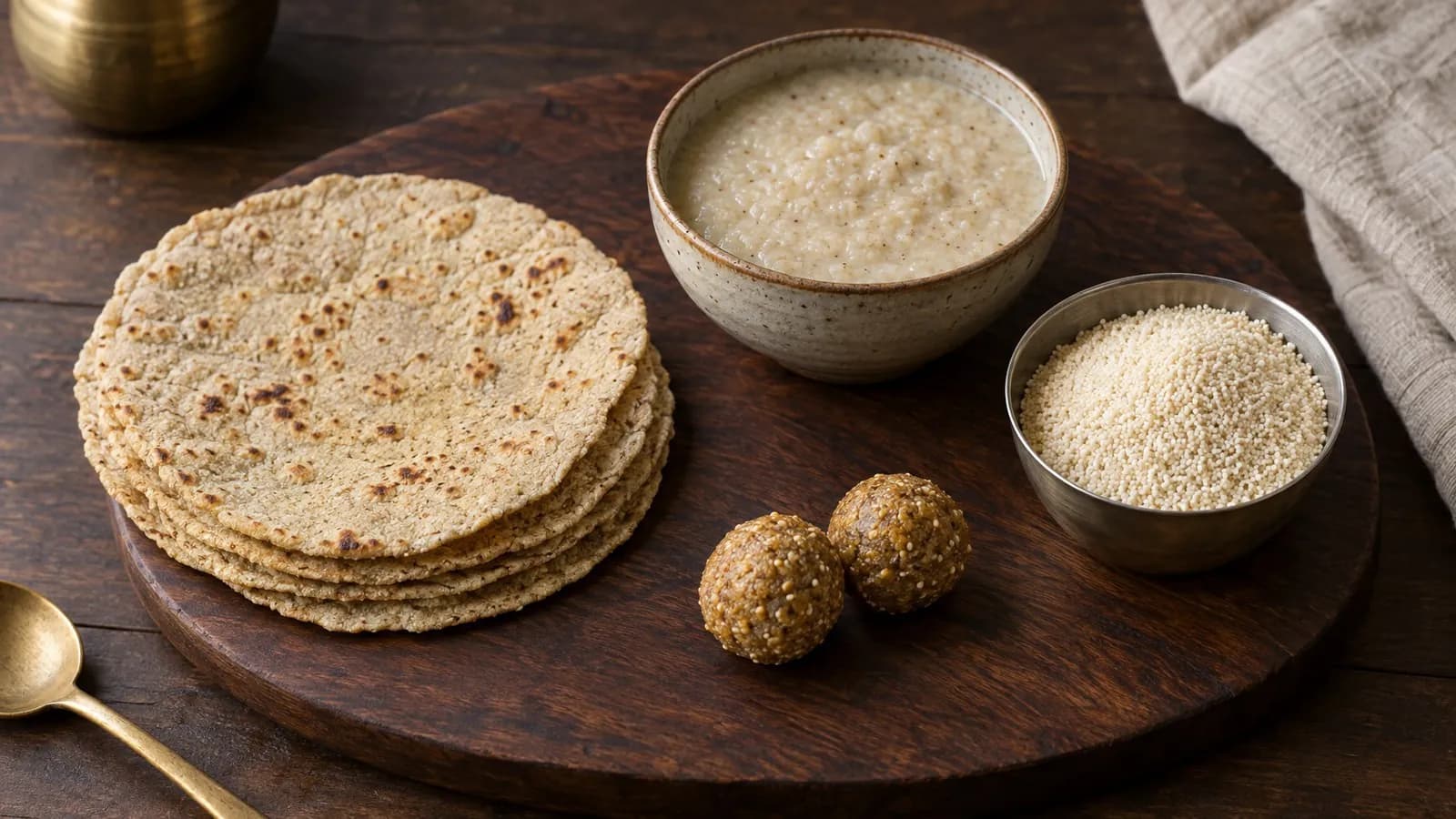
These ragi recipes cover the main ways finger millet is eaten in India, grouped by meal: a 15-minute porridge and a lacy dosa for breakfast, Karnataka's mudde and soft rotis for lunch and dinner, summer ambli, laddus, cookies and kheer. Six have full step-by-step pages; five carry a two-line method. New to the grain? The ragi guide covers its names, nutrition and storage.
How to cook with ragi flour: the two rules
Almost every dish on this page starts with ragi flour, and two habits decide whether it comes out smooth or lumpy. For anything liquid (porridge, malt), whisk the flour into cold water first and pour that slurry into hot water while stirring; flour dropped straight into hot water seizes. For anything shaped (roti, mudde), use boiling water: ragi has no gluten, and a hot-water dough is what holds it together and keeps the edges from cracking.
Buy whole ragi grain when you want to sprout it or cook it like rice, and flour for everything else. Sprouted (malted) ragi flour is paler and a little sweet; it is the flour South Indian homes use for babies and for ragi malt, and it works in every recipe below. Store the flour airtight and cook with it while it smells fresh; ICAR-IIMR explains that whole-grain flour goes rancid because the germ, crushed in milling, releases oil that oxidises. Per 100 g, the flour gives 321 kcal, 7.2 g protein, 11.2 g fibre and 364 mg calcium (IFCT 2017), so the 30 g in one roti is about 96 kcal and 109 mg calcium. For names, storage and what to look for when buying, see the full ragi guide.
Ragi breakfast recipes
Ragi breakfast is an easy place to start with the grain, because the flour cooks in minutes and each dish replaces something already on the table: porridge for oats, ragi dosa for rice dosa, ragi idli for idli.
Ragi porridge (ragi kanji)
Flour started in cold water, poured into the boiling pot and cooked for about seven minutes, then sweetened with jaggery and ghee or salted and loosened with buttermilk. Spoonfuls of the plain base, set aside before anything is added, can feed a baby over six months, after your paediatrician's advice. Full method: ragi porridge.
Ragi dosa
An instant, lacy dosa from ragi flour and a little rice flour, poured from a height onto a hot tawa with no soaking or fermenting; crisp edges, soft centre, eight dosas in 30 minutes. Full method: ragi dosa.
Ragi idli
Soak 1 cup whole ragi and 1/2 cup idli rice with 1/2 cup urad dal for six hours, grind smooth, salt and ferment overnight, then steam for 12 minutes. The idlis are dark, soft and slightly earthy; eat them with sambar and coconut chutney.
Ragi upma
Dry-roast 1 cup coarse ragi rava (broken ragi) until it smells nutty. Temper mustard, cumin, curry leaves, onion and green chilli in oil, add 2.5 cups hot water and salt, stir in the rava, cover and cook on low for 8 minutes; finish with lemon and coriander.
Ragi for lunch and dinner
In Karnataka, ragi is as much a lunch grain as a breakfast one, and the two dishes below are how it is eaten every day in the old Mysuru districts.
Ragi mudde
Flour cooked in boiling salted water, beaten smooth with a mudde kolu and shaped into balls with wet hands, then eaten by dipping pinched-off pieces in bassaru or any thin saaru and swallowing them without chewing. One mudde made from 50 g of flour, with its share of ghee, is about 220 kcal. Full method: ragi mudde.
Ragi roti
Made from a hot-water dough and shaped with wet fingers rather than a rolling pin, the roti is cooked on a tawa until it blisters, then smeared with ghee; it folds without the cracks a cold dough gives. Eat it plain at dinner beside dal and a sabzi, or knead in onion, coriander and cumin for the Karnataka-style ragi rotti. Full method: ragi roti.
Ragi drinks: malt, java and ambli
The summer face of ragi is a drink. Ragi java, ragi ambli and ragi malt are all the same base, flour cooked thin in water, finished either savoury or sweet, and they are what the ragi belt reaches for when the weather turns hot.
Ragi malt (ragi java, ragi ambli)
Cook one thin pot of ragi, let it cool and split it: one half takes sour buttermilk, onion, green chilli, cumin and curry leaves and becomes the ambli farmers drink in the heat, the other takes jaggery and cardamom and becomes the malt children are given at breakfast. Made with sprouted ragi flour it is the ragi malt of the name. Sweetened, each glass is about 128 kcal. Full method: ragi malt.
Ragi snacks
Ragi flour bakes and crisps well, so it slips easily into a snack box.
Ragi cookies
Cream 8 tbsp (120 g) soft ghee or butter with 75 g jaggery powder (about 1/2 cup), mix in 1 cup ragi flour, 1/4 cup rice flour (or wheat flour if gluten is not a concern), a pinch of baking soda, a pinch of salt and cardamom to a soft dough, press into flat rounds and bake at 180 °C for 15 to 18 minutes. They firm up as they cool; store them airtight for a week.
Ragi chapati chips
Cut leftover ragi rotis, kept in the fridge overnight, into triangles, brush lightly with oil, sprinkle with pepper and salt or chaat masala, and bake at 180 °C for 10 to 12 minutes or air-fry until crisp. A lunchbox snack made from last night's dinner, and a good way to use rotis that have gone stiff.
Ragi sweets
Ragi's earthy, faintly sweet taste suits jaggery better than white sugar, and both sweets below use jaggery; the laddu has a full page, the kheer is a two-line method.
Ragi laddu
Roasted ragi flour, warm ghee, jaggery powder, crushed groundnuts and sesame pressed into small laddus: no syrup, no string stage, about 30 minutes. Each laddu is about 137 kcal and gives about 57 mg calcium. Full method: ragi laddu.
Ragi kheer
Roast 3 tablespoons ragi flour in a teaspoon of ghee until nutty, whisk into 2 cups of cold milk and simmer for 10 minutes, stirring, until it coats the spoon. Take it off the heat, sweeten with jaggery powder, and finish with cardamom and a few chopped cashews or almonds. Serve warm.
Ragi recipes for weight loss: which to pick
Ragi is not a slimming food, but it is a filling one: it has 11.2 g of fibre per 100 g, and ICAR-IIMR notes that ragi digests slowly and that its fibre gives a feeling of fullness. What changes the arithmetic is what the flour is cooked with. Mudde, roti, porridge and ambli are flour and water with a spoon of ghee or a splash of buttermilk; a laddu or a cookie is flour plus jaggery plus a good deal of ghee. Pick the first group for a daily plate, keep the second for an occasional sweet, and count ragi as your grain portion rather than adding it on top of rice. Our guide to ragi for weight loss has the evidence and the portion sizes. A diet set for a medical condition changes the picture, so talk to your doctor or dietitian when ragi is to become your daily grain.
FAQs
How many calories in ragi mudde?
A ragi mudde made from 50 g of flour has about 160 kcal from the flour alone (IFCT 2017: 321 kcal per 100 g). Add its share of the ghee, a little in the pot and a teaspoon on the ball, and it comes to about 220 kcal. The saaru it is eaten with is extra, and its calories depend on the dal and oil in it.
Can we eat ragi roti at night?
Yes. Ragi roti is a normal dinner grain in Karnataka and there is nothing in ragi that makes it unsuitable at night. Made from 60 g of flour, a pair of rotis has about 193 kcal and 6.7 g fibre before any ghee: filling, but not heavy for the evening. Keep it to two rotis with dal or a sabzi, and eat a little earlier in the evening if a late meal disturbs your sleep.
Is ragi good in summer?
Yes, and in the ragi belt summer is when it is drunk rather than eaten as roti. Ragi ambli or ragi java, thin cooked ragi with sour buttermilk, salt and onion, is the traditional hot-weather breakfast in Karnataka and Rayalaseema, and Indian food tradition counts ragi as cooling. In practice the relief comes from the drink itself: chilled, watery and salted. The ragi malt recipe gives both the savoury and the sweet version.
Can I eat ragi everyday?
Yes, in normal portions, as a roti, a mudde, a bowl of porridge or a glass of malt. Eat jowar, bajra, wheat and rice at other meals, drink extra water for the fibre, and let ragi replace your usual grain. Kidney stones are the exception: ICAR-IIMR advises against ragi for people who have them, since eating a lot can raise oxalic acid, so talk to your doctor or dietitian first.
Is ragi java good for health?
Ragi java is cooked ragi flour and water, so it carries the grain's numbers in a drinkable form: 364 mg calcium, 4.6 mg iron and 11.2 g fibre per 100 g (IFCT 2017), or about 55 mg calcium and 1.7 g fibre in a glass made from 15 g of flour. The savoury version adds buttermilk and salt; the sweet one adds jaggery, and with it calories, so keep the sweet glass as a breakfast rather than an all-day drink.
Does ragi have protein?
Yes, but not a lot: 7.2 g per 100 g of ragi (IFCT 2017), so a 30 g roti holds about 2 g. Its protein is low in lysine, a gap that ICAR-IIMR says pulses and animal foods fill, so the traditional pairings do real work: mudde with a dal-based saaru, roti with dal or curd, porridge with milk. Ragi is a calcium and fibre grain first; look to dals for protein.
References
Shop this article
Keep reading
Rajma recipe: 5 ways to cook rajma beans at home
Dalia recipes: 10 easy broken wheat dishes from khichdi to laddu
Amaranth recipes: 8 rajgira dishes from roti to ladoo