by COWBERRY

10 minute read
Pure honey test: how to check honey purity with 2 FSSAI home checks

A pure honey test at home can flag added sugar but cannot prove a jar is pure. FSSAI's household manual gives two ways to run one: a drop of honey in a glass of water, or a cotton wick dipped in honey and lit. Honey is mainly fructose and glucose, so a cheaper sweetener blends in; measuring the sugars takes a laboratory. Both methods and their limits follow.
Why honey adulteration happens
Honey is slow to make and sugar syrup is not, and the two are close enough in sweetness and colour for one to pass as the other. A 2008 review in the Journal of the American College of Nutrition describes the main components of honey as carbohydrates, mainly fructose and glucose. A sweetener added to honey is hard to single out, because it is the same kind of thing.
ICMR-NIN's Dietary Guidelines for Indians describe adulteration as the addition, removal, substitution or modification of a food item, intentional or incidental, that may leave the food unsafe or substandard. With honey the worry is addition: a cheaper sweetener blended in.
What a market survey found
A 2023 study in the journal Foods bought 147 commercial honey samples from local and online markets in Turkey and the United States and measured them with reference laboratory methods. Sucrose was above the regulatory limit in 21 samples, which the author says may indicate possible adulteration with commercial sweeteners. HMF, another of the quality measures, was above the limit in 11 samples, which may imply temperature abuse during storage or prolonged storing. The survey is not about India. It is useful because it shows the two things a jar can hide: added sweetener, and rough handling of genuine honey.
Why a syrup is hard to spot
FSSAI's advertising and claims regulations name sucrose, glucose, honey, molasses and corn syrup side by side as examples of sugars. To the tongue they are all simply sweet. A household test can raise a doubt, as the next section shows, but measuring which sugars are in a jar takes a laboratory.
Honey purity test at home: FSSAI's water and wick methods
Under sugar and confectionery, FSSAI's DART manual gives two ways to test honey for sugar solution. The manual says its scope is the household and its aim is consumer awareness of food safety. Read either result as a reason to look closer, not as a verdict.
Method 1: a drop of honey in water
Fill a transparent glass with water and let one drop of honey fall into it. What you see: pure honey does not disperse in the water. If the drop disperses, FSSAI reads that as a sign of added sugar.
Method 2: a cotton wick dipped in honey
Dip a cotton wick in the honey and light it with a matchstick. What you see: pure honey burns. In adulterated honey, FSSAI says, the water present stops it from burning or, if it does catch, it burns with a cracking sound.
What the two methods cannot prove
A drop that holds together or a wick that burns cleanly is a pass on a quick screen, not proof of purity. The sugars themselves are measured in a laboratory: the 2023 study above determined glucose, fructose and sucrose, and HMF, by reference methods. Judging by colour or thickness is weaker still, since genuine honeys differ in appearance with their botanical origin. Beyond that, the protection is in buying: a named source, a label that can be checked and a seller who answers questions.
Tests FSSAI does not list
The thumb, blotting-paper and vinegar tests that circulate online are not in FSSAI's manual for honey or in the other sources behind this page, so they are left out. Crystals in the jar are not one of FSSAI's honey tests, and this page does not read them as a sign in either direction.
Lab tests for honey adulteration
The 2023 study shows what laboratory analysis of honey looks at. Using reference methods, it determined:
- Moisture and water activity: two measures of the water in the honey.
- Soluble solids: read in degrees Brix.
- pH and free acidity.
- The sugars: glucose, fructose and sucrose, each measured separately. Sucrose above the regulatory limit may indicate added commercial sweetener.
- HMF (hydroxymethylfurfural): a level above the limit may imply temperature abuse in storage, or prolonged storing.
The same study tried a portable infrared spectrometer that needs no sample preparation. Paired with a classification model, it identified all the samples that had been flagged, and the author suggests the technique may help regulatory bodies judge honey authenticity in a shorter time and at a lower cost.
None of this can be done in a kitchen, and that is the point of knowing about it. The claims regulations name a separate set of FSSAI rules, the Food Product Standards and Food Additives Regulations, 2011. No limit for honey from those rules appears in the sources behind this page, so no figure is quoted here.
How to identify pure honey from the label
A label cannot prove purity. It does tell you who is accountable and what they are prepared to put in writing.
- Ingredient list: honey should be the only entry. Ingredients appear in descending order of quantity, so anything else on the list is in the jar.
- Licence: the FSSAI logo with a licence number means the manufacturer is licensed by the food regulator. The manufacturer's name and address should be printed too.
- Dates: the jar should show when it was made and a use-by date, with storage instructions beside them.
- Source: a jar that names the flowers and the region gives you something to check. The 2008 review ties differences in honey's appearance, sensory qualities and composition to its botanical origin.
- Certification marks: ICMR-NIN's guidelines name AGMARK on honey as an example of a certification mark on packed food.
- Raw and unprocessed: these are not among the words that FSSAI's claims regulations define (natural, fresh, pure, authentic, genuine, real, traditional and original), so they are the seller's own description. Look for a plain statement of what was done to the honey, such as whether it was heated or filtered.
- Pure and natural: for honey these are conditional words. 'Pure' needs nothing added and freedom from avoidable contamination; 'natural' needs nothing added and no processing beyond what makes the food fit for human consumption.
- Health lines: the same regulations say a food shall not be described as 'healthy' or presented as if it will impart health by itself. A honey label that leans on health promises deserves a second look.
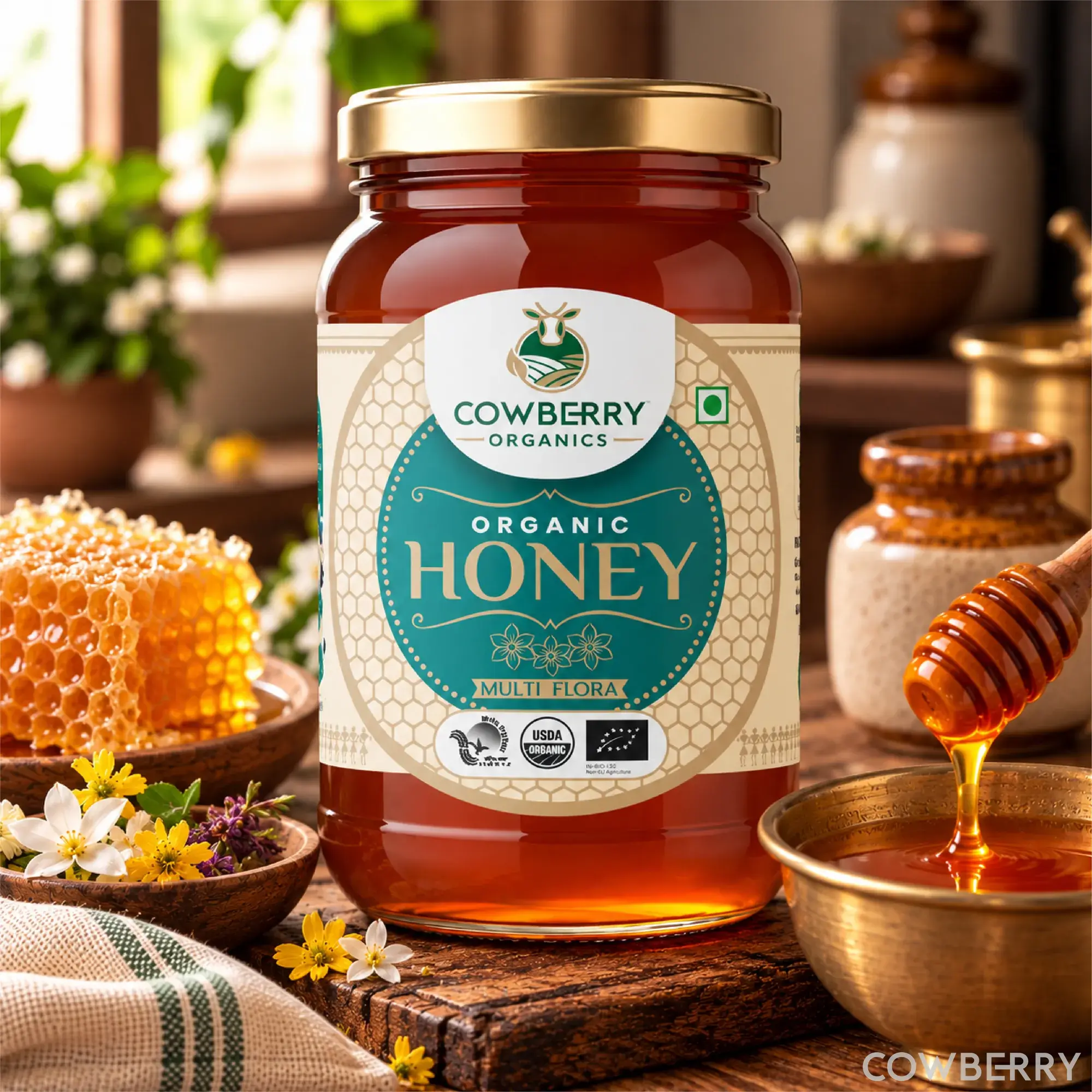
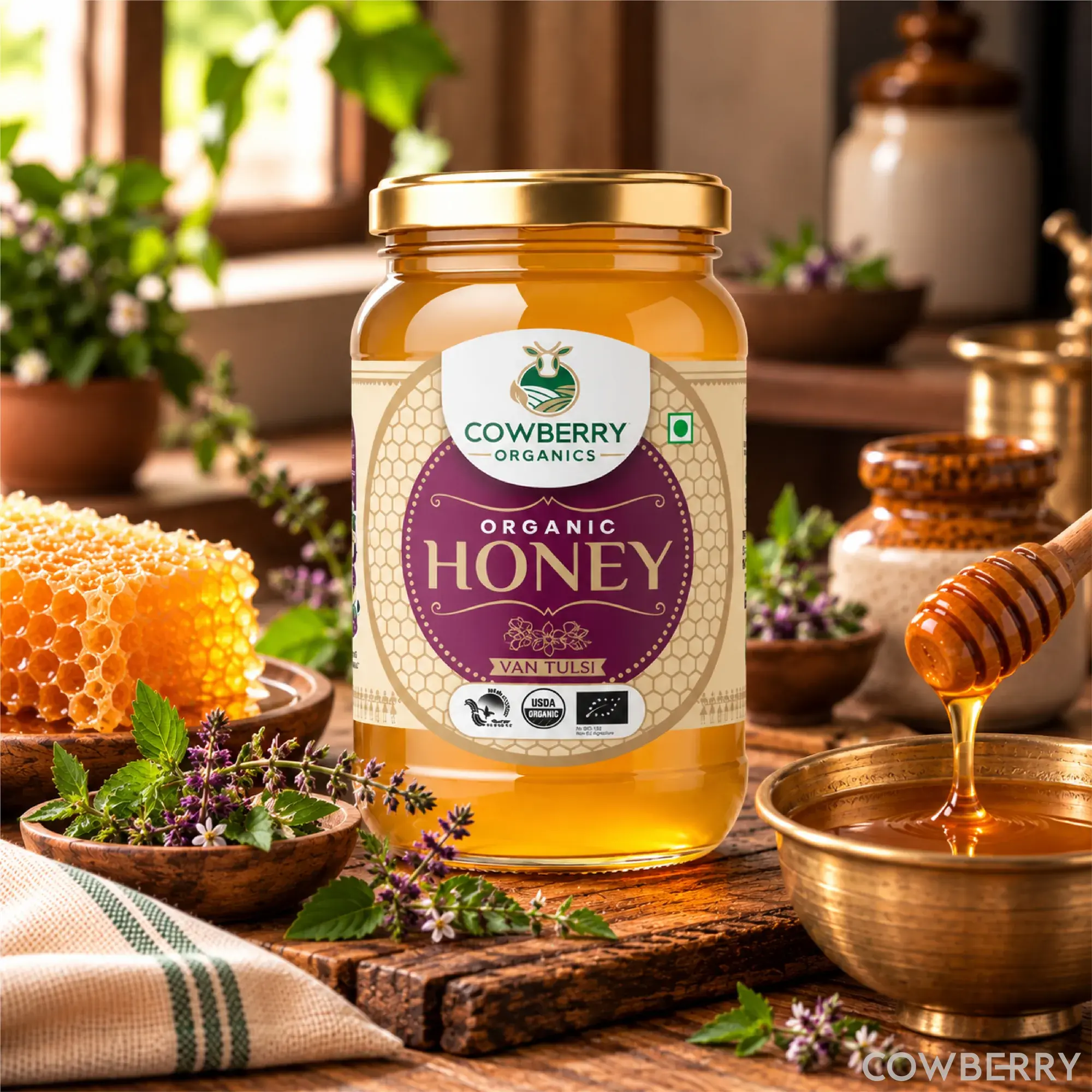
COWBERRY's organic multiflora honey comes from forest blossoms and wildflowers in Uttarakhand's Shivalik foothills, and its organic tulsi honey from the Himalayan foothills of the same state. Both are raw, not heated or heavily filtered, and India Organic, USDA & EU certified.
Honey is still sugar
Pure honey is a sugar, and an honest guide has to say so. USDA FoodData Central lists 304 kcal, 82.4 g carbohydrate and 0.3 g protein per 100 g of honey. A 7 g teaspoon works out to about 21 kcal and 5.8 g carbohydrate. The 2008 review describes the carbohydrates as mainly fructose and glucose, alongside small amounts of proteins, enzymes, amino acids, minerals, vitamins, aroma compounds and polyphenols.
The glycemic index of honey is 63 in the University of Sydney database, the mean of 7 entries. The review reports a wide range, from 32 to 85, depending on the botanical source.
The World Health Organization counts the sugars naturally present in honey as free sugars, together with sugars added to food by the manufacturer, the cook or the consumer. Its guideline sets the ceiling for free sugars at less than 10% of total energy, and suggests going further, to below 5%. ICMR-NIN's guidelines list honey and jaggery with table sugar among added sugars. Swapping sugar for honey changes the flavour; both still count as added sugar. The same holds for jaggery: see jaggery vs sugar and jaggery calories.
Keep honey away from babies. The NHS says not to give a child honey until they are over 1 year old: occasionally honey contains bacteria that can produce toxins in a baby's intestines, leading to infant botulism, a very serious illness. ICMR-NIN's guidelines go further. They count honey as an added sugar and allow no added sugar at all before the age of two; they also name honey among the feeds to avoid in the first 6 months, when breastfeeding should be exclusive. Ask your paediatrician before any sweetener goes into a young child's food.
How to store honey
Stored well, honey keeps its flavour for a long time. Stored badly, genuine honey loses quality with no help from an adulterant: the 2023 study read high HMF as a possible sign of temperature abuse during storage or of prolonged storing.
- Room temperature suits honey, with the lid shut tight and the jar kept clear of stove heat and sunlight.
- Use a clean, dry spoon, so that no water is carried into the jar.
- Glass or food-grade steel with a tight lid works well. Do not leave honey in an open bowl in humid weather.
- If the honey crystallises, stand the jar in warm water and stir. Avoid boiling or microwaving it.
- Follow the use-by date and the storage instructions printed on the label.
In the kitchen, honey belongs where its flavour counts: over curd or cut fruit, in a salad dressing or a glaze, or stirred into warm milk or nimbu pani once it is off the boil. Measure it as you would measure sugar.
FAQs
How to identify pure honey at home?
Try FSSAI's two household checks. Let a drop of honey fall into a transparent glass of water: pure honey does not disperse, while a drop that spreads out points to added sugar. Or light a cotton wick dipped in the honey: pure honey burns, while water in adulterated honey stops it burning or gives a cracking sound. A pass is a screen, not proof; sugars such as sucrose are measured in a laboratory.
How to identify pure honey by looking?
You cannot identify pure honey by looking. A 2008 review notes that honey differs in appearance, sensory perception and composition with its botanical origin, so colour and clarity vary from one genuine honey to the next. A clear, golden, free-flowing honey is not proof of purity; FSSAI's household checks for honey use a glass of water and a lit wick, not the eye.
Does honey contain sugar?
Yes. Honey is mostly sugar: USDA FoodData Central lists 82.4 g carbohydrate per 100 g, and a 2008 review describes those carbohydrates as mainly fructose and glucose. FSSAI's claims regulations name honey itself as an example of a sugar, so a food sweetened with honey cannot claim that no sugar has been added.
Does honey expire?
Honey keeps for a long time in a closed, dry jar, but it does not stay the same for ever. A 2023 study says HMF above the regulatory limit may imply prolonged storing or temperature abuse during storage. Go by the use-by date and storage instructions on the label, and keep the jar away from heat and moisture.
Can honey be heated?
Yes, gently. Standing the jar in warm water is a gentle way to bring crystallised honey back to liquid. Strong or repeated heating is best avoided: laboratories measure HMF in honey, and a 2023 study says a level above the regulatory limit may imply temperature abuse during storage. Add honey to drinks and dishes after they come off the boil.
What is the glycemic index of honey?
The glycemic index of honey is 63 in the University of Sydney GI database, taken as the mean of 7 entries. It is not one fixed number: a 2008 review reports that the figure varies within a wide range, from 32 to 85, depending on the botanical source. Either way honey is a sugar, to be counted with the day's other added sugars.
Is crystallised honey pure or adulterated?
Crystals alone cannot tell you. Crystallisation is not among FSSAI's household tests for honey, and none of the other sources behind this page reads it as a sign of purity or of adulteration. Judge the jar by FSSAI's water and wick methods and by the label, and remember that only laboratory analysis measures the sugars.
References
- FSSAI DART: Detect Adulteration with Rapid Test, common quick tests for food adulterants at household (Eat Right India)
- Aykas DP. Determination of possible adulteration and quality assessment in commercial honey. Foods, 2023
- Bogdanov S, Jurendic T, Sieber R et al. Honey for nutrition and health: a review. J Am Coll Nutr, 2008
- Dietary Guidelines for Indians, ICMR-National Institute of Nutrition
- NHS: Foods to avoid giving babies and young children
- FSSAI Food Safety and Standards (Advertising and Claims) Regulations 2018, compendium (PDF)
- WHO guideline: sugars intake for adults and children (2015)
- USDA FoodData Central
- University of Sydney glycemic index database (GI search)
Shop this article
Keep reading
Raw Sugar vs Brown Sugar: Is Demerara the Same Thing?
Does honey contain sugar? Carbs per 100g and the WHO sugar limit
Date Jaggery (Khejur Gur in English): Types, Forms and How to Use It