by COWBERRY

10 minute read
Fenugreek (methi): names, nutrition, benefits and how to cook it

Methi is the Hindi name for fenugreek, and one plant supplies the Indian kitchen with three ingredients: methi dana, the seeds; methi leaves, the fresh greens; and kasuri methi, the dried leaves. This hub gathers what the seed holds, what the trials show, and how each form is cooked, with the honest limits along the way.
What is methi? The three forms of one plant
Fenugreek grows as one plant and reaches the kitchen in three forms. Methi dana, the seeds, is the spice: small, hard, yellow-brown, tempered in hot oil at the start of dals and sabzis, soaked overnight, or roasted and ground into powder. Methi leaves, the fresh greens sold in bunches, are cooked as a vegetable or kneaded into flatbreads. Kasuri methi is those leaves dried and crumbled, a finishing herb crushed between the palms over curries, dals and gravies near the end of cooking.
A 2024 review in Food Science & Nutrition describes fenugreek seeds through their composition, their traditional uses and their wider applications in food; it is a broad account of the seed's place in the kitchen and beyond, and this hub leans on it only for that framing. The three forms do different jobs, and the pages linked below keep each job separate: the seed's numbers, the trials behind its reputation, and the honest limits of both.
Methi leaves, fenugreek leaves and menthya soppu
Methi leaves are the plant's greens, and fenugreek leaves is the same thing in English; fresh bunches cook down as a vegetable, and the leaves wilt quickly once picked, which is part of why the dried form exists. In Kannada the greens are menthya soppu, menthya being the Kannada name for fenugreek with soppu added for leafy greens; the phrase means fenugreek leaves. Hindi calls the greens methi and their dried, crumbled form kasuri methi.
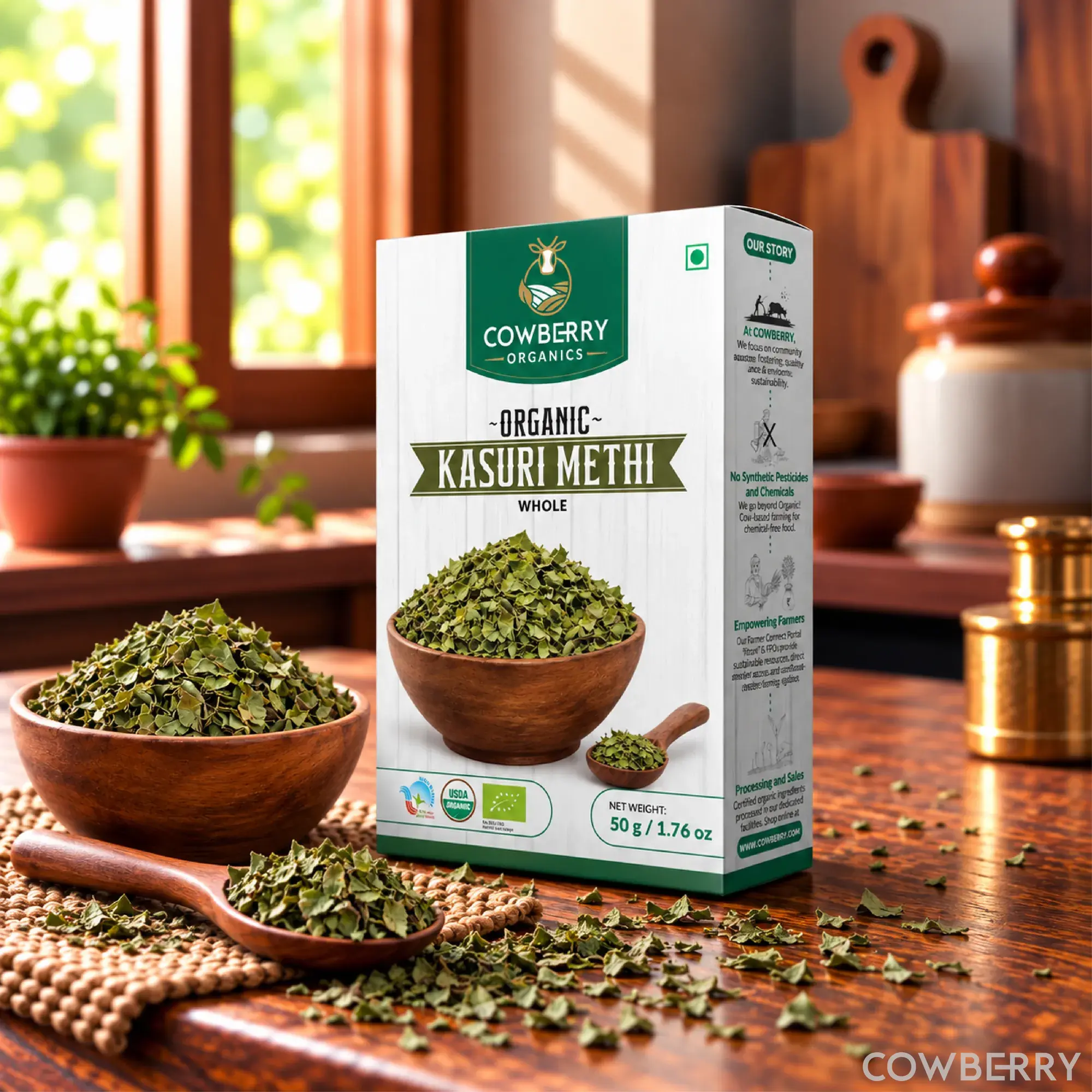
What the pack says about the leaf: COWBERRY's kasuri methi is made from leaves grown on organic farms in Rajasthan and naturally dried, and the pack lists the dishes it finishes, from curries and dals to paneer dishes, parathas and gravies. The seed and the leaf, and which does what in the pot, are compared on the pages linked below.
The names of methi across India
The printed name list from IFCT 2017 gives the seed as fenugreek seeds in English, with the botanical name Trigonella foenum graecum. Hindi, Urdu, Marathi, Punjabi, Bengali, Odia and Assamese all print methi; Gujarati adds the dana and prints methi dana. The south prints its own words: menthe in Kannada, menthulu in Telugu, venthayam in Tamil and uluva in Malayalam, with Sanskrit methe closing the list. Everyday spellings drift from the printed ones, and menthya, the Kannada spelling many kitchens use, is one drift you will hear often. The full list, with the note behind each spelling, is on the Fenugreek in English, Hindi and Indian languages page.
| Language | Name (romanised) |
|---|---|
| English | Fenugreek seeds |
| Hindi | Methi |
| Marathi | Methi |
| Gujarati | Methi dana |
| Punjabi | Methi |
| Bengali | Methi |
| Odia | Methi |
| Assamese | Methi |
| Kannada | Menthe |
| Telugu | Menthulu |
| Tamil | Venthayam |
| Malayalam | Uluva |
| Urdu | Methi |
| Sanskrit | Methe |
| Botanical name | Trigonella foenum graecum |
Source: IFCT 2017 (ICMR-NIN) local-names list. — means no name recorded in the source.
Fenugreek seeds nutrition per 100 g
Per 100 g of raw methi dana, the Indian Food Composition Tables (IFCT 2017) print 235 kcal, 25.41 g of protein, 5.72 g of fat, 10.57 g of carbohydrate and 47.55 g of dietary fibre. That split is unusual for a spice: close to half the weight is fibre and a quarter is protein, with carbohydrate a small share. The same tables report 8.47 mg of iron, 135 mg of calcium, 167 mg of magnesium, 891 mg of potassium, 3.80 mg of zinc and 51.11 mcg of folate per 100 g, and they print no vitamin C value and no glycemic index value, so this hub repeats none for them. The full table and the per-teaspoon arithmetic are on the fenugreek seeds nutrition page.
| Nutrient | Fenugreek seeds (methi dana), raw |
|---|---|
| Energy (kcal) | 235 |
| Protein (g) | 25 |
| Fat (g) | 5.7 |
| Carbohydrates (g) | 11 |
| Dietary fibre (g) | 48 |
| Iron (mg) | 8.5 |
| Calcium (mg) | 135 |
| Magnesium (mg) | 167 |
| Potassium (mg) | 891 |
| Sodium (mg) | 40 |
| Zinc (mg) | 3.8 |
| Folate (mcg) | 51 |
Per 100 g raw, edible portion. Composition: IFCT 2017 (ICMR-NIN). — means not reported. These are average values for the food; the label on a pack gives the values for that product.
Benefits: what the seed is made of
The seed's benefits begin with what it is made of. Protein at 25.41 g per 100 g puts methi dana well above the other seed spices, and fibre at 47.55 g per 100 g is the figure that changes how the seed behaves in a meal: the ICMR-NIN Dietary Guidelines describe dietary fibre as delaying the absorption of carbohydrate and fat from a meal and adding to its satiety value. The same guidelines count fenugreek seeds, alongside amaranth, flax, chia and basil seeds, among the foods with health promoting effects worth eating three to four times a week.
The 10 benefits of fenugreek seeds page numbers ten benefits and attaches each one to its nutrient or its study, then states which popular claims have no source behind them. The same facts in everyday Hindi are on methi dana khane ke fayde aur nuksan.
Fenugreek and blood sugar: what the trials show
The strongest human evidence sits in a 2014 meta-analysis published in Nutrition Journal, pooling ten clinical trials of fenugreek: the pooled change in fasting blood glucose was -0.96 mmol/L (95% CI -1.52 to -0.40, ten trials), in two-hour postload glucose -2.19 mmol/L (95% CI -3.19 to -1.19, seven trials), and in HbA1c -0.85 percentage points (95% CI -1.49 to -0.22, three trials). The glucose effects came only from the medium- and high-dose studies in people with diabetes; the summary gives the doses only as medium or high, and most trials were of low methodological quality. An older overview from 2008 calls the seeds a soluble-fibre-rich seed that reduces blood glucose and lipids and can serve as a food adjuvant in diabetes.
These are trial findings at trial doses, not a kitchen instruction: anyone on blood-glucose medicines should speak with their doctor before adding fenugreek to the daily routine, and prescribed medicines always keep their place. The is kasuri methi good for diabetes page walks through the numbers, the dose limits and the leaf-versus-seed question in detail.
Side effects, and the claims with no evidence
None of the fenugreek references prints a list of side effects, so this hub writes no list. The caution the references do support sits with blood glucose, as above: trial doses lowered it, so medicines and methi need a doctor between them. Pregnancy and breastfeeding are not addressed in any of the references; ask your doctor before adding fenugreek deliberately. For how much: no daily gram amount appears in any of the references, the 2014 meta-analysis describes its trial doses only as medium or high, and the guidelines' rhythm is three to four times a week. Beyond that rhythm, this hub gives no gram target and no daily schedule, because no reference prints one.
Three popular claims find no human evidence in the fenugreek studies in the references: hair growth, increased breast milk, and weight loss. A 2014 International Journal of Molecular Sciences review by Opara and Chohan makes the point: culinary herbs and spices, taken in small quantities alongside other foods, leave their true benefit for health hard to pin down. The honest version of each claim, claim by claim, is on the benefits page linked above. Before trusting any promise a product or a post makes about methi, check which claim it is making and which source it names; on this page, the only claims made are ones a named source carries.
How to cook with methi: seeds and leaves
Methi dana works in the pot early. A quarter teaspoon (1 g) tempered in hot oil starts dals, sambars and sabzis with the seed's bitter-sweet base; a teaspoon (4 g) soaked overnight softens the seeds for chewing; roasted two to four minutes and ground, they go into thepla and paratha doughs. Methi leaves cook differently: washed and chopped, they go into methi aloo or methi dal as a green vegetable. Dried and crumbled as kasuri methi, the leaf becomes a finishing herb, crushed over curries, dals and paneer dishes near the end of cooking so the aroma stays.
The difference between kasuri methi and methi page puts the seed and the leaf side by side, and what is kasuri methi covers the dried leaf's making, taste and storage. Step-by-step seed methods are on fenugreek seeds how to eat.
Methi dana water and fenugreek powder
Two seed preparations earn their own pages. Methi dana water is a teaspoon (4 g) of seeds steeped overnight in about a glass (250 ml) of water, drunk fresh in the morning with the softened seeds chewed so the fibre joins you; the methi dana water benefits page gives the full method and the honest limits of what the water itself has been shown to do. Fenugreek powder is seeds roasted two to four minutes and ground, kept in a jar for doughs and dry masalas; the how to make fenugreek powder page covers the roast, the grind and how long a jar keeps.
A level teaspoon (4 g) of seeds holds about 9 kcal, 1 g of protein and 1.9 g of fibre; every preparation above works at that scale, because the seed is a spoonful ingredient, not a bowl food.
Storing and buying methi
Storage is simple for both dry forms: a sealed jar kept cool, dry and out of sunlight keeps methi dana and kasuri methi fresh for months. Soaked seeds and sprouts are the exception: rinse them, eat them soon, and throw them out if they turn sour or slimy, with no day count promised. Pack size follows use: seeds sell in larger packs because a tempering takes them by the spoon, while kasuri methi comes in a small pack because a pinch finishes a dish.
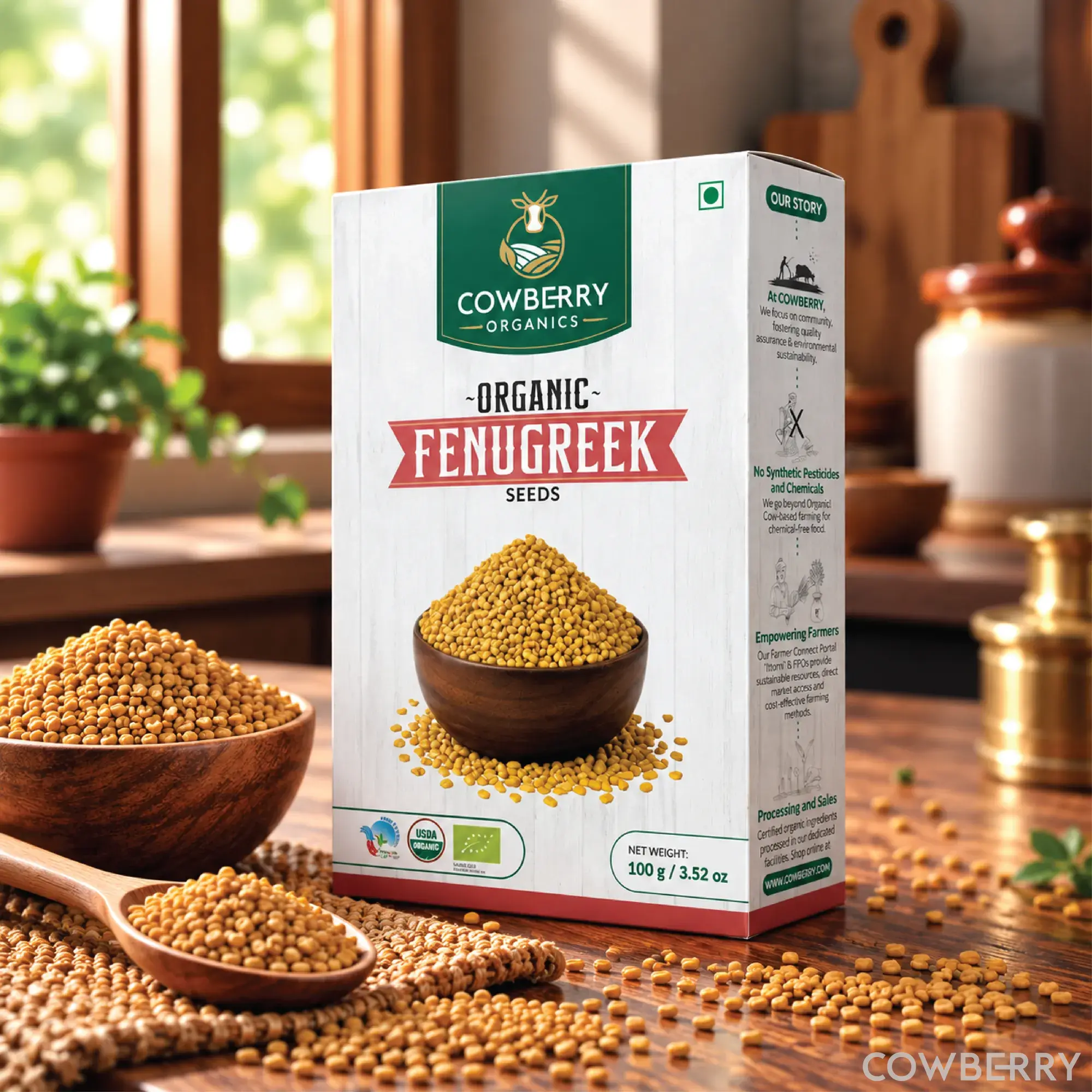
For buying, COWBERRY's Organic Fenugreek Seeds come from Rajasthan and Madhya Pradesh, slow-matured under natural cow-based farming, cleaned and packed whole with no additives or preservatives and non-GMO; the pack is India Organic, USDA & EU certified. The Organic Kasuri Methi is made from leaves grown on organic farms in Rajasthan, naturally dried. Both are whole, single-ingredient products with nothing added.
FAQs
What is methi dana?
Methi dana is the Hindi name for fenugreek seeds: methi is fenugreek and dana means seed. The same small yellow-brown seed goes by venthayam in Tamil, menthulu in Telugu and uluva in Malayalam, and the English name printed in IFCT 2017 is fenugreek seeds.
Why fenugreek seeds are added to idli batter?
None of the fenugreek references prints a reason, so this hub does not guess one. What the references do print is the seed's kitchen role as a tempering spice and its composition; the batter traditions are older than any of the references. The seed's kitchen methods, soaking and grinding, are on the how-to pages linked above.
Why methi seeds in dosa batter?
The same honest answer as for idli batter: none of the references prints why methi seeds go into dosa batter, so this page does not invent a reason. Home kitchens keep their own habits; the references describe the seeds for tempering, soaking and powder, not for batter.
What is menthya soppu?
Menthya soppu is Kannada for fenugreek leaves: menthya names the plant (IFCT 2017 prints it as menthe) and soppu means greens. In Hindi those greens are methi, and once dried and crumbled they are sold as kasuri methi.
How to store methi dana?
A sealed jar in a cool, dry spot away from sunlight, the same as kasuri methi. The seed is a dry spice, so months on the shelf are normal. Soaked seeds and sprouts are different: rinse, eat soon, and throw them out if sour or slimy. No reference prints a day count.
Can methi be eaten every day?
The guidelines' habit is the printed one: fenugreek seeds belong to the small seeds, like amaranth, flax, chia and basil seeds, that the guidelines say fit into meals three to four times a week. No daily gram amount appears in any of the references, and the 2014 meta-analysis describes its trial doses only as medium or high, so this hub sets no daily dose.
References
- Indian Food Composition Tables (IFCT) 2017, ICMR-National Institute of Nutrition
- Dietary Guidelines for Indians, ICMR-National Institute of Nutrition
- Neelakantan N, Narayanan M, de Souza RJ et al. Effect of fenugreek (Trigonella foenum-graecum L.) intake on glycemia: a meta-analysis of clinical trials. Nutr J, 2014
- Opara EI, Chohan M. Culinary herbs and spices: their bioactive properties, the contribution of polyphenols and the challenges in deducing their true health benefits. Int J Mol Sci, 2014
- Krishnaswamy K. Traditional Indian spices and their health significance. Asia Pac J Clin Nutr, 2008
- Faisal Z, Irfan R, Akram N et al. The multifaceted potential of fenugreek seeds: From health benefits to food and nanotechnology applications. Food Sci Nutr, 2024
Shop this article
Keep reading
Coriander water benefits: what dhania water actually does
Peanuts in Hindi (moongfali): groundnut names in Indian languages
Coriander vs cilantro: are they the same herb?