by COWBERRY

6 minute read
What is kasuri methi? Dried fenugreek leaves, uses and how to store

What is kasuri methi? Dried fenugreek leaves, crumbled and ready to crush over a curry at the end of cooking. It is the leaf of the same plant whose seeds are methi dana, dried to hold the green, earthy, slightly bitter note of fresh methi for months after the season ends. The fenugreek (methi) hub covers the plant.
What is kasuri methi
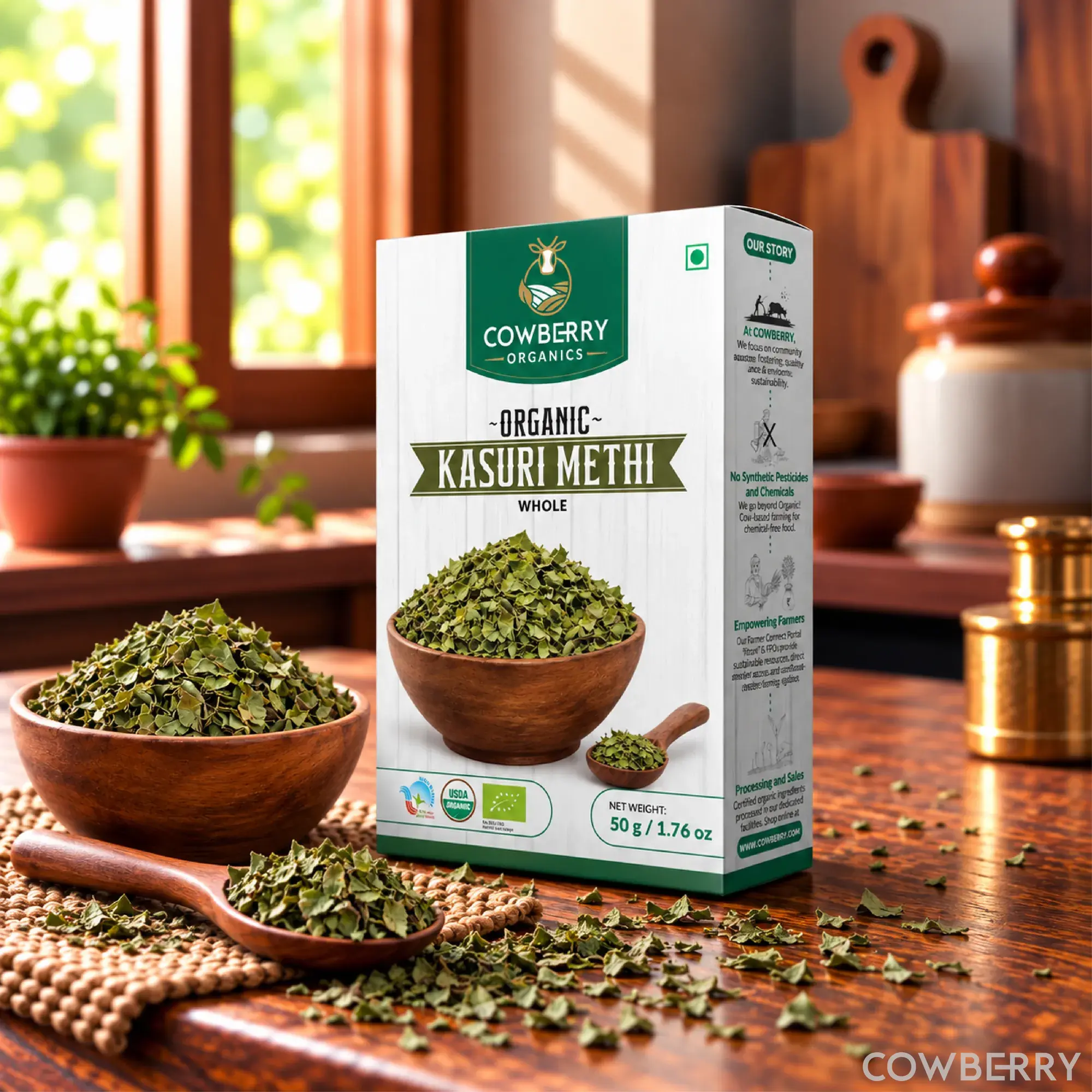
Kasuri methi is fenugreek leaves that have been dried and crumbled, sold as a dark green, ready-to-use herb in a small pack. It is the leaf half of the fenugreek plant: methi dana is the seed, kasuri methi is the leaf, and the two sit side by side on many Indian masala shelves. Today's packs, COWBERRY's included, are made from leaves grown in Rajasthan.
In the kitchen it is a finishing herb, not a cooking spice. It goes in last, off the flame, and its whole job is the green, earthy, slightly bitter lift that makes a dal or paneer dish taste finished. The fenugreek hub carries the rest of the plant's story.
How kasuri methi is made
The pack facts describe it plainly: fenugreek leaves grown in Rajasthan, harvested at peak freshness, naturally dried and packed with nothing added. Drying shrinks and concentrates the leaves, which is why a 50 g pack lasts for months of cooking while a bunch of fresh methi wilts quickly. Once dry, the leaves keep their green colour and their aroma, and they crumble easily between the fingers.
No roasting, no grinding: drying is the whole process. That matters because the dried leaf keeps the fresh leaf's character. The powder made from the seed is a different product altogether, covered on the fenugreek powder page.
How kasuri methi tastes, and how to use it
The pack describes the taste as earthy, with slightly bitter and aromatic notes, and that is exactly the point of it: a concentrated fenugreek aroma that blooms the moment it meets a hot, just-finished dish. The usual move is to take a pinch, crush the leaves between the palms, and scatter them over the curry off the flame, then cover the pot for a minute. Heat is brief or none; fried for long, the leaves turn harsh.
The dishes the pack names are curries, dals, paneer dishes, vegetables, parathas and rich gravies. Start with a pinch for a curry for four, taste, and add a little more if the dish can take it; the leaf is stronger than it looks, and a heavy hand turns the whole pot bitter.
How long kasuri methi lasts, and how to store it
The pack's own storage line is the right one: airtight, in a cool, dry place, away from sunlight and moisture. A dry herb needs no fridge; the pantry shelf is its home, and a damp spoon or a humid kitchen is what shortens its life. Neither the product page nor IFCT 2017 prints a shelf-life figure for dried fenugreek leaves, so the pack date and the nose govern: when the green fades and the aroma goes flat, the pack has given what it had.
Two habits stretch it: take pinches with dry fingers, and close the pack immediately, since the crumbled leaves drink moisture from the air. Kept like that, a 50 g pack quietly does months of dal duty.
Kasuri methi vs methi dana vs fresh methi
Three forms, one plant. Methi dana is the seed: hard, bitter-sweet, tempered in hot oil or soaked overnight. Fresh methi is the leafy green, sold in bunches and cooked as a vegetable in season. Kasuri methi is that same leaf dried, and it exists for the months when fresh methi is not around; the pack describes it as a convenient alternative to the fresh leaves, with a more concentrated aroma.
IFCT 2017 prints a nutrition entry for fenugreek seeds and none for the dried leaves, so no per-100 g numbers are given for the leaf; it is bought for aroma, not for arithmetic. The side-by-side account of the seed and the leaf is on the difference between kasuri methi and methi page, and the seed's nutrition numbers are on the hub.
FAQs
What is kasuri methi?
Kasuri methi is dried fenugreek leaves, crumbled and sold as a finishing herb. It comes from the same plant whose seeds are methi dana, and in cooking it goes in last, crushed over curries, dals, paneer dishes and gravies for a green, earthy, slightly bitter lift. The pack facts describe leaves grown in Rajasthan, naturally dried.
Does kasuri methi taste bitter?
Yes, slightly bitter, with earthy and aromatic notes, which is its job in a dish; the bitterness reads as depth rather than harshness when it is used in pinches at the end of cooking. It is far gentler than raw methi dana, the seed, whose bitterness needs heat or soaking to tame. Too much kasuri methi, though, turns a pot bitter.
How kasuri methi is made?
Fenugreek leaves are harvested at peak freshness and naturally dried, with nothing added, then packed crumbled; drying is the entire process, no roasting or grinding. The dry leaves keep their green colour and concentrated aroma, which is why a small pack lasts for months of cooking while fresh methi wilts quickly.
Does kasuri methi have an expiry date?
The pack carries its own date, and the storage rules do the rest: airtight, cool, dry and away from sunlight, with dry fingers on every pinch. Neither the product page nor IFCT 2017 prints a shelf-life figure for dried fenugreek leaves. When the green fades and the aroma goes flat, the pack has finished its useful life.
How much kasuri methi to use in a curry?
Start with a pinch for a curry that serves four: crush the leaves between your palms and scatter them over the pot off the flame, then cover it for a minute and taste. Add a little more only if the dish can take it. Neither the product page nor IFCT 2017 prints gram amounts; the leaf is measured by eye and by taste.
Can kasuri methi be used instead of fresh methi leaves?
Yes, that is exactly what it is for: the pack describes kasuri methi as a convenient alternative to fresh fenugreek leaves, with a more concentrated aroma, for the months when fresh methi is not in season. Use far less dried than you would fresh, and add it at the end of cooking rather than cooking it down as you would the fresh greens.
References
Shop this article
Keep reading
Coriander water benefits: what dhania water actually does
Peanuts in Hindi (moongfali): groundnut names in Indian languages
Coriander vs cilantro: are they the same herb?