by COWBERRY

8 minute read
Is kasuri methi good for diabetes? GI, portion and how to eat it

Is kasuri methi good for diabetes? The dried leaves have no blood-sugar evidence in the references; the evidence belongs to fenugreek seeds. A 2014 meta-analysis of ten clinical trials found fasting glucose 0.96 mmol/L lower than control, and two-hour post-load glucose and HbA1c lower too; the significant glucose effects came at medium or high doses in people with diabetes. The fenugreek (methi) hub covers the plant.
Short answer: is kasuri methi good for diabetes?
The honest answer splits in two. For methi dana, the seeds, the clinical trials lean towards yes: in people with diabetes, fenugreek intake lowered fasting and two-hour post-load glucose, with those effects seen at medium or high doses, and HbA1c was lower in the three trials that measured it. For kasuri methi, the dried leaves, no trial appears in the references, and a pinch of leaves over a curry is not the seeds those trials used.
So the useful question is not whether the leaf is good for diabetes but what the seed evidence actually shows, how it was obtained, and what a person with diabetes can sensibly do with fenugreek in the kitchen. The rest of this page walks through that, and the fenugreek hub covers the plant itself, its names and its nutrition.
Fenugreek seeds for diabetes: the 2014 research paper
Neelakantan and colleagues searched the trial literature up to November 2013 for studies of at least one week that compared fenugreek seeds with a control intervention, and pooled ten trials. In their meta-analysis, published in Nutrition Journal in 2014, fenugreek intake changed fasting blood glucose by -0.96 mmol/L (95% CI -1.52 to -0.40, ten trials), two-hour postload glucose by -2.19 mmol/L (95% CI -3.19 to -1.19, seven trials) and HbA1c by -0.85 percentage points (95% CI -1.49 to -0.22, three trials).
Three limits matter as much as the numbers. First, the significant effects on fasting and two-hour glucose showed up only in the studies that gave medium or high doses to people with diabetes; the paper's summary gives the doses only as medium or high, so this page gives no dose. Second, most of the trials were of low methodological quality, and the authors ask for better-designed trials before firm conclusions. Third, results varied widely between trials. Even so, the authors concluded that the clinical trials support beneficial effects of fenugreek seeds on glycemic control in people with diabetes. An older overview in the Asia Pacific Journal of Clinical Nutrition (2008) agrees, describing fenugreek seeds as a rich source of soluble fibre that reduces blood glucose and lipids and can be used as a food adjuvant in diabetes.
Kasuri methi: why the leaf does not inherit the seed's findings
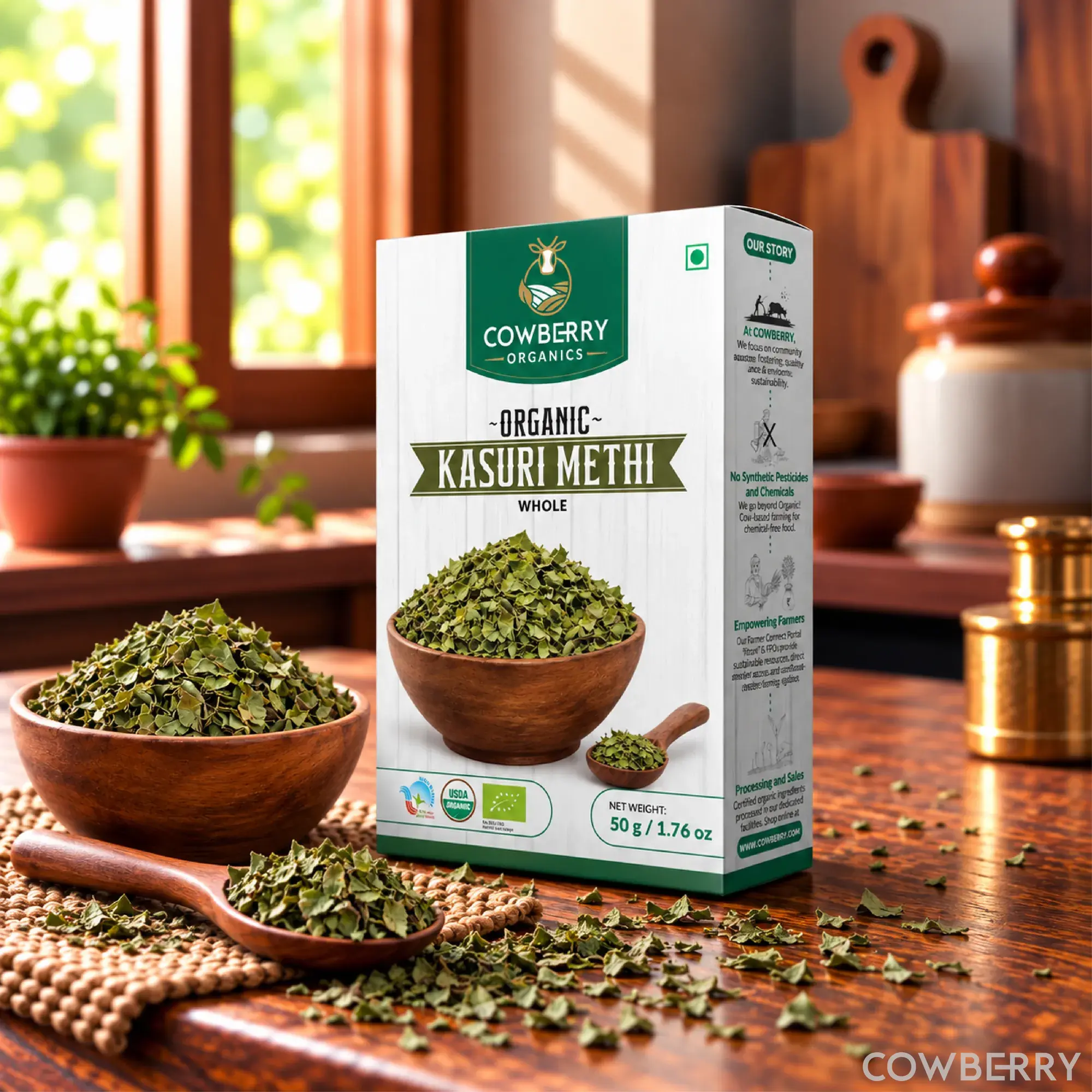
Kasuri methi is made from fenugreek leaves harvested at peak freshness and dried; COWBERRY's pack calls it a finishing touch for curries, dals, paneer dishes, vegetables, parathas and gravies. It goes in as a pinch, crushed between the palms near the end of cooking. None of the trials behind the numbers above used dried leaves, so the leaf gets none of the seed's results.
There is also a general reason to keep expectations low for any herb or spice eaten in culinary amounts. A 2014 review in the International Journal of Molecular Sciences points out that herbs and spices are normally consumed in small quantities and in combination with other foods, so what their true benefit is for health remains unclear. A pinch of kasuri methi is exactly that kind of culinary amount. What the leaf is, and how to use and store it, is on the what is kasuri methi page.
Glycemic index and what a teaspoon of methi dana holds
No glycemic index value is published for fenugreek in the Indian food composition tables, so this page gives no GI and does not guess one. What IFCT 2017 does print, per 100 g of raw fenugreek seeds: 10.57 g of carbohydrate, 47.55 g of dietary fibre, 25.41 g of protein, 8.47 mg of iron and 235 kcal. Most of the seed's weight is fibre and protein rather than carbohydrate.
Per real portion: a teaspoon of methi dana weighs 4 g and holds about 9 kcal, 0.4 g of carbohydrate, 1.9 g of fibre, 1 g of protein and 0.3 mg of iron. The fibre is the part worth noticing: ICMR-NIN's Dietary Guidelines say dietary fibre delays and retards the absorption of carbohydrates and fats and increases the satiety value. The same guidelines name fenugreek seeds, with amaranth, flax, chia and basil, among the foods worth building into the week's meals.
| Nutrient | Fenugreek seeds (methi dana), raw |
|---|---|
| Energy (kcal) | 235 |
| Protein (g) | 25 |
| Fat (g) | 5.7 |
| Carbohydrates (g) | 11 |
| Dietary fibre (g) | 48 |
| Iron (mg) | 8.5 |
| Calcium (mg) | 135 |
| Magnesium (mg) | 167 |
| Potassium (mg) | 891 |
| Sodium (mg) | 40 |
| Zinc (mg) | 3.8 |
| Folate (mcg) | 51 |
Per 100 g raw, edible portion. Composition: IFCT 2017 (ICMR-NIN). — means not reported. These are average values for the food; the label on a pack gives the values for that product.
How much fenugreek and how to eat it with diabetes
How much: the meta-analysis summary describes the doses only as medium or high, so this page sets no daily dose for diabetes. The guideline quoted above is a general eating habit, not a medicine schedule.
How: the Indian kitchen gives three easy forms. Soaked overnight, a teaspoon (4 g) of seeds softens and can be chewed in the morning with its soak water, the methi dana water method. Tempered in hot oil, a quarter teaspoon (1 g) flavours dal and sabzi. Roasted and ground into fenugreek powder, a little goes into thepla and paratha doughs.
If you have diabetes, use any of these as a spice in the meal, not as a medicine: keep the amounts culinary, eat them with the rest of the plate, and let your glucometer readings, discussed with your doctor, decide what suits you.
What to avoid
- Swapping your medicine for methi. Nothing on this page replaces prescribed medicines. If your readings improve while you eat fenugreek, show the readings to your doctor; the dose stays their decision.
- Heaped spoons to chase the trial effect. The trials used prepared fenugreek at medium or high doses under study conditions; home spoons are not that.
- Counting a pinch of kasuri methi as a blood-sugar measure. The leaves have no trial evidence in the references; use them for flavour only.
- Sweet fenugreek products sold for diabetes. A laddu or a syrup with methi in it is still a sweet; read the label before you buy, and clear any supplement with your doctor.
Talk to your doctor or dietitian
Diabetes is managed with medicines, monitoring and a diet plan built for one person, and a spice does not sit above any of them. The fenugreek effects above were measured in people with diabetes at trial doses, not at kitchen amounts, so this page sets no dose and promises nothing. If you take medicines that lower blood glucose, tell your doctor before you make fenugreek a daily habit, and never use spices or supplements in place of the medicines prescribed for you. Talk to your doctor or dietitian about whether, and how much, fenugreek fits your plan.
FAQs
Is dried fenugreek leaves good for you?
As a flavouring, yes: kasuri methi adds the earthy, slightly bitter, aromatic note that Indian cooking finishes curries and dals with, and it is used in pinches, not portions. As a health food, the honest answer is that no trial in the references tested the dried leaves, and culinary amounts of any herb make benefit hard to establish (a 2014 review). The measured evidence belongs to fenugreek seeds.
Is kasuri methi good for health?
No study in the references backs a health claim for the dried leaves, so this page makes none. What is known: fenugreek seeds, the same plant's other kitchen form, lowered fasting glucose, two-hour post-load glucose and HbA1c in trials (2014 meta-analysis), the significant glucose effects in people with diabetes at medium or high doses. Kasuri methi itself is for flavour; the numbers and their limits are in the sections above.
How much kasuri methi can a person with diabetes eat?
No trial in the references tested the leaves, so no number is given. The trials that found effects used fenugreek seeds, described in the meta-analysis summary only as medium or high doses. For cooking, a pinch to a quarter teaspoon of crushed kasuri methi per dish is the usual kitchen measure; agree anything beyond that with your doctor or dietitian.
Does fenugreek lower blood sugar?
In trials, fenugreek seeds lowered blood sugar: a 2014 meta-analysis of ten trials recorded fasting blood glucose 0.96 mmol/L lower and two-hour postload glucose 2.19 mmol/L lower than controls, and HbA1c 0.85 percentage points lower; the significant glucose effects came from people with diabetes at medium or high doses. In people without diabetes, or at the small amounts used in cooking, the paper does not show an effect.
Can kasuri methi be eaten raw?
It is already a dried, ready-to-use leaf, so raw is how it is normally eaten: crushed and sprinkled over a finished dish, and no reference suggests another way. If the question is really about the seeds, raw methi dana is hard and bitter, and the ways to soak, roast or powder them are on the fenugreek seeds how to eat page.
Is methi dana water good for diabetes?
The water itself has not been tested; the trials behind the seed findings gave fenugreek seeds, and none of them describes the overnight-soak drink. One teaspoon (4 g) of seeds holds about 9 kcal and 1.9 g of fibre, and those reach you only if you chew the softened seeds too. The method is on the methi dana water benefits page; the diabetes decision stays with your doctor.
References
- Indian Food Composition Tables (IFCT) 2017, ICMR-National Institute of Nutrition
- Dietary Guidelines for Indians, ICMR-National Institute of Nutrition
- Neelakantan N, Narayanan M, de Souza RJ et al. Effect of fenugreek (Trigonella foenum-graecum L.) intake on glycemia: a meta-analysis of clinical trials. Nutr J, 2014
- Opara EI, Chohan M. Culinary herbs and spices: their bioactive properties, the contribution of polyphenols and the challenges in deducing their true health benefits. Int J Mol Sci, 2014
- Krishnaswamy K. Traditional Indian spices and their health significance. Asia Pac J Clin Nutr, 2008
Shop this article
Keep reading
Coriander water benefits: what dhania water actually does
Peanuts in Hindi (moongfali): groundnut names in Indian languages
Coriander vs cilantro: are they the same herb?