by COWBERRY

6 minute read
Lobia nutrition per 100g: protein, calories and carbs

Lobia nutrition per 100g, from IFCT 2017: 321 kcal, 21.25 g of protein, 1.14 g of fat, 53.77 g of carbohydrate and 11.70 g of fibre, with the full mineral set in the table below. This page counts the raw, dry bean, shows what a katori and a serving give, and sets lobia beside rajma and kabuli chana. The lobia hub covers the rest.
Lobia nutrition per 100 g: the full table
The table below carries lobia's complete IFCT 2017 figures — the white cowpea, food code B006 — beside rajma, also from IFCT 2017, and kabuli chana, whose figures come from a USDA record. One honest gap: IFCT 2017 does not report vitamin C for lobia, so this page does not invent a figure for it. Read the table for the pattern: 21.25 g of protein for 321 kcal, fat at 1.14 g, and 53.77 g of carbohydrate of which 11.70 g is fibre.
| Nutrient | Lobia (cowpea, white) | Rajma (red kidney beans) | Kabuli chana (white chickpeas) |
|---|---|---|---|
| Energy (kcal) | 321 | 300 | 378 |
| Protein (g) | 21 | 20 | 20 |
| Fat (g) | 1.1 | 1.8 | 6 |
| Carbohydrates (g) | 54 | 49 | 63 |
| Dietary fibre (g) | 12 | 17 | 12 |
| Iron (mg) | 5 | 6.1 | 4.3 |
| Calcium (mg) | 84 | 126 | 57 |
| Magnesium (mg) | 213 | 173 | 79 |
| Potassium (mg) | 1243 | 1324 | 718 |
| Sodium (mg) | 13 | 10 | 24 |
| Zinc (mg) | 3.6 | 2.7 | 2.8 |
| Folate (mcg) | 249 | 316 | 557 |
| Vitamin C (mg) | — | — | 4 |
| Glycemic index (GI) | 37 | 45 | 23 |
Per 100 g raw, edible portion. Composition: IFCT 2017 (ICMR-NIN); USDA FoodData Central (SR Legacy), FDC ID 173756, NDB 16056. GI: University of Sydney GI database. — means not reported. These are average values for the food; the label on a pack gives the values for that product.
Protein, calories and carbs: the headline numbers
The headline: 21.25 g of protein and 321 kcal per 100 g. Protein-wise lobia sits a shade above rajma's 19.9 g and kabuli chana's 20.5 g, and its fat, at 1.14 g, is the lowest of the three. The carbohydrate figure, 53.77 g, carries the bulk of the calories in any dal. Quality matters too: a 2018 review calls cowpea protein high quality, with an amino acid pattern that complements cereals, and the dietary guidelines add the cereal rule: cereals and pulses mixed 3 to 1 by raw weight can meet the requirement for all the essential amino acids.
Fibre and the minerals: lobia against its two peers
Fibre: 11.7 g per 100 g, behind rajma's 16.6 g and close to kabuli chana's 12.2 g. The minerals are where lobia's strengths sit: 213 mg of magnesium, the most of the three (rajma 173 mg, kabuli chana 79 mg); 1243 mg of potassium (rajma 1324 mg, kabuli chana 718 mg); 3.57 mg of zinc (rajma 2.7 mg, kabuli chana 2.76 mg); 84.1 mg of calcium (rajma 126 mg, kabuli chana 57 mg); and 5.04 mg of iron (rajma 6.1 mg, kabuli chana 4.31 mg). Folate: 249 mcg, behind rajma's 316 mcg and kabuli chana's 557 mcg. Sodium is low at 12.52 mg per 100 g.
From 100 g to the plate: katori, serving and recipe numbers
What the per-100 g row means in real portions: one katori cooked from 30 g dry gives 96 kcal, 6.4 g of protein, 16 g of carbohydrate and 3.5 g of fibre, and a 50 g serving gives 160 kcal, 10.6 g of protein, 26.9 g of carbohydrate and 5.9 g of fibre. The site's recipes turn those into dishes: the lobia curry lands at 227 kcal per serving with 10.6 g of protein, while the lobia khichdi bowl carries 282 kcal, 8.3 g of protein and 4.0 g of fibre. Cooked lobia keeps up to two days in the fridge.
Raw, soaked, boiled: what cooking changes
This page counts by dry weight, and readers ask about the cooked bean. Soaking pulls water into the bean, soaked lobia roughly doubles in volume, and boiling adds water weight to the plate, which is why a cooked katori weighs more than 30 g while keeping the same 96 kcal. The food tables this page works from give no cooked per-100 g figures, so the honest move is to count dry and know that cooking dilutes the numbers, it does not change them. Cooking does change digestibility: the dietary guidelines name boiling or pressure cooking as the best method for pulses, since it destroys anti-nutritional factors, and boiling with just enough water, without draining, best retains folate in legumes. The soak method is on how to soak lobia.
The GI and what the numbers mean for the plate
Alongside composition, one number matters on the plate: lobia's GI of 37, the average of ten published entries for the plain boiled bean, sits in the low band (55 and under). The 11.7 g of fibre in each 100 g travels with that carbohydrate, and the full GI story is on black eyed peas glycemic index. For diabetes, the portion guide is on lobia for diabetes, and the benefits with side effects on cowpea benefits.
Which numbers to remember
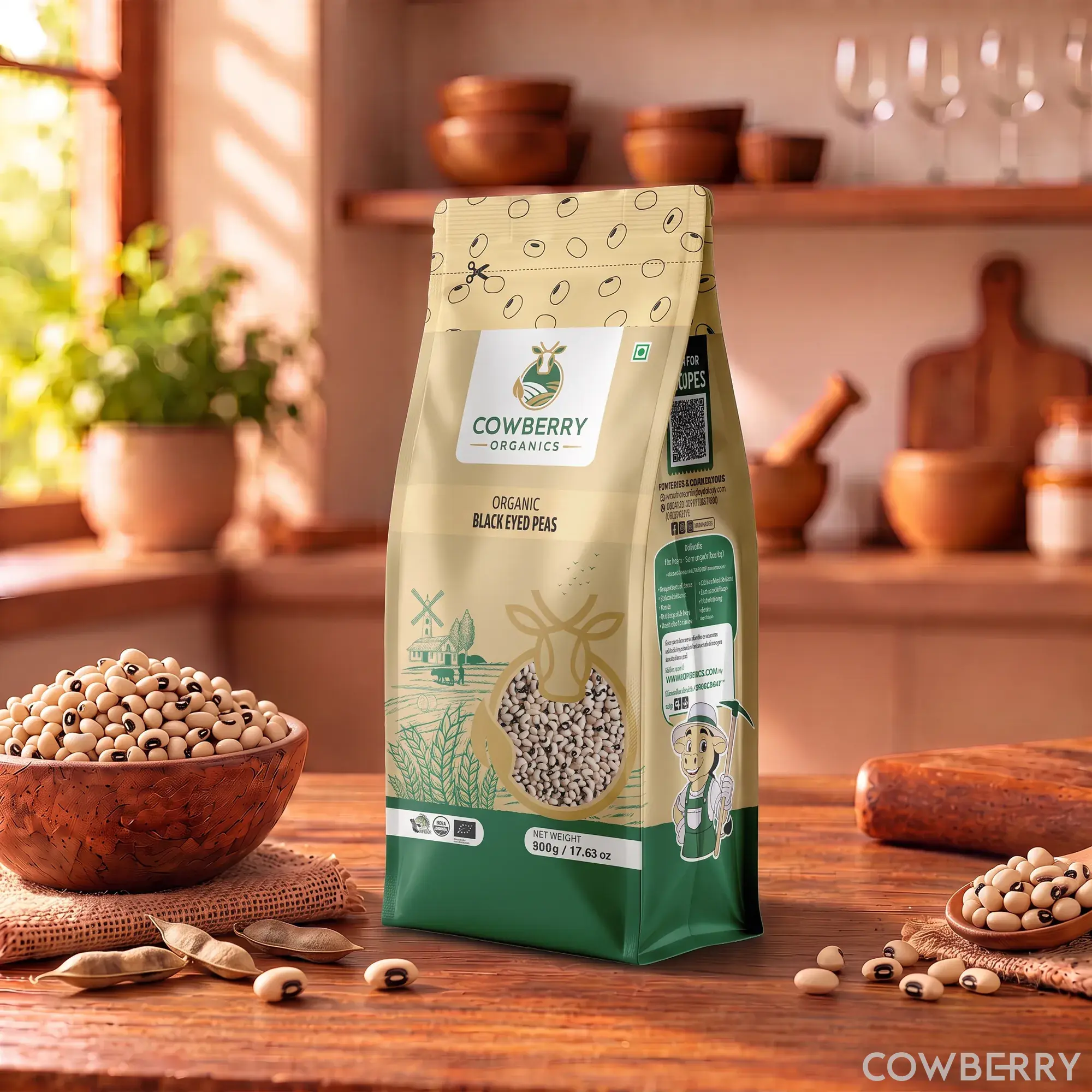
In one breath: 321 kcal, 21.25 g of protein, 1.14 g of fat, 53.77 g of carbohydrate, 11.70 g of fibre, and folate at 249 mcg per 100 g; 96 kcal and 6.4 g of protein in a katori; 160 kcal and 10.6 g of protein in a 50 g serving; GI 37. For the bean to cook with, COWBERRY's Organic Black Eyed Peas (Lobia) grow through natural cow-based farming in Rajasthan; the packs are raw and natural, with no additives. The lobia hub gathers the rest of the set.
FAQs
Is lobia good for health?
Lobia is a genuinely useful pulse: per 100 g it gives 21.25 g of protein with 11.7 g of fibre and 249 mcg of folate, all for 321 kcal, with a GI of 37 in the low band, and the pulse research lists iron, zinc, folate and magnesium among its significant contributions.
Does lobia have protein?
Yes: 21.25 g of protein per 100 g of raw lobia. One katori, from 30 g dry, holds 6.4 g; a 50 g serving holds 10.6 g. A 2018 review calls cowpea a high-quality plant protein source, and the guidelines' 3 to 1 cereal-pulse ratio makes that protein work with rice or roti.
What is lobia?
Lobia is the everyday Hindi name for cowpea (Vigna catjang), the bean sold as black eyed peas; IFCT 2017 gives 321 kcal, 21.25 g of protein and 53.77 g of carbohydrate per 100 g. The name map is on lobia in english.
Is lobia soaked overnight?
Yes, six to eight hours overnight is the standard soak, with a quick soak of two minutes' boiling plus one to two hours' rest as the shortcut. Soaking softens the bean and shortens the cooking, and the step-by-step is on how to soak lobia.
Can lobia cause gas?
It can, in some people. The galacto-oligosaccharides in lobia are fermented in the colon, releasing gas — though that explanation has recently been questioned. Most people who react find things settle down within a few weeks once the habit is kept; how much gas each person gets varies.
Is lobia good for diabetes?
In measured portions, yes: the plain boiled bean's GI averages 37, and one katori, 30 g dry, brings about 16 g of carbohydrate. Set your portion with your doctor or dietitian; the guide is on the lobia for diabetes page.
References
- Indian Food Composition Tables (IFCT) 2017, ICMR-National Institute of Nutrition
- Dietary Guidelines for Indians, ICMR-National Institute of Nutrition
- University of Sydney glycemic index database (GI search)
- University of Sydney: about the glycemic index
- Mudryj AN, Yu N, Aukema HM. Nutritional and health benefits of pulses. Appl Physiol Nutr Metab, 2014
- UK Food Standards Agency: How to chill, freeze and defrost food safely
- Thompson HJ. Improving human dietary choices through understanding of the tolerance and toxicity of pulse crop constituents. Curr Opin Food Sci, 2019
- Jayathilake C, Visvanathan R, Deen A, et al. Cowpea: an overview on its nutritional facts and health benefits. J Sci Food Agric, 2018
Shop this article
Keep reading
Green gram plant: crop, varieties and how it grows in India
Rajma vs lobia: difference, nutrition and which to choose
Rajma plant: how rajma is grown in India (it is not a tree)