by COWBERRY

11 minute read
Rajma in English (kidney beans), types of rajma and which is best

Rajma in English is kidney beans: the red, kidney-shaped seeds of Phaseolus vulgaris, the bean behind Punjabi rajma masala and rajma chawal. Read on for the types of rajma sold in India (Kashmiri or Jammu, chitra, red and white), which one suits which dish, how to cook it safely and soft, its nutrition per 100 g, and what to check on a pack before you buy and store it.
What is rajma? Rajma vs kidney beans
Rajma is the Hindi and Punjabi name for the dried red kidney bean. Botanically it is Phaseolus vulgaris, the species IFCT 2017 also gives for French beans, which is why rajma in English has one short answer (kidney beans) and one longer one (the red, kidney-shaped dried seed of that species). The bean is believed to have originated in Central and South America. The rajma COWBERRY sells is grown in the mountain regions of Himachal Pradesh and Jammu.
IFCT 2017, the ICMR-NIN food composition table, lists rajmah by colour (black, brown and red), and this page uses the red entry for the dried bean: 300 kcal, 19.9 g protein and 16.6 g fibre per 100 g, with 6.1 mg iron and 316 mcg folate. The table does not list market types such as Kashmiri or chitra by name, so these are the working figures for red rajma as a class, and the types below are told apart by look and use rather than by nutrition. In several languages the word barely changes: Hindi, Assamese and Malayalam spell it rajmah, Punjabi says lal rajmah and Urdu rajma. The full set of dal and bean names by language, including the ones that sound nothing like rajma, is on the types of dal page.
Types of rajma beans in Indian shops
Shop names for rajma describe either a place, such as Kashmiri or Jammu, or a look, such as chitra (speckled) or safed (white). IFCT 2017 sorts rajmah by colour instead, so a shop name tells you what the beans look like or where they were grown, not how their nutrients compare.
Kashmiri rajma (Jammu rajma)
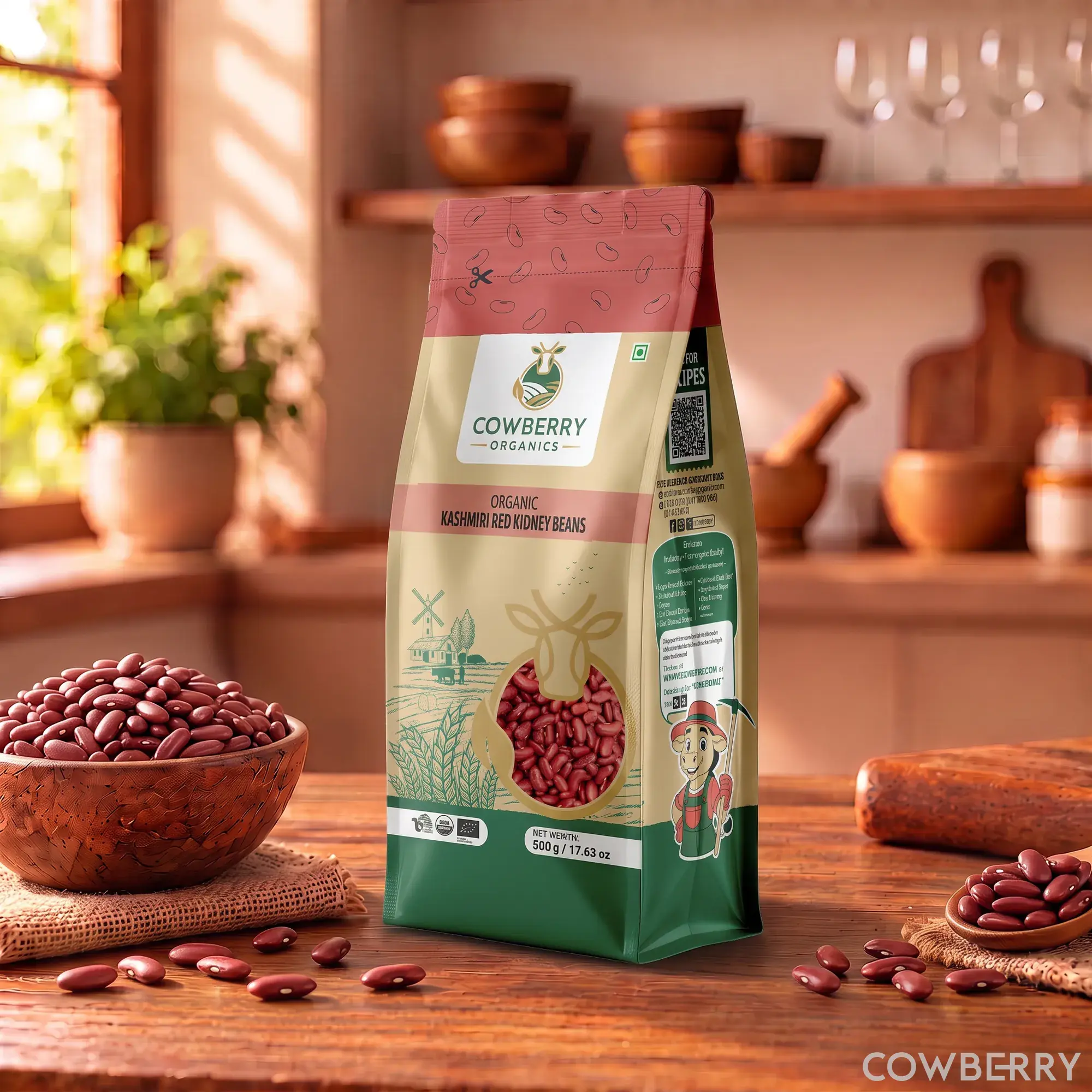
This is the small red type, and the one COWBERRY sells, grown in the mountain regions of Himachal Pradesh and Jammu, harvested at full maturity and picked by hand. The beans are small, glossy and deep red, with a creamy bite and a slightly sweet taste, and they cook soft while holding their shape. They suit rajma chawal and rich curries, where the beans should be soft inside but still whole on the plate.
Chitra rajma vs red rajma
On a shelf the two are easy to tell apart, because the difference is in the colour.
Chitra rajma (speckled rajma)
Chitra is the shop name for speckled rajma: beans marked with streaks or spots of a second colour rather than one even shade. IFCT 2017 has no chitra entry, so no printed figure sets its protein or fibre apart from red rajma. In the kitchen it gets the same soak and full boil as any other rajma.
Red rajma (lal rajmah)
Red rajma is the type behind the IFCT 2017 entry "Rajmah, red", the source of the rajma figures on this page, and in Punjabi it is lal rajmah. Kashmiri rajma is a small red rajma, so the same entry is the closest printed figure for it as well.
Red rajma vs white rajma
White rajma (safed rajma) is a cream-white kidney bean. IFCT 2017 lists rajmah in black, brown and red only, so there are no printed figures to set white rajma against red. Cook it the way you cook red rajma, soaked first and then boiled until soft.
Types of kidney beans at a glance
IFCT 2017 files three rajmah under Phaseolus vulgaris, black, brown and red, and shop names add a place or a look on top of those colours. Here is how the names on this page line up:
- Small, deep red and glossy: Kashmiri or Jammu rajma, the type COWBERRY sells.
- One even red: red rajma, lal rajmah in Punjabi, the colour whose IFCT 2017 entry this page uses.
- Speckled: chitra rajma.
- Cream-white: white rajma, sold as safed rajma.
- Black or brown: the two other rajmah colours in IFCT 2017.
Colour and size are what you can check at the shop; the nutrition figures on this page come from the red rajmah entry.
Which rajma is best for rajma masala, salads and rajma galouti
Which rajma is best depends on the dish. No printed figure ranks one type above another on nutrition, so the choice comes down to texture and colour.
- Rajma chawal and Punjabi rajma masala: a small red rajma such as Kashmiri. COWBERRY's cooks soft while holding its shape and has a creamy bite, so a few beans mashed against the pan thicken the gravy and the rest stay whole. The full method, with the overnight soak and the slow simmer, is in our rajma chawal recipe.
- Salads, chaat and sprouted rajma: any type, boiled soft and cooled fully before it is tossed with onion, tomato, lemon and chaat masala. Never use sprouted rajma raw; boil the sprouts as you would the dry bean.
- Rajma galouti and kebabs: any type, cooked until it mashes to a smooth paste with no bits of skin, then bound with besan or roasted chana flour (sattu).
- A pale gravy or soup: white rajma, which does not turn the dish red.
If you keep only one jar, a small red rajma covers the curry, the salad and the kebab. Whichever type you buy, the soak and the full boil described next apply to it.
How to cook rajma safely and soft
Soak, discard, boil fully
Never eat rajma raw or half-cooked. Kidney beans contain lectins, which a 2018 systematic review of Phaseolus vulgaris lectins describes as anti-nutritional factors that can cause intestinal disorders (He et al.), and a 2013 review in the journal Nutrition links kidney bean toxicity to its lectins, saponins, phytates and protease inhibitors, with allergy to its proteins as a separate problem (Kumar et al.). Thorough cooking takes care of this: boiling and pressure cooking, the ICMR-NIN Dietary Guidelines for Indians explain, destroy the anti-nutritional factors in pulses. In the kitchen, that comes down to five steps:
- Soak the beans in plenty of water for 8 to 12 hours, or overnight.
- Discard the soaking water and rinse the beans well.
- Cook in fresh water at a full rolling boil, or in a pressure cooker, until every bean is soft right through.
- If you plan to slow-cook or simmer the curry gently, boil the soaked beans fully first and only then move them to the slow heat.
- Do not serve beans that are still chalky or crunchy inside, and boil sprouted rajma the same way before it goes into a salad.
Why rajma does not get soft, and how to fix it
Rajma is slow to cook: the ICMR-NIN guidelines name it among the legumes that need a longer cooking time. When the beans are still firm, give them more time in fresh water or a few more whistles in the cooker, and test several beans, not one; each should mash easily between two fingers. Do not skip the soak, and cook the beans soft before they meet the tomato masala, the order our rajma chawal recipe follows. Look at the packing date too: storage time is among the conditions that, according to the guidelines, influence the quality of food. Leave out baking soda: the same guidelines advise against it for pulses because it adds sodium, just as salt does.
Rajma variety and nutrition: rajma per 100 g against lobia and kala chana
The table below prints the IFCT 2017 composition of raw rajma next to two pulses it is often swapped with in the same recipes: lobia (cowpea, black-eyed peas) and kala chana (whole Bengal gram). Rajma gives 19.9 g protein, 16.6 g fibre and 300 kcal per 100 g raw. Lobia is close on protein at 21 g with less fibre at 11.7 g, and kala chana has the most fibre of the three at 25.2 g with slightly less protein at 18.8 g. Rajma has the most potassium of the three at 1324 mg per 100 g and more folate at 316 mcg than lobia at 249 mcg or kala chana at 233 mcg; its iron at 6.1 mg sits between the two.
On the plate, 50 g of dry rajma cooks into one serving of rajma masala: about 150 kcal, 10 g protein and 8.3 g fibre before the ghee and onion of the gravy are added. Its glycemic index of 45 is the average of two tests of rajma done in India and listed in the University of Sydney database. The two results sit far apart, at 19 and 70, and the beans were prepared differently (plain boiled in one; soaked, stored moist and steamed in the other). The full breakdown, per katori, per serving and against kabuli chana and kala chana, is on rajma protein per 100 g, and what those numbers do for you, together with the side effects, is on rajma benefits and side effects.
| Nutrient | Rajma (red kidney beans) | Lobia (cowpea) | Kala chana (Bengal gram, whole) |
|---|---|---|---|
| Energy (kcal) | 300 | 321 | 287 |
| Protein (g) | 20 | 21 | 19 |
| Fat (g) | 1.8 | 1.1 | 5.1 |
| Carbohydrates (g) | 49 | 54 | 40 |
| Dietary fibre (g) | 17 | 12 | 25 |
| Iron (mg) | 6.1 | 5 | 6.8 |
| Calcium (mg) | 126 | 84 | 150 |
| Magnesium (mg) | 173 | 213 | 160 |
| Potassium (mg) | 1324 | 1243 | 935 |
| Sodium (mg) | 10 | 13 | 27 |
| Zinc (mg) | 2.7 | 3.6 | 3.4 |
| Folate (mcg) | 316 | 249 | 233 |
| Glycemic index (GI) | 45 | 37 | 23 |
Per 100 g raw, edible portion. Composition: IFCT 2017 (ICMR-NIN). GI: University of Sydney GI database. — means not reported. These are average values for the food; the label on a pack gives the values for that product.
How to buy and store rajma
What to look for: choose the type for the dish first, then check the pack for whole beans of an even size and colour, with no broken pieces, dust or insect holes, and for a recent packing date.
Unpolished: the ICMR-NIN Dietary Guidelines for Indians put whole legumes in their least-processed group, where nutrient losses are minimal, and note that highly polished dal and legumes lose some fibre. COWBERRY's rajma is hand-picked and left unpolished.
Certification: an organic pack should name the certification it holds. COWBERRY's Kashmiri red kidney beans are India Organic, USDA & EU certified, and they are grown with traditional cow-based farming and harvested at full maturity.
Storage: dry rajma belongs in an airtight container. The ICMR-NIN guidelines give that rule for all food grains, dried thoroughly first, to keep out moisture and the microbes that spoil stored grain. They also describe dried neem leaves placed in the bin as a traditional household step known to stop some infestations. Cooked rajma goes into the fridge in a lidded container, ideally in small portions, and is heated through once before eating; the guidelines advise against heating stored cooked food again and again.
FAQs
Which rajma is best?
It depends on the dish, since no printed figure ranks one type of rajma above another on nutrition. For rajma chawal and rajma masala, pick a small red rajma such as Kashmiri: COWBERRY's cooks soft while holding its shape and has a creamy bite. For salads, chaat or kebabs, any type works once it is boiled fully soft.
What is rajma?
Rajma is the Indian name for dried red kidney beans, the seeds of Phaseolus vulgaris. It is a pulse with 19.9 g protein and 16.6 g fibre per 100 g raw (IFCT 2017), cooked across North India as a thick onion-tomato curry eaten with rice. The Kashmiri rajma COWBERRY sells is grown in the hills of Himachal Pradesh and Jammu.
What is the difference between rajma and kidney beans?
None: kidney beans and rajma are the same bean. Rajma is the Hindi and Punjabi word and kidney beans the English one, and IFCT 2017 files its black, brown and red rajmah under one species, Phaseolus vulgaris. What changes from pack to pack is the type, such as the small red Kashmiri, the speckled chitra or the white safed rajma, and every type gets the same soak and full boil.
Can rajma be cooked without soaking?
Soak it first; beans cooked without a soak can stay hard in the middle. The ICMR-NIN guidelines rate soaking as an established household step that makes legumes more digestible. Give the beans 8 to 12 hours in water, drain them, and cook them in fresh water until not one bean has a firm centre left.
Does rajma cause gas?
It can for some people. Cooking the beans the safe way set out above also makes them easier to digest, since full boiling or pressure cooking breaks down the anti-nutritional factors in pulses. Soak the beans overnight, discard the water, cook until every bean is soft, and start with a small katori if you rarely eat beans.
Which rajma is good for health?
Any type, as long as it is whole, unpolished and cooked soft. IFCT 2017 lists rajmah by colour, not by market type, so there is no printed basis for ranking Kashmiri or chitra rajma on protein or fibre. Eat rajma with rice or roti, since a meal of pulses and grains together gives better protein quality than either alone. More on the rajma benefits page.
Is rajma good for kidneys?
The name describes the shape of the bean, not an effect on the organ. For healthy people rajma is an ordinary pulse. For someone with kidney disease on a restricted diet, its potassium at 1324 mg per 100 g raw and its protein are the two things that get counted, so whether rajma fits is a question for your own care team: talk to your doctor or dietitian.
References
- Indian Food Composition Tables (IFCT) 2017, ICMR-National Institute of Nutrition
- Dietary Guidelines for Indians, ICMR-National Institute of Nutrition
- University of Sydney glycemic index database (GI search)
- Kumar S, Verma AK et al. Clinical complications of kidney bean (Phaseolus vulgaris L.) consumption. Nutrition, 2013
- He S, Simpson BK et al. Phaseolus vulgaris lectins: a systematic review of characteristics and health implications. Crit Rev Food Sci Nutr, 2018
Shop this article
Keep reading
Green gram plant: crop, varieties and how it grows in India
Rajma vs lobia: difference, nutrition and which to choose
Rajma plant: how rajma is grown in India (it is not a tree)