by COWBERRY

8 minute read
Rajma in pregnancy: benefits, safety and how to eat it

Rajma in pregnancy earns its place on the plate when two rules hold: the beans are fully cooked, and the portion follows the pulse amounts the guidelines give. The ICMR-NIN pregnancy chart names kidney beans among the daily pulses, and the WHO's healthy-diet guidance counts beans in the variety a pregnancy needs. The rajma beans hub has the dal's full background; here are the safety rules, portions and trimester notes.
Short answer: is rajma safe in pregnancy?
Yes, with the cooking caveat in front. Cooked rajma is a pulse, and the pregnancy guidance counts pulses as a daily food: the ICMR-NIN chart for a normal pregnancy suggests 80 g of pulses a day and names kidney beans among the dal varieties that fill the slot. The WHO describes the healthy pregnancy diet as one that draws energy, protein, vitamins and minerals from a spread of foods, beans included, and adds that pregnancy calls for exactly that adequate intake to meet the mother's needs and the baby's. The safety side has two hard lines. First, rajma is never eaten raw or half-cooked: a 2018 review lists intestinal disorders among the harms the bean's lectins can cause (He et al., 2018), and soaking with proper cooking removes their activity (Thompson 2019). Second, skip raw sprouts: the US FDA puts pregnant women on the list of people who should avoid sprouts of any kind when they are raw or lightly cooked.
Kidney beans in pregnancy: the amounts the guidelines give
The pregnancy chapter of the Dietary Guidelines for Indians gives its own pulse numbers, and rajma fits them as one of the named pulses.
Pulses: 80 g a day
The daily food list for a normal pregnancy, which the guidelines call only suggestive, puts pulses at 80 g, beside 240 g of cereals and millets, 300 g of vegetables and 400 ml of dairy. The pulse line names kidney beans outright, alongside yellow dal, cowpea, greengram and chick pea, as the varieties of grams and dals that bring protein, minerals, vitamins, fibre and calories to the pregnancy plate.
The meal chart
The diet chart for a normal sedentary pregnant woman spreads the pulses across the day: 20 g with breakfast, 30 g with lunch (or meat), and 25 g of red gram or chana (half a cup) with dinner, all as raw-ingredient quantities. The breakfast and lunch lines read simply 'pulses' — the family that, in this chapter's own list, includes kidney beans — while dinner names red gram or chana. The chart also notes that a portion of dal may be swapped for fish, chicken, meat or egg. For the dal's full nutrition background, see the rajma beans hub.
| Nutrient | Rajma (red kidney beans), raw |
|---|---|
| Energy (kcal) | 300 |
| Protein (g) | 20 |
| Fat (g) | 1.8 |
| Carbohydrates (g) | 49 |
| Dietary fibre (g) | 17 |
| Iron (mg) | 6.1 |
| Calcium (mg) | 126 |
| Magnesium (mg) | 173 |
| Potassium (mg) | 1324 |
| Sodium (mg) | 10 |
| Zinc (mg) | 2.7 |
| Folate (mcg) | 316 |
| Glycemic index (GI) | 45 |
Per 100 g raw, edible portion. Composition: IFCT 2017 (ICMR-NIN). GI: University of Sydney GI database. — means not reported. These are average values for the food; the label on a pack gives the values for that product.
Rajma nutrition in pregnancy: protein, iron and folate
IFCT 2017 lists raw rajma per 100 g at 19.9 g of protein, 6.1 mg of iron and 316 mcg of folate, with 300 kcal. In portions: a katori from 30 g of dry rajma carries 6 g of protein, 1.8 mg of iron and 95 mcg of folate, and a 50 g serving carries 10 g of protein, 3.1 mg of iron and 158 mcg of folate.
Iron and folate, and how to absorb them
The guidelines name beans among the good iron sources for pregnancy (with dry fruits, eggs and flesh foods) and green leafy vegetables, legumes and nuts as the folic acid sources. Two pairing rules from the same pages matter as much as the nutrients: eat fruits such as guava or orange with meals, vitamin C-rich choices that lift iron absorption from plant foods, and keep tea, coffee and other caffeinated drinks away from meals. Rajma also brings fibre, and the guidelines note that fibre-rich pulses, taken with enough fluids, ease constipation, a familiar pregnancy complaint.
Food is not the whole answer
Even with a balanced diet, the guidelines advise daily iron and folic acid tablets and iodized salt; the WHO antenatal guidance recommends the same daily iron and folic acid supplementation. Every nutrient in one place is on the rajma protein per 100 g page.
Kidney beans in pregnancy: first trimester to third
The trimester guidance is about the whole diet, not about rajma alone, and rajma rides inside it.
First trimester
The guidelines' line for the first trimester is short: a balanced, nutrient-rich diet is the instruction, and the chapter asks for variety across the plate so the mother's needs and the growing baby's are both met. The daily 80 g of pulses applies from the start, kidney beans included, so a normal katori of rajma sits inside the guidance from the first weeks.
Second and third trimester
From the second trimester the same chapter asks for an additional 350 kcal a day on top of the nutrient-rich base, with a further bump for undernourished women. The chart adds that cereal and pulse amounts go up or down with the woman's body weight, calorie needs and activity, so the extra energy can mean more pulses as well as more cereal; your doctor or dietitian sets the figure. WHO's antenatal guidance keeps the same shape: its healthy-eating counselling and advice to stay physically active run through the whole pregnancy to keep the mother healthy and hold off excessive weight gain, and, for undernourished populations, it does not recommend high-protein supplementation.
How to cook rajma safely in pregnancy
Pregnancy raises the food-safety bar, and rajma has two known hazards: lectins when it is raw or half-cooked, and food-borne bugs when it is sprouted. These are the rules.
- Soak, then cook fully. Soak the beans overnight and rinse well, then pressure cook or boil until soft. A bean that is not cooked soft is not pregnancy food.
- Never raw sprouts. Sprouts grow from seeds and beans in warm, humid conditions where a few harmful bacteria can become many, which is why the FDA puts pregnant women on the list of people who should skip sprouts that are raw or lightly cooked; no cooking method is given as making sprouts safe for that group. Rajma belongs fully cooked in the curry, not sprouted and raw.
- Tea and coffee away from meals, per the pregnancy chart's don'ts, so the iron in the beans gets absorbed rather than blocked.
- Small, frequent meals for the nausea days: the same chart suggests four to six small meals a day, and a light rajma khichdi fits that pattern.
Full soaking and cooking steps are on the rajma soaking time and how to cook rajma pages.
Talk to your doctor or dietitian
The pregnancy chapter ends its food advice where this page must: the chart quantities are for a normal, sedentary pregnancy, and your own numbers decide the rest. Weight gain, blood pressure and haemoglobin should be watched through antenatal check-ups (the WHO recommends at least eight contacts), and the IFA tablets and iodized salt stay on top of whatever the plate holds. The portions above are general guidance, not a prescription. Bring your rajma questions to the next check-up; talk to your doctor or dietitian as your portions change.
FAQs
Which rajma is best?
For pregnancy, what counts is the cooking, not the variety: any whole rajma that has been soaked overnight and boiled until completely soft and tender fills the pulse slot in the pregnancy chart. The guidelines name kidney beans as a family without singling out a variety. See the types of rajma guide for Kashmiri, chitra, jammu and red rajma.
How much protein in rajma?
Each 100 g of raw rajma holds 19.9 g of protein (IFCT 2017). In portions that means about 6 g of protein in a katori built on 30 g of dry beans and about 10 g in a 50 g serving. In the pregnancy chart, 30 g is the lunch pulse slot and 20 g the breakfast one.
Does rajma cause gas?
It can, as every pulse can: the galacto-oligosaccharides in pulses travel undigested past the small intestine and ferment once they reach the colon; gas is part of that fermentation, though the review notes this explanation has recently been questioned (Thompson 2019). How much gas a person gets varies, and regular eaters usually settle in within a few weeks. Start with a small portion if you are new to rajma.
Is rajma a good source of protein?
Yes, per 100 g of the dry beans: 19.9 g of protein (IFCT 2017). A katori carries about 6 g and a 50 g serving about 10 g, the pulse protein the pregnancy chapter points to. Served with a cereal on the same plate, the two complement each other to provide good quality protein, as ICMR-NIN puts it.
References
- Indian Food Composition Tables (IFCT) 2017, ICMR-National Institute of Nutrition
- Dietary Guidelines for Indians, ICMR-National Institute of Nutrition
- WHO recommendations on antenatal care for a positive pregnancy experience (2016)
- US FDA: Selecting and Serving Produce Safely
- He S, Simpson BK et al. Phaseolus vulgaris lectins: a systematic review of characteristics and health implications. Crit Rev Food Sci Nutr, 2018
- Thompson HJ. Improving human dietary choices through understanding of the tolerance and toxicity of pulse crop constituents. Curr Opin Food Sci, 2019
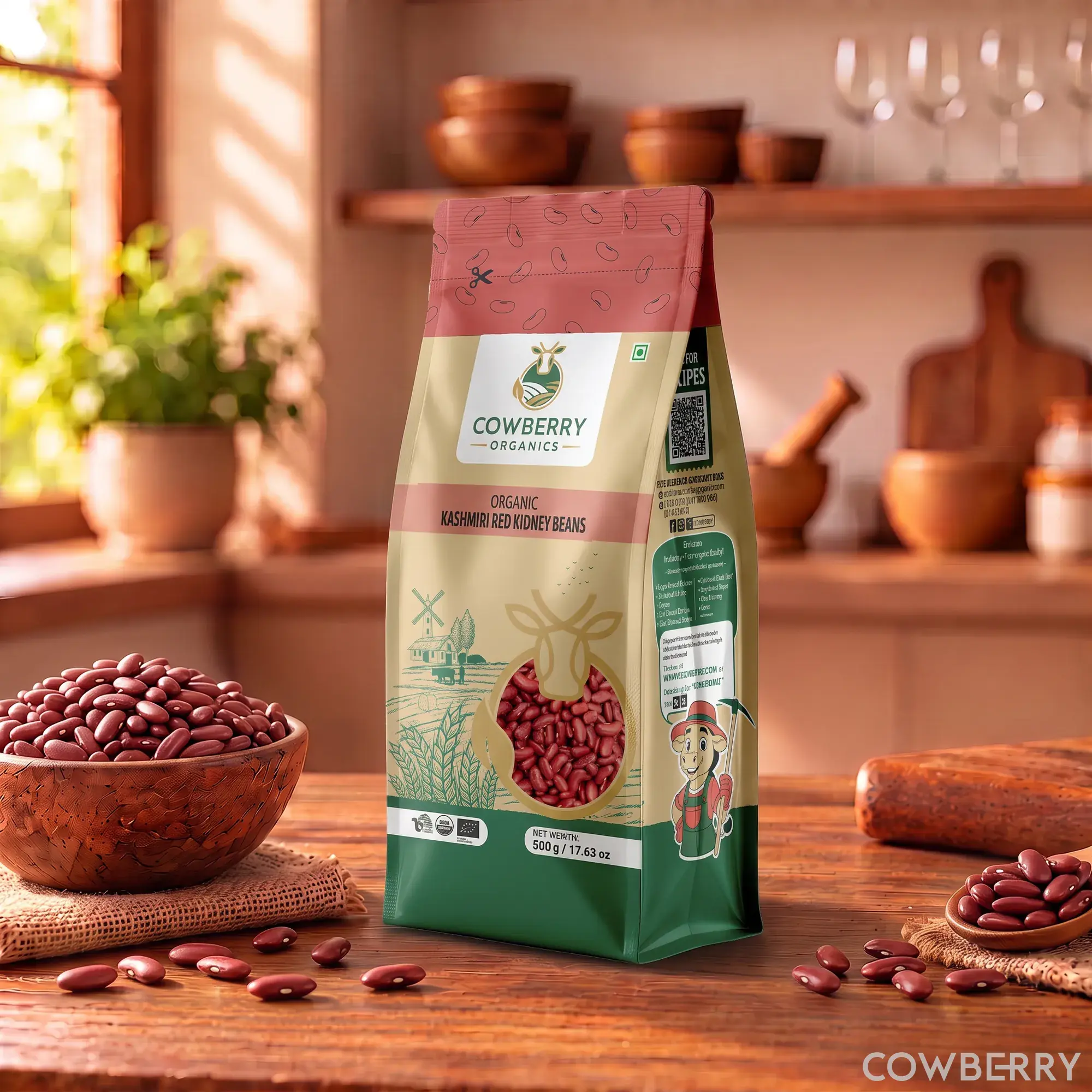
Shop this article
Keep reading
Green gram plant: crop, varieties and how it grows in India
Rajma vs lobia: difference, nutrition and which to choose
Rajma plant: how rajma is grown in India (it is not a tree)