by COWBERRY

7 minute read
Kidney beans in Hindi: rajma names in Indian languages

Kidney beans in Hindi is rajmah; kidney beans in English are the red kidney bean, botanical name Phaseolus vulgaris. Urdu says rajma, Punjabi lal rajmah, Gujarati phansi (lal) and Tamil karamani payir, with every language below and the rajma beans guide for the bean itself.
Kidney beans in Hindi and 10 Indian languages: quick answer
One line per language: Hindi rajmah; Punjabi lal rajmah; Urdu rajma; Marathi shravangheveda; Gujarati phansi (lal); Bengali barbati beej; Assamese rajmah; Kannada thugare bele; Telugu barigalu; Tamil karamani payir; Malayalam rajmah; Sanskrit makussttaka. In English the bean is the red kidney bean, and the botanical name is Phaseolus vulgaris. Odia is the one language IFCT 2017 leaves blank. Every name in the table traces to the local-names list IFCT 2017 gives for rajma, and a dash means IFCT 2017 records no name for that language.
| Language | Name (romanised) |
|---|---|
| English | Rajmah, red |
| Hindi | Rajmah |
| Marathi | Shravangheveda |
| Gujarati | Phansi (lal) |
| Punjabi | Lal rajmah |
| Bengali | Barbati beej |
| Odia | — |
| Assamese | Rajmah |
| Kannada | Thugare bele |
| Telugu | Barigalu |
| Tamil | Karamani Payir |
| Malayalam | Rajmah |
| Urdu | Rajma |
| Sanskrit | Makussttaka |
| Botanical name | Phaseolus vulgaris |
Source: IFCT 2017 (ICMR-NIN) local-names list. — means no name recorded in the source.
Rajma in English and the scientific name
Rajma in English is the kidney bean, more precisely the red kidney bean; IFCT 2017 lists the food itself as rajma (red kidney beans), and its English heading as 'Rajmah, red'. The botanical name is Phaseolus vulgaris, the common bean species that also covers many other beans, which is why the precise pairing matters: kidney bean is the shape and colour of this variety, not the whole species. The name kidney bean is visual, not medical: the bean is dark red and roughly kidney-shaped, and that shape is the source of the English name; nothing about it points to the organ.
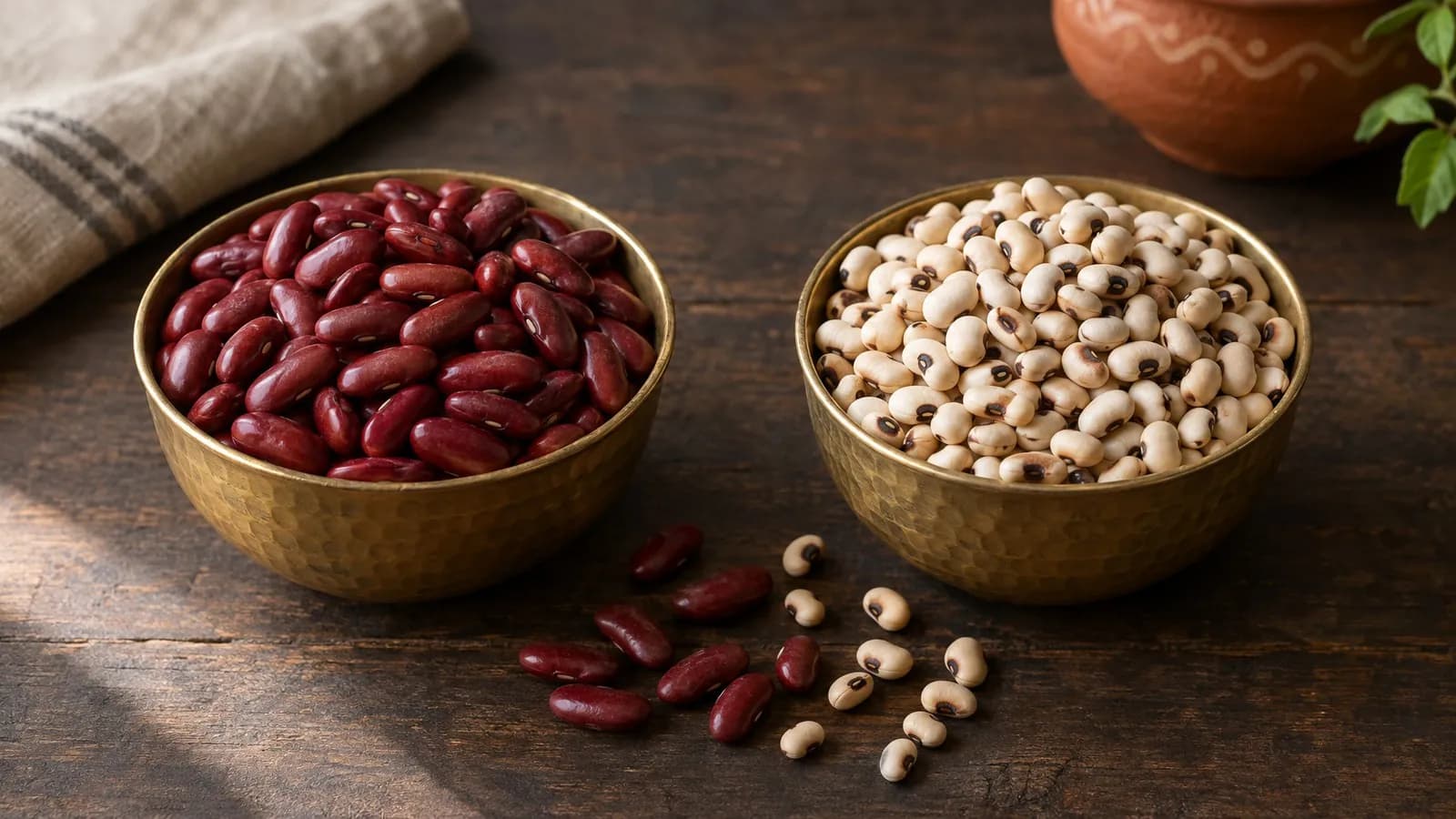
Rajma is also not the cowpea: lobia, the white cowpea, is a different species (Vigna catjang) with its own names, and the two are compared on rajma vs lobia. For rajma itself, the Hindi word is the one the rest of the country borrows, and the next section runs through the regional names one region at a time.
Rajma names by region
North India: rajma in Hindi, Punjabi and Urdu
In Hindi the bean is rajmah, the name IFCT 2017 lists. Punjabi adds the colour: lal rajmah, the red rajma. Urdu keeps the simpler rajma. All three are the same bean, and rajma chawal is the classic North Indian dish made with it.
West India: rajma in Marathi and Gujarati
Rajma in Gujarati is phansi (lal), with the 'lal' marking the red variety, and the IFCT name is the one to use on a shopping list in Gujarat. In Marathi the name is shravangheveda, the bean's other western name. Both are the IFCT 2017 names for the same red kidney bean.
East India: rajma in Bengali and Assamese
In Bengali the name is barbati beej, literally the barbati seed, and Assamese keeps rajmah. IFCT 2017 records no Odia name for rajma, so rajma itself is the name to use in Odisha. The Bengali name is worth a note, below, because plain barbati is the Bengali name of a different bean in IFCT 2017.
South India: rajma in Kannada, Telugu, Tamil and Malayalam
Rajma in Tamil is karamani payir; in Kannada it is thugare bele, in Telugu barigalu and in Malayalam rajmah. The South Indian names overlap with other dals, so the next section sorts out which name belongs to which bean before you shop.
Often confused: rajma names shared with other dals
Three of the rajma names also belong, in IFCT 2017, to other dals, and mixing them up means buying the wrong bag.
- Kannada thugare bele. IFCT 2017 lists thugare bele as the Kannada name of rajma, but the same two words are the Kannada name of pigeon pea, the toor or arhar dal. In Karnataka, ask for rajma by name or check the beans are red and kidney-shaped before buying.
- Tamil karamani payir. IFCT 2017 lists karamani payir for rajma and plain karamani for the cowpea (lobia). The 'payir' on the end is the difference, and the beans in the packet settle it: rajma is dark red, cowpeas are pale.
- Bengali barbati beej. IFCT 2017 lists barbati beej for rajma and barbati alone for the cowpea. Again the rajma name carries the extra word, beej, the seed.
The pattern is the point: the rajma entry in IFCT 2017 shares its South and East Indian names with other dals, which is why the safest name anywhere in India is rajma itself. And to settle the other common confusion: rajma and kidney bean are not two different things, the difference between rajma and kidney beans is language, not botany, and the Hindi name is simply the one Indian kitchens use. The genuinely different bean is the cowpea, compared in full on rajma vs lobia, and the bean's varieties are on types of rajma.
Where rajma fits: the Hindi kitchen and the COWBERRY pack
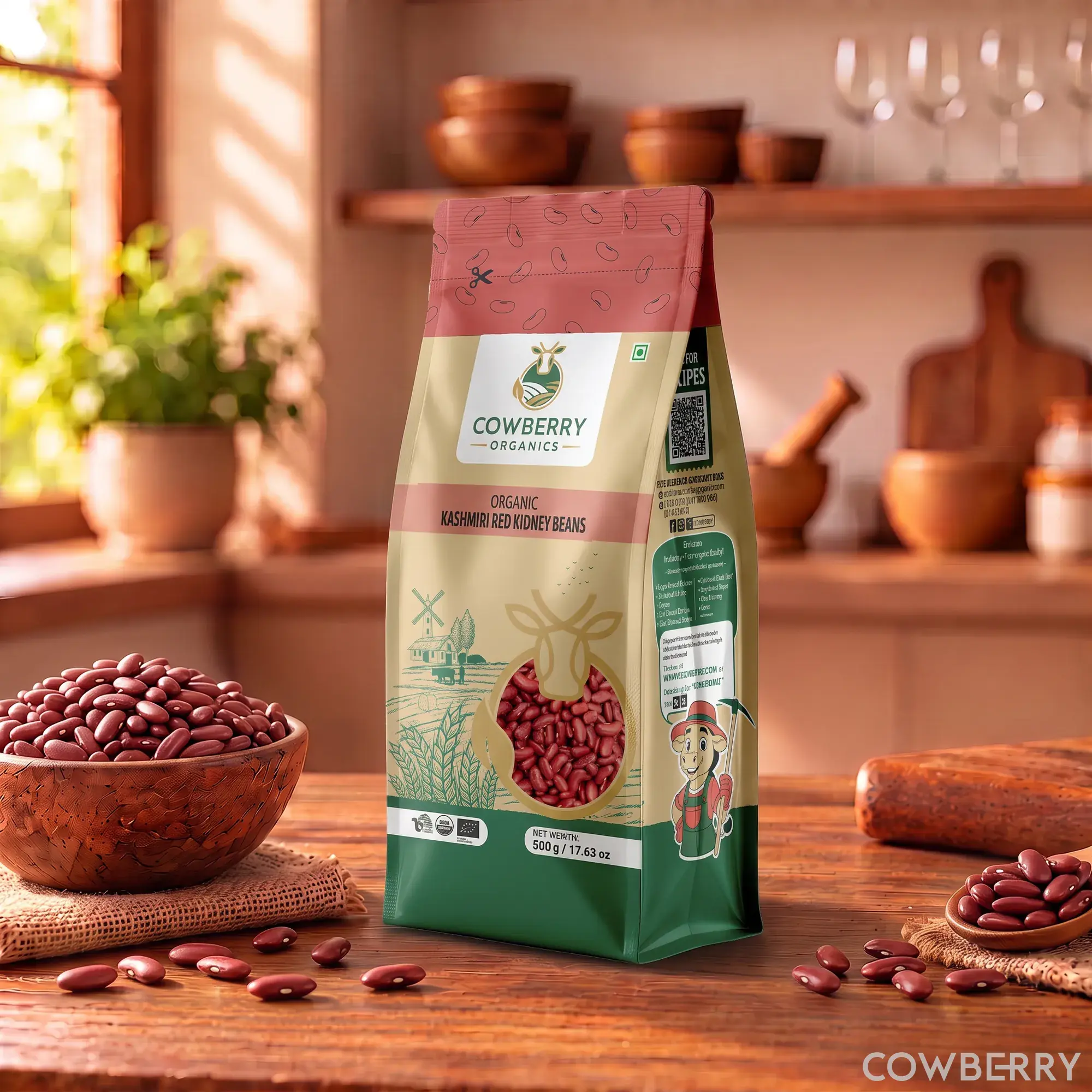
Rajma belongs to the North Indian plate: soaked overnight, pressure-cooked soft and simmered in an onion-tomato masala for rajma chawal, with more uses in the rajma recipes roundup. COWBERRY's rajma is the Kashmiri kind: organic Kashmiri red kidney beans grown in the mountain regions of Himachal Pradesh and Jammu, picked by hand, unpolished and harvested at full maturity, and the pack notes the bean is believed to have originated from Central and South America and is now grown widely in Kashmir. The numbers behind the bean, protein and all, are under rajma nutrition per 100 g, and the full picture of the bean, cooking and storage included, starts at the rajma beans guide.
FAQs
Is kidney beans and rajma same?
Yes. Rajma is the Hindi name for the kidney bean, specifically the red kidney bean, Phaseolus vulgaris, and both words describe one bean. IFCT 2017 lists the food as rajma (red kidney beans) with the Hindi name rajmah. Any pack labelled rajma or kidney beans is the same bean, so the two are the same in everything but the language on the label.
Why kidney beans are called kidney beans?
For the shape and colour: the bean is deep red and roughly kidney-shaped, and the English name simply describes what the bean looks like, with nothing to do with the organ of the same name. The Hindi name rajma carries no such description. In English the full name is usually red kidney bean, matching the colour of the beans on the plate.
Difference between rajma and kidney beans?
There is none: rajma is the Hindi name for kidney beans, the same red kidney bean, Phaseolus vulgaris. IFCT 2017 lists the Hindi name rajmah, and the English heading 'Rajmah, red'. A different bean entirely is lobia, the white cowpea (Vigna catjang), which has its own Hindi name and its own dishes; the two are compared on rajma vs lobia.
What is rajma?
Rajma is the red kidney bean, botanically Phaseolus vulgaris, the deep-red bean that is soaked overnight and pressure-cooked for rajma chawal and rajma curry. In Hindi the bean is rajmah, and IFCT 2017 lists it under the food name rajma (red kidney beans). Its nutrition is under rajma nutrition per 100 g, and cooking starts at how to cook rajma.
Is kidney beans good for kidneys?
The name is about shape, not the organ: kidney beans are called that because the bean looks like a kidney, and no special link between eating rajma and kidney health exists beyond it being an ordinary food in the diet. Anyone with kidney disease should follow their doctor's advice on pulses, as on everything else, rather than reading anything into the name.
Does rajma have protein?
Yes, rajma is a protein-rich pulse: IFCT 2017 lists 19.9 g of protein per 100 g of dry rajma, along with 16.6 g of fibre and 300 kcal. The guidelines for Indian diets point out that pulses are richer in lysine than cereals, so a cereal-and-pulse meal such as rajma chawal is the classic Indian way to bring the two together. The full numbers are on rajma nutrition per 100 g.
References
Shop this article
Keep reading
Green gram plant: crop, varieties and how it grows in India
Rajma vs lobia: difference, nutrition and which to choose
Rajma plant: how rajma is grown in India (it is not a tree)