by COWBERRY

10 minute read
10 benefits of rajma (kidney beans) and its side effects

Rajma benefits come from what is in the bean: 19.9 g protein, 16.6 g fibre, 6.1 mg iron and 316 mcg folate per 100 g raw, with little fat and a low glycemic index of 45. Here are ten benefits of eating rajma, each with its number, then the side effects and a sensible daily portion. New to the bean? Start with rajma in English and its types.
Rajma beans benefits: protein, fibre and slow carbohydrate
Each benefit below rests on a number printed in IFCT 2017 for raw red rajmah, or on what a named review or guideline says about pulses. A serving on this page means rajma masala cooked from 50 g of dry beans, the amount on one plate of rajma chawal.
1. Plant protein in every serving
Rajma has 19.9 g protein per 100 g, so a serving gives about 10 g. Kidney beans are on the list of protein-rich pulses in the Dietary Guidelines for Indians. The guidelines also explain that pulses run low in methionine and cereals in lysine, so a plate that has both rajma and rice, or rajma and roti, covers the gap in each.
2. A high-fibre food
With 16.6 g fibre per 100 g, a serving of rajma carries 8.3 g. By the same guidelines' account, dietary fibre slows how quickly carbohydrates and fats are absorbed, keeps you satisfied for longer after a meal and gives the stool more bulk.
3. Carbohydrate with a low glycemic index
Rajma has 48.6 g carbohydrate per 100 g and a glycemic index of 45, which is in the low range. A 2014 review of pulses describes them as high in fibre and low in glycemic index, and says this assists in maintaining healthy blood glucose and insulin levels (Mudryj et al.). Portion size still counts for anyone with diabetes; talk to your doctor or dietitian.
4. Very little fat
Dry rajma has 1.8 g fat per 100 g, which is under one gram in a serving. Whatever fat a plate of rajma masala carries comes from the ghee or oil in the tadka, and that puts the amount in the cook's hands.
Benefits of eating rajma for iron, folate and minerals
5. Iron
Rajma has 6.1 mg iron per 100 g, or 3.1 mg in a serving. Iron is needed to make haemoglobin. The Dietary Guidelines for Indians count beans among the good sources of iron, and add that plant iron is taken up better when a vitamin C-rich food, such as lemon or a green chutney of coriander and chillies, is eaten in the same meal. Squeeze lemon over the rajma or put that chutney on the plate.
6. Folate
At 316 mcg folate per 100 g, a serving of rajma has 158 mcg. The guidelines name legumes among the good sources of folate, a B vitamin the body needs to make red blood cells, and one that is required in larger amounts during pregnancy.
7. Potassium with very little sodium
Rajma carries 1324 mg potassium and only 10.5 mg sodium per 100 g. A serving has 662 mg potassium, about 17% of the 3800 mg a day that the guidelines give as the potassium requirement at the recommended salt intake. They list beans among the good sources of potassium and say sodium intake needs to be balanced with potassium intake. Salt the gravy lightly and that balance stays in your favour.
8. Magnesium, calcium and zinc
Per 100 g, rajma has 173 mg magnesium, 126 mg calcium and 2.7 mg zinc. The 2014 review of pulses names iron, zinc, folate and magnesium among the vitamins and minerals that pulses supply in significant amounts, and reports that a daily half cup of beans or peas can improve diet quality by raising the intake of these nutrients.
Red rajma benefits: heart markers and fullness
9. Pulses and heart markers
No study in our source list tests rajma by itself for heart health, so this benefit rests on pulses as a group. The 2014 review reports that eating pulses improves serum lipid profiles and has a positive effect on other cardiovascular risk factors such as blood pressure, platelet activity and inflammation. Its authors add that long-term randomised controlled trials are still needed to show direct effects on disease. Rajma's own contribution is its 16.6 g fibre, 1324 mg potassium and 1.8 g fat per 100 g.
10. A filling plate
Protein and fibre together make rajma a slow, filling food. The Dietary Guidelines for Indians say fibre-rich foods such as pulses improve satiety, and in their advice on managing weight they suggest including legumes such as beans and lentils, which give sustained energy and help you feel full. A serving of rajma is 150 kcal before the tadka, so the rice portion and the ghee decide how heavy the plate turns out.
Most of these benefits are shared with chana, lobia and the dals. The guidelines ask for variety, because different pulses have different nutrient profiles, so count rajma as one good bean in the rotation and not as a food that does everything.
Rajma benefits and side effects: who should limit it
Rajma side effects come mostly from how the bean is cooked and how much is eaten. A few people need to limit it for medical reasons.
Raw or half-cooked rajma
This is the side effect to take seriously. A 2013 review of the clinical complications of eating kidney beans divides them into toxicity, caused by the bean's lectins, saponins, phytates and protease inhibitors, and allergy, caused by its allergenic proteins (Kumar et al.). A 2018 systematic review of kidney bean lectins adds that lectins can cause intestinal disorders (He et al.). The Dietary Guidelines for Indians state that anti-nutritional factors in pulses are destroyed by boiling and pressure cooking. So soak the beans overnight, drain them, and boil or pressure cook them until soft to the centre before any slow simmering. Never eat it raw, as raw sprouts or while still crunchy.
Gas and bloating
Beans can cause gas in some people. The full cooking described above also helps here, since the same guidelines add that boiling and pressure cooking make pulses more digestible. Soak, throw away the soaking water and cook the beans very soft, then begin with half a katori and build up slowly.
Allergy
Kidney bean allergy is recorded in India. In a study of 355 Indian patients with a history of legume allergy, kidney bean showed sensitisation in 78 of them (22%), ahead of chickpea and peanut, and cross-reacted with peanut, black gram and pigeon pea (Kasera et al., 2011). The authors describe these legumes as major allergic triggers in asthma and rhinitis patients. Anyone who reacts to one of them should be careful with the others and take medical advice.
Kidney disease and restricted diets
Rajma's 1324 mg potassium per 100 g is useful for most people and a number to count for anyone told to restrict potassium or protein. In that case the decision is not one for the kitchen: talk to your doctor or dietitian.
How much rajma to eat in a day
The Dietary Guidelines for Indians plan for 85 g of pulses a day, raw weight, in a 2000-calorie vegetarian plate, and note that pulses can be fewer on days when fish or meat is eaten. A serving of rajma cooked from 50 g of dry beans uses a little over half of that, which leaves room for a bowl of dal at the other meal.
One serving at lunch or dinner is a sensible helping for an adult. The 2014 review of pulses, quoted under benefit 8, also speaks of a daily half cup of beans or peas.
- New to rajma: begin with half a katori and see how your stomach takes it.
- On rajma chawal days: keep the rice to a katori or so and let the beans be the larger share of the plate.
- Through the week: rotate rajma with chana, lobia, moong and the dals. It does not need to be a daily food.
- On a medical diet: the portion is for your doctor or dietitian to set.
Which rajma is good for health
Any rajma that is whole, unpolished and cooked properly. The food composition tables print one set of values for red rajmah. Kashmiri and chitra are market names that the tables do not separate, so no printed figure says one of them is more nutritious than another.
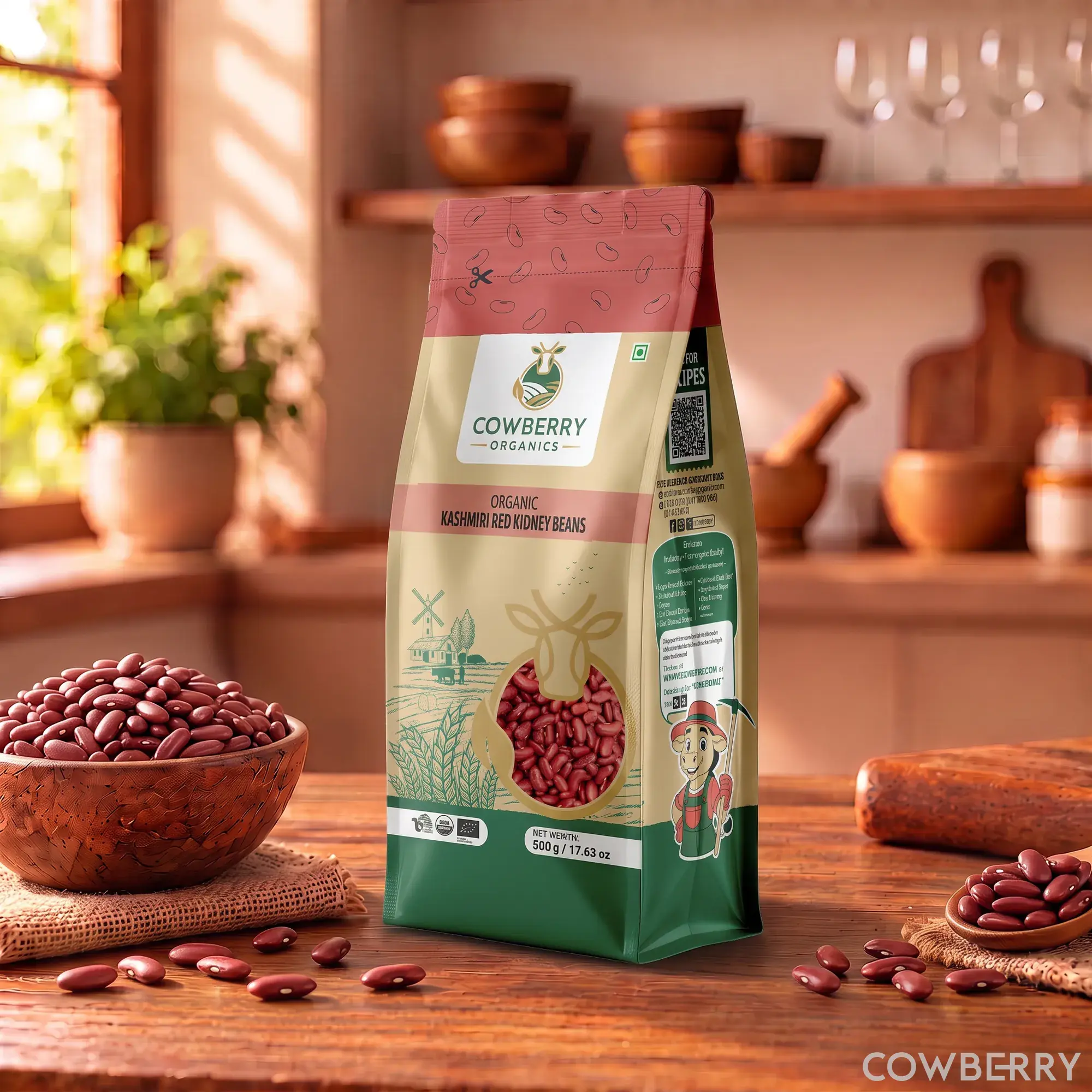
What sets the types apart is size and colour. COWBERRY's small Kashmiri rajma cooks soft while holding its shape, with a creamy bite; whichever type you pick, cook it all the way through. The types of rajma guide sorts them by look and matches them to dishes.
Three things matter more than the variety:
- The bean: whole, unpolished and of one size, so that the pot cooks evenly.
- The cooking: a full overnight soak and a thorough boil or pressure cook.
- The masala: the ghee, oil and salt in the gravy change the plate far more than the variety of bean does.
How to eat rajma
- Rajma chawal: the familiar plate, and a sound one, since beans and rice together give better protein quality than either alone. Our rajma chawal recipe uses 50 g of dry rajma per person.
- With roti or bhakri: cook the gravy a little thicker so that it can be scooped up. A jowar or bajra bhakri works as well as a wheat roti.
- As a salad or chaat: toss fully boiled, cooled rajma with onion, tomato, green chilli, coriander and plenty of lemon. The lemon brings vitamin C to the same plate as the iron.
- In soup: simmer boiled rajma with vegetables and mash a ladleful into the broth for body.
- Leftovers: mash leftover rajma, kept in the fridge, with boiled potato for a tikki, or use it as a paratha filling.
Whichever way you serve it, cook the beans soft before tomato or amchur goes in. The per-katori and per-serving figures and the comparison with chana are on the rajma protein per 100g page.
FAQs
Is rajma a good source of protein?
Yes. 100 g of raw rajma holds 19.9 g protein, and a serving (50 g dry weight) about 10 g. The Dietary Guidelines for Indians place kidney beans with the pulses that are rich in protein. Pair the beans with rice or roti, because the guidelines rate a meal of pulses plus grains above either one eaten alone for protein quality.
Can kidney beans cause gas?
Yes, they can, as many beans do. Start with half a katori and build up slowly. Soak the beans overnight, throw that water away and cook them until they mash easily; soaking is one of the household steps the ICMR-NIN guidelines give for making legumes easier to digest.
Is rajma good for kidney?
The kidney bean is named for its shape and has no special action on the kidneys. A healthy person can eat it like any other pulse. People with kidney disease are often asked to watch potassium and protein, and rajma has 1324 mg potassium and 19.9 g protein per 100 g raw, so the decision belongs with your doctor or dietitian.
Can we eat rajma daily?
You can, one serving at a time, if your digestion is comfortable with it. The Dietary Guidelines for Indians plan for 85 g of raw pulses a day and ask for variety, because different pulses have different nutrient profiles. Rotating rajma with chana, lobia and the dals is a better habit than eating one bean every day.
Is rajma good for weight loss?
Rajma can fit a weight-loss plate. A serving has 150 kcal, 10 g protein and 8.3 g fibre, and the Dietary Guidelines for Indians say fibre-rich foods such as pulses improve satiety. The rice and ghee served with it decide the total, so measure those. Where a health problem shapes the diet, talk to your doctor or dietitian.
Is rajma good for diabetes?
Rajma has a low glycemic index of 45 and 16.6 g fibre per 100 g, and a 2014 review describes pulses as assisting in maintaining healthy blood glucose and insulin levels. The rice eaten with it adds to the carbohydrate on the plate, so keep that helping small. The right helping differs from person to person, so talk to your doctor or dietitian.
References
- Indian Food Composition Tables (IFCT) 2017, ICMR-National Institute of Nutrition
- Dietary Guidelines for Indians, ICMR-National Institute of Nutrition
- University of Sydney glycemic index database (GI search)
- Mudryj AN, Yu N, Aukema HM. Nutritional and health benefits of pulses. Appl Physiol Nutr Metab, 2014
- Kumar S, Verma AK et al. Clinical complications of kidney bean (Phaseolus vulgaris L.) consumption. Nutrition, 2013
- He S, Simpson BK et al. Phaseolus vulgaris lectins: a systematic review of characteristics and health implications. Crit Rev Food Sci Nutr, 2018
- Kasera R, Singh BP, Lavasa S et al. Kidney bean: a major sensitizer among legumes in asthma and rhinitis patients from India. PLoS One, 2011
Shop this article
Keep reading
Green gram plant: crop, varieties and how it grows in India
Rajma vs lobia: difference, nutrition and which to choose
Rajma plant: how rajma is grown in India (it is not a tree)