by COWBERRY

8 minute read
Ragi in Hindi, English, Marathi, Kannada, Tamil and other languages

Ragi in Hindi is ragi, also mandua or mandika; ragi in English is finger millet, botanical name Eleusine coracana. Other languages have their own words: nachni in Marathi, nagli or bavato in Gujarati, kelvaragu in Tamil and mandia in Odia. Every name is below with its source; the grain itself is covered on the ragi hub page.
Ragi in Hindi, English and 12 Indian languages: quick answer
One line per language: Hindi ragi (mandua, mandika); Marathi nachni or nagli; Gujarati bavato or nagli; Punjabi mandal or mandhuka; Bengali ragi or marwa; Odia mandia; Assamese ragi; Kannada ragi; Telugu ragi or ragulu; Tamil kelvaragu or keppai; Malayalam moothari or panjapulle; Urdu mandwa; Sanskrit madhulika. In English it is finger millet, and the botanical name is Eleusine coracana.
Every row of the table traces to IFCT 2017's local-names list for food code A010, and the languages run in the order used on every COWBERRY grain page. When the vernacular lists of the ICAR-Indian Institute of Millets Research (ICAR-IIMR) give another name, the table adds it, and a footnote says where each name came from. The one swap is Marathi: IFCT prints 'Bakri', while both ICAR-IIMR lists give nachni (the web page adds nagli), so the table shows nachni. Every name is written in Latin letters, spelt as its source prints it.
| Language | Name (romanised) |
|---|---|
| English | Ragi |
| Hindi | Ragi, Mandua, Mandika |
| Marathi | Nachni |
| Gujarati | Bavato, Nagli |
| Punjabi | Mandal, Mandhuka |
| Bengali | Ragi, Marwa |
| Odia | Mandia |
| Assamese | Ragi |
| Kannada | Ragi |
| Telugu | Ragi, Ragulu |
| Tamil | Kelvaragu, Keppai |
| Malayalam | Panjapulle, Moothari |
| Urdu | Mandwa |
| Sanskrit | Madhulika |
| Botanical name | Eleusine coracana |
Source: IFCT 2017 (ICMR-NIN) local-names list. — means no name recorded in the source.
Hindi ‘Mandua’: ICAR-Indian Institute of Millets Research, Nutritional and health benefits of millets (PDF), vernacular names table. Hindi ‘Mandika’: ICAR-Indian Institute of Millets Research, millets information page (vernacular names). Marathi: IFCT 2017 prints ‘Bakri’; ‘Nachni’ per ICAR-Indian Institute of Millets Research, millets information page (vernacular names). Gujarati ‘Nagli’: ICAR-Indian Institute of Millets Research, millets information page (vernacular names). Punjabi ‘Mandhuka’: ICAR-Indian Institute of Millets Research, millets information page (vernacular names). Bengali ‘Marwa’: ICAR-Indian Institute of Millets Research, millets information page (vernacular names). Telugu ‘Ragulu’: ICAR-Indian Institute of Millets Research, Nutritional and health benefits of millets (PDF), vernacular names table. Tamil ‘Keppai’: ICAR-Indian Institute of Millets Research, millets information page (vernacular names). Malayalam ‘Moothari’: ICAR-Indian Institute of Millets Research, Nutritional and health benefits of millets (PDF), vernacular names table.
Ragi in English and the finger millet scientific name
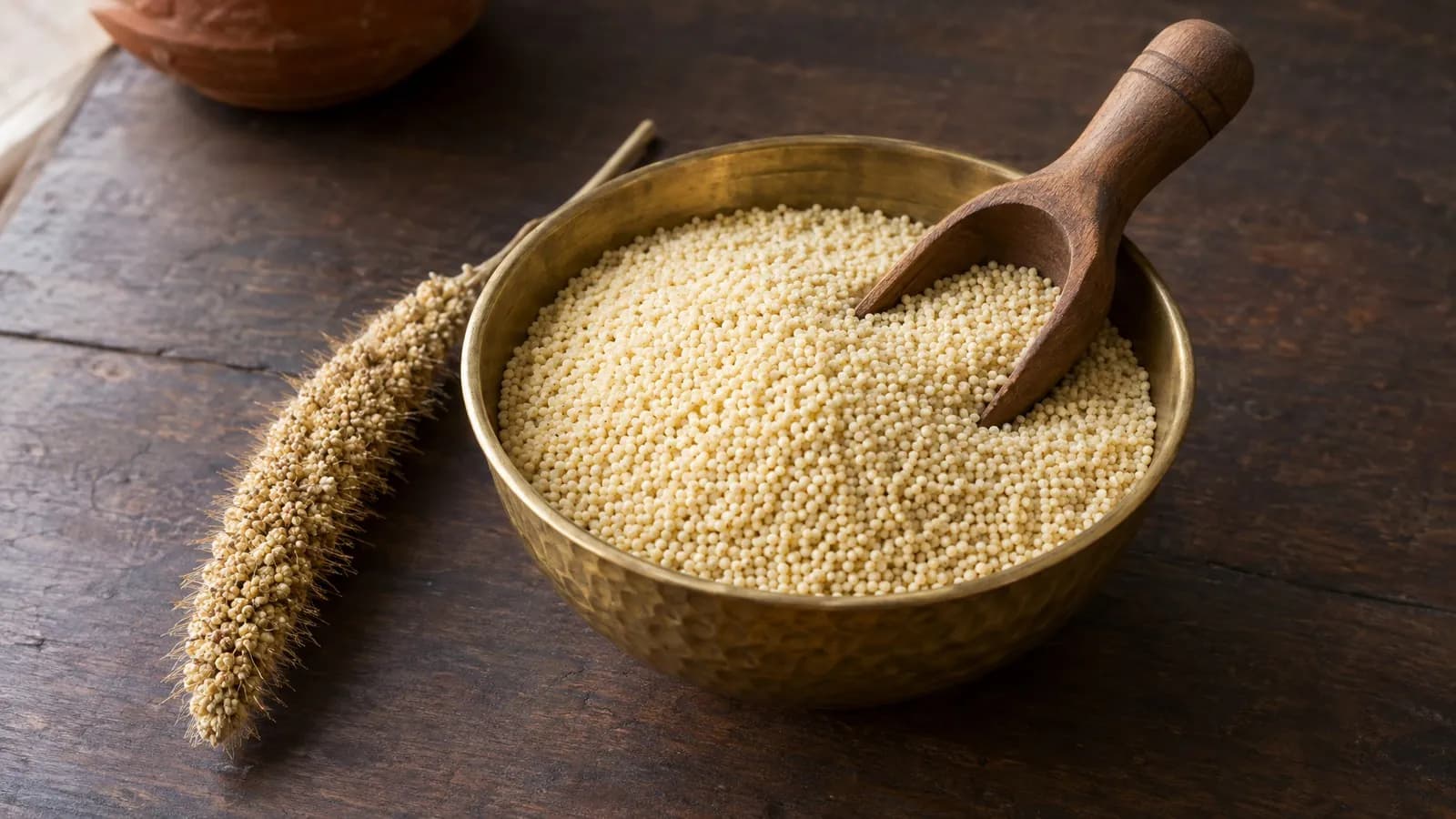
Ragi in English is finger millet. The name comes from the seed head: ICAR-IIMR describes 4 to 19 finger-like spikes that together resemble a fist when mature, each spike carrying many tiny seeds. The same review calls finger millet a staple food in many African and South Asian countries. Many Indian packs print 'ragi' in English text as well.
The finger millet scientific name is Eleusine coracana; ICAR-IIMR describes the plant as a cereal grass grown mostly for its grain. IFCT 2017 lists it under food code A010 as 'Ragi', so ragi and finger millet are one grain, not two. Nachni in English is also finger millet, because nachni is only the Marathi name for the same seed. The Sanskrit name IFCT records is madhulika; the ICAR-IIMR vernacular table adds nandimukhi and madhuli.
Whatever the pack says, ragi flour, ragi atta, nachni atta, mandua atta and finger millet flour are the same milled grain. The word on the label reflects a language, not a different grain: ragi is the Kannada and Telugu name and one of the Hindi ones, nachni the Marathi name and mandua another Hindi name.
Ragi names by region
North India: ragi in Hindi, Punjabi and Urdu
In Hindi the grain is ragi, the name IFCT 2017 prints. The ICAR-IIMR PDF table gives mandua, and the institute's web list adds mandika and marwah, so finger millet in Hindi is ragi or mandua, with two more names on record. Punjabi has mandal (IFCT) or mandhuka and mandhal (ICAR-IIMR), and Urdu has mandwa (IFCT).
West India: nachni in Marathi, nagli and bavato in Gujarati
The Marathi name is nachni in both ICAR-IIMR lists, and nachni in English is finger millet. The institute's web page also gives nagli for Marathi, and both of its lists give nagli for Gujarati. Ragi meaning in Gujarati is nagli or bavato; the ICAR-IIMR list spells the second name bavto, and IFCT spells it bavato.
East India: marwa in Bengali, mandia in Odia
The IFCT list gives ragi for Bengali, but the ICAR-IIMR page records marwa and the institute's PDF table gives mandua. In Odia the grain is mandia, the name IFCT 2017 and the ICAR-IIMR list share. In Assamese IFCT records ragi.
South India: ragi in Kannada and Telugu, kelvaragu in Tamil, moothari in Malayalam
In Kannada the grain is ragi, the word in ragi mudde. In Telugu it is also ragi, with ragulu (ICAR-IIMR PDF) and ragi chodi (ICAR-IIMR web list) also recorded. In Tamil the grain is kelvaragu, the name IFCT 2017 and both ICAR-IIMR lists print; the web list adds keppai and ragi. Malayalam has moothari in the ICAR-IIMR table, while IFCT records panjapulle.
Often confused with: ragi vs bajra, jowar, rajgira and nachni
Five names get mixed up with ragi in shops and in searches.
- Bajra (pearl millet): a much bigger grey-green pearl of a grain; sajje in Kannada, kambu in Tamil, sajja in Telugu. The difference between pearl millet and finger millet is plain to the eye: bajra grains are large and grey, ragi grains are tiny and red-brown.
- Jowar (sorghum): round, cream-coloured and larger than ragi; jola in Kannada, cholam in Tamil, jonna in Telugu. Jowar flour makes a pale roti, ragi flour a dark one.
- Rajgira (amaranth): the name sounds alike and both are tiny seeds, but IFCT 2017 describes amaranth seed as pale brown, and amaranth is not among the millets ICAR-IIMR lists.
- Nachni: not a different grain. Nachni is ragi in Marathi, so nachni atta and ragi atta are the same flour.
- Kodo (varagu): kodo millet, varagu in Tamil and harka in Kannada, is a separate small millet sold on the same shelf.
For the numbers behind these grains, see ragi nutritional value per 100 g, which sets ragi beside wheat and rice; the hub page on ragi covers its benefits, cooking and storage.
Where ragi grows in India
Ragi is a crop of dry, rain-fed land. In ICAR-IIMR's account, finger millet is one of the small millets found across most of India's southern and central states, above all where annual rainfall is under 350 mm and few other cereals can cope with the moisture stress. Its review lists Tamil Nadu and Gujarat among the states where finger millet is a primary crop and Telangana among those where it is minor, and says the grain is still one of the main ingredients of the staple diet in Karnataka.
The plant is a robust annual grass up to 170 cm high, and ICAR-IIMR calls finger millet a helpful famine crop because the grain is easily stored for lean years. COWBERRY's finger millet is grown in Karnataka and the Western Ghats and hand-harvested at full maturity, then sold whole as organic finger millet or stone-ground as ragi flour. Cook it the Karnataka way as ragi mudde, or start with an instant ragi dosa; the ragi recipes roundup has the rest.
FAQs
What is ragi?
Ragi is finger millet (Eleusine coracana), a tiny red-brown millet cooked as mudde, roti, dosa and porridge. It is naturally gluten-free and gives 364 mg calcium per 100 g (IFCT 2017), and ICAR-IIMR names finger millet the cereal with the highest calcium content. Its benefits and side effects are covered under ragi benefits.
What is ragi called in English?
Finger millet. The English name describes the seed head, whose finger-like spikes look like a fist once the head is mature, as ICAR-IIMR describes it. Indian packs often keep the word ragi even in English text, so both are correct. The scientific name is Eleusine coracana, and IFCT 2017 lists the grain as ragi under food code A010.
Is ragi a grain?
Yes. Ragi is the seed of a cereal grass, so it is a grain in the same sense as wheat or rice. It is classed as a millet: the ICAR-IIMR review names eight millet species that India commonly grows under rain-fed conditions, finger millet among them, along with jowar, bajra, kodo and little millet. It is not a pulse or an oilseed.
Are nachni and ragi the same?
Yes. Nachni is the Marathi name for ragi, so nachni atta and ragi atta are one flour. Gujarati has nagli or bavato, Tamil kelvaragu, Odia mandia and Hindi mandua for the same grain. IFCT 2017 prints a different Marathi word, bakri, but both ICAR-IIMR lists give nachni, and that is the name this page's table uses.
What is the difference between pearl millet and finger millet?
Pearl millet is bajra and finger millet is ragi, two different millets. Bajra is a large grey-green grain that ICAR-IIMR describes as a primary crop in the desert regions of Rajasthan; ragi is a tiny red-brown grain that the institute counts among the small millets, cooked as mudde, roti, dosa and porridge. Ragi's point of difference is calcium: 364 mg per 100 g in IFCT 2017.
Is ragi gluten free?
Yes. Ragi contains no gluten, so its dough is made with hot water and each roti is shaped by hand rather than rolled with a pin. It suits coeliac disease and gluten sensitivity, though coeliacs should still look for a cross-contamination note on the pack. How to use it in a gluten-free kitchen is on is ragi gluten free.
References
Shop this article
Keep reading
Foxtail millet vs quinoa: nutrition, taste and which to choose
Foxtail millet in Kannada, Hindi, Tamil and other Indian names
10 benefits of kangni (foxtail millet) and its side effects