by COWBERRY

6 minute read
Jaggery for Babies: Is It Safe Under One Year Old?

Jaggery for babies is an added sugar, and India's dietary guidelines say children under two should have none. This page walks through what jaggery is, why the NHS, WHO and ICMR guidance all point the same way, the 6-month and 1-year questions parents ask, and what to offer instead.
Short answer: is jaggery safe for babies?
No. ICMR's Dietary Guidelines for Indians put it in one line: no added sugar for children under 2 years old, and jaggery is on its list of added sugars, right beside table sugar and honey. For a baby under one, nothing sweetened belongs in the bowl. For a child between one and two, the same rule still applies, and the NHS adds that a baby simply does not need sugar or sweeteners. After the second birthday, ICMR's under-2 rule ends, but the NHS still advises no sugar in food or drink up to age four, and jaggery is never a health step for a small child.
What the numbers say about jaggery
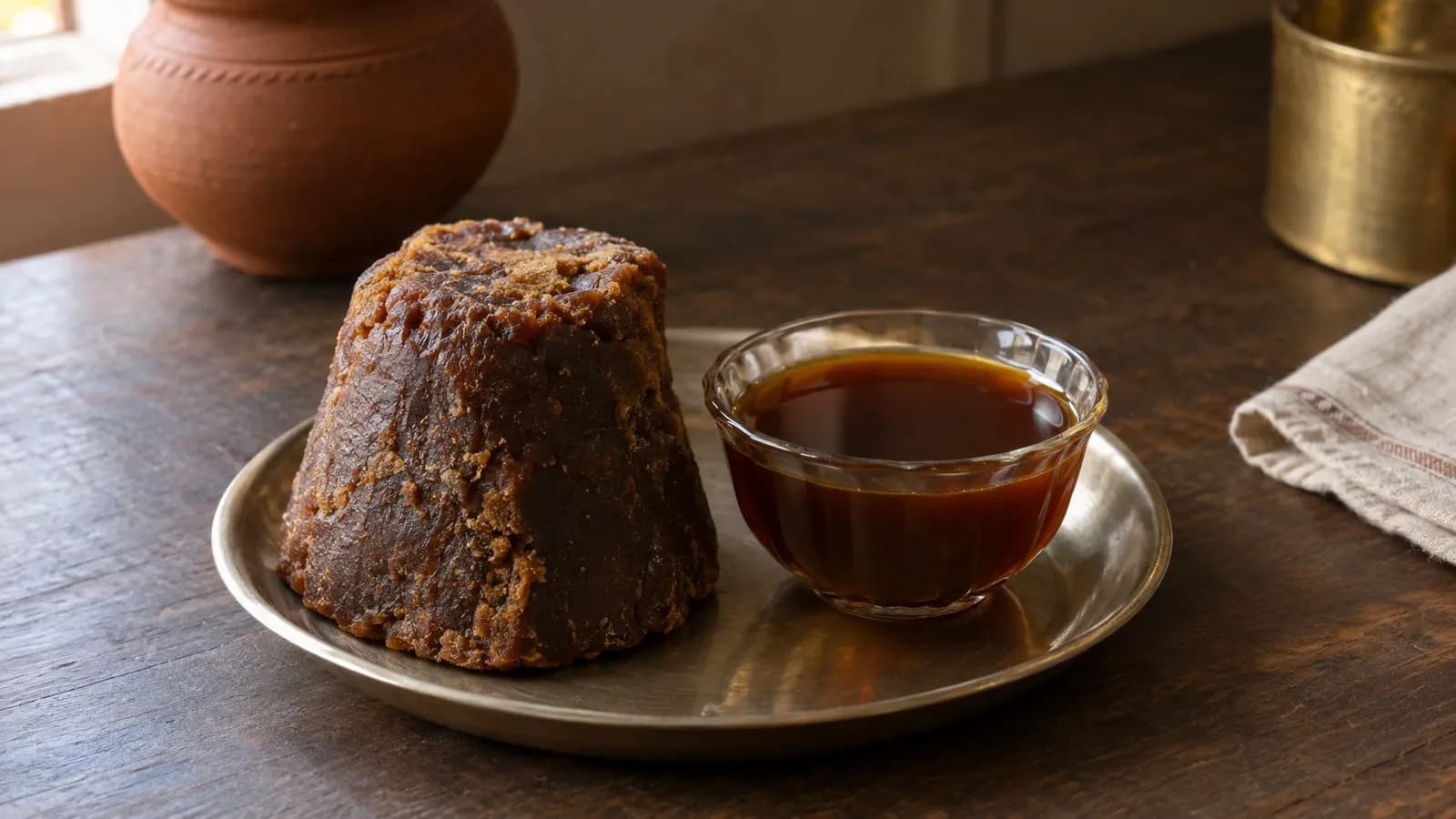
Jaggery is concentrated cane juice: per 100 g it carries 354 kcal, 84.87 g of carbohydrates and 4.63 mg of iron (IFCT 2017), and the table below shows the full values. The iron is what people usually point to, so measure it on a real spoon: a level 5 g teaspoon of jaggery brings about 18 kcal, 4.2 g of carbohydrates and 0.23 mg of iron. That is a sugar snack with a trace of iron, not an iron food, and complementary foods for a baby are meant to be nutrient-dense. The fuller jaggery nutrition comparison belongs to adult diets.
| Nutrient | Jaggery (cane) |
|---|---|
| Energy (kcal) | 354 |
| Protein (g) | 1.9 |
| Fat (g) | 0.2 |
| Carbohydrates (g) | 85 |
| Iron (mg) | 4.6 |
| Calcium (mg) | 107 |
| Magnesium (mg) | 115 |
| Potassium (mg) | 488 |
| Sodium (mg) | 25 |
| Zinc (mg) | 0.5 |
| Folate (mcg) | 14 |
Per 100 g raw, edible portion. Composition: IFCT 2017 (ICMR-NIN). — means not reported. These are average values for the food; the label on a pack gives the values for that product.
Why jaggery gets no pass
Jaggery sits on the same list as table sugar. The guidelines name added sugars as sucrose (table sugar), jaggery, honey, glucose, fructose and dextrose, and the WHO asks adults and children alike to keep free sugars below 10% of the day's energy, and suggests going further, below 5%. How jaggery is made or what it keeps from sugarcane juice does not move it off that list. It is true that jaggery holds minerals white sugar loses, but per spoon those amounts are tiny, and an infant's micronutrient needs are five to ten times an adult's for each kilo of body weight, which added sugar does nothing to meet.
Jaggery for babies 6 months and 1 year: how much and when
At six months, complementary foods begin: home-made, semi-solid and plain. The guidelines are direct that complementary foods need neither sugar nor salt, and that biscuits, cakes and sweet drinks stay off the list. So for jaggery for babies 6 months old, the amount is none. Near age one, the child joins the family diet, which is exactly where jaggery sneaks in, a spoon of gur in the dal or milk. Is jaggery for babies 1 year old okay then? Still no: the no-added-sugar rule runs to the second birthday, and the NHS says children four and under should not have food or drink with sugar or sweeteners, including the natural sugar in honey, syrup, fruit juice and smoothies. Fruit itself is fine. After two, any jaggery the family uses counts toward ICMR's sugar limit of less than 5% of the day's energy; ask the paediatrician how it fits the child's day.
Better or worse options in the sweet family
Within the sweet family, none of the sweeteners gets a baby pass: white sugar, jaggery and honey are all added sugars, and syrup and fruit juice are on the NHS avoid list for under-fours. When parents ask about gur for babies versus honey, honey carries an extra risk: the NHS bars it before the first birthday because it can occasionally contain bacteria that cause infant botulism. Jaggery shares the sugar problem either way. The one sweet food that is welcome is fruit, mashed or as finger pieces a baby can manage. And the jaggery recipes on this site are family-table cooking for older children and adults; keep them off the baby's plate.
What to avoid, and what to do instead
Avoid jaggery stirred into milk or water for a baby, sweetened porridges and shop cereals, and the foods the guidelines name: biscuits, cakes, fruit juices and cool drinks with added sugar. The WHO adds tea, coffee and sugary soft drinks to the no list for complementary feeding. Do instead: continue breast milk, keep home-made complementary foods plain, and build the bowl from cereals, pulses, cooked vegetables and mashed fruit, adding eggs, fish or meat in small quantities from eight months where the family eats them, all thoroughly cooked and mashed. That is how a baby gets the iron and the variety jaggery cannot provide.
Talk to your doctor or dietitian
Feeding choices for a baby belong with the people who know the child. If jaggery or honey has already been going into the baby's food, if the family plans to add jaggery after age two, or if anyone is worried about iron or weight gain, those are all questions for the paediatrician. At the next visit, ask how sweet foods fit the child's day and which iron-rich foods suit the family's diet. For anything about your baby's food, talk to your doctor or dietitian.
FAQs
Is jaggery good for babies?
No. Jaggery is an added sugar, and India's guidelines give children under two none at all. It adds sweetness and calories without the nutrients a baby needs. After two it still counts as added sugar, the NHS advises none up to age four, and the paediatrician is the one to ask.
Can jaggery be given to babies?
Not under two, and the NHS goes further, asking for no sugar or sweeteners in food and drink for children up to four. Before two, India's guidelines are clear: no added sugar. Mashed fruit and plain home-made foods give the sweetness instead.
Can I give jaggery to baby?
Not before two, and longer is safer: the NHS advises no sugar or sweeteners in food and drink for children up to four. The sugar in jaggery is what a baby's diet does not need; fruit is the sweet food that is fine. If someone in the family has already been adding jaggery to the baby's food, it is worth raising with the doctor at the next visit.
Is gur safe for babies?
Gur is not poisonous, but it is an added sugar, and the guidance says no added sugar for children under two. The question to ask is not whether gur is safe, but whether it belongs in a baby's food. For the first two years, the guidance says it does not.
Is gur good for babies?
No. Gur is jaggery, an added sugar. For babies, sweetened foods push out the nutrient-dense foods that complementary feeding is meant to deliver. Fruit is the better sweet food, and only in forms a baby can manage safely.
Is jaggery good for health?
For adults, jaggery is still sugar: about 354 kcal and 84.87 g of carbohydrates per 100 g. The guidelines advise adults to avoid sugar or keep it to 20 to 25 g a day, under 5% of daily energy. A little can fit; it is not a health food.
References
- Dietary Guidelines for Indians, ICMR-National Institute of Nutrition
- WHO: complementary feeding (health topic)
- NHS: Foods to avoid giving babies and young children
- WHO guideline: sugars intake for adults and children (2015)
- Indian Food Composition Tables (IFCT) 2017, ICMR-National Institute of Nutrition
Shop this article
Keep reading
Raw Sugar vs Brown Sugar: Is Demerara the Same Thing?
Does honey contain sugar? Carbs per 100g and the WHO sugar limit
Date Jaggery (Khejur Gur in English): Types, Forms and How to Use It