by COWBERRY

8 minute read
10 benefits of cinnamon (and its side effects)

Cinnamon benefits are real but modest: the spice brings fibre, calcium, iron and its sweet-spicy flavour, while the boldest claims made for it - blood sugar, weight loss - are not shown by human evidence. This page separates the nutrients on record from the blog claims, covers the coumarin reading behind the daily limit, and points to the cinnamon powder guide for the spice itself.
10 benefits of cinnamon: the honest list
- Fibre, 53.1 g per 100 g, more than half the spice's carbohydrate. Fibre slows the body's uptake of carbohydrate and fat from a meal and lifts how full the meal feels - the mechanism the Dietary Guidelines for Indians put in writing.
- Calcium, 1000 mg per 100 g, the strongest line in the record. The same guidelines note that children require a higher level of calcium for growth and bone development.
- Iron, 8.32 mg per 100 g. Iron is essential for the synthesis of hemoglobin, in the guidelines' words.
- Vitamin C, 3.8 mg per 100 g. The guidelines note that eating vitamin C-rich foods along with meals improves the bioavailability of iron.
- Manganese, about 88 mg per 100 g, worked out from the 879.8 micrograms per gram a 2014 spice analysis measured; that analysis found manganese higher in cinnamon than in cardamom or clove.
- The wider mineral set: potassium 431 mg, magnesium 60 mg and zinc 1.83 mg per 100 g. The guidelines put these minerals to work maintaining skin, hair, nails, blood and soft tissues, and keeping nerve signals, acid/base and fluid balance, and enzyme and hormone activity running.
- Sweetness without sugar. The spice smells warm and sweet-spicy, and a level teaspoon adds only 2.1 g of carbohydrate; it seasons a dessert or a cup of tea without sweetening it.
- Nearly free of energy. A level teaspoon (2.6 g) carries about 6.4 kcal; the flavour costs almost nothing in a meal's energy budget.
- Storage. COWBERRY's own advice is a sealed jar in a cool, dry place, away from moisture and direct sunlight; whole sticks also let you see what you are buying.
- The safety reading. The tolerable daily intake for coumarin is 0.1 mg per kilogram of body weight a day, and the review behind it flags heavy cassia consumers; since the same review gives no per-gram coumarin figure for any product, no spoonful routine follows.
The nutrients behind dalchini benefits
Per 100 g, the USDA FoodData Central record lists for ground cinnamon: 247 kcal, 80.6 g of carbohydrate of which 53.1 g is fibre, 3.99 g of protein, 1.24 g of fat, 1000 mg of calcium and 8.32 mg of iron. A level teaspoon, weighed by the same record at 2.6 g, brings about 6.4 kcal, 2.1 g of carbohydrate, 1.4 g of fibre, 0.2 mg of iron and 26 mg of calcium - a small, real contribution to a meal, not a substitute for the rest of the plate. The full per-100 g table, with cloves and cumin seeds alongside for comparison, is on the cinnamon nutrition per 100g page.
Flavour, polyphenols and the lab-to-plate gap
Opara and Chohan's 2014 review of culinary herbs and spices lays out the biology and the gap: spices contribute dietary polyphenols, compounds the review links with a lower risk of chronic non-communicable diseases, yet the amounts eaten are small and usually folded into other foods, so what the spices truly add to health stays unclear. In the kitchen the gap closes the other way - the flavour is the point. The flavour is warm and sweet-spicy, and the uses listed on COWBERRY's product page show the reach: biryanis and curries, masala blends, teas, desserts, baked preparations, rice dishes and traditional beverages. A use list that wide is a benefit no trial needs to prove.
What cinnamon is not proven to do
Three questions people often ask are about blood sugar, weight loss and cholesterol. Blood sugar has the fullest human record of the three, and it shows no clear benefit. Ten trials, 577 people with type 1 or type 2 diabetes, cinnamon at a mean of 2 g a day for trials lasting 4 to 16 weeks: the 2012 Cochrane review that pooled them saw no statistically significant difference between the cinnamon and the control groups in serum insulin, HbA1c or post-meal glucose. On fasting glucose the effect was inconclusive, and the review's verdict on the evidence was insufficient. For weight loss, not one of the ten trials in the Cochrane review measured weight as an outcome, so no weight-loss claim follows. For cholesterol, the same: the reviews on record do not cover it, and no claim is borrowed from elsewhere. With diabetes, your prescribed medicines stay as they are; ask your doctor before leaning on cinnamon. The detailed reading of the diabetes evidence is on is dalchini good for diabetes.
Cinnamon side effects: the coumarin question
A 2010 toxicology review worked out the tolerable daily intake for coumarin at 0.1 mg per kilogram of body weight per day, and it names cassia cinnamon as the chief dietary source; heavy cassia consumers, the review found, may take in coumarin daily at a level matching that limit. For a 60 kg adult the arithmetic is simple: 0.1 mg per kilogram comes to about 6 mg of coumarin a day. The review gives a per-gram coumarin figure for no product, so there is no way to say how much cinnamon that is; what can be said is that the concern belongs to heavy, daily cassia use, not to a pinch in a curry. Two quieter findings complete the picture: the Cochrane review above recorded side effects as infrequent and generally mild when people took a mean of 2 g a day, and a 2014 analysis of aromatic spices found arsenic, cadmium and lead in the spices at very low levels that posed no threat to consumers. Cassia is the bark the USDA record itself describes, which makes the type question real; how to tell the two barks apart is on cinnamon vs cassia.
How much cinnamon per day
Neither ICMR-NIN's Dietary Guidelines nor any of the cinnamon reviews sets a daily amount for cinnamon, so none is set. The everyday amounts are the kitchen's own: per dish, a pinch up to half a teaspoon of powder; in a dal or curry, a single 3 cm piece or a quarter teaspoon; in a cup of tea, a small stick piece or a pinch of powder. The coumarin review is the reason not to scale that up into a daily spoonful routine: the tolerable daily intake is written for coumarin, cassia is its main dietary source, and heavy consumers are the ones the review says may reach the limit. If you are thinking of a daily supplement or larger amounts, talk to your doctor or dietitian first. The full amount table is on cinnamon how to use; the cinnamon powder guide covers the spice from names to buying.
How to eat it, and how to buy it
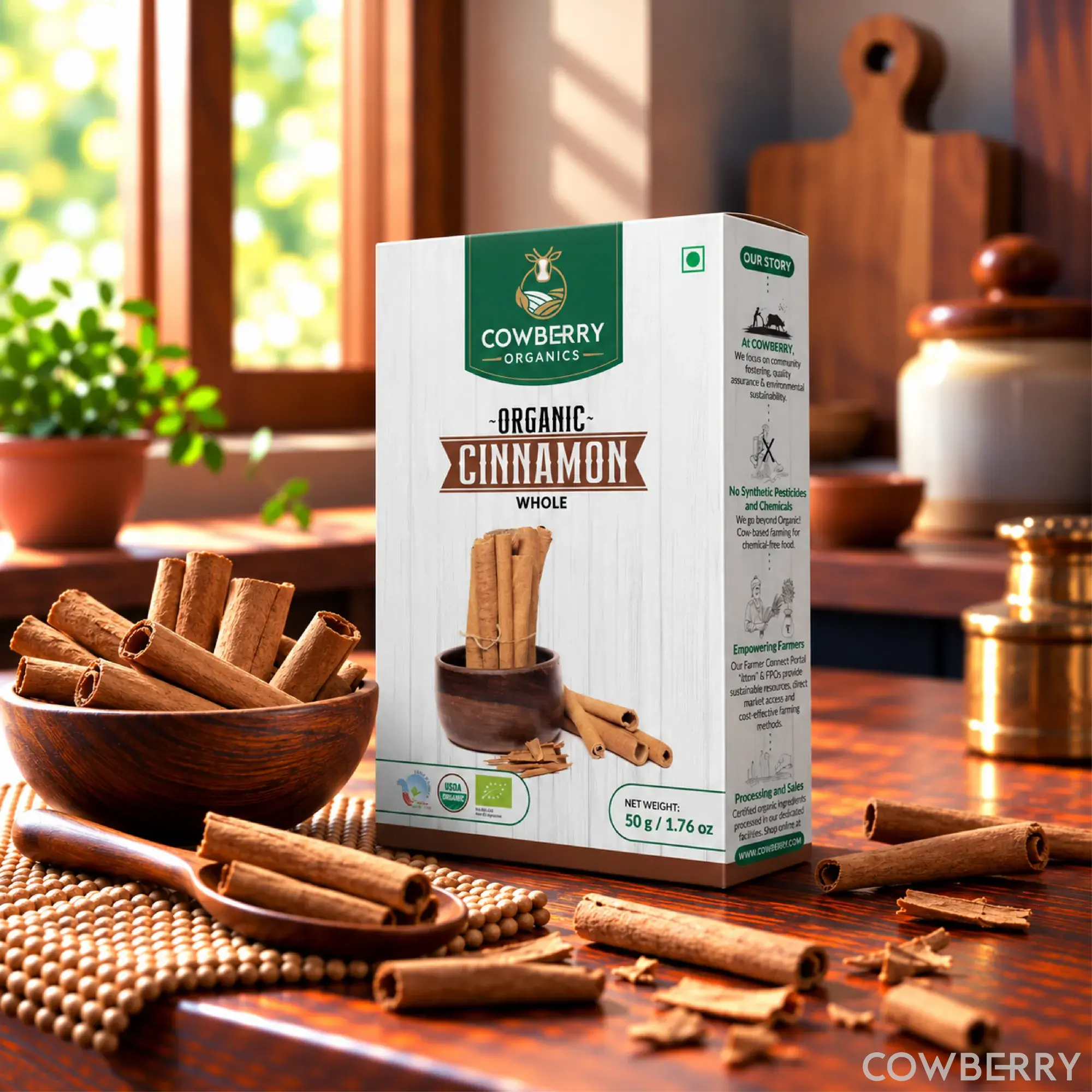
Eat it the way Indian kitchens already do: a small piece of stick in tea, a pinch in a dessert, and the amounts above in dal, curries and biryanis. Two drinks get their own pages with methods and honest limits: cinnamon tea and cinnamon water benefits. For powder, cinnamon how to make powder grinds sticks at home in about twenty to twenty-five minutes. When buying, the FSSAI quick test separates the two barks: true cinnamon's bark is so thin it can be wrapped around a pencil or pen, whereas cassia bark comes in several layers; whole sticks let you check that by eye. COWBERRY's organic cinnamon is whole dalchini from Kerala, grown with traditional cow-based farming, packed with no additives or preservatives, and India Organic, USDA & EU certified. The Hindi guide to all of the above is dalchini ke fayde.
FAQs
Is cinnamon good for health?
As a flavour and a small nutrient top-up, yes. A level teaspoon adds 1.4 g of fibre, 26 mg of calcium and 0.2 mg of iron to a meal, and the spice brings sweet-spicy flavour without sugar. As a medicine, the evidence is thin: the reviews on record do not show a health effect in people from everyday amounts.
What is dalchini good for?
Mostly for flavour: COWBERRY's product page lists uses that run through biryanis, curries, teas, desserts, baked preparations, masala blends, rice dishes and traditional beverages. On paper it also carries real nutrients - 53.1 g of fibre and 1000 mg of calcium per 100 g - but a pinch is small, so the honest answer is taste first.
Does cinnamon help in weight loss?
No human study on record shows that. The amounts eaten are so small, and usually folded into other foods, that what it truly adds to health stays unclear, in the words of a 2014 review; no weight-loss claim is made.
Can dalchini reduce cholesterol?
No human study on record covers cinnamon and cholesterol, so no cholesterol claim is made. What is on record: cinnamon's fibre, 53.1 g per 100 g, is the kind of nutrient the Dietary Guidelines tie to slowing carbohydrate and fat absorption and to satiety; no study on record ties cinnamon itself to cholesterol numbers.
Why cinnamon is sweet?
By smell more than sugar. The USDA record lists 80.6 g of carbohydrate per 100 g, but 53.1 g of that is fibre, and the sweet-spicy character is flavour, not sugar; the spice flavours a dessert without sweetening it the way sugar does.
How to identify pure cinnamon?
By the bark. FSSAI's quick test describes true cinnamon by its bark: thin enough to wrap around a pencil or pen, with a distinct smell. Cassia's bark is thicker, built of several layers. Whole sticks let you see both, which is one more reason to buy sticks and grind as you go.
What is dalchini?
The Hindi name for cinnamon, the bark sold as rolled sticks or ground powder; COWBERRY's product page lists it as Organic Dalchini (Cinnamon). The English and botanical names on record live on the cinnamon in hindi page.
References
- Dietary Guidelines for Indians, ICMR-National Institute of Nutrition
- USDA FoodData Central
- Leach MJ, Kumar S. Cinnamon for diabetes mellitus. Cochrane Database Syst Rev, 2012
- Abraham K, Wohrlin F, Lindtner O et al. Toxicology and risk assessment of coumarin: focus on human data. Mol Nutr Food Res, 2010
- Khan N, Choi JY, Nho EY et al. Determination of minor and trace elements in aromatic spices by micro-wave assisted digestion and inductively coupled plasma-mass spectrometry. Food Chem, 2014
- Opara EI, Chohan M. Culinary herbs and spices: their bioactive properties, the contribution of polyphenols and the challenges in deducing their true health benefits. Int J Mol Sci, 2014
- FSSAI Eat Right India: DART (Detect Adulteration with Rapid Test), salt, spices and condiments tests
Shop this article
Keep reading
Coriander water benefits: what dhania water actually does
Peanuts in Hindi (moongfali): groundnut names in Indian languages
Coriander vs cilantro: are they the same herb?