by COWBERRY

11 minute read
Cinnamon powder (dalchini): names, nutrition, benefits, how to use it

Cinnamon powder is the ground bark of the cinnamon tree, the same spice whole dalchini sticks carry, and the form Indian kitchens reach for in desserts, tea, biryanis and masala blends. Everything about the spice sits on this page: its names, nutrition per 100 g, what the evidence does and does not show, the coumarin caution, everyday uses, storage and buying.
What is cinnamon powder (dalchini)?
Cinnamon is the inner bark of the cinnamon tree, sold two ways: whole sticks rolled into quills, and cinnamon powder, the same bark ground fine. The ground form is the one the USDA FoodData Central record measures, and its scientific name there is Cinnamomum aromaticum, which is cassia; the same record also carries Cinnamomum verum, the name for true cinnamon. The difference between the two barks matters for one compound, coumarin, and the cinnamon vs cassia page sorts them out with FSSAI's quick test.
In Indian kitchens the spice seasons the whole menu, from curries and biryanis to teas, desserts, baked preparations and rice dishes, the use list COWBERRY prints on its pack. Sticks release their flavour slowly into anything that simmers, while powder mixes straight into batters, dry blends and desserts, where a stick would sit unbroken; which form belongs where is the subject of the cinnamon how to use page.
Cinnamon names in Hindi and Indian languages
Two names do the everyday work. In Hindi the spice is dalchini, the word COWBERRY's whole-spice pack carries as Organic Dalchini (Cinnamon); in English it is cinnamon, and the USDA record lists the ground form as Spices, cinnamon, ground, with the botanical name Cinnamomum aromaticum. Where the table below shows a dash, no name is on record for that language: IFCT 2017 has no cinnamon entry, and the USDA record lists only the English and botanical names, so nothing is guessed to fill a blank.
Which record each name comes from, and the two confusions people search for, dalchini versus cinnamon and cinnamon versus cassia, are walked through on the cinnamon in hindi page. For reading a spice label, knowing that both names point to one bark is usually enough.
| Language | Name (romanised) |
|---|---|
| English | Spices, cinnamon, ground |
| Hindi | — |
| Marathi | — |
| Gujarati | — |
| Punjabi | — |
| Bengali | — |
| Odia | — |
| Assamese | — |
| Kannada | — |
| Telugu | — |
| Tamil | — |
| Malayalam | — |
| Urdu | — |
| Sanskrit | — |
| Botanical name | Cinnamomum aromaticum |
Source: USDA FoodData Central record 171320 (English and scientific name only; no Indian-language names in source). — means no name recorded in the source.
Cinnamon nutrition per 100 g
Every number on this page comes from one record, USDA FoodData Central's entry for ground cinnamon, because IFCT 2017 does not list the spice. Per 100 g it lists 247 kcal, 3.99 g of protein and 1.24 g of fat, 80.6 g of carbohydrate (53.1 g of that is fibre), calcium at 1000 mg and iron at 8.32 mg, and no glycemic index is listed for cinnamon, so none is invented.
A level teaspoon is the honest serving. The record weighs one at 2.6 g, which works out to about 6.4 kcal and 2.1 g of carbohydrate, with 1.4 g of fibre, 0.2 mg of iron, 26 mg of calcium; a pinch in tea or half a teaspoon in a dessert is what the spice really adds, and the numbers say that is very little. The full table, the tablespoon amounts and how cinnamon lines up against cloves and cumin seeds are on the cinnamon nutrition per 100g page.
| Nutrient | Ground cinnamon (USDA record) |
|---|---|
| Energy (kcal) | 247 |
| Protein (g) | 4 |
| Fat (g) | 1.2 |
| Carbohydrates (g) | 81 |
| Dietary fibre (g) | 53 |
| Iron (mg) | 8.3 |
| Calcium (mg) | 1000 |
| Magnesium (mg) | 60 |
| Potassium (mg) | 431 |
| Sodium (mg) | 10 |
| Zinc (mg) | 1.8 |
| Folate (mcg) | 6 |
| Vitamin C (mg) | 3.8 |
Per 100 g raw, edible portion. Composition: USDA FoodData Central (SR Legacy), FDC ID 171320, NDB 2010. — means not reported. These are average values for the food; the label on a pack gives the values for that product.
Benefits of cinnamon
The honest list starts with the nutrient column. Ground cinnamon per 100 g holds 53.1 g of fibre, with calcium at 1000 mg and iron at 8.32 mg; manganese is the mineral a 2014 spice analysis measured high in cinnamon, at 879.8 micrograms per gram, which works out to about 88 mg per 100 g, ahead of cardamom and clove. Scaled down to a level teaspoon, those nutrients come to 1.4 g of fibre, 26 mg of calcium, 0.2 mg of iron: a small, real addition to a meal, not a replacement for the rest of the plate.
The honest limit sits right beside it. The review behind that framing, a 2014 look at culinary herbs and spices, notes that such spices are eaten in tiny quantities, usually as part of other foods, so what they truly add to health stays hard to establish. For blood sugar, the most complete human evidence is a 2012 Cochrane review, and its verdict was insufficient evidence; the full reading lives on the is dalchini good for diabetes page. The ten-point list with each source is on the cinnamon benefits page, and a Hindi version of the same list is on the dalchini ke fayde page.
Cinnamon side effects: the coumarin limit
The one caution on record is a compound called coumarin, and the safety figure attached to it is a tolerable daily intake of 0.1 mg per kilogram of body weight per day, the ceiling a 2010 toxicology review worked out. The same review names cassia cinnamon the main dietary source, and its finding is that people who consume cassia heavily can arrive at a daily coumarin intake right at that ceiling; for a 60 kg adult the sums give about 6 mg of coumarin a day. Since the review gives no coumarin figure per gram for any product, no page in this guide turns the limit into a count of teaspoons.
The practical reading follows the amounts in the cooking section below: a pinch in tea or a quarter teaspoon in a curry is a long way from heavy daily cassia use, while a spoonful-a-day habit is exactly the pattern the review flags. In the 2012 Cochrane diabetes trials, where people took about 2 g of the spice daily, adverse reactions were infrequent and generally mild. Anyone considering a cinnamon supplement or large daily amounts should talk to their doctor or dietitian first, and the full coumarin reading with the bark test is on cinnamon vs cassia.
How to cook and use cinnamon
The form follows the dish. A whole stick goes into anything that simmers, powder into anything that is mixed or baked. For a biryani or pulao pot, a quill or two, or half a teaspoon of powder; for dal or curry, a 3 cm piece, or a quarter teaspoon; for a cup of tea, a small stick piece, or a pinch; for dessert or kheer, somewhere between a quarter and half a teaspoon of powder. Sticks are lifted out before the dish is served, and powder stays in. The full per-dish table, plus the storage rules that keep the jar fragrant, is on the cinnamon how to use page.
No daily amount is on record for the spice, so this guide sets none. The amounts above are flavour measures, chosen so dalchini seasons a dish without shouting over it, and the coumarin reading in the section above is the reason not to scale them up into a spoonful-a-day routine.
How to store cinnamon
The whole rule is one line: whole sticks in an airtight jar, kept somewhere cool and dry, protected from moisture and direct sunlight — the storage instruction COWBERRY prints on its pack. No shelf life is on record for the spice, and what fades first is the smell; whole sticks hold their aroma longest, which is one more reason to buy them whole and grind powder in small batches. The cinnamon how to make powder page turns a 50 g pack of sticks into a small jar of powder in about twenty to twenty-five minutes. Keep the jar away from the steam above the stove, and dip with a dry spoon every time, since a wet spoon is how powder clumps. A dark cabinet shelf works as well as any jar; the three enemies are heat, moisture and sunlight, and a spice tin kept on the shelf above the flame gets all three at once.
Cinnamon recipes: dalchini tea and cinnamon water
Cinnamon's own two recipe pages are drinks. The cinnamon tea page makes dalchini tea at home with a small stick piece or a pinch of powder, eight to ten minutes from tap to cup, and the cinnamon water benefits page shows the overnight glass, a quarter teaspoon of powder or a stick piece soaked in warm water for about eight hours. Both pages carry the honest reading of what the drink does and does not do.
For food, the spice travels inside other dishes rather than standing alone: a quill in a biryani, a pinch in kheer, a quarter teaspoon in a masala blend, exactly the amounts in the cooking section above. That is the whole recipe story, and it keeps dalchini where it does its work best, inside the pot.
How to buy cinnamon: what to look for
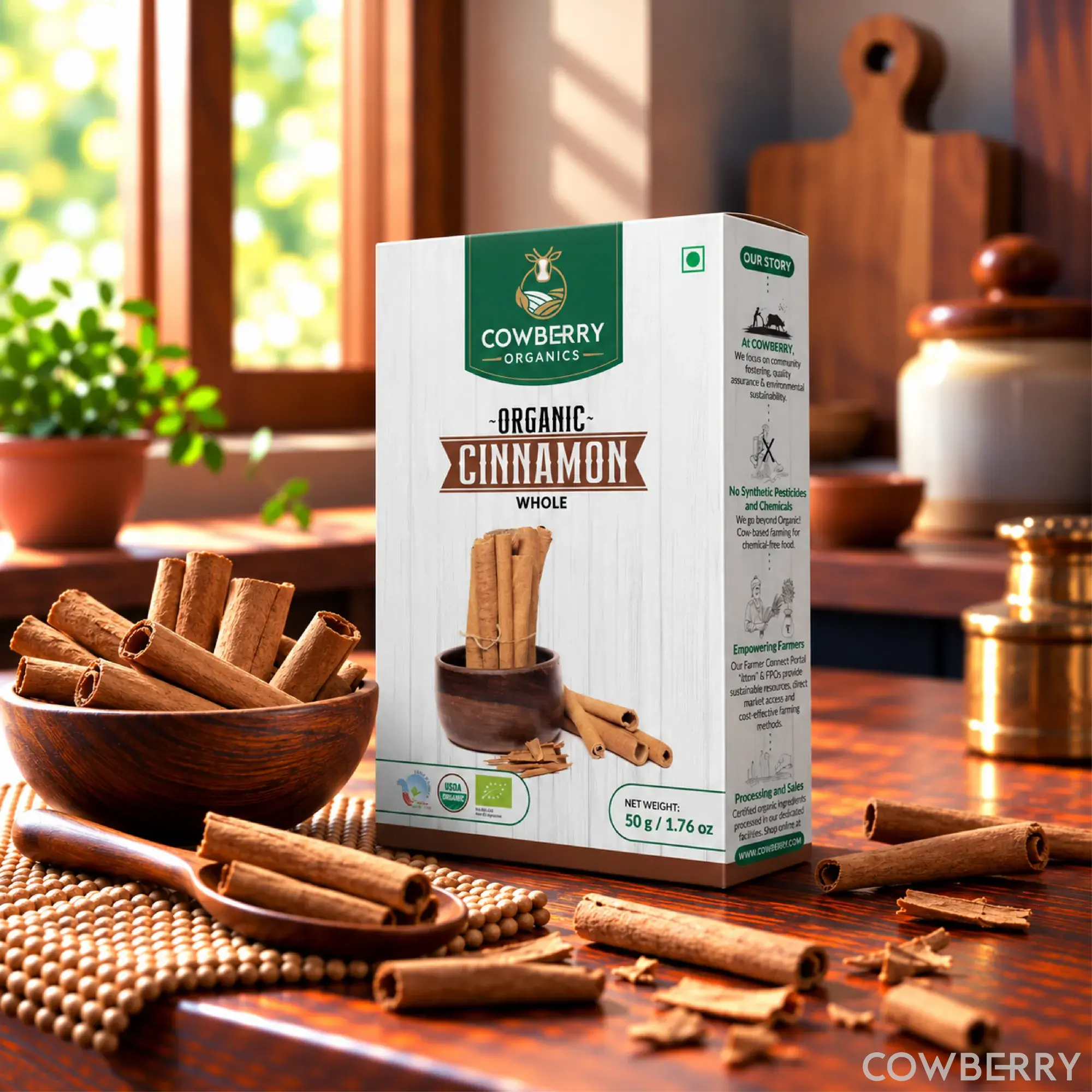
Buy whole sticks when you can, because the bark is the one check you can run by eye. FSSAI's quick test describes true cinnamon bark as very thin, wrapping right around a pencil or pen, with a smell of its own; cassia bark is built in layers, a rough outer surface over a smooth one within. A jar of powder hides all of that. For organic cinnamon, the pack should carry the certification line: COWBERRY's organic cinnamon is whole dalchini farmed in Kerala the traditional cow-based way, packed with no additives or preservatives, and the pack line India Organic, USDA & EU certified. It is sold whole in a 50 g pack, the form this guide recommends, so the pencil test and home grinding both stay open to you.
FAQs
What is cinnamon?
Cinnamon is the dried inner bark of the cinnamon tree, the spice sold as whole quills or as ground powder, and what Indian kitchens call dalchini. The USDA FoodData Central record for the ground form gives the botanical name Cinnamomum aromaticum, which is cassia, while true cinnamon, Cinnamomum verum, is the very thin bark FSSAI's quick test describes.
What is dalchini?
Dalchini is the Hindi word for cinnamon: one spice, two names, nothing more. COWBERRY's own pack prints the pair together as Organic Dalchini (Cinnamon), and dalchini powder is simply the same bark ground fine. The English, Hindi and botanical names sit together on the cinnamon in hindi page.
Which dalchini is best?
For cooking, whichever form fits the dish: whole sticks for biryanis and dal, powder for desserts and blends. On health there is no winner on record, because most of those diabetes trials used cassia and the result was still no clear benefit, as the is dalchini good for diabetes page explains. For everyday use, whole quills let you check the bark, which powder does not.
Does cinnamon help in weight loss?
Nothing on record shows that it does, so no weight-loss claim is made for the spice anywhere in this guide. The review behind that reading, a 2014 look at culinary herbs and spices, notes that such spices are normally eaten in tiny quantities, usually as part of other foods, which leaves their true benefit from a health perspective unclear. What cinnamon honestly offers is flavour at about 6.4 kcal a level teaspoon.
How to identify pure cinnamon?
By the bark, and only on whole sticks. FSSAI's quick test says true cinnamon bark is so thin it wraps right around a pencil or pen, with a smell of its own; cassia bark is thicker, made of several layers between a rough outside surface and the smooth surface within. Powder hides the layers, which is one reason the buying guide above points to whole quills.
Can cinnamon induce periods?
Nothing on record supports the idea, and no such claim is made: neither the USDA record nor any of the reviews covers cinnamon and periods, so there is no basis to use the spice for that purpose. Anyone using spices or supplements for a medical purpose should talk to their doctor first.
Is cinnamon good for health?
As a flavour, yes, and the nutrients are real but small: a level teaspoon adds about 1.4 g of fibre, 26 mg of calcium, 0.2 mg of iron to a dish. As something that changes health outcomes, the human evidence is thin, and the fullest study on record, the 2012 Cochrane review of cinnamon for diabetes, found the evidence insufficient. The complete list is on the cinnamon benefits page.
References
- USDA FoodData Central
- Indian Food Composition Tables (IFCT) 2017, ICMR-National Institute of Nutrition
- Leach MJ, Kumar S. Cinnamon for diabetes mellitus. Cochrane Database Syst Rev, 2012
- Abraham K, Wohrlin F, Lindtner O et al. Toxicology and risk assessment of coumarin: focus on human data. Mol Nutr Food Res, 2010
- Khan N, Choi JY, Nho EY et al. Determination of minor and trace elements in aromatic spices by micro-wave assisted digestion and inductively coupled plasma-mass spectrometry. Food Chem, 2014
- Opara EI, Chohan M. Culinary herbs and spices: their bioactive properties, the contribution of polyphenols and the challenges in deducing their true health benefits. Int J Mol Sci, 2014
- FSSAI Eat Right India: DART (Detect Adulteration with Rapid Test), salt, spices and condiments tests
Shop this article
Keep reading
Coriander water benefits: what dhania water actually does
Peanuts in Hindi (moongfali): groundnut names in Indian languages
Coriander vs cilantro: are they the same herb?