by COWBERRY

5 minute read
Cinnamon how to make powder at home (and how quills are made)

Cinnamon how to make powder at home: start with whole, dry dalchini sticks, break them into bits, grind them in short pulses in a dry mixer jar, sieve out the coarse bits, let the powder cool and jar it airtight. It takes about twenty to twenty-five minutes; a 50 g pack of sticks makes a small jar of powder. The cinnamon guide covers the spice itself.
Short answer: what you need and what happens
You need whole dalchini sticks, a dry mixer or spice grinder, and a fine sieve. What happens: the quills are broken into short bits, ground in short pulses with rests in between, sieved, cooled, and jarred. Short pulses matter because a jar that runs non-stop heats the powder; rests between pulses keep the grind cool. Storage afterwards follows the product page's own rule for cinnamon: an airtight container in a cool, dry place, away from moisture and direct sunlight.
Step by step
Here is the full run, with times that add up to about twenty to twenty-five minutes.
- Check the sticks. They should be dry and brittle enough to snap cleanly. If they feel soft or damp, air them in a dry spot until they snap.
- Break them into bits. Snap each quill into 2 to 3 cm pieces; small bits grind more evenly than long sticks.
- Dry-toast them (optional). A dry pan on a low flame for 1 to 2 minutes, stirring, until the spice smells stronger; this drives off leftover moisture. Let the bits cool before grinding.
- Grind in short pulses. Run the dry jar for 20 to 30 seconds, pause, and repeat, checking between runs. Stop when the bits have turned into a fine powder.
- Sieve the powder. Shake it through a fine sieve over a plate; whatever stays on top goes back to the jar for one more pulse round.
- Cool it completely. Spread the powder on the plate for about ten minutes; warm powder sealed in a jar turns damp.
- Jar it airtight. Airtight container, cool dry place, away from moisture and direct sunlight, and a dry spoon every time you use it.
How quills are made before you grind them
Whole cinnamon is the bark of the cinnamon tree, sold as rolled sticks. The sources used for this page do not cover how the bark is harvested and rolled. FSSAI's Eat Right India quick test, built to catch cassia bark passed off as cinnamon, describes the real thing: true cinnamon bark is so thin that it curls around a pencil or pen, and it carries a smell of its own; cassia bark, by contrast, is built of several layers between its rough outer surface and its innermost smooth one. The cassia question is covered on cinnamon vs cassia.
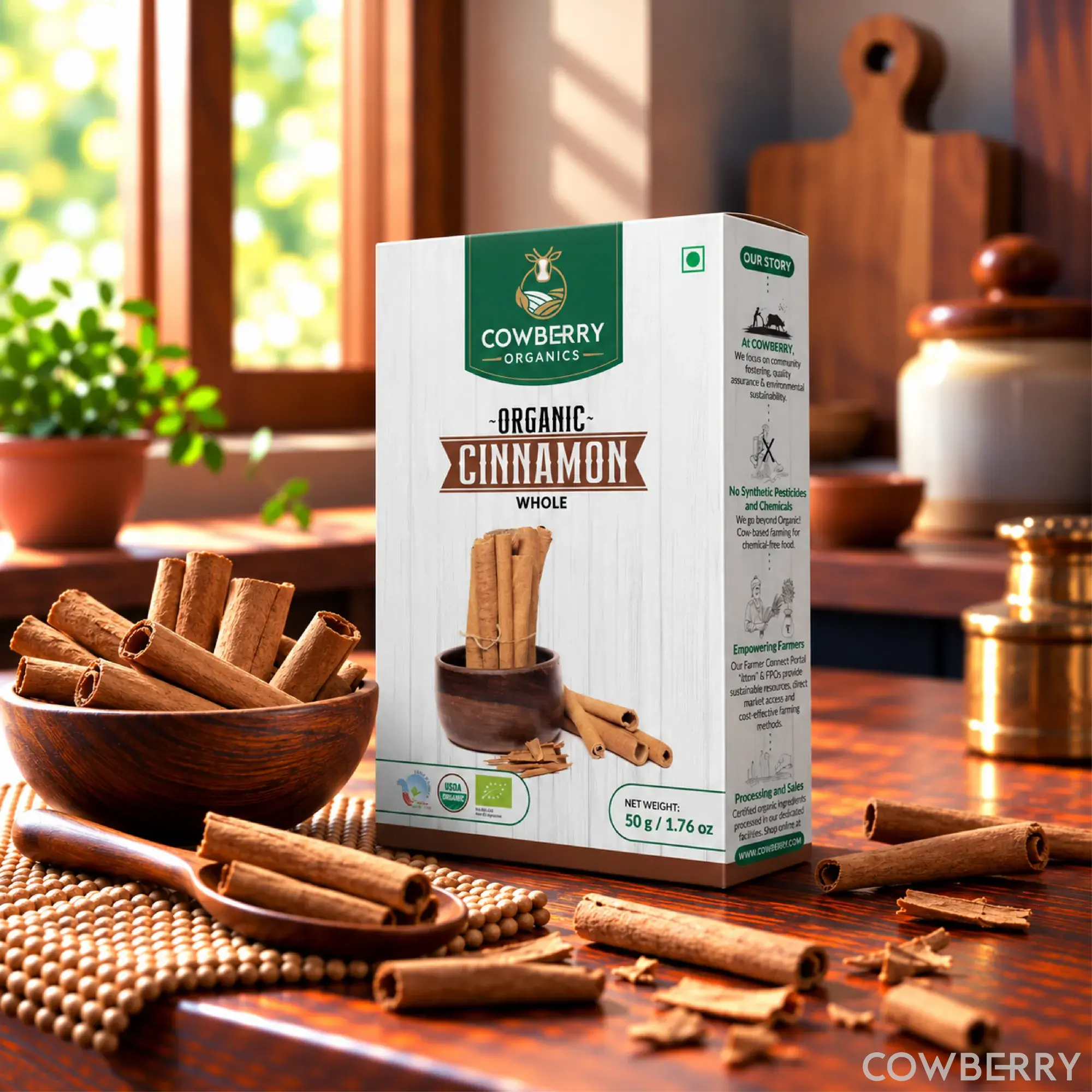
COWBERRY's cinnamon is grown in Kerala with traditional cow-based farming and sold whole, which is exactly the form this page starts from; the powder you grind at home begins as those same quills.
Common mistakes (and the fix)
- Running the jar non-stop until it turns hot. The jar and powder get hot; pulse with pauses and let the jar cool between runs.
- A damp jar or a damp stick. Moisture clumps the powder; dry everything before you start.
- Grinding a month's worth at once. Grind a small batch and top up when it runs low.
- Skipping the sieve. The leftover chips make the powder gritty in desserts and sink to the bottom of a cup of tea.
- Jarring while still warm. The jar beads up inside; cool the powder on a plate first.
- Storing the jar above the stove. Heat and steam reach it there; a cool, dry place away from moisture and direct sunlight is the product page's own line.
Time and quantity table
Times are for one 50 g pack of whole sticks in a regular home mixer; the result is one small jar of powder.
| Step | Time |
|---|---|
| Checking and breaking the sticks | 5 minutes |
| Dry toasting (optional) | 2 minutes |
| Grinding in short pulses | 3 to 4 minutes |
| Sieving and regrinding the coarse bits | 2 minutes |
| Cooling before jarring | 10 minutes |
| Total | About 20 to 25 minutes |
The cinnamon powder guide covers the spice's nutrition and everyday uses once the jar is full.
FAQs
How cinnamon is made?
The short answer: cinnamon is the thin bark of the cinnamon tree, sold as rolled quills; FSSAI's quick test describes it as very thin bark that can be rolled around a pencil or pen. The home answer: powder is made by grinding those dry quills, which is the method above.
What is dalchini?
Dalchini is the Hindi word for cinnamon, the name in the title of COWBERRY's own product page, Organic Dalchini (Cinnamon). It is one spice under two names, and the ground form is the same bark ground fine. Names in other languages are on the cinnamon in hindi page.
How to identify good quality cinnamon?
By the bark. The quick test FSSAI publishes for adulteration says real cinnamon bark is so thin that it rolls around a pencil or pen, and its smell is distinct; cassia bark is thicker, layered. Whole sticks let you check both, and with powder the smell is your only guide.
Can I grind cinnamon in a mixer?
Yes, and a regular Indian mixer jar is all it takes. Keep the jar and the sticks bone dry, fill the jar no more than halfway, and run it in short pulses with rests so the powder does not heat up; a jar that is even slightly wet turns the powder into a clumping paste.
Why does my cinnamon powder smell weak?
Two things to check: how old the powder is, and how hot the jar got while grinding. Grind small batches from whole sticks and keep the jar airtight in a cool, dry place; a fresh batch should smell clearly sweet-spicy.
References
Shop this article
Keep reading
Coriander water benefits: what dhania water actually does
Peanuts in Hindi (moongfali): groundnut names in Indian languages
Coriander vs cilantro: are they the same herb?