by COWBERRY

6 minute read
Cinnamon nutrition per 100g: calories, fibre and per-tsp amounts

Cinnamon nutrition per 100g comes from one record, USDA FoodData Central's entry for ground cinnamon: 247 kcal, 80.6 g of carbohydrate with 53.1 g of fibre, 3.99 g of protein, 1000 mg of calcium and 8.32 mg of iron, and no printed glycemic index. The table below reads that record beside cloves and cumin seeds, then the per-teaspoon amounts; the cinnamon powder guide covers names and benefits.
Cinnamon nutrition per 100 g: the full table
These are the values the USDA FoodData Central record prints for ground cinnamon per 100 g, set beside cloves and cumin seeds from the Indian Food Composition Tables 2017 (ICMR-NIN). The cinnamon column comes from the American record because IFCT 2017 does not list cinnamon. Read it with one caution: nobody eats 100 g of a spice; the per-teaspoon section below shows what a real pinch carries.
Two numbers jump out. Dietary fibre is 53.1 g per 100 g, most of the 80.6 g of carbohydrate, and calcium is 1000 mg per 100 g, more than either spice beside it. The ground cinnamon this record describes is Cinnamomum aromaticum, which is cassia; what that means for the two barks is on cinnamon vs cassia.
| Nutrient | Ground cinnamon (USDA record) | Cloves (IFCT 2017) | Cumin seeds (IFCT 2017) |
|---|---|---|---|
| Energy (kcal) | 247 | 187 | 305 |
| Protein (g) | 4 | 5.9 | 14 |
| Fat (g) | 1.2 | 8.4 | 17 |
| Carbohydrates (g) | 81 | 19 | 23 |
| Dietary fibre (g) | 53 | 35 | 30 |
| Iron (mg) | 8.3 | 9.4 | 21 |
| Calcium (mg) | 1000 | 567 | 878 |
| Magnesium (mg) | 60 | 334 | 442 |
| Potassium (mg) | 431 | 1434 | 1886 |
| Sodium (mg) | 10 | 183 | 125 |
| Zinc (mg) | 1.8 | 1.1 | 4.3 |
| Folate (mcg) | 6 | 33 | 28 |
| Vitamin C (mg) | 3.8 | — | — |
Per 100 g raw, edible portion. Composition: USDA FoodData Central (SR Legacy), FDC ID 171320, NDB 2010; IFCT 2017 (ICMR-NIN). — means not reported. These are average values for the food; the label on a pack gives the values for that product.
Cinnamon calories per 100g, per teaspoon and per tablespoon
Energy is 247 kcal per 100 g, but no dish uses 100 g of cinnamon. The same USDA record prints two household measures for the spice: a level teaspoon (2.6 g) and a level tablespoon (7.8 g), which is three level teaspoons. The table below works the main numbers out for both.
| Measure | Weight | Energy (kcal) | Protein (g) | Carbs (g) | Fibre (g) | Iron (mg) | Calcium (mg) |
|---|---|---|---|---|---|---|---|
| 1 level teaspoon | 2.6 g | 6.4 | 0.1 | 2.1 | 1.4 | 0.2 | 26 |
| 1 level tablespoon | 7.8 g | 19 | 0.3 | 6.3 | 4.1 | 0.6 | 78 |
So cinnamon calories per teaspoon come to about 6.4 kcal, and a level tablespoon to about 19 kcal, before whatever the spice seasons. If a recipe asks for a pinch in a cup of tea or a quarter to half a teaspoon in a dessert, these are the numbers it adds; how much goes into each dish is on cinnamon how to use.
Dalchini nutrition against cloves and cumin seeds
Against the two spices in the table, cinnamon wins on fibre and calcium and loses on protein, iron and potassium. Protein is 3.99 g per 100 g, below cumin seeds at 13.91 g and cloves at 5.86 g. Fibre is 53.1 g per 100 g, 1.75 times cumin's 30.35 g and about 1.5 times cloves at 34.52 g. Calcium: cinnamon's 1000 mg stands above cumin's 878 mg and cloves' 567 mg. Iron flips it: cumin leads with 20.58 mg per 100 g, cloves hold 9.41 mg, and cinnamon 8.32 mg. Fat is 1.24 g, the lowest of the three, against 16.64 g in cumin seeds and 8.41 g in cloves. Potassium goes the other way too: 1886 mg in cumin and 1434 mg in cloves against 431 mg in cinnamon. No spice wins every row; cinnamon's calling card is the fibre-and-calcium pair.
Cinnamon glycemic index: what is printed
No glycemic index is printed for cinnamon in the USDA record, and this page will not invent one. In the kitchen the question is mostly academic: a level teaspoon of the spice adds 2.1 g of carbohydrate to a meal, a small share of any dish it seasons. The useful question is the glycemic index of the meal, not of the pinch of spice in it. What the trials say about cinnamon and blood sugar is on is dalchini good for diabetes.
The micronutrients in dalchini: calcium, iron and manganese
Calcium is the standout, at 1000 mg per 100 g, and iron is 8.32 mg per 100 g. The rest of the mineral profile: magnesium 60 mg, potassium 431 mg, sodium 10 mg, zinc 1.83 mg, folate 6 mcg and vitamin C 3.8 mg per 100 g. A 2014 analysis of aromatic spices measured manganese at 879.8 micrograms per gram of cinnamon, about 88 mg per 100 g, the highest manganese among the spices it tested, ahead of cardamom and clove; the same study measured the toxic trace elements arsenic, cadmium and lead at very low levels, posing no threat to consumers. A teaspoon of the powder carries 26 mg of calcium and 0.2 mg of iron, so the spice adds a little to a day rather than supplying it. What each nutrient does for you is on the cinnamon benefits page.
From the table to the kitchen
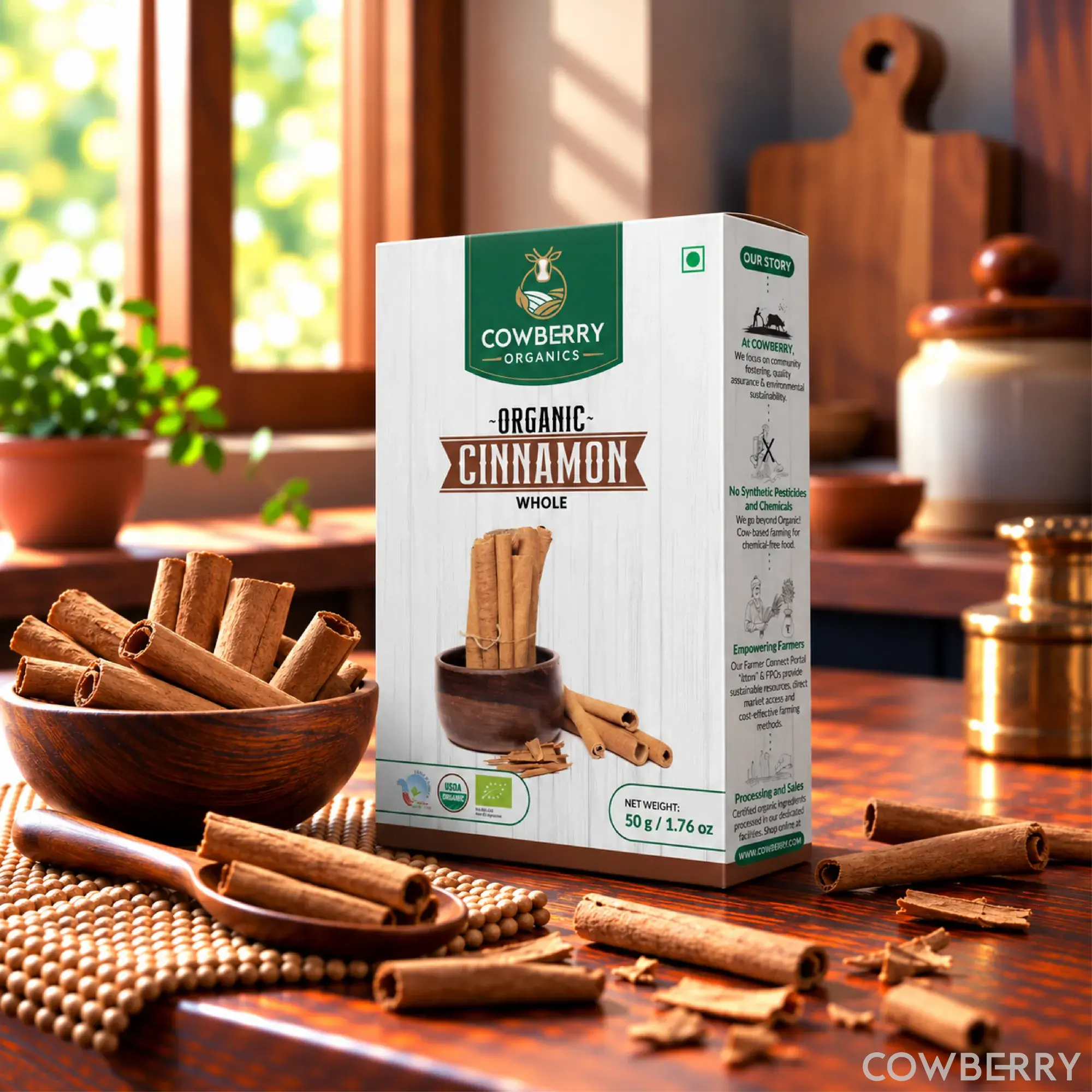
Two forms, one record. The powder is the form the USDA record measures, so the per-teaspoon numbers above apply to it; a whole stick has no printed weight, so the drink recipes on this site measure it by the piece rather than by gram. The cinnamon tea page and the cinnamon water benefits page each show the drink made, and the cinnamon how to make powder page grinds sticks at home, so the jar never sits around losing its smell. Buy whole sticks when you can, grind small batches, and keep the jar airtight in a cool, dry place; the organic cinnamon pack from COWBERRY is whole Kerala dalchini. Names, storage and the daily amounts are on the cinnamon powder guide.
FAQs
What is cinnamon?
Cinnamon is the aromatic bark of the cinnamon tree, sold as rolled sticks or ground powder; in Hindi it is dalchini. The USDA FoodData Central record this page's numbers come from covers the ground form, printed as Spices, cinnamon, ground, with the scientific name Cinnamomum aromaticum, which is cassia.
How many calories in one teaspoon of cinnamon?
About 6.4 kcal in a level teaspoon. The USDA record's own household measure for the spice is a level teaspoon at 2.6 g, and 247 kcal per 100 g works out to 6.4 kcal. A level tablespoon (7.8 g) carries about 19 kcal, before anything the spice seasons.
Is cinnamon good for health?
As a flavouring, yes; as a medicine, the evidence is thin. A teaspoon adds 1.4 g of fibre, 26 mg of calcium and 0.2 mg of iron to a dish, a small real contribution. A 2014 review points out that spices are eaten in such small amounts, usually with other foods, that their true health benefit is unclear.
Why cinnamon is sweet?
Mostly by aroma. Per 100 g the record prints 80.6 g of carbohydrate, and 53.1 g of it is fibre, about 66 percent; the warm sweet-spicy character people taste comes from the bark's aromatic oils. Cinnamon does not sweeten a dish the way sugar does.
Does cinnamon have carbohydrates?
Yes: 80.6 g per 100 g, with fibre making up most of it, at 53.1 g. In the amounts actually eaten this is small: a level teaspoon adds about 2.1 g of carbohydrate and a level tablespoon about 6.3 g to a dish. No glycemic index is printed for the spice.
Is dalchini good for diabetes?
The evidence says the question is open. A 2012 Cochrane review of ten trials covering 577 people with diabetes found no statistically significant difference between cinnamon and control groups in HbA1c, insulin or post-meal glucose, and called the evidence insufficient. Dalchini is fine as a flavour; the full reading is on is dalchini good for diabetes.
References
- USDA FoodData Central
- Indian Food Composition Tables (IFCT) 2017, ICMR-National Institute of Nutrition
- Khan N, Choi JY, Nho EY et al. Determination of minor and trace elements in aromatic spices by micro-wave assisted digestion and inductively coupled plasma-mass spectrometry. Food Chem, 2014
- Opara EI, Chohan M. Culinary herbs and spices: their bioactive properties, the contribution of polyphenols and the challenges in deducing their true health benefits. Int J Mol Sci, 2014
Shop this article
Keep reading
Coriander water benefits: what dhania water actually does
Peanuts in Hindi (moongfali): groundnut names in Indian languages
Coriander vs cilantro: are they the same herb?