by COWBERRY

12 minute read
Types of poha: thick, thin (nylon) and red, and which dish uses which

Thick poha is the flake for cooked dishes and roasted chivda, and thin poha is the flake for laddu, cutlets and no-cook dishes; that one rule settles most questions about types of poha. Below, thick, medium and thin (nylon) poha are compared, red poha is set against white, and each is matched to dishes such as kanda poha, dahi poha and chivda, with quality checks and storage.
Types of poha at a glance
All poha begins the same way, as paddy that is soaked, heated, husked, rolled flat and dried. The types differ in two ways: how thick the flake is, and which rice went in, white or unpolished red. Thickness decides how a flake takes water and so which dishes it suits; the rice decides colour and taste. The table sums up the thicknesses, and the sections below take each type in turn.
| Type | In water | Best for |
|---|---|---|
| Thick poha | Rinse for about ten seconds and rest about five minutes; the flakes stay separate | Kanda poha, Indori poha, poha upma, dahi poha, gul pohe, poha kheer, poha idli and dosa; roasted slowly for poha chivda |
| Medium poha | A brief rinse and a shorter rest than thick; handle gently | Cooked dishes where a softer flake is welcome |
| Thin (nylon) poha | Usually used dry or dampened briefly; rinsed and squeezed only for cutlets | Poha laddu, dadpe pohe, poha cutlets; roasts for chivda in about half the time |
| Red poha | As for white poha of the same thickness | Any dish that uses thick poha, for a nuttier taste |
If you buy one pack, buy thick poha: it covers every cooked dish in the table and the chivda. Add a pack of thin poha when laddu, cutlets or dadpe pohe are the plan.
Thick poha: the flake for cooked dishes
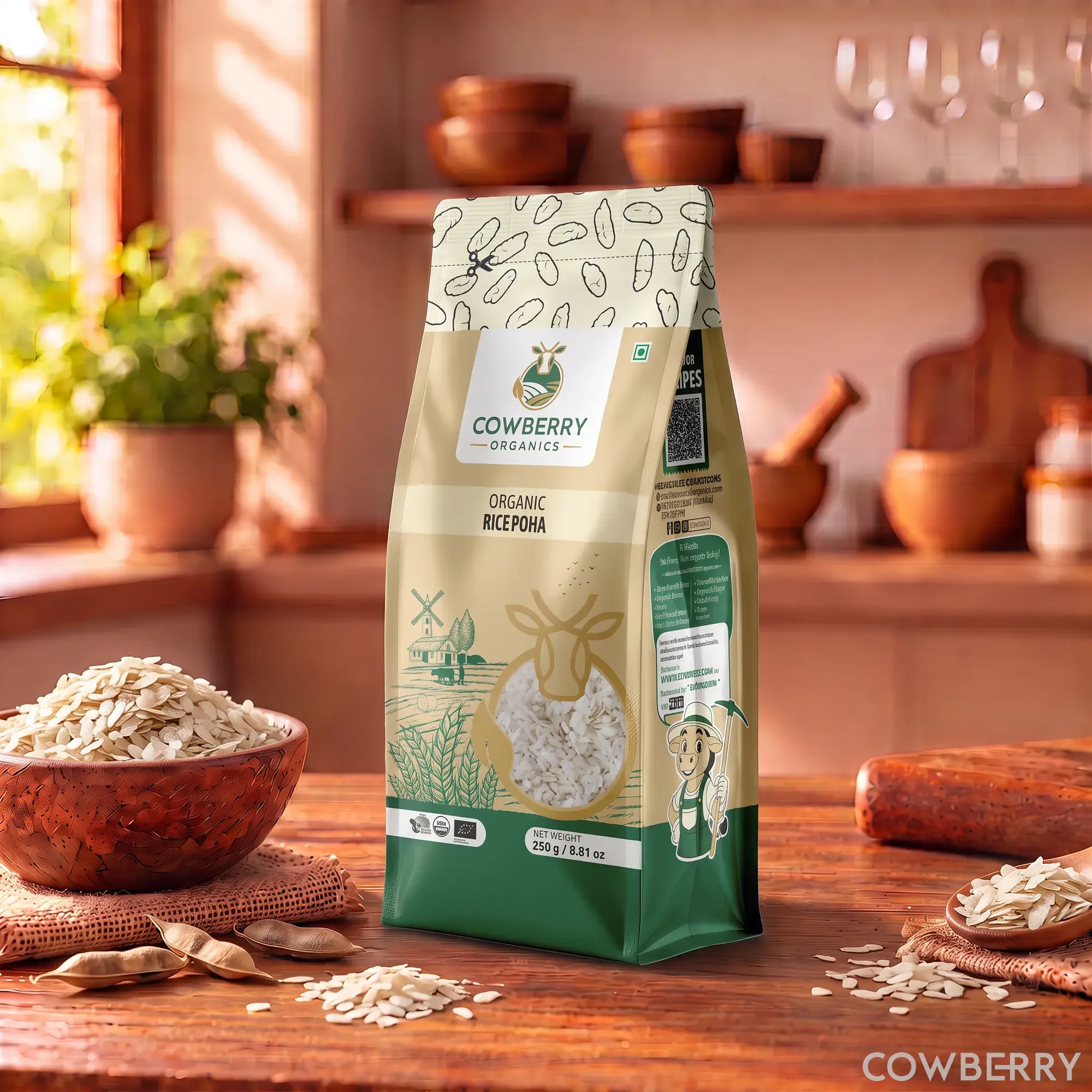
Thick poha is the sturdiest flake sold: opaque and stiff, with the outline of the rice grain still visible. That sturdiness is what lets it take a rinse. Rinse it in a sieve for about ten seconds while you turn the flakes over, let it drain, and leave it about five minutes; the water clinging to the flakes softens them from inside and they stay separate. Soak it in a bowl instead and even thick poha drinks up too much water and goes pasty. COWBERRY's organic rice poha is this thick kind.
It is the flake for every cooked dish. Kanda poha, the Maharashtrian onion poha, folds rinsed thick poha into a pan of softened onion, mustard seeds, curry leaves and turmeric, with fried peanuts stirred through. Indori poha steams it over boiling water and finishes it with a fennel tempering, jeeravan masala, sev and pomegranate. Dahi poha stirs rinsed flakes into curd, poha upma cooks them with vegetables, and poha kheer simmers them in milk, while poha idli and dosa grind soaked thick poha into the batter. Roasted slowly and dry, it also makes the crisp poha chivda.
Does thickness change the nutrition? The Indian food tables give rice flakes a single entry, with no thickness stated, so the figures on this site cover them all. One laboratory study from the University of Mysore, published in 2007, looked closer: it tested flakes from 0.08 mm to 1.20 mm thick, bought from four commercial sources, and phosphorus, phytin phosphorus and fibre were lower in the more heavily flaked, thinner samples. In its test the share of iron and calcium available was higher in the thin flakes, but those differences were not significant. The per-100 g and per-plate numbers are on the poha calories page.
Medium and thin (nylon) poha: where each one fits
Medium poha sits between the two. It needs only a brief rinse and a shorter rest than thick poha, and it gives a softer, closer texture, so handle it gently in the pan. None of the recipes linked here calls for it; if a pack of medium is what you have, use it where thick poha is asked for and cut the rest short.
Thin poha, sold as nylon poha, is pressed so fine that the flakes are papery and almost see-through. Water that a thick flake takes in its stride turns a thin one to mush, so its dishes use it dry or dampen it only briefly. Roasted dry, it crisps in about half the time thick poha needs, so it can replace thick poha in the poha chivda recipe with a shorter roast. Roasted and ground, it is the base of poha laddu; mixed with grated coconut and onion, it softens in their juices for dadpe pohe; and rinsed, squeezed and mashed with potato, it holds poha cutlets together.
What thin poha will not do is make kanda poha or Indori poha, because both recipes are written for thick flakes. Keep it for snacks, sweets and the no-cook dishes.
Thick vs thin poha: how to tell them apart and when to swap
In the pack, thick poha looks opaque and stiff, and each flake keeps the outline of a rice grain; thin poha is translucent at the edges, and a flake crumbles when you bend it between two fingers. Medium falls in between, so trust the label. The quickest kitchen test is water: rinse a spoonful of each for about ten seconds and wait about five minutes. Thick flakes come out soft but whole, while thin ones have already gone to mush.
Swapping is easier one way than the other. Thick poha can stand in for medium if you rest it a little longer, while thin poha cannot replace thick in a cooked dish; the last question below has the rescue if it is all you have.
Which poha is good, thick or thin, is really a question about the dish: thick for a plate you eat with a spoon, thin for laddu, cutlets and the no-cook dishes. Weight works the same way. The flakes share one composition entry, so the calories come from what goes in with them. Made to the recipe, a plate of kanda poha comes to 294 kcal once the oil, peanuts and sugar are counted, and a 38 g serving of the chivda recipe is 170 kcal, a portion that is easy to overshoot when you eat straight from the jar.
Red poha vs white poha
Red poha uses unpolished red rice, so the bran stays on the flakes and gives them their colour and a nuttier taste. White poha is the everyday flake, and it is what most recipes mean when they say poha. Beyond colour and taste the two are handled alike: rinse, rest and cook red poha as you would white poha of the same thickness.
On numbers, there is little to go on. IFCT 2017 prints one entry for rice flakes, with no colour given, and none for red poha, so this site quotes no separate figures for red poha. The rice-flakes entry gives 354 kcal, 7.4 g protein, 1.1 g fat, 76.8 g carbohydrate, 3.5 g fibre and 4.5 mg iron per 100 g. Whether red flakes carry more of any of these is not in the Indian tables, and this page attaches no numbers to red poha benefits.
In the kitchen, red poha can take the place of thick white poha in any cooked dish, and it turns kheer and dahi poha pinkish and nuttier. Store it in an airtight jar like any other poha. The red rice it comes from is described with the other varieties under types of rice in India.
| Nutrient | Poha (rice flakes) |
|---|---|
| Energy (kcal) | 354 |
| Protein (g) | 7.4 |
| Fat (g) | 1.1 |
| Carbohydrates (g) | 77 |
| Dietary fibre (g) | 3.5 |
| Iron (mg) | 4.5 |
| Calcium (mg) | 9.2 |
| Magnesium (mg) | 78 |
| Potassium (mg) | 148 |
| Sodium (mg) | 2.6 |
| Zinc (mg) | 1.5 |
| Folate (mcg) | 8.5 |
| Glycemic index (GI) | 59 |
Per 100 g raw, edible portion. Composition: IFCT 2017 (ICMR-NIN). GI: University of Sydney GI database. — means not reported. These are average values for the food; the label on a pack gives the values for that product.
How poha is made
The raw material is paddy, rice that still has its husk on. At the mill the paddy is washed, soaked in water and heated. Once the husk is off, heavy rollers press each grain flat, and the space between the rollers sets the thickness of the flake: thick, medium or thin. Drying then makes the flakes crisp enough to pack.
That process explains how poha behaves at home. The grain has already been heated, so it needs no boiling; thick flakes turn soft after a quick rinse and a short spell under a lid, and the kanda poha recipe needs just 25 minutes in all. And because each flake is a single grain pressed flat, good poha looks like flattened rice rather than a breakfast-cereal flake.
White or red is settled before any of this, by the rice that goes in: white rice for white poha, unpolished red rice for red. COWBERRY's poha is processed with no artificial whitening agents and no synthetic preservatives.
How to choose good poha and check quality
Smell it first. Fresh poha smells faintly of rice and nothing else. Mustiness is a sign of damp, and a stale, oily note is a sign of old flakes; pass over a pack like that, and throw out any at home that smells that way.
Look at the bottom of the pack. Good poha is mostly whole flakes of an even size. A layer of crumbs means the flakes have broken up, and that dust turns to paste in the pan and makes kanda poha gummy. Thin poha breaks more easily, so a little dust is normal there; in thick poha it is not.
Check for insects. Webbing, live insects or tiny holes in the flakes mean the pack is infested. Leave it in the shop, and if one turns up at home, check the rest of the cupboard.
Feel and snap. Dry poha is crisp: a thick flake snaps and a thin one crumbles. Flakes that bend without breaking have taken up moisture, and damp flakes are where mould starts. Read the label for the words thick, medium, thin or nylon, and match the flake to the dish using the table above. Try a spoonful first from a new brand: rinse it, wait about five minutes, and thick poha should come out soft, separate and whole, neither mushy nor hard.
How to store poha, and what to look for when buying
Poha lasts as long as it stays dry. Move an opened pack into an airtight steel or glass jar, keep the jar in a cool cupboard away from the stove and the sink, and finish one pack before opening the next. FAO's review of grain storage in developing countries has chapters on grain spoilage and the risk of mycotoxins, on drying and on insect control, and a kitchen jar of poha needs the same care on a small scale: keep it dry, keep insects out, and throw out flakes that smell musty. Cooked poha is best eaten the same day; refrigerated, it steams back to life the next morning with a spoon of water.
When buying, decide the thickness before the brand: thick for cooked dishes and chivda, thin for laddu, cutlets and no-cook dishes, and medium only if a softer flake suits the way you cook. If you want organic poha, check the pack for a printed certification mark; a word like natural on its own certifies nothing about how the paddy was grown. COWBERRY organic rice poha, a thick poha, is India Organic, USDA & EU certified. For what to cook once the pack is home, start with the poha recipes roundup, and for names, nutrition and benefits go back to the main poha guide.
FAQs
Which poha is good thick or thin?
For anything cooked, thick: it survives a rinse and stays in whole flakes, so it suits kanda poha, dahi poha, upma, kheer and the steamed Indori version, and it roasts slowly into chivda. Thin (nylon) poha belongs in laddu and cutlets, where it is ground or rinsed and mashed. The choice rests on the dish, though one 2007 laboratory study did find less fibre in thinner flakes.
Which poha is best for weight loss?
IFCT 2017 has one entry for all rice flakes, whatever the thickness or colour: 354 kcal and 3.5 g fibre per 100 g dry. The dish is what changes, through the oil, peanuts, sugar and sev that go into it and how much of it you eat. For a portion that suits your own plan, talk to your doctor or dietitian.
What is flattened rice?
Flattened rice is poha by its English name: paddy that has been heated, husked and rolled into flat flakes, then dried. Recipes also call it beaten rice. The flakes come thick, medium or thin depending on the roller gap, and white or red depending on the rice, with red poha made from unpolished red rice.
How is poha made?
Paddy is cleaned, soaked and heated, then husked and pressed between heavy rollers, and the roller gap sets how thick the flakes come out. The flakes are dried until crisp and packed. Because the grain was heated at the mill, poha needs no boiling at home, only a rinse or, for snacks such as chivda and laddu, a dry roast.
Is red poha healthier than white poha?
There is no Indian composition data to say. IFCT 2017 has no entry for red poha, only one for rice flakes, which gives 3.5 g fibre and 4.5 mg iron per 100 g, so this site quotes no separate numbers for red poha. What is known is that red poha keeps the bran of the unpolished red rice it is made from, and the bran gives the flakes their colour and nuttier taste.
What is nylon poha?
Nylon poha is another name for thin poha, the finest flake sold, papery and almost translucent. Because water softens it almost at once, it is mostly used dry, roasted quickly for chivda or ground for laddu, while for cutlets it is rinsed, squeezed and mashed with potato. It will not hold up in kanda poha or Indori poha, which both need thick flakes.
Can I use thin poha for kanda poha?
Not well. The kanda poha recipe calls for thick poha, and thin flakes turn to paste when rinsed. If thin poha is all you have, dampen it with water a spoon at a time until it just softens, fold it into the finished tempering off the heat, and expect a softer, closer texture. For a proper kanda poha, buy thick poha.
References
- Indian Food Composition Tables (IFCT) 2017, ICMR-National Institute of Nutrition
- USDA FoodData Central
- Suma RC, Sheetal G, Jyothi LA et al. Influence of phytin phosphorous and dietary fibre on in vitro iron and calcium bioavailability from rice flakes. Int J Food Sci Nutr, 2007
- FAO: Grain storage techniques, evolution and trends in developing countries
Shop this article
Keep reading
Red rice vs brown rice: the fibre, GI and honest verdict
Red rice vs black rice: nutrition, glycemic index and which to choose
Red rice nutrition per 100g: calories, protein, fibre and GI